
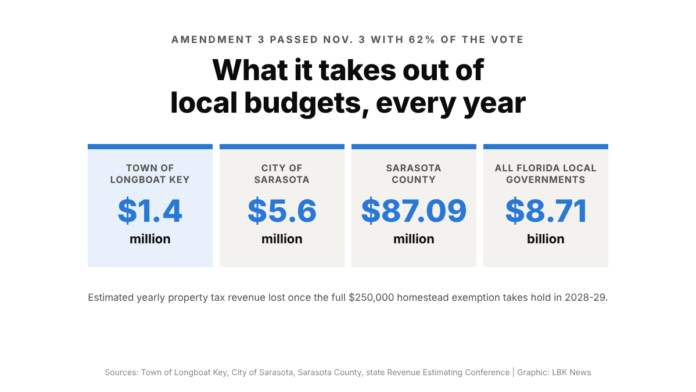
Amendment 3 cleared its 60 percent bar with about 62 percent statewide. Longboat Key’s Town Hall precinct said yes with 61.5 percent after a fall of warnings about a $1.4 million hole; the City of Sarasota’s core precincts said no. From Pensacola to the Keys, cities and counties are freezing jobs, banking cash, pausing projects and lining up new fees, while Tallahassee prepares a special session that could shut the very escape hatches they are counting on.
—Longboat Key spent the fall telling its residents exactly what Amendment 3 would cost.
—Commissioner Gary Coffin wrote homeowners that “the Town anticipates approximately $1.4 million in reduced annual General Fund revenue” once the larger exemption is fully in place. Commissioner BJ Bishop, who presides over the ManaSota League of Cities, wrote state Rep. James Buchanan that “much will depend on our ability to defeat Amendment 3 in November.” The Town’s own Property Tax Facts page warned that the Longboat Key Police Department and Fire Rescue’s EMS “can and will be affected by reduced property tax revenues in the general fund if the amendment is passed.”
—On Nov. 3, the island voted yes anyway. So did Florida.
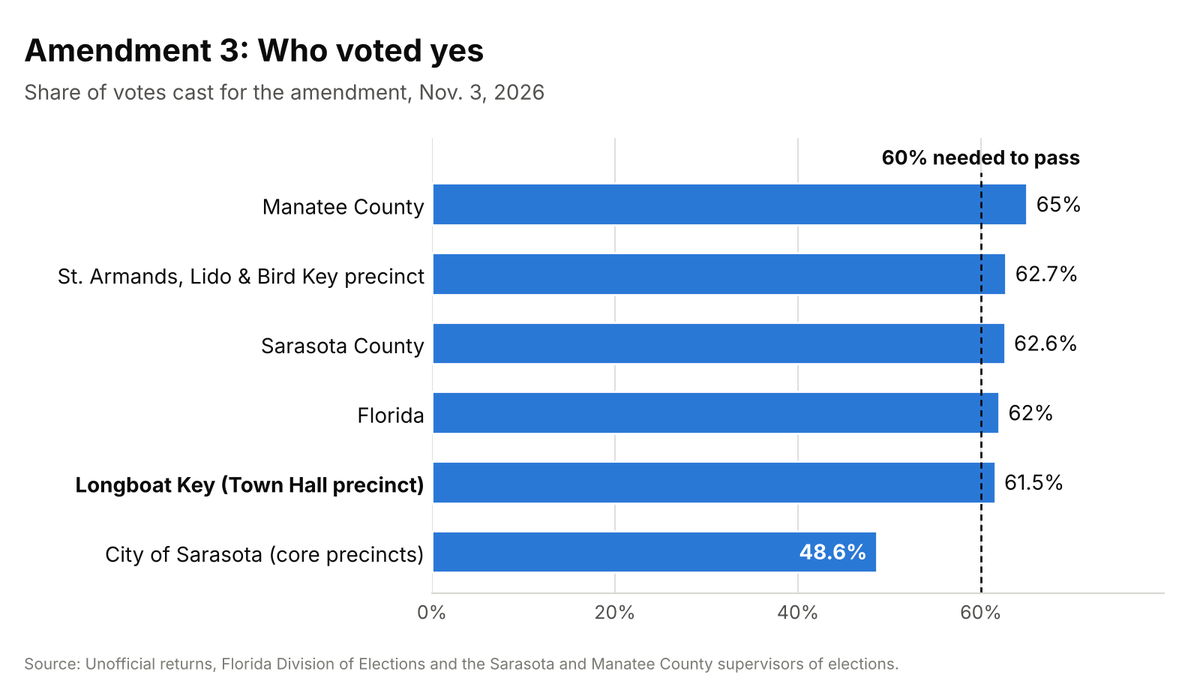
—Unofficial statewide returns show Amendment 3 passing 4,917,906 to 3,016,273, or 61.98 percent, with 99 percent of precincts counted. That is two points over the constitutional bar, and enough to rewrite the property tax bill of nearly every homesteaded Floridian along with the budget of nearly every city, county and special district that sends one.
—Across New Pass, the City of Sarasota’s core precincts voted it down. They got the same result anyway.
—Now the question for both places is no longer whether, but what. And neither is starting from scratch. For five months, local governments from Pensacola to Key Biscayne have been drafting their answers: hiring freezes, banked millage, paused construction, fire assessments, user fees, outsourced dispatch, preserves handed back to the state and, in a few places, talk of small cities dissolving altogether. This is what the rest of Florida is doing, what it means for Longboat Key and downtown Sarasota, and why the final word still belongs to Tallahassee.
—The vote, precinct by precinct
—Amendment 3 carried 64 of Florida’s 67 counties. Only Leon, Gadsden and Alachua, home to Tallahassee and Gainesville, said no. The state canvassing commission is scheduled to certify the results Nov. 17.
—Sarasota County approved it 136,070 to 81,286, or 62.6 percent. Manatee County approved it 114,897 to 61,773, or 65 percent.
—At Longboat Key Town Hall, the Sarasota County precinct that holds roughly two-thirds of the town’s voters, the amendment drew 1,930 yes votes to 1,206 no, or 61.5 percent, almost exactly the statewide number. Turnout ran near 77 percent. How people voted mattered. Election Day voters backed it 794 to 390, about 67 percent. Early voters were close behind, 439 to 238. The mail ballot, the island’s most deliberate vote, was the tightest: 697 to 578, about 55 percent. Precinct-level results for the north end, which votes in Manatee County, were not available at this writing.
—There is a structural reason a town that warned against the amendment still passed it. Everyone on Longboat’s voter rolls is, by definition, a Florida resident, and many of the homeowners among them hold a homestead exemption that just got much bigger. The seasonal owners who carry a large share of the island’s tax base, and who will feel the shift, vote somewhere else.
—Longboat did not vote a straight ticket. Amendments 1 and 2 failed statewide; the island split almost evenly on the first, the rainy-day fund measure, 1,545 to 1,500, and gave the second, a farm equipment tax break, 61.8 percent. Then it voted 2,554 to 496, or 83.7 percent, to extend Sarasota County’s quarter-mill conservation and parkland levy through 2049, and 2,405 to 633, or 79.2 percent, to authorize up to $250 million in bonds against it. The same island that cut the county’s tax base voted five to one to keep paying a dedicated property tax for land.
—Downtown told a different story. Across the 13 precincts wholly or mostly inside the City of Sarasota, 9,963 voters said yes and 10,551 said no, or 48.6 percent in favor. Newtown rejected it 1,418 to 828. The North Trail precinct said no 1,050 to 717, and downtown’s largest precinct, at First Presbyterian on Oak Street, 1,678 to 1,613. Arlington Park, Southside Village and the Rosemary District all voted no.
—The exception was the city’s barrier islands. The precinct covering St. Armands, Lido Key and Bird Key voted 1,098 to 652 for the amendment, 62.7 percent, the highest in the city and a shade above Longboat’s Town Hall precinct. City voters approved the two county conservation questions with 85 and 81 percent; countywide, they passed with 84.3 and 78.7 percent.
—What voters actually approved
—Much of what was said about Amendment 3 during the campaign overshot in one direction or the other. The measure passed the Legislature in its June special session as HJR 1F, and Attorney General James Uthmeier rewrote its ballot summary in August after a Leon County circuit judge ruled the original defective. Here is what it does.
—The exemption. For county, city and special district taxes, the homestead exemption, now about $51,400 in two tiers, rises to $150,000 for the 2027 tax year and $250,000 for 2028, then grows with inflation starting in 2029. School taxes are untouched; they keep today’s $25,000 exemption.
—The newcomer rule. Anyone who was not a Florida resident on Dec. 31, 2026, gets the old exemption when they first qualify and the bigger one only from their fifth year. Property appraisers in Hillsborough and Pinellas counties have pointed out that the Florida Supreme Court struck down a similar waiting period in 1983, which makes this the provision most likely to end up in court.
—The cap. Beginning in 2027, the assessed value of non-homestead property, meaning second homes, rentals and commercial buildings, can rise no more than 5 percent a year for non-school taxes, down from 10 percent.
—The spending list. County and city property taxes are steered to public safety, education, infrastructure, natural resources, debt service, retirement obligations and operations and administration. Other spending is still allowed unless state law forbids it, which makes the restriction far softer than its billing.
—The path to elimination. The amendment does not schedule the end of homestead property taxes. It requires the Legislature to create a uniform procedure under which counties and cities may choose to raise their own homestead exemptions as high as full assessed value; special districts could do so only by referendum. There is no deadline. The governor’s office nonetheless described it before the vote as a measure that “creates a path to full elimination of property taxes for homesteaded Floridians.”
—The money. None comes back. An early Senate idea for a state trust fund to cushion local governments was dropped from the final measure. State economists estimate the statewide loss at $4.93 billion in 2027-28, $8.71 billion in 2028-29 and about $11.8 billion a year once fully in place.
—The timing. Nothing changes on this November’s bills. The cut first shows up on the TRIM notices mailed in August 2027 and the tax bills that arrive in November 2027, which means the first budgets that absorb it are the ones local governments adopt next September. The full $250,000 exemption lands in the budgets adopted in September 2028.
—What it costs Longboat Key
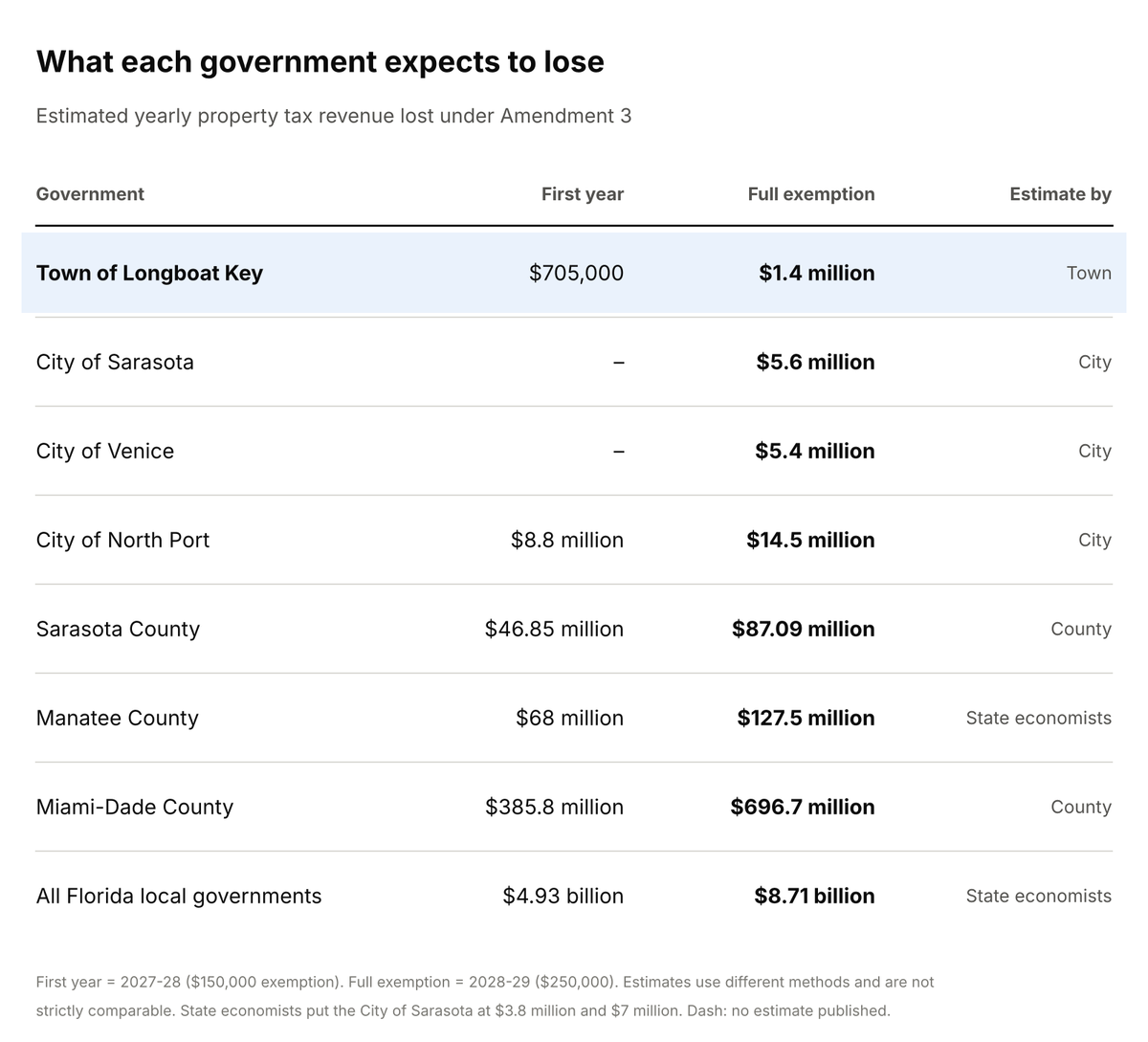
—The Town’s number has not moved since June, when Finance Director Sue Smith calculated a loss of about $705,000 in the first year and $1.4 million a year once the $250,000 exemption takes effect. Against a General Fund of about $25 million, roughly three of every four dollars of it property taxes, that is between 5 and 6 percent of the operating budget. It lands on a town that spent nearly $30 million on the 2024 storms and is still owed more than $28 million by FEMA. The Town’s Property Tax Facts page puts it bluntly: Longboat “is still waiting to see the first dollar from FEMA for the 2024 storms.”
—On the homeowner side, the extra $200,000 or so of exemption is worth roughly $400 a year on the Town’s line of the bill, at an operating rate just under 2 mills. Sarasota County, the hospital district and the other authorities on the same bill each take their own cut; county staff illustrated the savings this summer with a $350,000 homestead that would save about $1,000 a year.
—The commission’s pre-election hedge was modest. It raised the operating rate from 1.96 mills to just under 2, added a canal maintenance levy and set out to rebuild reserves drained by Helene and Milton. That covers part of the first year, not the second.
—The Town has also already named its most likely tool. Its Property Tax Facts page lists “consideration of alternative funding sources, such as special assessments.” Hold that thought. It is exactly the kind of tool the governor now wants to restrict.
—The library on the Green
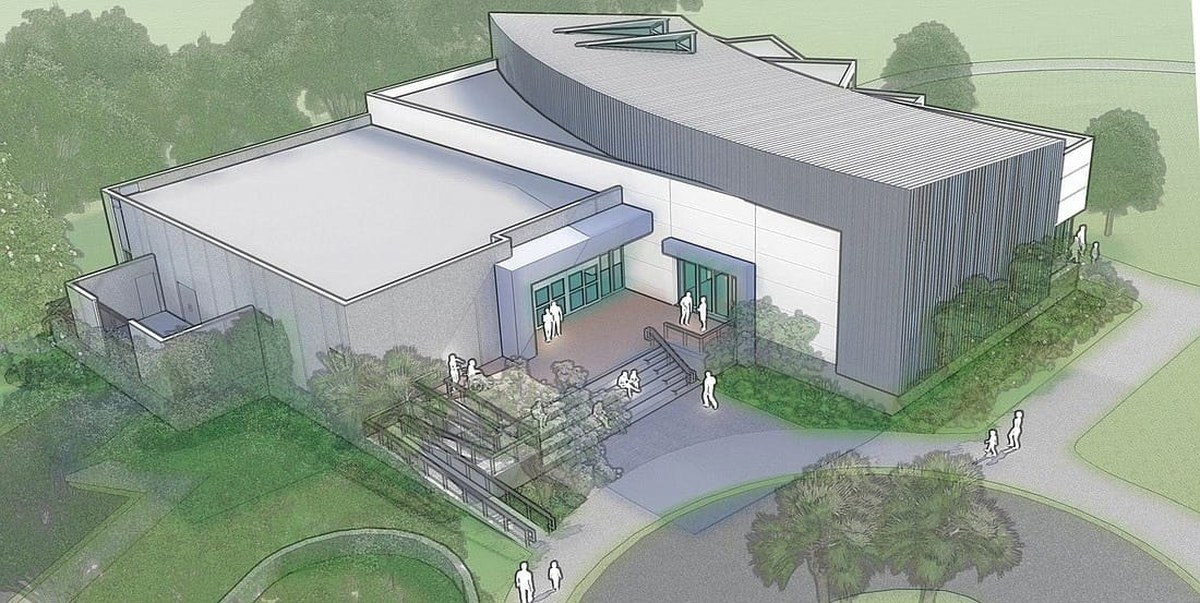
—On Nov. 2, the night before the election, the Town Commission gave unanimous final approval to the site plan for the Sarasota County library on the Town Center Green. The construction money is in hand: roughly $11 million in county library impact fees for the building and more than $3.5 million in private pledges, led by a $1 million gift, for the community hall and terrace. Groundbreaking had been penciled in for as soon as February.
—Operating money is the problem, and it is a county problem. County staff estimated the branch would cost about $740,000 to run in a partial first year in 2028, $1.1 million in 2029 and $1.4 million by 2031, all from a county General Fund that county finance staff project will lose about $87 million in property tax revenue by fiscal 2029. Coffin’s letter relayed the county’s own warning that “significant reductions could affect parks and libraries, including the Sarasota County Longboat Key Branch Library.” In September, Assistant Town Manager Isaac Brownman told commissioners the county had made clear it would not build the library at this time if the amendment passed. County officials have said the private gifts would be returned to donors if the project is abandoned.
—The county put the Longboat branch on its list of capital projects under review before the vote. County Commission Chair Ron Cutsinger said the day after the election that the board would begin working through what the amendment means at its Nov. 17 meeting. That is the date to watch for the Green.
—Downtown Sarasota: the city that said no
—The city’s estimate has not moved either. In its Nov. 4 statement, City Hall put the loss at about $5.6 million a year in General Fund revenue once the exemption is fully in place, a figure that will grow with inflation. The state’s economists, counting differently, put the city’s loss at about $3.8 million in 2027-28 and $7 million in 2028-29.
—The city’s own property tax page explains why that hurts: “Property taxes comprise 51% of the City’s total General Fund revenue sources,” and “The Sarasota Police Department budget is 53% of total General Fund expenditures.” In the comparison the city offered this fall, $5.6 million is the cost of 37 police officers. The same page warns that “Renters would not benefit from a property tax reduction,” that recreation programs, including school-break programming, could be affected, and that the effects on the Bay Park tax increment district and the Newtown Community Redevelopment Area have not yet been calculated.
—City Manager Karie Friling committed to nothing beyond analysis. “Florida voters have spoken, and we respect their decision,” she said in the statement, adding that it would be premature to speculate about service cuts or reorganization before a full financial review. Staff will work with the city’s legislative delegation on the implementing law and bring recommendations to the commission, folded into a strategic planning process that is about to begin.
—The groundwork predates the vote. The city already has a hiring freeze on certain General Fund positions. Its property tax page said in plain terms that “The City cannot wait for the results of the November election,” and laid out three prongs: efficiencies, service reductions and alternative revenue, including increased fees. And in one of the quieter moves of the fall, the city declined, for now, Sarasota County’s offer to hand it Ted Sperling Park and Nora Patterson Bay Island Park, the kind of transfer that will become more common as every government looks to move costs onto someone else’s books.
—Parking, the first domino
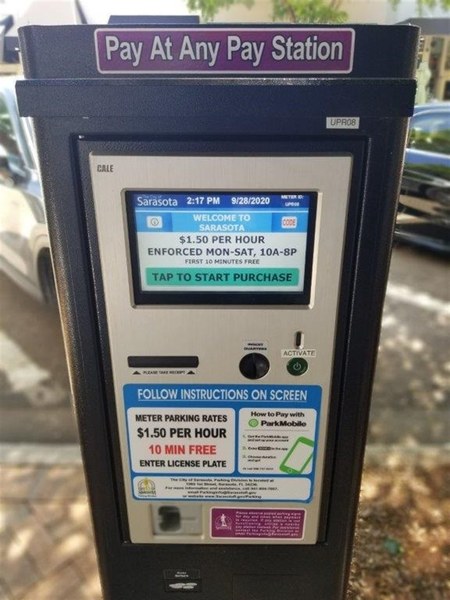
—The Parking Division was built to pay for itself and has not. The General Fund has put about $3.9 million into it since 2013, and the division owes the General Fund more than $1.6 million. The extended hours and Sunday enforcement that took effect at the end of June were meant to close that gap; merchants and residents revolted, and the commission suspended them in August. The city told residents the rollback would stay in place until the Amendment 3 result was known, explaining that “The decision on Amendment 3 will affect the City’s future budgets and how the parking program can be funded.”
—That result is now known. On Oct. 28, parking operations moved under the Sarasota Police Department’s Patrol Division. With the General Fund about to shrink, the parking subsidy is the most obvious first cut on the table, which leaves the division with three paths: the rates and hours the public rejected this summer, a different structure entirely, or someone else running it.
—A new commission inherits it
—The decisions will fall to a reshaped commission. In the race for two at-large seats, Jen Ahearn-Koch won a third term with 40.7 percent of the vote, and Flo Entler won the seat Mayor Debbie Trice gave up with 35.1 percent. John Harshman finished third with 24.2 percent. Ahearn-Koch and Entler took the oath at the commission’s noon statutory meeting Friday, Nov. 6, where commissioners also unanimously chose District 3 Commissioner Kathy Kelley Ohlrich as mayor and Ahearn-Koch as vice mayor. The first reduced tax bills arrive in November 2027; the budget that absorbs the full $5.6 million must be adopted by September 2028.
—The counties in the middle
—For Longboat and downtown alike, the biggest exposure may be the county’s budget rather than their own. Sarasota County’s finance staff projected losses of $46.85 million in fiscal 2028 and $87.09 million in fiscal 2029, with the Sheriff’s Office alone facing more than $50 million over two years under a proportional cut. The county’s Amendment 3 page warned residents of “park fees, library fees, or increases to the bus system.”
—The county has already slowed down. As of early October, Libraries and Historical Resources had 18 vacant positions and Parks, Recreation and Natural Resources was short 21 full-time employees, with recruitment paused on many vacancies because of the amendment. Commissioners have said they will look hard at the county’s sales tax program, and Commissioner Tom Knight has proposed capping spending growth at 2.3 percent for fiscal 2028, to be weighed at the board’s December retreat. County Administrator Jonathan Lewis has likened the budgets ahead to the recession years.
—Manatee County, which serves Longboat’s north end, has been under a hiring freeze for non-safety positions since January and trimmed library hours systemwide Aug. 1. State economists put its loss at about $68 million in 2027-28 and $127.5 million the next year. Bradenton faces about $5.2 million and Palmetto about $1.4 million; the three Anna Maria Island cities and the Manatee side of Longboat Key together lose close to $647,000. Commissioner Tal Siddique said after the vote that residents will have to get used to a different level of service. Commissioner George Kruse had already made the point that matters most for the long run: no one is ever going to win 60 percent of a statewide vote to put these taxes back.
—Elsewhere in the region, Venice puts its loss at “about $5.4 million in City of Venice general fund revenue,” or “roughly 10% of the general fund.” North Port projects “a funding gap of approximately $8.8 million initially” and “$14.5 million by 2028,” with police, EMS and parks exposed. Charlotte County Sheriff Bill Prummell projects $26 million in fiscal 2028 and $47 million in 2029 for his office alone, and calls the amendment the right problem with the wrong solution.
—The Florida playbook
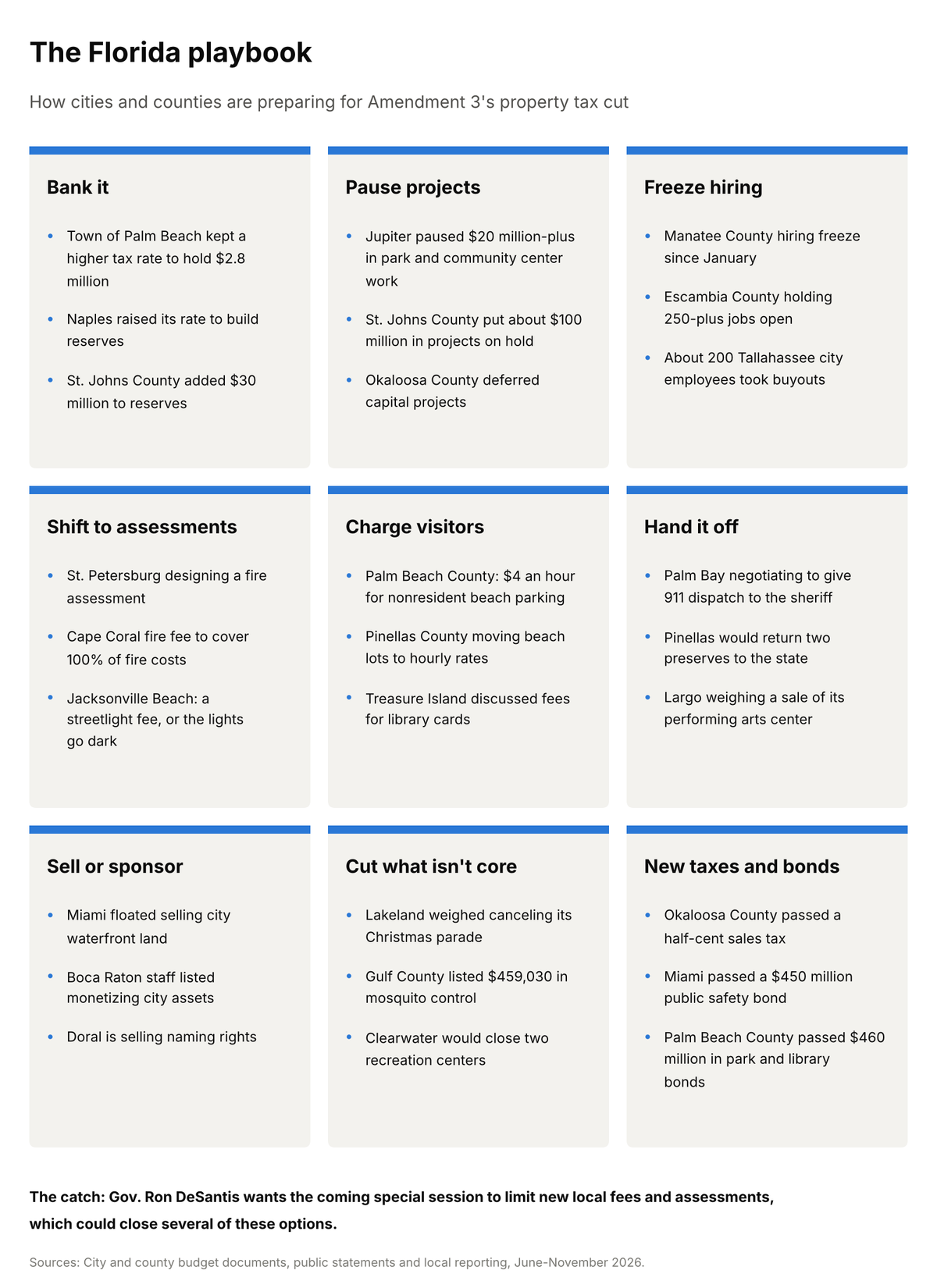
—Across the state, the responses fall into a handful of strategies. Most places are using several at once.
—Bank it before it’s gone. The Town of Palm Beach, the closest thing Florida has to Longboat Key, kept its tax rate at 2.61 mills this fall instead of dropping to the 2.53 its manager proposed, holding onto about $2.8 million as a cushion on top of a fund balance near $40 million. Naples raised its rate from 1.23 to 1.29 mills to build reserves. St. Johns County added $30 million to General Fund reserves and put about $100 million in capital projects on hold. “Our goal is to position St. Johns County to respond responsibly to whichever outcome our voters choose,” County Administrator Joy Andrews said in the county’s September announcement. Orlando is building a stabilization fund from year-end surpluses and may raise its rate for the first time in 13 years. Bay County deliberately filled its reserves to the top.
—Pause the shovels. The Town of Jupiter identified more than $20 million in projects to pause, including its community center and renovations at five parks. “A pause does not mean these projects have been canceled, but if Amendment 3 passes, these projects could be canceled,” the town’s Amendment 3 page says. It passed. Okaloosa County froze General Fund hiring and deferred capital projects. Fort Myers Beach delayed its pool.
—Stop hiring, start buying out. Manatee and Sarasota counties are holding vacancies. Escambia County asked every department for 10 percent cuts and is leaving more than 250 jobs empty. Pensacola has had a hiring freeze since Sept. 1. In Tallahassee, about 200 city employees took severance, saving roughly $8.5 million. Tiny Valparaiso, facing the loss of about a fifth of its $5.4 million budget, cut two police and three firefighter positions before the vote.
—Move it to an assessment. This is the most popular idea in Florida and the most endangered. St. Petersburg has hired a consultant to design a fire assessment. Cape Coral plans to raise its fire assessment from 81 percent of fire costs to 100 percent, freeing General Fund money for everything else. Safety Harbor and Lakeland are studying fire assessments; Lakeland has also floated a parks taxing unit. Palm Coast is looking at a separate fire fee, Sanibel at a stormwater assessment, St. Johns County at a municipal service benefit unit. Jacksonville Beach’s city manager told residents the streetlights could move to a fee, and if no one pays for them, they go dark. Port Orange’s mayor floated a hypothetical flat $600 assessment on every home. And Longboat’s own fact sheet lists special assessments first among its alternatives.
—Charge the visitor. Palm Beach County began charging nonresidents $4 an hour at county beach lots Oct. 1. Pinellas County’s budget switches beach parking from $6 a day to $3.50 an hour and raises boat ramp fees, and Pinellas Commissioner Chris Latvala has floated asking the Legislature for more freedom to spend tourist development tax money. Treasure Island has talked about paying its library cooperative per cardholder or making residents buy their own cards. Flagler Beach is studying library user fees. Bay County is eyeing consumption taxes that fall on tourists.
—Hand it to someone else. Palm Bay voted 3-2 to negotiate turning its 911 dispatch over to the Brevard County sheriff, saving about $2.8 million a year. Bradenton Beach studied outsourcing its police to the Manatee County sheriff this spring, citing hurricane costs, at a savings of about $628,000 a year. Pinellas County’s budget would return the Weedon Island and Shell Key preserves to the state. Largo has talked about selling or privatizing its performing arts center. Former state Sen. Jeff Brandes, a Republican who opposed the amendment, has proposed a minimum-viable-city standard and resident votes on mergers, as officials in the Panhandle warn that some small cities may have to dissolve into their counties.
—Sell, sponsor, monetize. Miami officials floated selling city waterfront property and changing employee pensions under a declared financial emergency. Boca Raton’s staff listed rebating community redevelopment money and monetizing city assets. Hillsborough County’s staff list included selling county property. Doral is selling naming rights and sponsorships.
—Cut what isn’t core. Lakeland’s menu included downgrading fire response from advanced to basic life support and canceling both the Christmas parade and Red, White & Kaboom. Largo’s library would lose 62 percent of its budget and half its hours. Clearwater’s planning document would close two recreation centers and reduce library service. Gulf County’s list of 23 possible cuts includes $459,030 in local mosquito control, and the county’s page warns that “Once a service is cut, restoring it would be very unlikely, since future budgets would not have the funding to bring it back.” Brevard County’s manager has said mosquito control is not a core service. Jacksonville council members have floated a 10 percent cut to the Kids Hope Alliance and an end to what one called giveaways to developers and nonprofits.
—Ask voters for something else. Okaloosa County voters, who backed Amendment 3 with about 69 percent, approved a half-cent infrastructure sales tax on the same ballot. Polk County Commissioner Bill Braswell has proposed swapping the county’s half-cent indigent care tax for a 1 percent infrastructure tax worth about $180 million a year, an idea that would need the Legislature and a 2028 vote. Palm Coast is weighing a half-cent sales tax. Miami voters approved a $450 million public safety bond the same night they cut property taxes. Palm Beach County voters approved $460 million in park and library bonds while the county was telling those departments to plan for cuts of up to 50 percent; Commissioner Maria Marino said the county now has to figure out how to keep the new buildings open once they are built.
—Raise the rate on what’s left. Brevard County’s manager has reportedly floated raising the millage 35 to 40 percent on the property still taxed. Monroe County’s budget director has said a rate increase would be necessary for its Lower Keys fire district. Boca Raton’s options include raising its rate from 3.66 to 4.11 mills. A higher rate falls on what Amendment 3 left behind, mostly second homes, rentals and businesses, which is why opponents called it a shift. If local governments raised rates to make up the difference, an analysis by tax researcher Jared Walczak found, Sarasota County landlords would face about $261 more per apartment and $696 more per single-family rental in 2028.
—Show the public the math. DeLand built an interactive budget model so residents can try to cut $5.2 million themselves. Miami-Dade commissioners required the mayor to present a spending plan, due early next year, if the amendment passed. Largo produced an alternative budget showing exactly what doing nothing would mean.
—The big-government numbers
—Miami-Dade County, which backed the amendment with about two-thirds of its vote, expects “approximately $385.8 million less in property tax revenue” starting October 2027, “increasing to $696.7 million in October 2028.” Its Fire Rescue department alone draws $743.7 million a year from property taxes. Mayor Daniella Levine Cava warned of difficult choices ahead; Commissioner Raquel Regalado predicted it will not be as painful as people think.
—Jacksonville’s estimates run about $200 million in the first year and $300 million in the second, which Mayor Donna Deegan described as a full third of the city’s discretionary budget. Hillsborough County staff estimate about $367 million a year and listed layoffs, a pay freeze, an extra five-cent fuel tax, higher park fees and cuts to nonprofits such as the Crisis Center, MOSI and the Humane Society. Tampa wrote two budgets this year, one for each outcome; after the vote, its council chair put the first-year loss at $40 million to $60 million, with paving likely delayed and police and fire staffing held where it is. Orange County expects about $165 million in the first year and $275 million in the second, with LYNX bus routes on the table.
—Volusia County’s page says “$129.3 million is removed every year — 28% of all property taxes,” and adds a sentence every commission in Florida could post: “No allocation of a cut this large avoids public safety.” Leon County, which voted no, says that after about $161 million in state mandates and constitutional officers, “That leaves only about $3.5 million to fund everything else the County provides.”
—The seasonal-town exception, and what it means for Longboat
—Not every place loses the same way. The more of a town’s value that sits in second homes and investment property, the smaller the homestead hit.
—Monroe County’s property appraiser projects a small countywide gain in the first year, about $287,000, because more than 60 percent of the Keys’ taxable value is not homesteaded, even as the Lower Keys fire district loses money. Sanibel, where only about 30 percent of residential parcels are homesteaded, expects to lose 3.7 percent of its property tax revenue at the $150,000 exemption and 7.5 percent at $250,000. Miami Beach puts its loss at 2.3 percent of the General Fund in 2028 and 4.4 percent in 2029. Key Biscayne, where homesteads pay about a third of the $33.8 million levy, expects about $1 million the first year and $2 million the second. Marco Island, which held its rate flat, projects $1.07 million rising to $3.4 million by 2031-32, and its manager notes that police and fire make up nearly 60 percent of the budget.
—The Town of Palm Beach found something Longboat should study closely. Its budget figures showed the new 5 percent cap on non-homestead assessments costing about $1.6 million a year, more than the homestead exemption costs in the first year, about $800,000, and nearly as much as it costs in the second, about $1.7 million. For an island where much of the value is seasonal, the exemption is the headline, but the cap is the slow leak. In every year that values on second homes would have risen faster than 5 percent, the Town collects less than it otherwise would have, until the property sells and resets. Palm Beach Council member Lew Crampton framed the deeper loss another way: local government, he said, is handing a large share of its budget power to Tallahassee.
—Five lessons from around the state stand out for the island.
—Bank early, and say why. Palm Beach, Naples and St. Johns County moved before the vote and explained it as insurance. Longboat’s move to just under 2 mills was a smaller bet than Palm Beach’s decision to hold its higher rate.
—Watch the cap, not just the exemption. The 5 percent limit compounds, and it bites hardest where values run fastest.
—The assessment route may close. Longboat’s fact sheet lists special assessments first among alternatives. So do St. Petersburg, Cape Coral and a dozen others. The governor wants to stop exactly that.
—The county is the exposure. Longboat runs its own police, fire and public works. Its library, its transit and much of its regional infrastructure run through Sarasota and Manatee counties, which are losing far more, in dollars and in percentage, than the Town.
—Partnerships will be renegotiated. From Palm Bay’s dispatch to Pinellas’s preserves to the parks Sarasota County offered the city, every government is looking to move a cost onto someone else’s books. Longboat’s interlocal agreements, starting with the library, are now in play.
—The other side of the ledger
—Supporters never claimed the cut would be painless; they argued it was overdue. “Local governments are taking in almost twice as much money—far more than inflation and population has increased,” the governor’s office said in an Oct. 21 release. On election night DeSantis posted: “Big win on Amendment 3 for Florida homeowners!” He later called the vote the beginning of the state’s effort to eliminate property taxes, and credited the amendment with turning out voters who went on to vote Republican down the ballot.
—The coalition was not neatly partisan. Bishop wrote in October that the Sarasota County Democrats had sent a mailer recommending a yes vote on Amendment 3. “I was floored,” she wrote.
—Former Longboat Key Town Manager Dave Bullock, who took the supporting side at a Selby Library forum this fall when organizers could not find anyone else to argue it, told the audience that Sarasota and Manatee county spending had risen somewhere between 85 and 100 percent since 2021, and that someone did not have a hand on the controls. He doubted, though, that a constitutional amendment was the right tool. In Walton County, Commissioner Dan Curry said the county is bloated and the amendment forces its hand. Jacksonville Sheriff T.K. Waters, a supporter, said relief is on the way for hardworking Floridians. Florida Realtors, which put roughly $19.5 million into a yes campaign that outraised its opponents many times over, said voters chose meaningful relief. The Florida Chamber said it “will be actively engaged in the implementation of Amendment 3,” with an eye to avoiding harm to businesses, renters and job creators.
—On the other side, the Florida League of Cities’ line all fall was “Amendment 3 is not a tax cut, it’s a tax shift,” and its analysis, posted on city websites around the state, found that “In at least 176 Florida cities, spending on police, fire, and EMS exceeds all property tax revenue collected.” Senate President Ben Albritton, who voted to put the measure on the ballot, announced in October he would vote no, saying in a statement that “Amendment 3 would eliminate up to 30 percent of resources for Florida’s rural counties.” Sheriffs, police unions and firefighters campaigned against it. Florida TaxWatch urged a no vote. The Florida Policy Institute’s Sadaf Knight called it a tax shift and urged local governments to raise any replacement revenue in the least regressive way they can.
—The credit markets are watching, too. In a September survey of 90 rated Florida issuers, S&P found an average revenue loss of 14 percent by the end of 2028, and most said they would raise fees and assessments rather than cut. Analysts have warned of possible downgrades, which would raise borrowing costs for the same governments now losing revenue.
—Tallahassee holds the last word
—Everything above depends on a law that does not exist yet.
—DeSantis says the implementing legislation has to be done by Jan. 1, and that he will call a special session before he leaves office in early January, though he said he would let legislative leaders pick the dates. He wants the law to stop local governments from making an end run around the amendment with other taxes and fees, a package his allies are calling a taxpayer bill of rights. He has also promised a pool of state grants for core needs, and described the help rural sheriffs need as a sliver of the state budget, in the tens of millions of dollars.
—The Legislature that will write that law is changing hands. Before the election, incoming Senate President Jim Boyd said he personally thought the work could wait until lawmakers reconvene in January, and incoming House Speaker Sam Garrison said he would rather be right than quick. Sen. Don Gaetz, a Niceville Republican, said he wants to see the grant language before he signs on and warned against playing a cruel joke on taxpayers. No implementing bill has been filed.
—That leaves every strategy in this story in limbo. A fire assessment designed in St. Petersburg this fall, a streetlight fee in Jacksonville Beach, a special assessment on Longboat Key, a nonresident beach parking rate in Palm Beach County: each could be legal in December and off-limits by spring, depending on what the special session writes. Cities that move fast risk building on sand. Cities that wait risk running out of time before their September 2027 budgets.
—What comes next
—Nov. 17: The state canvassing commission certifies the vote. Sarasota County commissioners begin working through the amendment’s consequences at their regular meeting, the first public test for the Longboat library.
—December: Sarasota County’s board retreat, where a cap on spending growth is on the table. A special session is possible any time before early January.
—Early 2027: Leon and Alachua counties bring budget frameworks to their commissions in January; Miami-Dade’s mayor owes commissioners a spending plan; Sarasota County’s fiscal 2028 budget workshops begin in February.
—August 2027: TRIM notices show the first reduced homestead taxes.
—September 2027: Longboat Key, the City of Sarasota and every Florida government adopt the first budgets that absorb the cut.
—November 2027: The first reduced tax bills arrive.
—September 2028: The budgets that carry the full $250,000 exemption.
—For Longboat Key, the Town Commission’s next meetings are its first chance to say which pages of the state’s playbook it intends to use, and how much it is willing to bet that Tallahassee will still allow them. For downtown Sarasota, a new commission starts with a parking division, a strategic plan and a $5.6 million hole. Both places said, in their own ways, what they thought of Amendment 3. Neither will decide what comes next on its own.

