
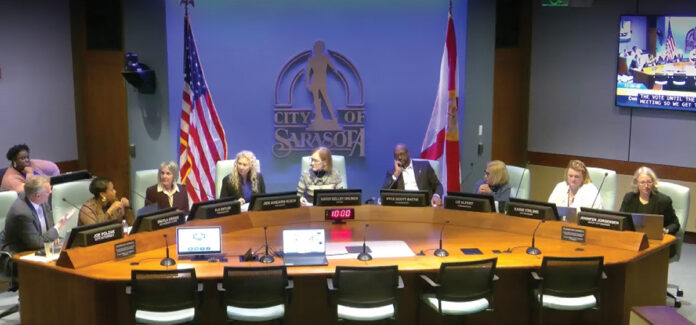
Thirteen days after Florida voters approved the homestead exemption increase, it ran through Sarasota’s first regular City Commission meeting since the vote. It sank a long-sought Rosemary District garage deal 3-2, put a warning about the city’s bond rating on the record, shaped the Bay Park debate and quietly rewrote the city’s lobbying agenda for Tallahassee.
—Amendment 3 was not on the agenda at Sarasota City Hall on Monday, Nov. 16. It did not need to be.
—It surfaced in the first public comment of the day, before 9:20 a.m. It came back minutes later in a protest over a golf driving range. After lunch it decided the meeting’s biggest vote, killing an $8 million deal for 160 public parking spaces in the Rosemary District that Rosemary business owners have been asking for for years. It found its way into the Bay Park rezoning. And at 5:31 p.m., with the room nearly empty, it rewrote the city’s wish list for Tallahassee.
—It was the first regular meeting since voters approved the amendment on Nov. 3, the first regular meeting run by new Mayor Kathy Kelley Ohlrich and the first regular meeting for new Commissioner Flo Entler. It ran nearly nine hours.
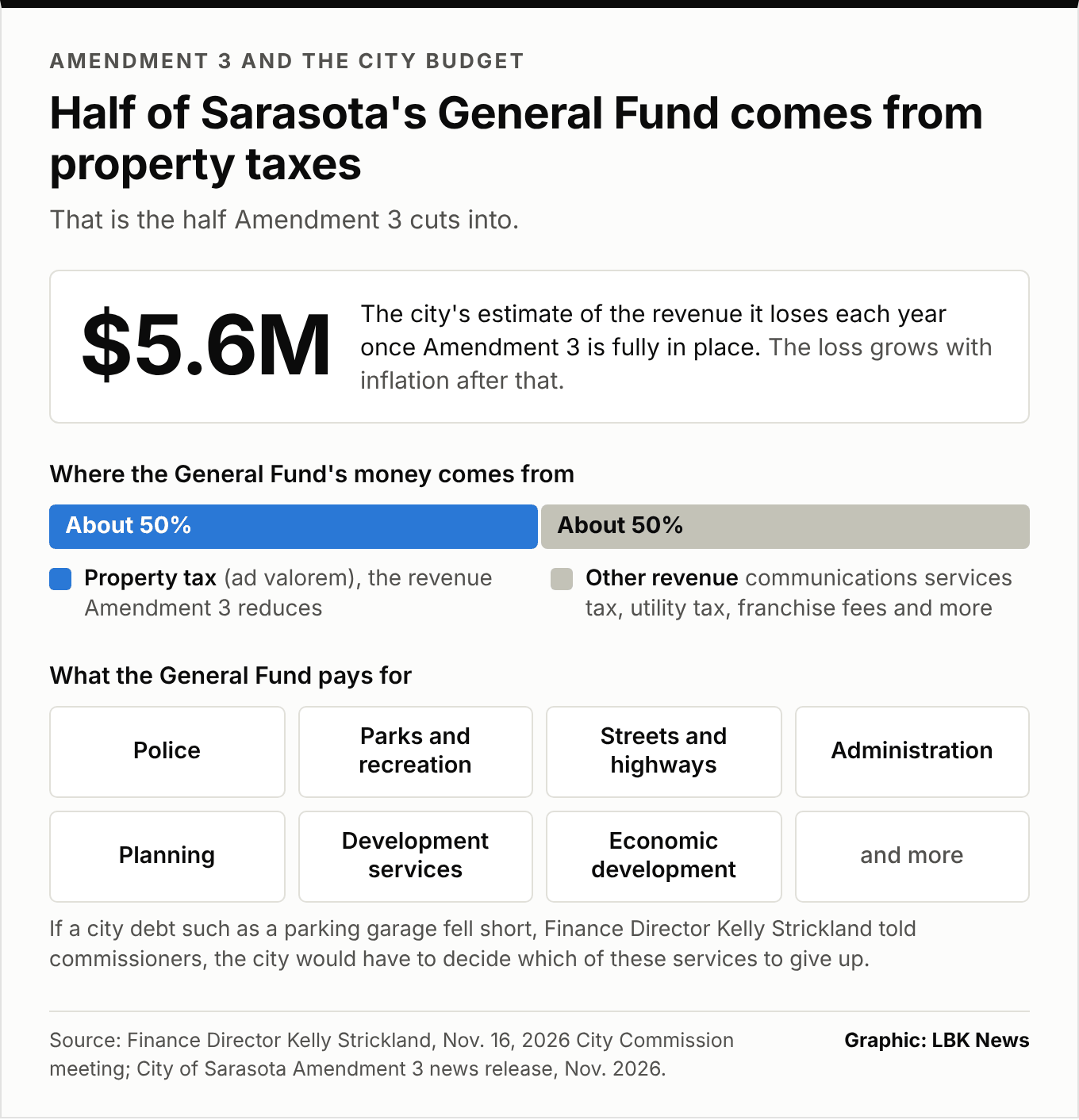
—The city’s own estimate, released the day after the election, puts the loss at about $5.6 million a year once the amendment is fully in place, growing with inflation after that. Finance Director Kelly Strickland reminded commissioners Monday that property taxes pay for half of the city’s General Fund.
—Nobody on the dais put a specific budget cut on the table. City Manager Karie Friling made clear why: nobody yet knows what Tallahassee will hand down.
“We have more unknowns than knowns right now,” she said.
—The $8 Million Question
—The proposal came from the Sarasota Housing Authority, which is building a new senior affordable housing tower, retail space and a parking garage on the McCown Towers campus at Boulevard of the Arts and Cocoanut Avenue. The agency asked the city for an answer so it could finish its underwriting, and it wanted a binding one.
—Friling opened by telling commissioners exactly what that meant.
“$8 million is not a small amount of money,” she said. “What you vote on today, you cannot change your mind in the future.”
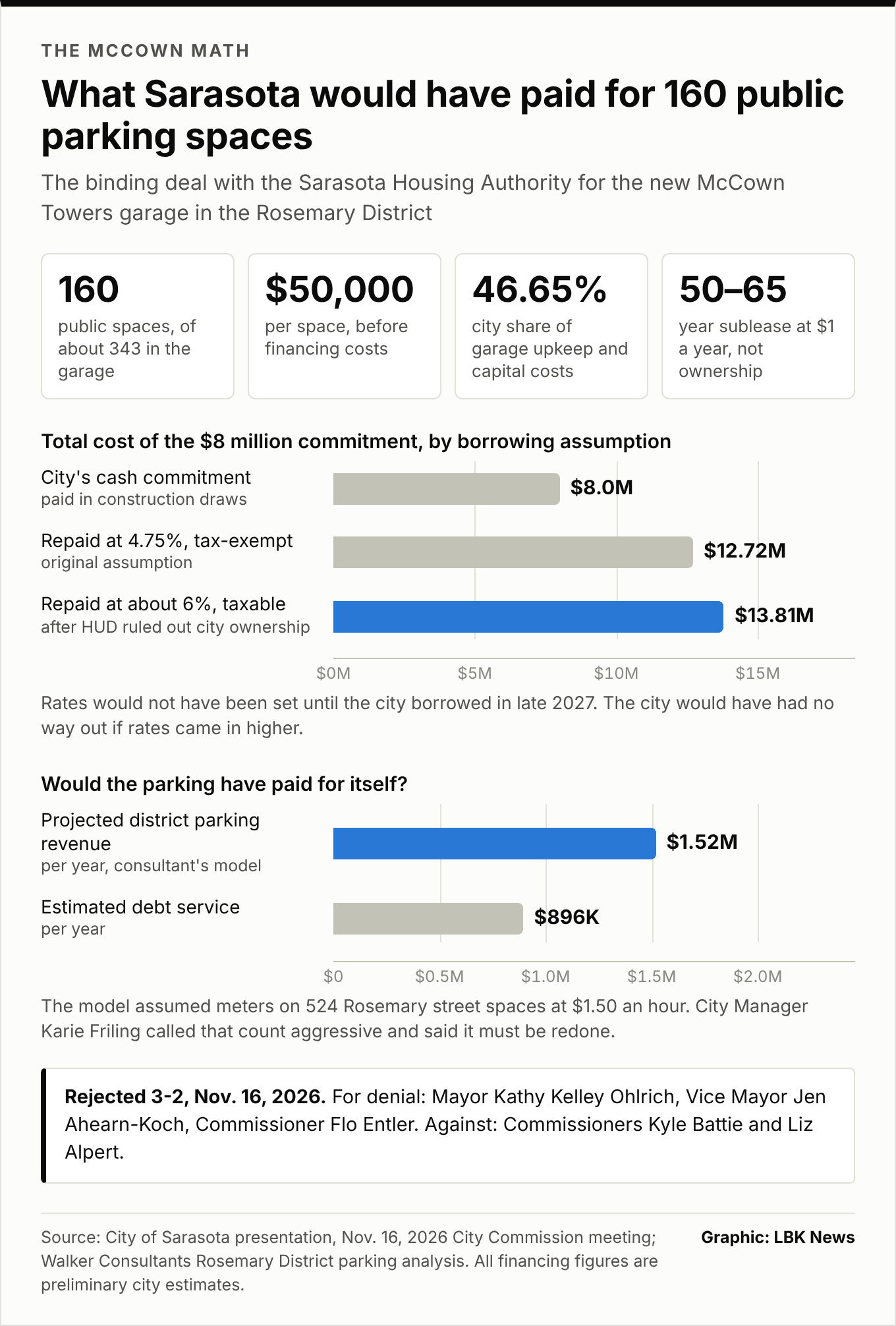
—Under the memorandum of understanding, the city would have put $8 million into the garage through construction draws in exchange for long-term rights to run 160 of its roughly 343 spaces as public parking. The city would set the rates, issue permits, handle enforcement and keep the revenue.
—The deal had changed shape since commissioners last saw it. Friling said the city had long assumed it would own its spaces as a condominium. In October, the Housing Authority told the city that HUD would not allow that structure. The city would instead hold a sublease of up to 65 years, and no shorter than 50, at $1 a year.
—That change carried a price. Because the city would lease the spaces instead of owning them, Friling said, the city’s financial advisers and bond counsel told her the borrowing would have to be taxable rather than tax-exempt. Her preliminary estimate put the added carrying cost at about $1.1 million.
—The numbers she put on the screen:
—At an assumed 4.75 percent tax-exempt rate, total repayment of about $12.72 million.
—At an assumed 6 percent taxable rate, total repayment of about $13.81 million.
—Financing would not be secured until late 2027, so the actual rate, terms and total cost would be set then.
—Other terms drew scrutiny too. After 20 years, or once the city’s debt was paid off if that came first, the city would share up to 25 percent of its parking revenue with the Housing Authority, minus operating expenses. The city would pay its proportionate share of garage maintenance and capital costs, about 46 percent. The city would waive its permitting, inspection, mobility and road-closure fees for the garage. And an exhibit in the agreement obligated the city to budget non-property-tax revenue to cover the debt if parking money fell short.
—A Parking Study Nobody Would Vouch For
—To show the garage could pay for itself, the city hired Walker Consultants to model a paid parking program for the whole Rosemary District. The model counted 524 on-street spaces, 39 existing public off-street spaces and the 160 garage spaces. At $1.50 an hour on the street and $1 in the garage, it projected about $1.52 million a year in revenue against roughly $896,000 in annual debt service. Bumping street parking to $2 an hour added another $698,000 in cushion.
—Friling did not oversell it. She said Walker had been aggressive in counting how many of those 524 street spaces would actually be paid, and that staff would need to go back and redo the numbers.
—Ahearn-Koch went further. She reminded the board that when the city installed meters downtown a decade ago, commissioners were told the program would pull the Parking Division out of the hole and pay for itself. It never has. Each change since then came with the same promise, she said, and the division still borrows from the General Fund. She noted that the Walker report itself warns against bonding or borrowing based on its figures.
—Did the projections account for COVID, or for hurricanes Irma, Ian, Milton, Debby and Helene, she asked?
“Not in the Walker study they didn’t,” Friling said.
—Asked what share of the city’s existing garages fill up on average, Friling turned to staff for the answer: about two-thirds. She did not know what occupancy rate Walker had assumed.
—From $50,000 a Space to $82,000
—Ahearn-Koch then did her own math on the taxable repayment figure. She put the fully loaded cost at about $82,000 per parking space.
“Yeah, fully loaded. Full pay-back,” Friling said. Without financing costs, she said, the $8 million works out to $50,000 a space, and any garage the city built on its own would carry interest costs too.
—Then Ahearn-Koch asked the question that brought Amendment 3 into the room. If the city signed and the borrowing rate came in at 10 percent instead of 6, did the city have any way out?
“No, you do not,” Friling said.
—A Bond Rating Warning, on the Record
—What came next was the clearest statement yet from Sarasota’s top administrator on how Amendment 3 could reach past property tax bills and into the city’s ability to borrow.
“I do know that we will still have a good credit rating but we also don’t know how the bond market is going to look at us because of Amendment 3,” Friling said. “And I think every single city and county in the State of Florida are wondering if our bond ratings are going to be impacted because now our hands are tied on how we can assess property taxes in the future.”
—She told commissioners they did not have the answer, and neither did she.
“You are committing today that regardless of what your financing carrying costs will be a year from now, that you will find a way to pay for it,” she said.
—Where the Money Would Come From
—Entler, in her first regular meeting, asked the plainest version of the question: If the parking does not pay for itself, where does the money come from?
—From non-ad valorem revenue, Friling said, meaning not property taxes but some other fund.
—Entler pressed. “Is it possible that the businesses could end up with assessments like they do at St. Armands?”
“That is a possibility,” Friling said, adding that the city would have to negotiate any assessment and the businesses would typically have to agree to it.
—Her own recommendation, if revenue fell short, was to raise parking rates. If the debt came in at 8 percent, she said, a $2 hourly rate might have to become $3.
—Strickland came down from the audience to spell out the alternative.
“Right now you know that 50% of the general fund is funded by property tax. The other half of the general fund is funded by non-ad valorem revenues,” Strickland said. “So what services are you going to give up in order to pay your debt service because your debt service is a primary expense.”
—The non-property-tax side of the ledger, she said, includes the communications services tax, the utility tax and franchise fees. The General Fund pays for police, parks and recreation, streets and highways, administration, planning, development services and economic development.
—Friling then told the commission not to approve the deal if anyone on the dais expected the parking to be free.
“If you wanted free parking in the parking garage, you would have to cut something out of the general fund to pay for that,” she said. “I would strongly encourage the commission to only vote for this if you have an understanding that this will be supported by paid parking because we are already going to be in extremely stressful times in developing our budget going forward.”
—Earlier, answering Commissioner Kyle Battie, she had put it more bluntly.
“We do not have money in our operating budget to do it any other way,” she said. “Our operating budget is going to become more difficult and difficult year after year, unfortunately.”
“We don’t have money just sitting in the bank to pay for public parking,” she added.
“Oh, we don’t?” Battie asked.
“No, we don’t,” Friling said, to laughter in the chambers.
“We Can’t Dance Around It Any More”
—Ahearn-Koch finally said the name out loud.
“Amendment 3, I know we’re sort of dancing around it,” she said. “We can’t dance around it any more because part of Amendment 3 is for the legislature to set a schedule to potentially eventually do away with ad valorem taxes altogether.”
—How real was that within a year, she asked? What reality did the commission need to accept?
“My crystal ball is not working anymore since I got here day 3,” said Friling, who has been city manager for about five months.
“We do not know when the state goes back into session what they are going to craft that will be sent down to all the cities and counties,” she said. “We do not know what the County of Sarasota will cut that will also shift to the cities. There are a lot of unknowns. We have more unknowns than knowns right now.”
“What we do know is that we have two years to implement what was voted on by the voters in November, and we’re working diligently to figure out how to fill those gaps,” she said. “But past two years, we do not know. And no one does at this point. I wish we did.”
—Rosemary Makes Its Case
—The business owners who came to speak did not argue about Amendment 3. They argued about survival.
—Dan Henson, who owns Arts & Central restaurant, said his family put $4.5 million into the 200-seat restaurant five years ago on assurances that parking would be solved by the time it opened. It was not. He told commissioners he now pays for 30 employee spaces, 10 commercial spaces for customers and about $40,000 a year in valet.
“The net-net is it costs me between 60 and 70 thousand dollars a year to cobble together a subpar parking solution for our restaurant,” Henson said. “I’m one of the proponents of paid parking. I would love to just have the complaint that there is an hourly charge. Our clients can’t even find parking.”
—He offered to redirect that spending to the city in exchange for spaces.
—Kimberly Duffy and Sandy Wagner of the Toasted Mango Cafe, in the same plaza, said they had heard the same promises, pay top-dollar rent and have no valet. Their older customers, they said, simply cannot get in the door.
—Melissa Laughlin, president of the Rosemary District Association, said the neighborhood had been hearing about parking solutions for eight years.
“The concrete solution is $8 million for 160 spots,” she said. “As you’re making fiscally responsible tradeoffs and decisions, this is something that’s bringing money into the neighborhood.”
—Friling said Rosemary businesses at a March meeting with staff were unanimous in backing paid parking in exchange for more spaces; Laughlin said 35 businesses were in the room. Residents were mixed. Entler, who said she had walked the city’s neighborhoods, told the board she heard a lot of opposition from Rosemary residents.
—The Vote: “Now Is Not the Time for the City to Be Gambling”
—Ahearn-Koch moved to deny the agreement. Entler seconded.
“I do want to help the businesses and the residents in Rosemary but not at any cost,” Ahearn-Koch said. She cited the $8 million, the cost of starting up a paid parking program and decades of shared maintenance, “with Amendment 3 hanging over our head, not understanding what that’s going to do to our bond rating, we could be paying even higher percentage than 6%, and we don’t know.”
—If the projections missed, she said, the money would come out of departments that are already stretched.
“Either we don’t pay for parks or we don’t pay for sustainability, or we don’t pay for economic development. There’s somebody else who will have to pay for this,” she said. “This year is a big gamble in my opinion, and now is not the time for the city to be gambling.”
—Entler said she was torn.
“I did not think I would have to make this difficult of a decision on my first meeting,” she said. “With Amendment 3, I just don’t know how I responsibly say yes to this. It would be like buying a car knowing the price of a car, but not knowing the licenses, the fees, the taxes, the options.”
—Battie, whose district includes Rosemary and who lives there, was having none of it.
“This is the price that you pay for leadership,” he said. “You should never operate or make decisions based on fear. Listen, Amendment 3 is what it is. This is what we’re confronted with. This is where we are.”
—He borrowed a line he attributed to Michael Jordan’s trainer: “You either pay the price to do what it is you need to do to win in this situation or you can write the check later for regret.” If the city waited and built its own garage, he warned, it would cost two or three times as much.
—Commissioner Liz Alpert sided with Battie. Every option for Rosemary parking carries unknowns, she said, and putting it off would not make the amendment go away.
“We can put this off and spend millions more and still have the issue of we’d have to figure out how to pay for it. We’re still going to have Amendment Three to deal with,” Alpert said. Thriving businesses, she argued, would help the city weather the amendment. “If our community dies, we definitely, you know, don’t have any options.”
—Ohlrich spoke last. Earlier she had asked why the city was learning of the lease change so late.
“This is like the 11th and a half hour, and this commission is being asked to make a dramatic change with huge financial implications for the city,” she said.
—Before the vote, she explained where she landed.
“Initially, I was all in on this project,” Ohlrich said. “However, to me, the relatively newly revealed uncertainty makes the city participating in this project dangerous.”
—The motion to deny passed 3-2, with Ahearn-Koch, Entler and Ohlrich in favor and Battie and Alpert opposed.
—What Happens to Rosemary Now
—The Housing Authority project goes on without the city. Friling said the agency told the city it would redesign the garage and proceed. Housing Authority President and CEO William Russell had said as much at the table.
“One way or the other, we are moving forward,” Russell said.
—Friling said staff has been looking at other Rosemary sites for public parking, but those efforts are at a very early stage and she would not discuss them publicly. Any of them will take time, consultants and public money. She summed up the tradeoff with a saying from her father about a bird in the hand versus two in the bush.
—A Lighted Driving Range in a “Post-Amendment 3 World”
—The amendment’s first appearance of the day came from the public, and it was aimed at the consent agenda.
—Martin Hyde, back at the lectern after his losing state Senate run, used his citizens’ input time to urge the city, in light of Amendment 3’s passage, to take away employees’ purchasing cards and the risk of misused tax money that comes with them.
—Then John Simon, a city resident who lives at 1350 Main, came to speak on Item 6.2, a lighted driving range at Bobby Jones Golf Club.
“I looked at the agenda and I saw item 6.2, frankly I was shocked,” Simon said. “In the post-Amendment 3 world to be spending a million one as the first item out of the box on a lighted driving range for the Bobby Jones golf course is mind-boggling to me.”
—He said he is a golfer and asked whether anyone had done a market study or a return-on-investment analysis.
“I guess the real question here is how $1.1 million in improvements to a golf driving range gets on to a consent agenda,” Hyde said, suggesting the Lido Beach pool and other parks were more pressing needs and asking the board to table the item.
—It was too late. The commission had already approved the rest of Consent Agenda 1, driving range included, on a 5-0 vote before either man spoke on it. City Auditor and Clerk Shayla Griggs told the mayor she had missed their speaker cards. “That was on me,” Ohlrich said. “I had the cards right here.” She heard the comments and moved on. No commissioner revisited the item.
“Not to Exceed” and Other New Habits
—If no one on the dais tied the consent items to Amendment 3 by name, the questioning had a different edge than in years past.
—Ohlrich told staff she would have voted against anything on the agenda listed with an “estimated cost” instead of a not-to-exceed cap. “To me, if it’s estimated, the sky is the limit,” she said. Utilities Director Verne Hall promised every future contract would carry the language.
—Ahearn-Koch pulled four consent items for questions. On the $2.6 million purchase order for county landfill fees, she wanted to know why staff budgeted less when the city spent about $3.04 million last year. She briefly moved to delay the vote until staff produced the figures, then withdrew the motion once Public Works Director Nik Patel supplied them. Deputy City Manager Jennifer Jorgensen explained that the purchase order is a cap, and any overage has to come back to the commission. The county’s tipping fee held at $58 a ton.
—On five utilities engineering contracts, she asked why the annual ceiling was jumping from $200,000 to $1.5 million. The city has spent $3.9 million across the five since 2024, staff said.
—On Consent Agenda 2, Strickland called a budget amendment for the Bobby Jones Golf Club fund “a happy story”: rounds and revenue were up, so spending rose with them. Alpert did the subtraction. With roughly $332,000 in added revenue and about $300,000 in added spending, the city netted only about $32,000. Strickland said the higher spending came from the extra activity.
—Hyde called the year-end budget re-appropriations, which he put at close to $4 million, “municipal sofa diving” and asked that staff write explanations the public can follow.
—Every consent item passed 5-0.
—The Bay Says Its Money Is Safe
—When the Bay Park Conservancy came to the table for its rezoning, A.G. Lafley opened by trying, in his words, to put Amendment 3 in perspective.
—The tax increment financing district that funds the park’s capital work was valued by the county this summer at $357 million, Lafley said, “virtually all of which is unaffected by Amendment 3.” His reason: most of the commercial and residential development in the district has come in the last five years. He added that the conservancy covers 80 percent of the park’s operating and maintenance costs and provides design and project management work for free.
“We know you are working diligently hard to manage the impact of Amendment 3,” Lafley said.
—Ahearn-Koch took it a step further. The amendment limits what local governments may spend property tax money on, and she urged the conservancy to keep describing The Bay as stormwater and resiliency infrastructure, not just a park.
—She was talking about “the world of Amendment 3 where what we are allowed to spend taxpayer dollars on could or couldn’t be limited and some of those definitions have hinted at infrastructure,” she said.
—Before the meeting ended, City Attorney Joseph Polzak said he had asked the conservancy to include green infrastructure language in a future Phase One document. Both Bay Park ordinances, the new Bay Park Zone text amendment and the rezoning of about 46 acres, passed 5-0.
—Rewriting the Ask to Tallahassee
—The last item of the day was the one where the city formally answered Amendment 3, and it got the least debate.
—At 5:31 p.m., Jorgensen walked commissioners through the draft 2027 State Legislative Priorities for the session that opens March 2, 2027, and adjourns April 30. She focused on what had changed.
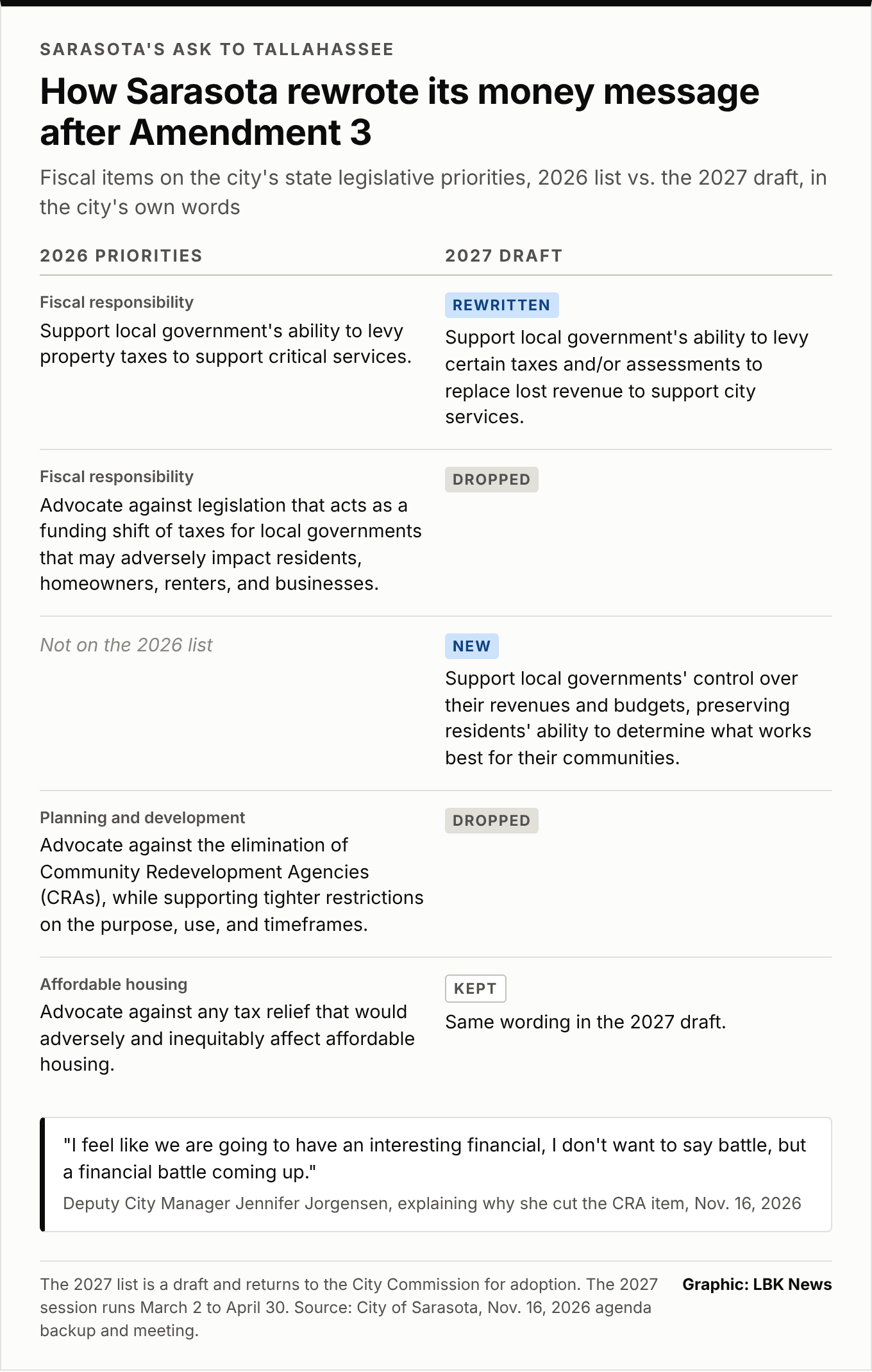
—Under Fiscal Responsibility, last year’s list said the city would “Support local government’s ability to levy property taxes to support critical services.” It also said the city would “Advocate against legislation that acts as a funding shift of taxes for local governments that may adversely impact residents, homeowners, renters, and businesses.”
—Both are gone. The 2027 draft says the city will “Support local government’s ability to levy certain taxes and/or assessments to replace lost revenue to support city services,” and adds a new line: “Support local governments’ control over their revenues and budgets, preserving residents’ ability to determine what works best for their communities.”
“We all know that has passed,” Jorgensen said of the property tax ballot question. “I changed that language a little bit to basically allow us to look at some taxes or assessments to replace some of the lost revenue. Of course, this will depend on a special session that our governor may call that may answer some of these.”
—She also cut last year’s priority opposing elimination of community redevelopment agencies. Ohlrich asked why.
“I deleted the CRA mainly because I feel like we are going to have an interesting financial, I don’t want to say battle, but a financial battle coming up and focusing on the higher level items of our overall budgets seemed a little bit more important,” Jorgensen said. She noted that bills to eliminate CRAs come back every year and have not passed, and offered to restore the item if commissioners wanted it. They did not ask her to.
—Kept on the list: “Advocate against any tax relief that would adversely and inequitably affect affordable housing.”
—Also New on the List
—Three other additions are worth noting.
—The city wants a new exemption from Florida’s public records law for communications between the city and its attorneys. Jorgensen said it “kind of shocked me to learn those are not excluded from our public records,” and argued confidentiality may be warranted during contract negotiations. She said she is not trying to change the public records law otherwise.
—The city wants permission to use Florida Building Code permit and inspection fees, now tightly restricted, as grants to help low-income homeowners bring houses up to code. Ohlrich said the idea drew strong support at her Florida League of Cities committee.
—And the list now spells out liability protection for city water and wastewater utilities that receive PFAS, the so-called forever chemicals, from sources outside their control. It also writes in the commission’s earlier resolution supporting a ban on offshore oil and gas drilling in the eastern Gulf.
—Ahearn-Koch asked about adding biosolids alongside PFAS and confirmed that last year’s push to fix SB 180 is still on the list. No one debated the fiscal bullets, and no vote was taken. Jorgensen will bring a final version back for adoption.
—Longboat Asked Small. Sarasota Asked for More.
—The contrast with the island is hard to miss.
—As LBK News reported, six days after the election Longboat Key’s longtime state lobbyist told town commissioners there is no fixing Amendment 3 and no getting around it, and the town cut its Tallahassee wish list from 12 items to five.
—Sarasota went the other way. Its draft grew from eight categories and 16 bullets last year to nine categories and 19 bullets this year. Its new fiscal language asks the Legislature for room to replace lost property tax money with other taxes and assessments.
—Longboat Key has put its own General Fund hit at about $1.4 million a year once the full exemption takes hold.
—What Amendment 3 Does
—Raises the homestead exemption from non-school property taxes to $150,000 of assessed value starting Jan. 1, 2027, and to $250,000 in 2028, indexed to inflation after that.
—Leaves school taxes alone, so homesteaded owners will still get a tax bill.
—Cuts the cap on annual assessment increases for non-homestead property, such as second homes, rentals and businesses, from 10 percent to 5 percent.
—Limits what counties and cities may spend property tax revenue on.
—Requires the Legislature to set out a procedure for eventually eliminating non-school property taxes altogether.
—Passed with about 62 percent of the statewide vote, above the 60 percent required.
—What Comes Next
—Final legislative priorities: Jorgensen will return with the final 2027 list, including any biosolids language, for a commission vote.
—Dec. 9: The Sarasota County legislative delegation holds its annual public meeting. Ohlrich will speak for the city and, Ahearn-Koch reminded her, will get three minutes. Jorgensen said the city will focus on its top two or three priorities.
—Jan. 1, 2027: The $150,000 homestead exemption takes effect. The Legislature still has to write the rules to carry out the amendment, and Jorgensen said the governor may call a special session.
—March 2 to April 30, 2027: The regular legislative session.
—Rosemary: Staff will keep looking for other public parking options. The Housing Authority will redesign its garage without the city.
—For now, Sarasota’s top administrator is planning around a two-year horizon and little else.
“But past two years, we do not know,” Friling said. “And no one does at this point. I wish we did.”

