
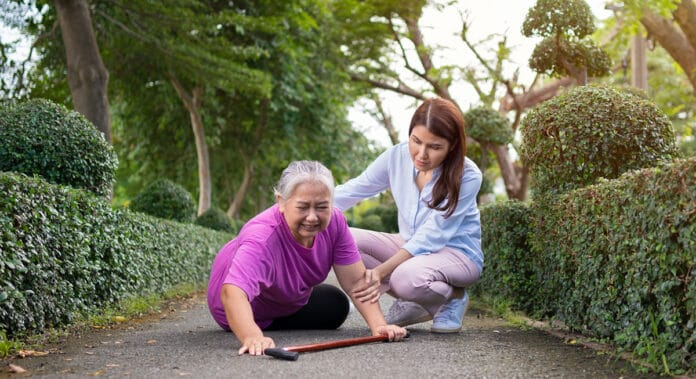
A medical feature for Longboat Key, Lido Key, St. Armands and Bird Key readers on the biggest under-discussed health threat on our islands, and what to do about it
—Theologians have argued for two thousand years about the Fall of Man. One bite of forbidden fruit, one moment of imbalance in the Garden, and humanity was cast out of Eden into a world of labor, mortality and, presumably, throw rugs.
—But there is a second fall that scripture never warned us about, and it comes later in life. It happens on a tile floor at two in the morning, on a pool deck slick with afternoon rain, on the lip of a bathtub or the last step of a staircase you have descended ten thousand times. It is quieter than the first fall and, for the person it happens to, often more consequential. Nobody hands you an apple. Gravity simply collects a debt it has been patiently carrying your whole life.
—Here on Longboat Key, Lido, St. Armands and Bird Key, where the median age runs decades above the national figure and many residents measure their tenure in paradise by the number of hips, knees and vertebrae they have negotiated along the way, the fall is not a theological abstraction. It is the single most common reason Longboat Key Fire Rescue paramedics are dispatched. Not fires. Not car accidents. Falls. Town fire officials have said for years that falls are the department’s number one medical call, and the department now runs roughly 2,200 calls annually, about 700 of which end in an ambulance ride over the bridge.
—The fragility of the body is the one true democracy on these islands. It does not check your net worth, your golf handicap or the view from your lanai. It asks only one question: can you catch yourself? And the honest answer, for all of us, changes with every passing year.
—This story is about that question. What happens to the body as it ages, why a fall at 78 is a fundamentally different event than a fall at 38, what breaks and why it matters, and, most importantly, the substantial and growing body of evidence about what actually prevents falls, what medicine can do before and after, and which of the new technologies are worth your attention.
—The Numbers Are Worse Than You Think
—Nationally, about one in four adults 65 and older falls each year, roughly 14 million people annually. Falls are the leading cause of injury-related death in that age group, killing more than 38,000 older Americans in a single recent year, and they send about three million seniors to emergency rooms annually. Roughly one million of those visits become hospitalizations.
—The signature injury is the hip fracture. Around 300,000 older Americans are hospitalized for broken hips every year, and falls cause the overwhelming majority of them, along with more than 80 percent of hip fracture deaths. Women absorb about 70 percent of those fractures, a direct consequence of postmenopausal bone loss. And the risk compounds brutally with age: among adults 85 and older, the rate of hip fracture emergency visits runs roughly nine times higher than for those 65 to 74.
—One more number worth committing to memory: after a first fall, the odds of falling again roughly double. A fall is not an event. It is frequently the opening chapter of a sequence.
—What Aging Actually Does to the Body
—Staying upright is not one skill. It is a continuous, unconscious negotiation among three systems: vision, which tells you where the world is; the vestibular system of the inner ear, which tells you where your head is; and proprioception, the network of nerve sensors in your feet, ankles and joints that tells you where your body is. The brain integrates all three, then dispatches muscle commands fast enough to correct a stumble before it becomes a catastrophe.
—Age erodes every link in that chain. Cataracts, glaucoma and macular degeneration degrade the visual feed. The hair cells of the inner ear thin out, which is one reason brief dizziness on standing becomes so common. Peripheral neuropathy, often from diabetes, numbs the feet. Reflexes slow. And then there is the muscle itself: adults lose roughly 3 to 8 percent of muscle mass per decade after age 30, a process called sarcopenia that accelerates sharply after 60. The fast-twitch fibers, the ones that fire when you need to catch yourself right now, decline fastest of all.
—Meanwhile the skeleton is quietly running the same program in reverse. Bone is living tissue, constantly torn down and rebuilt, and sometime in midlife the demolition crew starts outworking the construction crew. Women can lose up to 20 percent of their bone density in the five to seven years after menopause. The result is osteoporosis: bones that look normal from the outside but have the internal architecture of coral, beautiful and brittle.
—Put it together and you get the cruel arithmetic of the later-life fall. A younger body trips, corrects, maybe bruises. An older body trips, cannot correct in time, and lands on bone that can no longer absorb the blow.
—What Breaks, and Why the Hip Is Different
—The most common fractures follow the physics of how we land. Wrists break because we instinctively throw out a hand. Vertebrae compress, sometimes from falls and sometimes from nothing more than a hard sit-down. The pelvis, the shoulder and the ribs all make the list. Head injuries deserve special mention: falls are the leading cause of traumatic brain injury in older adults, and for anyone on blood thinners, a hit to the head that seems trivial can become a slow, dangerous bleed hours later.
—But the hip is the injury that changes lives. A hip fracture in an older adult almost always means surgery within a day or two, because the alternative, immobility, is deadlier than the operating room. Then comes the cascade: weeks of limited movement invite pneumonia, blood clots, pressure sores and delirium. Muscle that took years to build vanishes in days of bed rest. Studies have found that a substantial share of hip fracture patients die within a year, and that many who survive never regain their previous independence. A significant number of people who lived alone before the fracture cannot do so afterward.
That is what makes fall prevention different from most preventive medicine. You are not shaving a few percentage points off a distant risk. You are defending, quite directly, your ability to keep living in your own home on this island.
—The Fear Spiral
—There is a second injury that shows up on no X-ray: fear. After a fall, or even a near-miss, many people quietly begin restricting themselves. They stop walking on the beach, skip the stairs, decline the invitation. It feels prudent. It is, physiologically, the worst possible response, because inactivity accelerates exactly the muscle loss and balance decay that caused the trouble in the first place. Researchers call it the fear-of-falling spiral, and it can turn one stumble into a permanently smaller life. The entire modern science of fall prevention can be summarized as a campaign against that spiral: the answer to falling is almost never to move less.
—Fall-Proofing Paradise: The Home Audit
—Most falls happen at home, and island homes have their own signature hazards: tile everywhere, wet pool decks, sandy sandals, bare feet on polished stone, and the sliding-glass-door track that has ambushed more than one resident. A serious walk-through, ideally with a physical or occupational therapist, but even armed with a checklist, should cover:
- Throw rugs. Remove them or tape them down. They are the banana peels of retirement living.
- Lighting. Night lights along the bedroom-to-bathroom route, switches reachable from bed, and lighting on every stair. Most 2 a.m. falls are navigation errors in the dark.
- Bathrooms. Grab bars in the shower and beside the toilet (towel bars are not grab bars and will come off the wall), non-slip mats, and a shower chair if balance is questionable. The bathroom is the most dangerous room in the house per square foot.
- Stairs. Handrails on both sides, contrasting tape on step edges, nothing stored on the steps.
- Clutter and cords. Clear the pathways you actually walk, especially the routes you travel half-asleep.
- Footwear. Supportive shoes with non-slip soles, indoors too. Backless slippers and socks on tile are a paramedic’s origin story.
- Pets. We love them. They are also small, mobile tripping hazards with excellent timing, a fact any honest veterinarian and most emergency physicians will confirm.
—Balance Is a Skill, and Skills Can Be Trained
—Here is the most hopeful finding in all of geriatric medicine: balance responds to training at every age. The evidence is not vague wellness talk; it is one of the best-documented interventions in preventive health.
—Tai chi sits at the top of the evidence pyramid. Multiple large trials show that regular tai chi practice cuts fall risk substantially, in some studies by half or more, by training exactly the slow, controlled weight shifts and single-leg moments that real-world balance requires. It is, essentially, falling rehearsal at a speed the body can learn from.
—Strength training twice a week, with real resistance, directly attacks sarcopenia. Legs first: sit-to-stand repetitions from a chair, step-ups, heel raises. The single best predictor of whether you can catch a stumble is leg power.
—Yoga and Pilates both build the core strength, hip stability and body awareness that underpin balance, with Pilates particularly good for people rebuilding after injury and yoga for flexibility and controlled single-leg work. Aquatic classes offer resistance without fall risk, a sensible on-ramp for the deconditioned.
—Simple daily drills cost nothing: stand on one leg while brushing your teeth (near a counter), walk heel-to-toe down the hallway, practice rising from a chair without using your hands. Balance is use-it-or-lose-it, and thirty seconds a day genuinely counts.
—Islanders do not have to leave the Key to do any of this. The Paradise Center on Longboat Key (941-383-6493) runs a year-round calendar that includes tai chi, gentle yoga, Pilates-style classes and fall-prevention programming aimed squarely at this population, hundreds of classes a year, plus health seminars. For structured medical programs, Sarasota Memorial’s outpatient rehabilitation network offers physical therapy and balance work, including vestibular rehabilitation for inner-ear disorders, on referral.
—The Medicine Cabinet Audit
—Ask any geriatrician to name the most overlooked fall risk and the answer is usually sitting in the bathroom cabinet. Sedatives and sleep aids, benzodiazepines, some antidepressants and antihistamines, and any combination of four or more prescriptions all measurably raise fall risk. Blood pressure medications can cause orthostatic hypotension, the head rush on standing that precedes so many bedroom falls. None of this means stopping medications on your own; it means an annual brown-bag review, every pill and supplement, with your physician or pharmacist, asking one question: is anything here making me unsteady?
—The proactive medical checklist extends further. Annual eye exams matter, and bifocal or progressive lens wearers should know those lenses distort depth perception on stairs. Hearing matters too; hearing loss is independently associated with falls, likely because the brain diverts balance resources to straining after sound. Vitamin D sufficiency supports muscle and bone. And anyone with dizziness or vertigo deserves a proper workup, because conditions like benign paroxysmal positional vertigo are often fixable in a single office visit with repositioning maneuvers.
—Building Better Bone
—Since the severity of a fall depends on what it lands on, bone itself is a medical target. Every woman 65 and older, and younger women and men with risk factors, should have a DEXA bone density scan; Medicare covers it. If the scan shows osteoporosis, modern pharmacology has real answers: bisphosphonates such as alendronate slow bone breakdown; denosumab, an injection every six months, does the same by a different mechanism; and for severe cases, newer anabolic agents such as teriparatide, abaloparatide and romosozumab actually build new bone rather than merely preserving the old. These drugs demonstrably reduce hip and spine fractures. An untreated osteoporosis diagnosis, and studies suggest the majority of patients who suffer a fragility fracture are never treated for the underlying disease, is one of the great missed opportunities in American medicine.
—After a Fall: Who You Call, Who You See
—First, the non-negotiables. Call 911 if there is significant pain, an inability to bear weight, a blow to the head, or if the person takes blood thinners, no exceptions on that last one, even if they feel fine. Longboat Key Fire Rescue would far rather lift you up than pick you up later. The island’s serious trauma goes to Sarasota Memorial Hospital, the region’s Level II Trauma Center, with trauma surgeons and orthopedic specialists in-house around the clock.
—For a fracture, the orthopedic surgeon leads, but recovery is a team sport. Sarasota Memorial’s 74,000-square-foot Rehabilitation Pavilion handles inpatient rehab for broken bones, spinal fractures and brain injuries, with physiatrists, physicians who specialize in physical medicine and rehabilitation, directing the program, and the system’s outpatient clinics carry patients the rest of the way home. Ask specifically about a falls assessment before discharge; the goal is not just healing the break but preventing the sequel.
—For falls that do not injure, do not shrug them off. Tell your primary care physician; a fall is a vital sign. It should trigger a medication review, orthostatic blood pressure check, vision screen, and a referral to physical therapy for balance training. And island residents now have a purpose-built resource: Longboat Link, the town’s partnership launched with a local home-care nursing agency, offers free follow-up after 911 calls, connecting residents, especially those without family nearby, to services before the next fall instead of after it.
—A Word About the Post-Fall Marketplace
—One warning your doctor may not deliver: a fall makes you a marketing demographic. The moment mobility wobbles, an industry appears, unsolicited brace offers, miracle balance supplements, high-pressure pitches for equipment and procedures of dubious value. Medicare fraud investigators have spent years chasing schemes built on exactly this vulnerability. The defense is simple: run every purchase and procedure past your own physician or therapist, be deeply skeptical of anyone who calls you first, and remember that the interventions with the strongest evidence, exercise, medication review, home modification, bone treatment, are mostly cheap and none of them are sold door to door.
—The New Technology, Sorted by Usefulness
—The gadget world has finally taken falling seriously, and some of it has matured into genuinely good medicine.
—Detection first. Modern smartwatches, including the Apple Watch, and medical-alert pendants now include automatic fall detection that summons help if you go down and cannot respond. For anyone living alone, this is the baseline, because outcomes after a fall worsen dramatically with every hour spent on the floor.
—Ambient sensors. For those who will not wear anything, a newer generation of wall-mounted radar and infrared sensors monitors movement and detects falls without cameras, preserving privacy in bathrooms and bedrooms while watching for trouble.
—Prevention tech. Artificial-intelligence gait analysis, via smart insoles, scales and even phone cameras, can flag deteriorating balance before the first fall, and motion-activated smart lighting quietly eliminates the dark 2 a.m. hallway.
—Impact protection. Perhaps most striking, wearable hip-airbag belts sense a serious fall in progress and inflate before impact. In a recent multicenter study of high-risk older adults, one such smart belt cut major hip injuries from serious falls by roughly 90 percent compared with matched controls, with fewer hospitalizations and ER visits. Airbags saved a generation of drivers; there is no reason they cannot save a generation of grandmothers.
—East of Eden, Keep Walking
—The first fall cost us the Garden. The second one, the one that stalks us in our seventies and eighties, threatens something arguably dearer at this stage of life: the morning walk on the beach, the tennis game, the drive to St. Armands, the simple sovereignty of living in your own home on your own island.
—But here is the difference between the two falls. The first, we are told, was destiny. The second is substantially negotiable. The evidence says the residents who keep moving, who train balance like the perishable skill it is, who audit their homes and their medicine cabinets, who treat their bones and screen their eyes and swallow their pride about grab bars and watches that tattle to the paramedics, those residents fall less, break less, and stay in paradise longer.
—Gravity is patient, but it is not unbeatable. It just requires that we take it as seriously as it takes us. Fight gravity daily, and it may yet leave you standing.
—If you or a loved one has fallen or fears falling, start with your primary care physician and ask for a falls risk assessment. On Longboat Key, the Paradise Center (941-383-6493) offers balance and fitness classes year-round, and Longboat Key Fire Rescue can connect residents to the Longboat Link follow-up program.

