
Sarasota commissioners advance the sale and rezoning of the Marian Anderson brownfield, a former unlicensed landfill in the heart of the city’s historic Black community, while wrestling live on the dais over recycling plants, data centers and an Oxford comma
—In places, the soil at 2046 Dr. Martin Luther King Jr. Way is laced with lead at 180,000 milligrams per kilogram, which is another way of saying that nearly one-fifth of what a shovel turns up is lead. The state’s cleanup target for residential land is 400. Arsenic runs as high as 134 milligrams per kilogram against a target of 2.1. Beneath a thin blanket of topsoil, household debris sits packed as deep as 12 feet.
—This is what the City of Sarasota buried in Newtown, and on September 8 the City Commission took two of the most consequential steps yet toward digging the city out from under it.
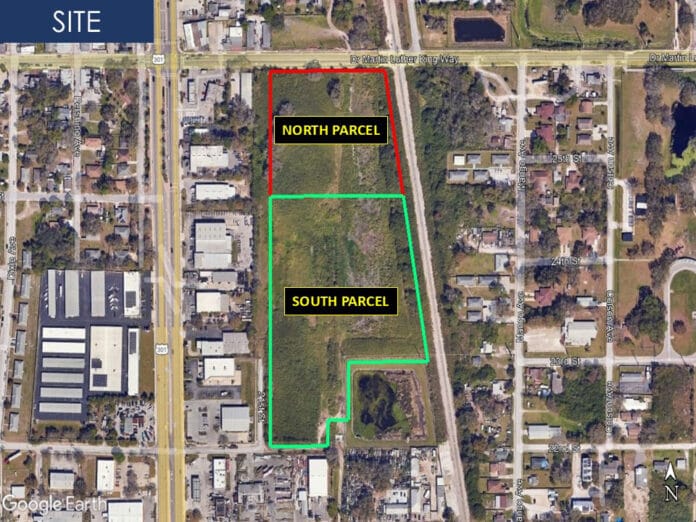
—In a pair of unanimous votes, commissioners approved a Third Amendment to the city’s purchase and sale agreement with Newtown Gateway LLC, resetting a cascade of missed environmental deadlines, and then passed on first reading Ordinance 25-5582, rezoning 9.22 acres of the nearly 14-acre Marian Anderson Place site from Commercial Residential to Industrial General. The rezoning clears the way for a healthcare campus on the north end of the property facing Dr. Martin Luther King Jr. Way and more than 100,000 square feet of light industrial and warehouse space on the south, along 21st Street.
—If the project holds, it will end more than 80 years in which the largest parcel the city owns has produced nothing: no jobs, no services, and not one dollar of property tax.
—But the afternoon also showed how fragile the moment remains. A citizen watchdog warned that the city was rezoning a contaminated site for industry with no site plan attached. The vice mayor accused the ordinance of quietly narrowing an environmental restriction the Planning Board had demanded. The specter of a concrete-crushing operation near Booker High School hung over the room, and the words “data center” entered the record for the first time, raised at 1 a.m. the night before and unresolved by adjournment. Commissioners ended up drafting new ordinance language from the dais, comma by comma.
“You’re cleaning up a brownfield,” Mayor Debbie Trice told the developers near the end of the hearing. “You do not want to create more pollution.”
—A Dump in the Heart of Newtown
—The story begins in April 1944, when the City of Sarasota bought the land east of U.S. 301 for $10 and began using it as an unlicensed landfill. For roughly two decades, the city’s refuse went into open excavations at the edge of Newtown, the community founded in 1914 as a home for Sarasota’s Black residents in the era of segregation. When the dumping stopped in the early 1960s, the pits were covered with soil scraped from the site itself, and the land was left alone.
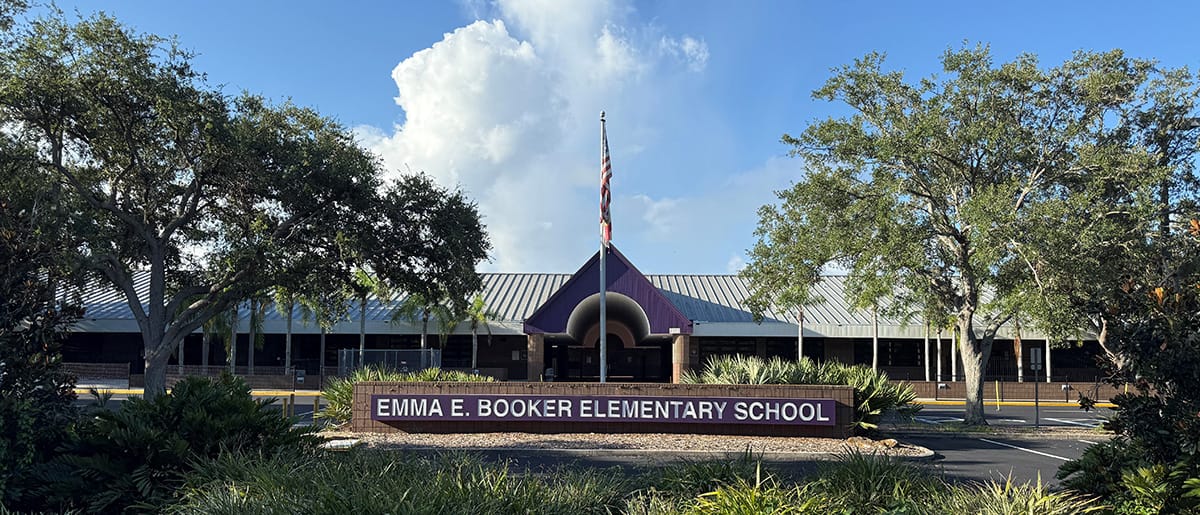
—It has been left alone ever since. The property sits today within sight of Emma E. Booker Elementary School and the Betty J. Johnson North Sarasota Public Library, bounded by the railroad right-of-way on the east and, on the west, by Marian Anderson Place, the street named for the pioneering Black contralto who broke the color barrier at the Metropolitan Opera in 1955. The name is one of the site’s quieter ironies: a monument to a woman who overcame what America buried, attached to a field where Sarasota buried its garbage in a Black neighborhood.
—For Keith DuBose, one of the Newtown Gateway partners and a Booker High School alumnus, the history is not abstract. His brother and partner Ernie DuBose has recalled riding to the property as a boy: “I remember coming here with my grandfather and dumping things off.”
—The city has tried before to give the land a second act. A Walmart courtship came and went; so did negotiations with a developer over an industrial park, retail hub and vocational training center. At one point, Barron Channer told commissioners on September 8, the site’s industrial zoning was actually stripped down in parallel with the Walmart conversations. “Effectively we’re bringing it back to the industrial zoning,” he said, “not for that reason, but mainly to facilitate our particular project.”

—What the Tests Found
—The Florida Department of Environmental Protection knows the property as Waste Cleanup Tracking No. ERIC_10007, Brownfield Site BF580401001. A March 2026 letter from the department, reviewing the developer’s site assessment of the northern parcel, reads like a toxicologist’s inventory.
—Arsenic, chromium, lead, benzo(a)pyrene equivalents and the banned pesticide dieldrin all exceed state cleanup targets in the soil. In the groundwater, arsenic and antimony exceed drinking-water-based cleanup levels, and iron, manganese and total dissolved solids exceed alternative targets set against background conditions. The department ordered further testing to map exactly how far, and how deep, the contamination runs.
—Those findings explain both the site’s six decades of dormancy and the structure of the deal. Residential use, city staff told a community workshop, is off the table entirely because of the landfill history. What the land can support, once remediated under state supervision, is exactly what Newtown Gateway proposes: commercial buildings and warehouses over engineered caps and controls, with environmental covenants recorded against the deed in perpetuity.
—A $50,000 Price Tag and a $4.5 Million Problem
—On paper, the April 2023 sale is one of the most lopsided land deals in city history: nearly 14 acres of urban land for $50,000, in a market where a single downtown quarter-acre routinely trades for millions. In substance, the price is a recognition that the buyer is purchasing an obligation. Channer has estimated the assessment and cleanup at roughly $4.5 million, and the purchase agreement binds Newtown Gateway to a state-supervised gauntlet of brownfield agreements, site assessment reports and remedial action plans before a closing can occur.
—Newtown Gateway itself is a deliberate hybrid: Channer, the Miami-based CEO of Woodwater Investments, brings brownfield and capital-markets experience, while partners Keith DuBose, Ernie DuBose and Pastor Al Davis bring generations of Newtown roots. The plan divides the property in two. The north parcel, roughly a third of the site, is slated for a healthcare clinic and medical office complex, an answer to a long-documented shortage of accessible care in North Sarasota. The south parcel, the 9.22 acres rezoned last week, is intended for warehousing, distribution and logistics.
“The idea is to build light industrial that can be job-producing,” Channer told commissioners, “recognizing the nature of the site, the assets it has, and the weaknesses that it has, but also, more importantly, the opportunity for the Newtown area.” The rezoning, he said, would let the company “engage in the market to try to find the tenants that we need or the occupiers that we need to bring economic development to the area.”
—Hurricanes, Traffic Rules and a Ticking Clock
—Why, three and a half years after the sale was approved, has it still not closed? The answer is a chain of delays that no one in the room on September 8 blamed on the developer.
—First came Hurricane Milton. After the October 2024 storm, the city commandeered the vacant property as a disaster debris staging site, and for more than six months Newtown Gateway’s consultants could not set foot on the land to drill and sample. The site was not released until the city received a closure letter in April 2025, and a Second Amendment to the contract reset the testing clock.
—Then came the city’s own zoning code. The rezoning application, filed in July 2025 and unanimously endorsed by the Planning Board that September, was frozen for nearly a year while the city rewrote its traffic concurrency rules, a fix adopted only on August 3 of this year. “The delay with the rezone is not their doing at all,” Deputy City Attorney John Shamsey told commissioners.
—The trouble was that the contract’s clock kept running anyway. Two hard deadlines, one for a supplemental environmental filing on the north parcel and one for a state brownfield agreement on the south, both fell on August 31, 2026, and both passed unmet. Under the old contract, the commission then had just 14 days to either extend the deal or kill it. September 8 was the only meeting inside that window.
“The amendment is trying to make the agreement coincide with the facts on the ground,” Shamsey explained. The Third Amendment pushes the north parcel filing to October 31 and gives the south parcel roughly six months after the rezoning becomes final to secure its own state agreement. More significantly for the long run, it hands City Manager Karie Friling authority to grant future extensions of up to 60 days administratively, with a 60-day runway for the commission to act if a deadline still slips.
—Commissioner Jen Ahearn-Koch probed whether “reasonable discretion” was guardrail enough for that new power. “I feel comfortable with that,” Friling answered, and the item passed without dissent. Vice Mayor Kathy Kelley Ohlrich summed up the housekeeping with a sigh of institutional fatigue: the amendment, she said, “seems to be an attempt to keep complications and moving parts from complicating the project even further.”
—The Ghost of U.S. Recycling
—The afternoon’s real friction arrived with the rezoning hearing, and it arrived carrying a name every commissioner recognized.
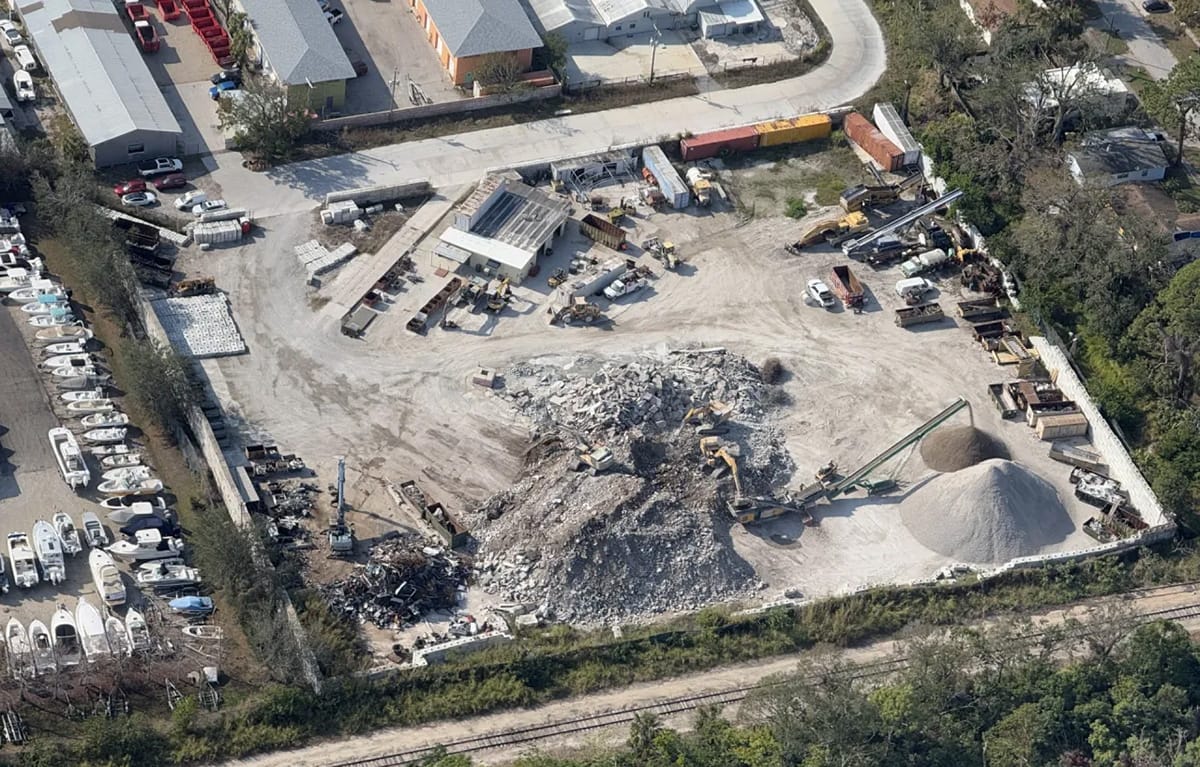
—Ron Kashden, speaking for the Coalition of City Neighborhood Associations’ Air Quality Committee, reminded the board that Industrial General zoning permits, by right, exactly the kind of operations that turned the former U.S. Recycling concrete-crushing site near Booker High School into a running civic wound. “A rezone without a site plan is the one item that has the most unknowns out of any application that can possibly come before you,” Kashden warned.
—His deeper complaint was about drafting. When the Planning Board recommended approval in September 2025, its members wanted broad protection against environmental harm from the site, but they could never land on exact wording; the motion approved “the proffer as discussed.” What emerged in the ordinance prohibited trash processing, recycling and the crushing of rock, concrete, asbestos and asphalt only “in an open-air setting.” Move the crusher indoors, in other words, and the restriction arguably evaporates.
“It is very clear to me that the ordinance we have before us today does not state the intent of the Planning Board,” Ohlrich said, noting she had rewatched the year-old hearing herself.
—Keith DuBose met the concern head-on, invoking his own family’s stake in the neighborhood downwind. “We want to be good players. We want to work with the environment,” he said. “I know about the one at Booker High School. I’m heavily involved at Booker High School, being a Booker High alum and parent of Booker High alums. So I’m concerned about that.” The developers, he added, wanted to be “not here in a defensive posture but in a proactive posture.”
Channer’s hesitation was never about intent, he said, but about handing strangers a weapon. A proffer written into a zoning ordinance can be enforced by anyone, forever. “The second I say you can’t do it at all, then, hey, that firm is recycling boxes. We don’t like them here, and this says they can’t recycle. Now we have a litigation, and even if I think it’s frivolous, we’re in court because the word is on the piece of paper.” An overbroad restriction, he argued, could scare off the very tenants the project exists to attract: “It’s one thing for me to incidentally violate an environmental law and the EPA comes down with a hammer. It’s another thing for me to make a proffer to you, because it creates an opportunity for any resident, whether it be truthful or not, to assert we violated something.”
—Drafting an Ordinance Live, Oxford Comma and All
—What followed was 20 minutes of something rarely seen at City Hall: five commissioners, two city attorneys and a developer writing law together in real time.
—Commissioner Liz Alpert opened the door by asking whether Channer would ban commercial-scale recycling outright, not merely outdoors. He would, he said, so long as a tenant compacting its own cardboard inside a 100,000-square-foot warehouse could never be dragged into court over it. Ahearn-Koch proposed inserting “commercial” before “processing or recycling.” Staff preferred the zoning code’s term “primary use.” Ahearn-Koch then flagged a missing comma in the list of banned materials: “After asphalt, a comma. An Oxford comma.”
—Ohlrich, making the motion, drew laughter with a nod to the mess that started it all: “I don’t want to pull a Planning Board trick here and say, as discussed.”
—The language Shamsey finally read into the record, and the commission adopted 5-0, prohibits any primary use on the site, and any open-air activity at all, involving the processing or recycling of refuse or trash, or the crushing, breaking, grinding or pulverizing of rocks, concrete, mortar, asbestos, asphalt or substantially similar materials. It is materially stronger than what was printed in the agenda packet that morning, and it will run with the land no matter who owns it in 2050.
—The Data Center Question
—Then Ahearn-Koch reached for the issue roiling seemingly every growth-corridor government in Florida. “My other concern, which is a relatively new item, but it’s the topic of the day, is data centers,” she said, asking whether Newtown Gateway would proffer that the site never become one. One week earlier, North Port commissioners had advanced an 18-month moratorium on data center applications; a new state law, Senate Bill 484, shapes who regulates the biggest ones.
—Channer, who said he first heard the idea from DuBose “maybe 1 a.m. last night,” declined, but carefully. “It’s not an intent. It’s not been a consideration,” he said. The company simply refused to negotiate a bespoke definition of “data center” at the podium, hours after hearing the term, when the city itself is likely headed toward citywide rules. “We wouldn’t want to front-run that,” he said, pledging instead to abide by whatever regulations the commission eventually adopts for everyone.
—City attorneys offered the commission a backstop: Sarasota’s zoning code does not define or list data centers anywhere, and under the code’s default rule, a use that is not expressly permitted is prohibited. Trice added a dose of definitional humility, noting that City Hall itself runs data equipment and recycles its paper and cardboard: “Would it be appropriate to say, oh, no, you cannot have a data center or recycling in your building?”
—No data center restriction was added. The issue now migrates to the citywide arena, where Ahearn-Koch made clear she intends to take it, and where the Marian Anderson site, a large, rail-adjacent, industrially zoned parcel, will be Exhibit A for why the code needs an answer.
—What Newtown Stands to Gain
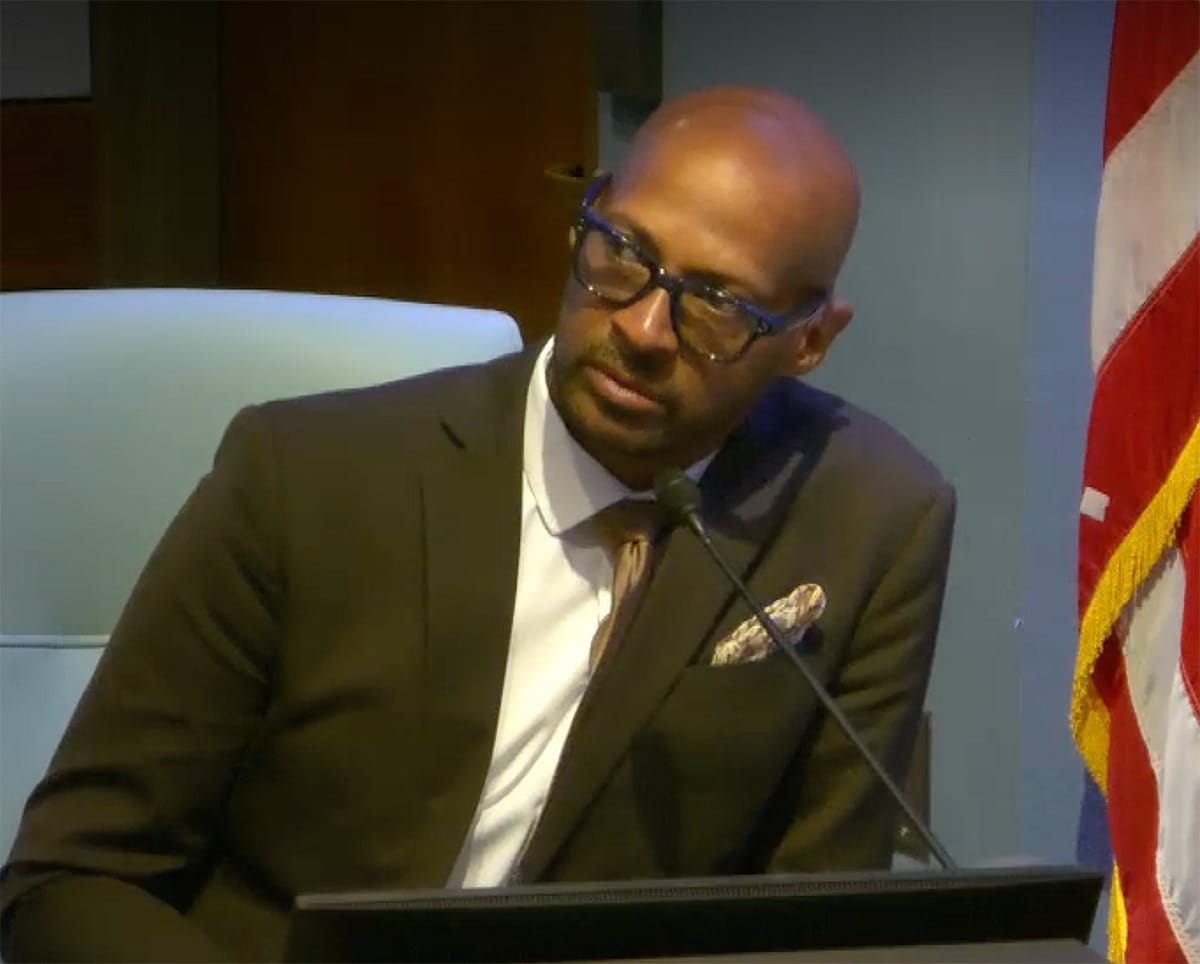
—Strip away the legal machinery and the stakes are stark. This is a property inside the city’s Community Redevelopment Area that has never once appeared on the tax rolls, in a district Commissioner Kyle Battie, who represents Newtown, described as “a community that’s been deemed underserved or economically diminished.” Battie, who seconded both motions, said he knows the developers personally and that “the last thing they want is anything that would be a detriment to the community and cause harm.”
—The promised returns come in layers. The healthcare campus, envisioned at roughly 45,000 square feet of clinic space and 51,600 square feet of medical offices in earlier filings, targets one of North Sarasota’s most persistent gaps. The industrial parcel is pitched as a jobs engine, with the developers already in talks with CareerSource about construction apprenticeships and committed to a program giving Newtown youth exposure to commercial real estate careers. The team has floated using the adjacent rail line to move freight, and FDOT plans to signalize 21st Street at the industrial entrance. City economic development staff have long predicted that activating the parcel would ripple outward along the MLK corridor, drawing further investment behind it.
—And there is the ledger’s other side: a $4.5 million private cleanup of a public mess, at a moment when the city could not credibly fund that remediation itself.
—What Comes Next
—The rezoning still needs a second and final reading. After that, the contract’s dominoes begin to fall in sequence: a state brownfield agreement for the south parcel within roughly six months, site assessments, remedial action plans, FDEP approvals, and finally a closing, or possibly two, since the amended contract allows the north parcel to close first, with half the purchase price paid at each closing. Only then come development applications, site plans and construction, each with its own city review.
—Channer, who has now stood before this commission across three land-use cycles and three contract amendments, offered his own metric for progress: every appearance costs him, and every appearance means the project is still alive. The number, he said, “grows every time I’m with you, which is a painful thing but also a good thing.”
—For eight decades, Sarasota’s approach to Marian Anderson Place was to cover it and look away. On September 8, for a few contentious, comma-splicing hours, the city finally did the opposite: it looked directly at what is buried there, argued in public about what should rise above it, and voted, twice and unanimously, to keep going.

