
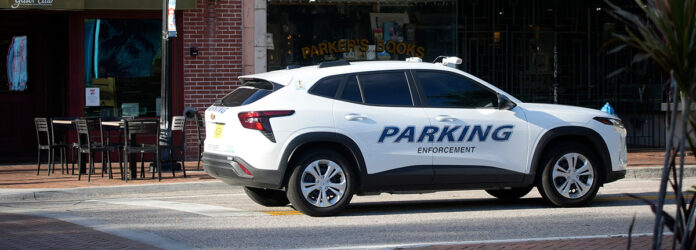
Two days after commissioners spent a workshop pleading with the public to stop abusing city parking staff, an enforcement officer was assaulted near the Circle. The rancor now runs from the street to the budget books, and the garage that started it all may end up on the auction block.
—The Sarasota parking wars are no longer a metaphor. On the afternoon of Sept. 2, two days after the City Commission devoted a morning workshop partly to pleading with the public to stop berating city parking employees, a uniformed enforcement officer was writing two citations near North Washington Drive and John Ringling Boulevard when a 61-year-old Bradenton woman pulled up behind her city vehicle and began shouting at her to move, police said.

—The officer moved her car to let the woman pass, then followed her to the employee lot behind the Tommy Bahama store to photograph her license plate and report the harassment. According to a probable cause affidavit, Anita Grace Valdez got out of her car, a second argument erupted, and Valdez grabbed the officer’s ID badge and yanked the lanyard around her neck hard enough that it struck her in the stomach. The officer later reported neck and stomach pain. Valdez told police she grabbed the badge only to read the officer’s name.
—Valdez was arrested on a felony charge of battery on a public servant, booked into the Sarasota County Jail and released on supervised pretrial release, jail records show.
—For two summers, Sarasota’s parking revolt was waged with petitions, surveys, three-minute speeches and 124-signature protest letters. It cost the city a parking general manager, who resigned in July, and consumed five commission meetings, an open house and a workshop. Now it has a case number.

‘I Would Poison You’
—The assault was not an isolated flash of temper. In an internal memo forwarded to commissioners, Planning Director Steven Cover relayed what parking staff have been absorbing in the field as the dispute escalated through the summer.
—In one incident, a passing driver yelled a racial slur at an officer writing a citation. In another, a couple walking past an officer told her, “If I were a restaurant owner, I would poison you.” One officer was frightened enough by a customer reaching into her scooter to return a citation that she demanded the person leave and called police, who responded but said they could not act because they had not heard the exchange. A customer at the State Street Garage yelled, “I hate the garage people.” Another told an officer writing a No Parking Anytime ticket that she was “going to have your freaking job.”
“I feel the need to share the below information with you, so you can best understand what our staff is experiencing in the field when doing their jobs,” City Manager Karie Friling wrote in transmitting the list to the commission, adding that she has asked the Sarasota Police Department to maintain a presence downtown to back up parking staff.
—Commissioner Kyle Battie put it bluntly: “The amount of vitriol and animosity regarding this matter, we are trying to do everything that we possibly can to quell it and not only keep it at a minimum, but eradicate it altogether.” When tempers flare over a ticket, he said, “emotions are high and logic is low.”
—A New Manager Calls for a Ceasefire
—The assault landed on Friling’s desk in her 13th week on the job. At the Aug. 31 workshop, which marked her 90th day as city manager, she had already warned that parking employees “have been subjected to increased anger and personal attacks by members of the public, both in the field and online. It is getting worse and needs to stop immediately.”
—Two days later, it got worse. The morning after the attack, Friling and Police Chief Troche met with the Parking Division to talk through what happened, and she sent an all-employee memo titled “Standing Together in Support of Our Employees” declaring “zero tolerance for anyone in the public putting their hands on our employees or even threatening our employees.” Her request to commissioners was pointed: when engaging constituents, “please be proactive in turning down the rhetoric and emotions.”
—Friling has also tried to reframe the fight itself. “There is no such thing as free parking,” she told the commission at the workshop. Garages must be built and maintained, streets striped, technology bought, people paid. “If the person using a parking space does not pay those costs, the costs do not disappear. They are simply paid from another source.” And she signaled fatigue with the city’s serial reversals. “We cannot continually revisit the same issue at the expense of the many other priorities requiring the attention of this Commission, our staff and our community.”
—The public, notably, did not get to answer her in the room. Commission rules bar public comment at workshops, a fact that stung after the Aug. 24 open house drew more than 100 people, many expecting to speak, only to find a staff presentation and written comment cards. Two dozen or more walked out in protest. Friling conceded the format was poorly communicated, calling it “an oversight on our part.”

—The Numbers Fueling the Fire
—Strip away the shouting and the fight is about a set of figures the city itself put on the screen at the workshop, and they are remarkable for a city of roughly 58,000 people.
—The Parking Division’s proposed downtown fund budget has ballooned from $3.7 million in fiscal 2025 to $4.2 million in 2026 to $6.7 million for 2027, driven by personnel of $1.87 million and a $1.45 million capital outlay that includes $750,000 to replace the State Street Garage elevators, with another $750,000 for Palm Avenue’s elevators the following year, $650,000 in new pay stations, license plate readers and four new vehicles. The division fields 24 full-time employees to manage 9,527 public spaces, about 397 spaces per employee, more than a third of which remain free.
—The city’s own projections show the combined parking system losing money every single year through 2031 at current rates: a $2.1 million operating loss next year, $2.7 million the year after. Meanwhile the extended-hours experiment that ignited the revolt, enforcement from 8 a.m. to midnight plus Sundays, generated all of $112,413 in its first month before the commission suspended it.
—What paid parking has reliably produced is citations. July’s parking revenue hit $552,248, up 55 percent over July 2025, with citation revenue alone up 70 percent to $210,230. Dr. Kirk Voelker, in a letter to Friling, calculated that roughly 34 percent of the proposed main parking fund’s revenue would come from fines and forfeitures, against a typical 7 to 9 percent in peer cities. “Why is writing substantially more tickets considered success?” he asked.
—Resident Thomas Brennan traced the problem further back. Parking has operated as an enterprise fund, meant to pay its own way, since 1990. Yet by his review of city records it has taken at least $3.9 million in General Fund subsidies and loans since 2013 and still owes the General Fund more than $1.6 million. The fund created to protect taxpayers from subsidizing parking has had taxpayers subsidizing it anyway, which led Brennan to the question that hung over the entire open house: “What problem are we actually trying to solve?”
—What Merchants and Residents Are Being Asked to Pay
—Staff came to the workshop with three ways to close the gap, and each lands on somebody.
—Raising rates would push on-street parking from $1.50 to as much as $2.25 an hour and squeeze roughly $2.3 million more a year out of drivers. Funding free parking through the General Fund would require an additional $9.25 million annually, a 0.5111-mill property tax increase, about 15.6 percent on the operating millage, or $255 a year on a $500,000 taxable value. A special assessment district would divide the bill among 1,522 downtown and St. Armands businesses at $6,080 apiece per year, or $506.63 a month, atop the employee permits merchants already buy: 1,640 downtown at $20 a month and 690 at St. Armands at $10.
—Merchants say the current system is already extracting a price the ledgers do not capture. Chris Voelker’s survey of downtown businesses drew 174 responses in three days, with more than 90 percent asking for a rollback. Dr. Voelker’s letter cataloged the summer’s casualties: Bavaro’s, Element, Circo, Cuba 1958, Wolfie’s, Tsunami, with more owners privately doubting they survive the year, while customers migrate to the free lots of UTC and Waterside.
—Residents, meanwhile, are left circling and decoding. Enforcement starts at 8 a.m. east of U.S. 301 in the Judicial District, later elsewhere downtown, and the rules have changed and un-changed twice in ten weeks. Even the city needs a memo chain to explain itself: when a resident challenged a Coconut Avenue citation, interim Parking General Manager Phillip Deveau concluded the ticket was “technically” valid but had been dismissed anyway because the enforcement photos did not clearly show the signage.
‘Duped’
—At the open house, the comment cards went straight at the origin story. “This city was duped by poor management and wishful thinking,” one wrote of the St. Armands garage, “and a parking director who admittedly had not a clue what his break-even point for said garage” was. Staff’s written response: “We disagree with you on this – but thank you for your comment.”
—Another card retold the sequence Longboat Key News documented in its investigation of the 2014 consultant study that conjured a 320-space shortage and a $751,000 annual revenue projection the garage has never once met. In its follow-up as the island’s president rose to the garage’s defense. St. Armands merchants wanted a garage, then learned it had to be paid for with street meters, then insisted Main Street get meters too. “It should have ended right there,” the writer said. “But the tail wagged the dog and started the path of destruction for Main St. when Main St. was doing just fine.”
—That is the whiplash at the center of the public’s fury. A generation of St. Armands visitors was told the island desperately needed structured parking. Now, with the garage bleeding money, they are told the city might be better off without it.

—Sell It? The $12 Million Question
—The idea is no longer a stray comment card. Katherine Hermes, in a detailed proposal emailed to all five commissioners, urged the city to obtain an independent valuation and competitive bids to sell the St. Armands garage when its 2017 bonds, a $13.595 million issuance maturing in 2038, become callable on Oct. 1, 2027. A sale near $12 million would likely retire the debt that drove paid parking to the Circle in the first place. Her broader plan would bid out management of the Palm Avenue and State Street garages and fold enforcement into the police department, noting Sarasota spends roughly $1,300 per space per year against a national norm of $470 to $520.
—Commission candidate John Harshman promptly poured cold water on the arithmetic. An investor would demand at least a 12 percent return, he wrote, meaning the garage would have to gross nearly $2 million a year to justify a $12 million price. “According to the Suncoast Searchlight, the garage has never even produced its projected annual income of $751,000.” His counter: a citizen task force with a hard 45-to-60-day deadline.
—Either way, the irony is complete. A garage justified on scarcity may yet be sold on futility.
—A Commission Trying On Outfits
—Through it all, the commission has approached parking policy the way an insecure dresser approaches a mirror, trying on one wardrobe after another in search of a look the public will finally applaud. Two hours free. Then meters. Then enforcement to midnight and on Sundays. Then, five weeks later, a hurried rollback of everything but the higher fines, which survived a 3-2 vote. Each ensemble has been modeled, frowned at and flung on the floor, while merchants, employees and residents are asked to keep memorizing the new rules and paying for the alterations.
—What Comes Next
—For now, the extended hours remain suspended, and the city says the commission is expected to revisit the Parking Division’s future after the Nov. 3 general election. That is not an idle date: the same ballot carries Amendment 3, the homestead exemption expansion that could blow a hole in city revenues and make subsidized parking harder, not easier, to afford. Behind it looms Oct. 1, 2027, the day the garage bonds become callable and the sale conversation becomes real.
—The Valdez case will wind through court. The officers will keep writing tickets under whatever rules survive the next fitting. And Sarasota will keep circling the question underneath all of it, the one no rate table answers: who pays for the city we built? The least the community can do while it argues, as Friling put it, is disagree “without being disagreeable.” As of Sept. 2, that is no longer a given.

