
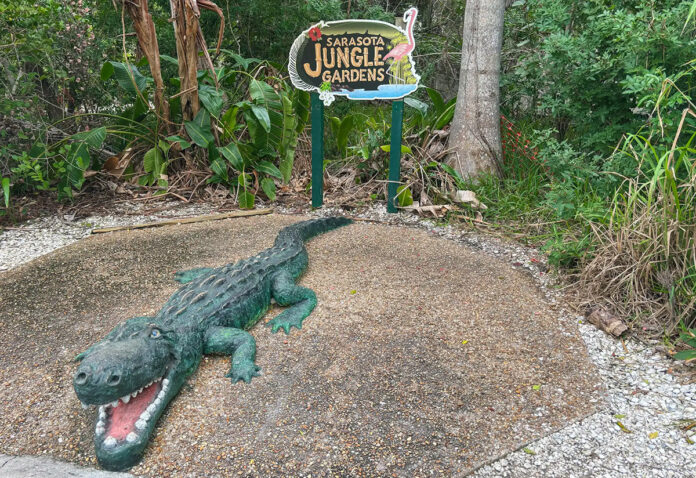
Jerry Kamensky says a new eight-foot fence at the 1939 attraction violates its special exception, has knocked 7 to 10 percent off nearby home values, and that Code Compliance is going after the old barbed wire instead because the city is afraid of its own permit
—For 87 years, the jungle has been the point.
—Sarasota Jungle Gardens opened on New Year’s Eve 1939 on ten acres that city records once described as “an impenetrable swamp,” a banana grove that newspaperman David Breed Lindsay turned into a botanical maze of royal palms, strangler figs and the largest Norfolk Island pine in Florida. The flamingos came later. So did the alligators, the lemurs, the parrot shows and three generations of the Allyn family, who bought the place in 1971 and still run it. It is one of the last Old Florida roadside attractions still operating in its original form, and the shady curve of Bay Shore Road that runs past it through Indian Beach Sapphire Shores is one of the prettiest half-miles in the city.
—Which is why a fence has become a war.
—The complaint
—Jerry Kamensky, a neighbor, has been pressing the City of Sarasota for months over a new fence Jungle Gardens installed along Bay Shore Road. He calls it, without hedging, “the newly installed eyesore.” He says it went up under a permit the city should never have issued, that it violates the special exception under which the attraction operates in a residential neighborhood, that it conflicts with the property’s historic designation, and that a local realtor estimates it has cut neighboring property values by 7 to 10 percent.
—Then, in a letter to City Commissioner Jen Ahearn-Koch, he lays out the part that turns a fence complaint into an accusation.
“Code Compliance’s plan to pursue the removal of the chain link and barbed wire fence is detrimental to the neighborhood as it leaves exposed the newly installed eyesore,” Kamensky wrote. “Landscaping the chain link is a far better outcome.”
—Read that twice. According to Kamensky, the city’s code officers looked at two fences on the Jungle Gardens frontage, an old chain-link fence topped with barbed wire and a new one he describes as yellow, and decided the problem was the old one. They dismissed his complaint about the new fence and moved to force removal of the barbed wire. He wants the opposite: take down the new fence, keep the old one and hide it behind landscaping.
—Two fences, one permit
—The dispute turns on a claim Kamensky says Jungle Gardens made when it applied for the permit: that an eight-foot fence was required.
—Federal rules for licensed animal exhibitors do require perimeter fencing, and for facilities housing potentially dangerous animals the standard height is eight feet. Jungle Gardens keeps crocodiles and alligators. On its face, that is a plausible reason for a tall fence.
—Kamensky’s argument is that the requirement was already satisfied. “That requirement was unnecessary as long as the chain link fence with the barbed wire top remained in place,” he wrote, calling the eight-foot claim a “misrepresentation.” If the old fence did the job, the new one was never required, the permit was granted on a false premise, and the city is not stuck with it.
—That matters because of the second half of his theory.

—The liability trap
—Kamensky believes the city will not go after the new fence for one reason: it issued the permit, and it is afraid that ordering removal of something it approved would make the city liable for the cost.
“I believe the city has been unwilling to do this and continues to be unwilling to do this based on a mistaken understanding that the city may be held liable for issuing the permit,” he wrote.
—His answer is a legal doctrine called estoppel, which in this context means a party cannot benefit from a misstatement it made to obtain a government approval. If Jungle Gardens told the city an eight-foot fence was mandatory and it was not, Kamensky argues, Jungle Gardens cannot turn around and say the city is responsible for the fence. “The estoppel argument mentioned above will protect the city from liability,” he wrote.
—He has offered to do the legal research himself. He says he presented it to the Legal Department, to Code Compliance, and at a meeting held with the city manager present. He says City Attorney Joseph Polzak, on a telephone conference with Ahearn-Koch, “offered to review this research and discuss the legal basis for requiring Jungle Gardens to remove the new fence and landscape the original one.” He says he offered to help Polzak prepare the argument for the code enforcement magistrate.
“Again, no response in spite of his promise to meet with me,” he wrote.
—Ordinance 1618 and the deal Jungle Gardens made
—Jungle Gardens is a commercial attraction sitting in the middle of one of Sarasota’s oldest residential neighborhoods, and it exists there on the strength of a special exception. Kamensky cites Ordinance 1618 as the governing document and reads it as a bargain: the attraction gets to operate, and in exchange its exterior property lines must respect the homes around it.
“Ordinance 1618 requires exterior property line changes to respect neighboring property values,” he wrote, “and demand that Jungle Gardens remain respectful of the surrounding residential community.” He has repeatedly asked the city to commission an expert appraisal to document the 7 to 10 percent decline his realtor estimates, so that the removal case has evidence behind it. He says the city has declined.
—His closing line to Ahearn-Koch is a plea more than an argument: “Please let me know what next steps the City is willing to take to preserve Bayshore Road as a beautiful path through IBSS.”
—What the city has said
—Ahearn-Koch forwarded Kamensky an updated Code Compliance briefing sheet, which is what prompted his latest letter. The briefing sheet itself is not in the public correspondence, but Kamensky’s reading of it is that Code Compliance relied on “several mistaken premises” in deciding not to pursue the new fence, and that its current direction “is inconsistent with the original grant of special exception, the governing ordinance, and the needs of the community.”
—Jungle Gardens’ own account of why it built the fence, and what it told the city to get the permit, is not part of the record Kamensky has assembled. Neither is the city’s explanation of why it chose the barbed wire as the target. Longboat Key News has asked both for comment.
—A neighborhood that has had enough of fences
—Kamensky’s fight lands in a neighborhood already fenced in more ways than one. Indian Beach Park, a few blocks away where Bay Shore Road meets the water, has been closed behind chain-link since the 2024 hurricanes, with the city citing a $17 million recovery gap and FEMA delays. The neighborhood association president told WSLR this summer that a spot once used for sunsets by neighbors and students alike now sits empty behind a fence and a surveillance camera.
—Jungle Gardens took its own beating from Milton. The attraction’s website still carries a notice that the storm “caused significant damage to our facility,” with an appeal for donations toward restoration. It is not hard to imagine a family-run attraction, two years past a hurricane and two years past the death of its longtime president, Dorothy Allyn-Lavick, doing what it believed the rules required to reopen and stay open. It is also not hard to imagine a neighbor who moved to Bay Shore Road for the canopy looking at eight feet of new fence and feeling the neighborhood change.
—What happens next
—The next move belongs to Code Compliance, and the venue is the special magistrate. If the city proceeds as Kamensky describes, it will bring a case to remove the chain-link and barbed wire fence, leaving the new fence standing with its permit intact. Kamensky is asking for the process to stop until the Legal Department answers his estoppel argument and his request for an appraisal.
“While I have additional legal points to present, a commitment from the Legal Department to address these issues before code compliance moves forward is necessary,” he wrote. “I strongly urge a comprehensive review before any final action is taken.”
Whether that review happens is now Ahearn-Koch’s call to escalate. Kamensky left it to her discretion whether to forward his research to the city manager. He thanked her for her efforts “in assisting with keeping Bayshore Road beautiful.”
For 87 years the jungle kept the neighborhood beautiful by being a jungle. Now the question before the city is which fence to tear down, and it has, at least so far, picked the one that was already there.

