
With federal reimbursements for the 2024 storms still stalled in a state-and-federal review pipeline, Longboat is asking the region’s next state senator to intervene, and the town’s Amendment 3 warning letter puts a $1.4 million hole next to the $28 million one.
—With federal reimbursements for the 2024 storms still stalled in a state-and-federal review pipeline, Commissioner BJ Bishop is asking the region’s next state senator to intervene, and the town’s Amendment 3 warning letter puts a $1.4 million hole right next to the $28 million one.
—Two years ago this week, Hurricane Helene shoved the Gulf of Mexico across Longboat Key. Two weeks after that, Hurricane Milton finished the job from the other direction. The town spent millions it did not have budgeted to haul away the debris, replace the electrical panels, rebuild the docks and put the island back together, and it did so on the same understanding every coastal Florida community operates under: pay now, and the Federal Emergency Management Agency pays you back.
—Longboat Key is still waiting for the second half of that bargain.
—In a letter this month to state Rep. James Buchanan, the Republican who is all but certain to take the region’s open state Senate seat in November, Commissioner BJ Bishop put the frustration in plain terms.
“None of our municipalities have been paid by FEMA for the 2022 and 2024 hurricanes,” Bishop wrote. “LBK is owed over $28 million and we are not seeing any movement from Washington to deal with these issues. If DC is going to hand FEMA funds to the State, will we be able to have some resolution of these long outstanding debts to our towns?”
—It is the clearest signal yet that the town’s patience with the federal process has run out, and that Longboat Key’s elected officials are now looking to Tallahassee, not Washington, to break the logjam.
—A Number That Keeps Growing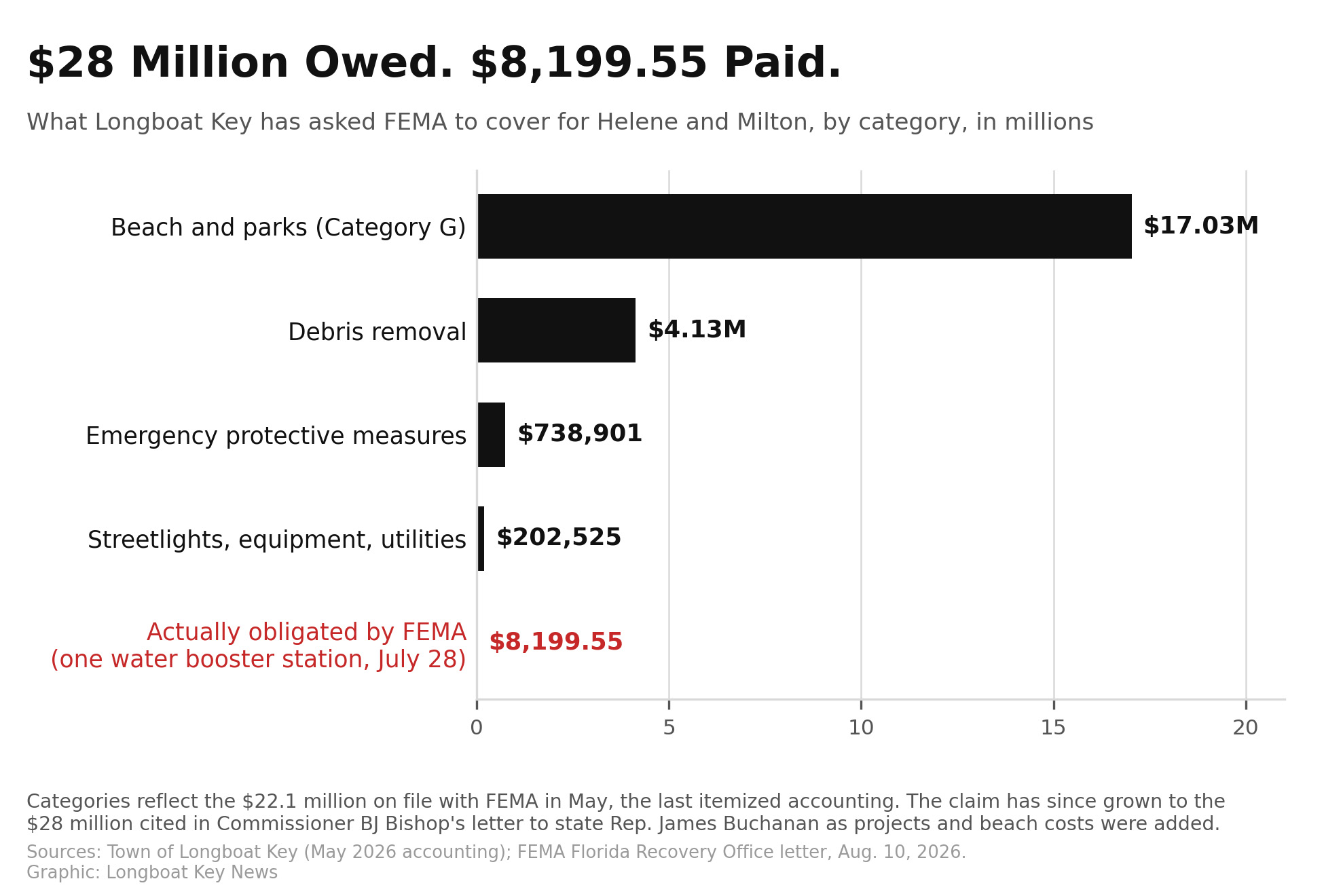
—The size of Longboat Key’s claim has climbed steadily over the past year and a half as the town has refined its paperwork and the cost of restoring its beach has come into focus.
—In May, Accounting Manager Ronica Jackson gave commissioners a category-by-category breakdown of what the town had submitted to FEMA for Helene and Milton. At that point there were 14 projects pending review and a total federal cost share of $22,103,053.32. The lion’s share, $17,028,756.55, sat in Category G, Parks and Recreation, the category that includes beach renourishment. Debris removal accounted for another $4,132,870.22. Emergency protective measures added $738,900.77. Streetlights, building equipment and utilities rounded out the rest.
—By early June, then-Town Manager Howard Tipton was describing the outstanding balance as “more than $20 million” and calling the process “very slow.” By the end of July, Bishop was telling the Florida League of Cities the town was owed “over $24 million in reimbursements from past hurricanes with no funds yet received.” Tipton, in one of his last public accountings before retiring, put the town’s total expectation at $29.7 million. Bishop’s September letter to Buchanan uses $28 million.
—The exact figure matters less than the direction. Whatever the number, it is a large fraction of a town whose entire general fund runs about $67,000 a day, and it has been sitting on the wrong side of the ledger for two full hurricane seasons.
—What $28 Million Buys on Longboat Key
—To understand why the delay is causing anxiety at Town Hall, it helps to walk the cost of the two storms.
—By the town’s accounting a year after the hurricanes, the 2024 cleanup ran roughly $7.7 million in direct expenses: $4.3 million for debris removal, $738,000 to replace electrical panels, $705,475 for parks rehabilitation and $218,000 for vehicle replacements, among other line items. The town’s finance department had received about $1.7 million from insurance by last fall and nothing from FEMA for Helene or Milton. The one FEMA check that did arrive was for Idalia and Debby, the much smaller 2023 and 2024 events.
—Then there is the beach. Longboat Key’s coastal engineers estimate the storms stripped roughly 629,000 cubic yards of sand from the island’s shoreline. The town filed a FEMA claim for 407,300 of those cubic yards, and staff have said that reimbursement, if it comes, would give the island a running start on its next major renourishment, an 800,000-cubic-yard project scheduled for late 2027 or 2028. That project is the single largest item in the town’s five-year capital plan, and depending on how the state and federal shares shake out, local taxpayers could be responsible for anywhere from $5.1 million to $12.7 million of it.
—In other words, the FEMA money is not an abstraction. It is the difference between a beach project the town can afford and one it will have to borrow for, at a moment when Longboat is already paying $3.6 million a year to retire the loan on the last renourishment.
—Reserves Drained, Reserves Rebuilt on Paper
—The most immediate casualty of the delay has been the town’s savings.
—Longboat Key entered the 2024 hurricane season with about $3.7 million set aside specifically for extreme events, enough to cover roughly 60 days of operations. Helene and Milton drew down close to $3 million of that within weeks. By the spring of 2025, Bishop was warning colleagues that the town was “much lower in our reserves than we’re ever comfortable being.” Staff later estimated the two storms had depleted the town’s fund balance by roughly $8 million.
—The town has since clawed its way back to within policy guidelines, helped by a favorable audit and by booking anticipated FEMA reimbursements as receivables. But that is money on paper, not money in the bank, and Tipton spent much of his final year as manager warning that a town without real cash reserves is a town that will be forced to borrow the next time a storm hits.
—His description of the process, delivered to commissioners this summer, has become something of a rallying cry among staff: the FEMA representatives assigned to the town turn over so often that the town ends up retelling its entire recovery story to a new person who has no record of the previous conversations.
—Inside the Pipeline: Ten of 22
—FEMA’s own account of where things stand, delivered to the commission in August in response to Bishop’s inquiries, does not dispute that the money has not arrived. It describes a process.
—According to Josefina “Josie” Genao of FEMA’s Florida Recovery Office, the agency has obligated 10 of 22 Longboat Key projects for Helene and Milton. The town, for its part, counts 26 eligible projects. Among the specifics FEMA offered as of Aug. 10:
—The Helene debris removal project and one of two Milton debris removal projects both cleared the state’s application review on July 9, only to be sent back to the town for additional information. The second Milton debris project was sitting with FEMA’s program delivery manager, who was reviewing documentation to confirm it was ready to advance. The beach renourishment project, the $17 million claim, was undergoing legally required environmental and historic preservation reviews. A water booster station pump replacement was stalled while FEMA staff reviewed insurance documentation, because the agency cannot duplicate assistance already provided by an insurer.
—And one project had actually been obligated: a water booster station, for which FEMA approved $8,199.55 on July 28.
—Genao’s letter framed FEMA’s Public Assistance program as “locally led, state-managed, and federally supported,” and said the most efficient path to obligation “remains the timely submission and review of complete documentation.” The town’s FEMA point of contact, Koree Hughes, separately assured staff the claims were a priority for his team.
—Mayor Debra Williams has said publicly she is concerned about the delay as the beach project approaches on the calendar, but that the town intends to proceed with renourishment whether or not the federal money materializes, because Longboat Key maintains an engineered shoreline and cannot afford to let it go.
‘Broken at Many Levels’
—If FEMA’s letter describes a process, the town’s finance director describes a maze.
—Responding to Bishop’s questions in August, Finance Director Susan Smith explained that because the State of Florida manages federal disaster funds, a Longboat Key claim does not simply move from FEMA to payment. “It goes through a multi-tiered review pipeline between State and Federal portals,” she wrote. The debris removal claim, the town’s second-largest, was “pending State application review,” meaning the Florida Division of Emergency Management had it after FEMA’s review and was either going to ask more questions or move it along. The town, Smith said, had answered every question put to it.
—Some of the smaller projects were hung up on something even more mundane: the town was still waiting for a final insurance payment it had been told was on the way, and FEMA will not advance a project until proof of that payment is in hand.
—Bishop’s response to the update was four words: “Can you get on top of this?”
—The 2022 Claim Nobody Can Find
—Buried in the same exchange is a detail that explains why Bishop’s letter to Buchanan refers to hurricanes in 2022 as well as 2024.
—Tipton had told commissioners the town still had a pending request from 2022. When Bishop asked whether that claim was still in the queue and on track, Smith traced it to the Town Hall Hardening project, a hazard mitigation grant, and reported that the delay in that case was not FEMA’s. “This claim is currently delayed by FDEM, not FEMA,” she wrote. “As mentioned previously, the State manages the Federal funds, and the process appears to be stalled at the State level.”
—Then she added the line that may be the most honest summary of the whole affair: “The system seems to be broken at many levels.”
—That admission cuts to the heart of Bishop’s question to Buchanan. If the federal government is intent on pushing disaster money down to the states to manage, and a claim from four years ago is stuck at the state, then the state is precisely where the pressure needs to be applied.
—Washington’s $17 Billion Traffic Jam
—Longboat Key’s experience is not unique, and its timing has been terrible.
—In June 2025, then-Homeland Security Secretary Kristi Noem instituted a requirement that she personally sign off on any FEMA expenditure of $100,000 or more. The result, by early 2026, was a backlog that The New York Times estimated at $17 billion in disaster funds already approved by regional FEMA offices but held up awaiting review in Washington. Rep. Jared Moskowitz of Florida, the only former state emergency management director in Congress, testified in January that FEMA had postponed roughly $11 billion in reimbursements owed to 45 states, shifting payments planned for fiscal 2025 into fiscal 2026. By late February the hold-up still exceeded $14 billion.
—Former Sen. Markwayne Mullin replaced Noem at DHS in late March and has reversed some of the policies blamed for slowing the agency. FEMA has since announced a string of large obligations, including more than $2 billion nationwide in late August, and Florida’s congressional delegation has trumpeted the recovery of $1.8 billion in delayed reimbursements statewide, with Rep. Greg Steube and Sen. Ashley Moody announcing $64 million for Charlotte County in July.
—None of that has reached Longboat Key’s general fund.
—Meanwhile, the Trump administration’s FEMA Review Council delivered its final report on May 7 with 10 recommendations to shift more disaster response and recovery responsibility onto states and local governments, including raising the per-capita damage threshold a state must hit before it qualifies for a federal declaration at all. That is the policy shift behind Bishop’s phrase about DC handing FEMA funds to the state, and it is the reason the town’s lobbyist, Adam Cross, has been monitoring the House Transportation and Infrastructure Committee’s FEMA hearings on the town’s behalf.
—Bishop shared his summary with the League this summer. The bipartisan takeaway, he reported, was that both parties are dissatisfied with FEMA’s performance, that the FEMA Act of 2025 to restore the agency’s independence and streamline Public Assistance has strong support on the committee, and that there is “little optimism” it passes this session.
—The Beach Is the Big One
—For all the paperwork on debris and pump stations, the fate of the town’s finances turns on a single claim: the $17 million for sand.
—Public Works Director Charlie Mopps told the commission in July that the town had a productive mid-July meeting with FEMA’s beach specialists and that he expected them to approve the town’s beach request and send it up the chain. In May, Assistant Town Manager Isaac Brownman reported that the FEMA representative on the beach claim had scheduled a site visit, calling it “a good sign.” As of August, the project was in environmental and historic preservation review.
—A site visit in May and an environmental review in August, for a claim first filed in 2025, is roughly on pace with what Sarasota County officials describe as a typical FEMA timeline: up to three years. That would put Longboat Key’s beach money somewhere around the time the dredges are supposed to arrive.
—Not Alone: The County’s $268 Million
—Longboat Key’s $28 million looks almost modest beside its neighbor’s ledger. Sarasota County has tallied seven declared disasters since Hurricane Hermine in 2016, including COVID, with $352 million in needed expenditures and an outstanding balance of $268.5 million in FEMA and state recovery funds. Hurricane Milton alone left the county with 140 identified recovery projects at an estimated $152 million. A decade after Hermine, the county is still waiting on $3.38 million from that storm.
—The City of Sarasota, for its part, pulled money out of planned capital projects to cover its 2024 cleanup. The ManaSota League of Cities, which Bishop leads as president, represents all of them, and Bishop told Buchanan the League would be discussing its 2027 legislative priorities at its meeting this week, with FEMA reimbursement alongside home rule, state grant funding, short-term rentals and sovereign immunity. The League is planning an early-session trip to Tallahassee.
—Amendment 3: The Second Shoe
—The FEMA standoff would be a serious problem for Longboat Key on its own. It is arriving at the same moment the town is bracing for a self-inflicted revenue cut.
—In a letter to island homeowners drafted this month with staff and circulated to the Country Club Shores associations, Commissioner Gary Coffin lays out what Amendment 3 would do if 60 percent of Florida voters approve it on Nov. 3: raise the homestead exemption to $150,000 in 2027 and $250,000 in 2028, with inflation adjustments thereafter. For Longboat Key, Coffin writes, the town anticipates approximately $1.4 million in reduced annual General Fund revenue once the higher exemption is fully implemented.
—Then he ties it directly to the storms.
“Our experience with Hurricanes Helene and Milton is an important example of why maintaining adequate local resources matters,” Coffin writes. “The 2024 storms resulted in nearly $30 million in costs to the Town, including beach-related expenses. With continued uncertainty surrounding future federal disaster assistance and FEMA reimbursements, communities may be required to assume a greater share of recovery costs in the future.”
—Coffin notes that Sarasota County has warned the town that significant reductions could affect parks and libraries, including the Longboat Key branch library, and that the town may have to weigh service cuts, tax rate changes or new non-ad valorem assessments to close the gap. He is offering to meet with any association before the election.
—The Florida Policy Institute made the same point statewide in August, describing FEMA’s retreat and Amendment 3 as a “one-two punch.” Property taxes fund the local half of disaster response, the think tank noted, including the reserves that front costs while a community waits on FEMA. Cut the property tax base and stretch the FEMA wait at the same time, and the reserves that carried Longboat Key through October 2024 are the first thing to go.
—Bishop, in his letter to Buchanan, was blunt about the connection. Much of what the League will ask for in 2027, he wrote, “will depend on our ability to defeat Amendment 3 in November.”
—A New Manager Inherits the Wait
—The person who will carry the town’s FEMA file into its third year is new to the building. George Landry began work as town manager this month, succeeding Tipton, and used his first-day message to staff to promise a smooth transition and a listening tour. He did not mention FEMA. He will not have that luxury for long.
—The commission that hired him has made clear the reimbursement fight is now a political priority, not a back-office accounting task. Bishop has been pressing the Florida League of Cities to make FEMA reform a top statewide priority for the coming session, has directed the town’s lobbyists to identify newly elected legislators with local government backgrounds, and has now asked the region’s incoming senator directly for help.
—What Happens Next
—Buchanan, the son of Longboat Key’s own congressman, Vern Buchanan, won the Aug. 18 Republican primary for Senate District 22 with nearly 78 percent of the vote and faces the general election Nov. 3 in a district the Florida Chamber rates as solidly Republican. Bishop’s letter offered him a phone call on any of the League’s issues and a heads-up that the coalition of local governments he will represent is coming to Tallahassee early in the session with a list.
—Whether a freshman state senator can pry loose money sitting in a federal-state review portal is an open question. What is not in question is the arithmetic the town is staring at: a $1.4 million annual revenue cut on the ballot, a $17 million beach claim in environmental review, a debris claim bounced back for more paperwork, a 2022 grant stalled at the state, a reserve fund rebuilt on receivables, and a hurricane season that does not end until Nov. 30.
Two years after Helene, Longboat Key has learned how to survive a storm. It is still learning how to survive the paperwork.

