
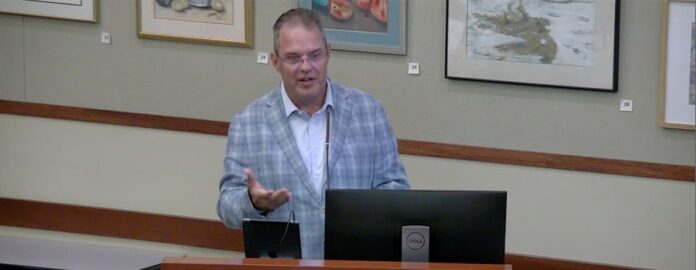
Six days after Florida voters approved Amendment 3, the Town’s longtime state lobbyist told commissioners there is no fixing it, no getting around it and no more half-hour visits with Longboat Key’s own senator. Commissioners responded by cutting a 12-item wish list to five.
—Dave Ramba has been Longboat Key’s man in Tallahassee since at least 2013, and on Nov. 9 he came to Town Hall with the kind of advice lobbyists usually save for the hallway.
—Ask for less. Lead with the bike trail. Keep home rule on the list, but put it at the bottom, to “just make the League happy.” And when a legislator with five minutes to spare looks across the desk and says pick one, pick one.
“And when they say, ‘Pick one,’ and you pick it, that’s what you get,” Ramba told the Town Commission.
—It was the Town’s first public conversation about Tallahassee since voters statewide approved Amendment 3 on Nov. 3, the homestead exemption increase Town officials had warned would cost the General Fund roughly $1.4 million a year. What followed over the next hour was a rare, unvarnished look at how Longboat Key does politics: how it asks, whom it asks, whom it would rather not offend, and how little leverage its own leaders believe it has left.
‘It’s in there now’
—Ramba opened with the number everyone in the room already knew. Sixty-two percent of Florida voters said yes.
—He put that in perspective. The marijuana industry, he said, spent hundreds of millions of dollars on its own amendment and couldn’t clear 60 percent. Amendment 3’s only real money, by his account, came from the Florida Realtors, at about $30 million.
“It was not well thought out, in my opinion, what they put in the Constitution, but it’s in there now,” Ramba said. “And so we all have to deal with it.”
—The base amendment can’t be changed, he said. It starts Jan. 1 and will hit the Town’s next budget “fairly substantially.” He described the homestead increase as $150,000 the first year and $250,000 the second.
“There’s not a lot of other places Longboat Key can shift money to,” he said.
—The island’s problem is its own makeup. Longboat Key leans heavily on property taxes. It doesn’t have the commercial and mixed-use base that cushions other cities, and it collects little in gas tax. Ramba pointed to South Florida cities where homestead property taxes may make up only 28 percent of revenue, and where commercial property and non-homesteaded vacation rentals will absorb the blow. Those cities, he said, will feel it less even though their residents probably use more government services per person than Longboat’s do.
—And the relief itself? On Longboat Key, Ramba said, it barely registers.
“I don’t know what an extra $100,000 is going to do to a home on the beach here,” he said. “Nothing.”
“They took a sledgehammer to something that probably could have used a scalpel, and they put it in the Constitution,” he said. “We are Florida. We do some weird stuff.”
‘Wishful thinking’
—Town leaders didn’t pretend they had seen it coming.
“When we were putting these priorities together, we were wishful thinking on the outcome of the election, and obviously things have changed,” Town Manager George Landry told the Commission.
—Commissioners had campaigned against the measure in the weeks before the vote. Commissioner Gary Coffin wrote to condominium association presidents in Country Club Shores warning of the local consequences. Commissioner B.J. Bishop pressed the case through the Manasota League of Cities. The Town put a price tag on the loss.
—None of it moved the statewide math, and Ramba made clear the island’s own tally wouldn’t have mattered either way. He said he had meant to look up how Longboat voters went on both sides of the county line, then decided there was no point.
“If you voted 40% on the island, it’s not going to change anything,” he said. “It’s still required in every community of the state.”
—His message to local governments was to accept the verdict. “62% is 62% and people need to listen to what the voters said,” he said.
—He also offered a theory of the vote. With gas and groceries expensive, he said, people were desperate for something. Many voters, he said, sensed the amendment wasn’t quite right, but didn’t grasp how hard it is to undo something once it is written into the Constitution. Reversing it would take another 60 percent vote against something that just passed with more than 60 percent.
—The question nobody asked
—Landry introduced Ramba by noting the Town would want his input on its priorities “since we’re paying him for his services.”
—No commissioner asked what, if anything, the Town’s lobbyist had done about Amendment 3 before the Legislature sent it to the ballot. Ramba didn’t volunteer it.
—He did describe how it got there. The Legislature put the measure on the ballot “just as the governor asked,” Ramba said, and Gov. Ron DeSantis still vetoed about a billion dollars of lawmakers’ budget projects afterward.
—And he described his own fingerprint on it, which came from an unusual location. When the list of core services that property taxes could still pay for was drawn up, Ramba said, it left out the county constitutional officers: tax collectors, property appraisers, supervisors of elections and clerks of court. He was on safari in South Africa at the time, with a special session about a day and a half away.
—So he called the Senate President. The answer, by Ramba’s telling: “Oh, we didn’t think about that.” Lawmakers added them in. Schools were exempted.
—Ramba was also clear about what the Town’s contract covers and what it doesn’t.
“I’m on an hourly contract with you guys,” he said. “You’re probably one of the only hourly contracts I have. I go work to get you guys money.”
—He said he will deliver a home rule message to the Town’s legislators when the Florida League of Cities needs one carried and the Commission has authorized it, on issues such as red light cameras or vacation rentals. But he is not there to fight every preemption bill.
“I’m not there to go to every League of Cities meeting,” he said. “You could spend 10 hours a day doing that, trying to fight every little issue that would preempt home rule.”
—Under that arrangement, the statewide fights that hit every city, the kind Amendment 3 turned out to be, run through the League first. Nobody on the dais asked whether that should change.
—No end runs
—If any local government is hoping to slip around the amendment, Ramba advised against it.
—Some governments, he said, moved within weeks to replace lost property tax revenue with special assessments, and he expects lawmakers to shut that door. He said they also won’t tolerate a city spinning off a dependent fire district to move costs outside its 10-mill cap.
—What lawmakers do expect, he said, is for fees to rise on what the amendment treats as non-core services, such as libraries, parks and parking. He said lawmakers may try to require supermajority or unanimous votes for fee increases, similar to the rules for raising millage, and noted the House has created a new committee aimed at policing local officials.
“Anybody that brings something like that to the Legislature will probably get knocked down pretty quick,” he said of work-arounds. If the Legislature doesn’t do it, he said, the Tax and Budget Reform Commission, which convenes in 2027, will be right behind it.
—The timing of an implementation bill is still up in the air. DeSantis has said he wants a special session before he leaves office in early January, and Ramba said the only practical window is the committee week starting around Dec. 1. But he said lawmakers have been calling their presiding officers asking to wait until spring, under Gov.-elect Byron Donalds.
—Bishop asked whether Donalds was on board with what she called a special session from a governor who “is basically a lame duck.” Ramba said Donalds likely wouldn’t weigh in during his transition, and that the real question is whether incoming Senate President Jim Boyd and incoming House Speaker Sam Garrison want one.
—He doubted it.
“I can’t see the upside of them providing him yet another present under the Christmas tree by giving him everything he wants in a special session,” Ramba said.
‘Mr. FAFO’ and the tree counters
—Bishop asked whether Chief Financial Officer Blaise Ingoglia would keep up his DOGE-style audits of local budgets.
—Ramba said Ingoglia, now elected statewide in his own right, isn’t going anywhere. He referred to him as “Mr. FAFO” and said the CFO enjoys showing up to fix local budgets, usually “with that same sledgehammer.”
“Anybody who says there’s no way we can do this, I think he may show up at your door in a minute and a half,” Ramba said.
—As an example of the spending the audits target, he cited Orange County paying $50,000 to $100,000 a year to count its trees.
“It’s called being a Tree City,” Bishop said.
“Could you get the 4-H Club to do it or something?” Ramba asked, adding that it’s “definitely not something you can spend ad valorem on anymore.”
“Yes, you too can spend the $100,000 just counting trees,” Bishop said.
—About an hour later, the same Commission took up its own tree code. Bishop argued against the Planning and Zoning Board’s proposal to cut the Town’s tree replacement ratio from two-for-one to one-for-one, saying the change was “very shortsighted” and “I don’t think it serves Longboat Key’s interest.” Commissioners agreed to send Ordinance 2026-11 to a Dec. 7 first reading. Nobody suggested calling the 4-H Club.
—A Legislature full of rookies
—The Tallahassee the Town will be lobbying in January will look very different from the one it has known.
—Ramba said Republicans’ edge in the Florida House dropped from 85-35 to what looks like 70-50, pending a Brevard County recount. That means 48 or 49 freshmen who have never held a committee hearing or pushed a voting button on the floor, he said, along with a reshuffle of chairmanships because many members who expected to lead committees lost.
—Even parking is contested. With so many new members, he said, House offices and parking spaces are still being sorted out, and a basement space means walking up “some dark, wet stairs” in a Capitol that still leaks after its renovation.
—He was hopeful about the people at the top. Garrison, he said, spent years as a lawyer for local governments, including cities and school boards.
“I don’t think it’s an anti-local government issue as much as it has been in years past,” Ramba said.
—He predicted a “kinder, gentler Governor Donalds” than DeSantis, whom he called “a little retributive.” Donalds served in the Florida House and asked for local projects himself, Ramba said, while DeSantis never served in the Legislature and could cut a billion dollars a year because his approval ratings let him.
—On the state budget, Ramba said lawmakers cut $5 billion over two years, and then, as he said happens every year, they found more money after budget estimators warned the state was going broke.
“Magically, poof, there it is,” he said. He expects a budget around $120 billion, a fully funded rainy day fund and rural counties lining up for help after DeSantis promised, Ramba said, that Tallahassee could make them whole with “budget dust.” That governor, he noted, won’t be around to keep the promise.
—Washington, for now
—Commissioner Sarah Karon asked whether the federal government’s stated plan to shift disaster costs to the states was weighing on Tallahassee.
—Not yet, Ramba said. With Republicans running both Florida and Washington, he said, disaster declarations are coming quickly, and he pointed to a recent storm in Pensacola. He noted reports that blue states aren’t getting the same treatment.
“Right now when we need it, you write a letter and you get it,” he said. “So we have that advantage today. Whether we have that after ’28 with a new president, we don’t know.”
—Thirty minutes becomes five
—The biggest change for Longboat Key may be the most personal one.
—Boyd, the Bradenton Republican whom Ramba called “our Senator from here at Longboat Key,” is set to be elected Senate President on Nov. 17. Commissioners know him well. Ramba said that familiarity is about to become a lot harder to use.
“If you want to go see him, you just walk in and go see him,” Ramba said of the old days. “That ship has sailed. That’s gone. You better have an appointment.”
—The Town used to get half an hour with Boyd. Now, Ramba said, “it’ll probably be five minutes,” and a five-minute slot can be bumped when another senator walks in with a bone to pick.
—His advice was to work through Kathy Galea, Boyd’s longtime aide, who he said handles the senator’s appropriations and scheduling.
“If you try to get up there with Senator Boyd and you can’t, but you can get with Kathy, take the meeting with Kathy,” Ramba said.
—Bishop didn’t need convincing. “Kathy could do Jim’s job on most days,” she said.
‘Pick one’
—That’s the new reality the Town’s priority list now has to fit.
—Bishop said Ramba has long told her that the best thing she can do with a legislator is find something positive to talk about. Coffin said the whole exercise came down to “relationships and compromise,” and that a long list “doesn’t work for anybody because no one wants to read anything that long.”
—Ramba agreed. When you’re asking for money, he said, whoever you’re meeting, Boyd, Rep. Fiona McFarland or Galea, will often say the same thing.
“‘You’re not getting two, that just means you’re not getting two. You’re getting one. Which one do you want?'” he said, quoting the familiar Tallahassee response.
—Commissioner Steve Branham offered a name for the shorter list.
“In a previous life we used to call this ‘the precious few,'” he said. A short list, he argued, signals that the Town has done its homework and whittled its asks down to what is essential and might actually succeed.
‘Just make the League happy’
—The sharpest line of the afternoon came from Bishop, about the item at the top of the list staff brought forward.
“Home rule has become a joke in Tallahassee,” she said. “We have no more leverage on home rule issues than one of the mice crawling around in the woods out there.”
—Ramba didn’t argue. Lead with something unique to Longboat Key, he said, and keep home rule on the list for appearances.
“So keep the home rule on there, just put it at the bottom, just make the League happy, but that’s what you pay as a member of the League to be a part of them for,” he said.
—When the Town goes to Tallahassee, he said, it goes for itself, “not on behalf of the town of Pahokee or Shalimar or anybody else out there.”
—Bishop noted that the current president of the Florida League of Cities is the mayor of Shalimar, population 750.
—That set up a darker exchange. Bishop said the League’s Casey Cook told local officials in August that as many as 40 Florida cities could be, in essence, bankrupt after the first and second years of Amendment 3. Ramba, who said he started his career at the League in 1995, said he expects Florida’s roughly 410 cities to shrink in number. “I would say probably 20 the first year,” he said.
“Some are destined to fail,” he said. “I mean, do you need a city hall when you’ve got 400 residents?”
—He offered a lesson in consolidation from the past: helping dissolve the volunteer Trailer Estates Fire District in Manatee County, whose firefighters were landing federal grants for breathing gear.
“I don’t need an 80-year-old guy throwing on some tank and rebreather walking into a burning trailer,” he said. “Now I got two people to rescue, not just one!”
—Three pots, one road
—Ramba’s recommended order put the SUN Trail first, transportation and evacuation routes second, beach renourishment third and short-term rentals fourth, with home rule last.
—Coffin asked why the trail and the road were separate items.
“Roads are through DOT, the bike trail’s through DEP,” Ramba said. “Unbelievably, yes, they’re two different agencies in Florida.” He suggested that might be an efficiency someone could propose.
—Spreading asks across different state funding pots, he said, lets the Town pivot halfway through session, when leaders decide how much money goes into each trust fund. “That’s where you get to decide whether you’re getting $200,000 or $4 million,” he said.
—Vice Mayor Penny Gold asked whether the Town was “using up one of our bullets” on road projects that traditionally sit five years out. Ramba said DeSantis started pulling projects up the list two years ago, and that when he hears money is moving, “I try to move 48 up to 8 and get it in there.”
—Assistant Town Manager Isaac Brownman noted that every congested route off Longboat Key is a state road: State Road 789, Cortez Road, State Road 64, U.S. 41 and Fruitville Road. He said the Gulf of Mexico Drive request is written to cover the full context-sensitive roadway plan with the SUN Trail on the east side, or the trail alone, because at the federal level, Congressman Vern Buchanan had warmed to the trail but not the larger road project.
“Our goal has always been let’s go for the whole thing and have a legislator tell us, ‘That’s great, I’ll give you the trail,'” Brownman said.
—Mayor Debra Williams said she’d rather keep it together, and asked whether Bradenton Beach and Holmes Beach might join forces. Ramba said Bradenton Beach hasn’t set its list yet and urged the Town to call. Bishop said the Manasota League would collect local priorities at a Thursday meeting and, for the first time, make its own lobbying trip to Tallahassee in addition to the Florida League’s.
‘They know all our tricks’
—Commissioner Nick Gladding raised the question that may define the Town’s asks for years.
—After Amendment 3, he said, “aren’t you going to be asked, ‘Well, what is the Town doing to contribute to this and where is their money going to come from?'”
—Ramba said that question is already built in. Every request includes a required local effort, and the state’s Community Budget Issue Request forms ask what share the Town is paying, what it’s seeking and whether it asked before.
“So they know all our tricks,” he said. The Town’s answer, worked out among staff and the Town Attorney, is “almost an offer letter to the state. If you fund us for this, this is what we’ll contribute.” Local matching dollars remain an allowed use of property taxes under Amendment 3, he said, so he doesn’t expect lawmakers to be pickier than before.
—Beach money and the rental law
—Ramba warned that the money behind beach and waterway projects is about to shrink. The West Coast Inland Navigation District and the water management districts are funded by property taxes too, he said, and they’re going to get cut, which means dredging programs will slow.
—The warning landed on a day when the Town’s coastal engineer reported an unusually high rate of sand loss. The State of the Beach presentation in the agenda packet shows the island losing about 1.2 million cubic yards since 2021, roughly 240,000 a year. Public Works Director Charlie Mopps reminded the audience that the last renourishment was 100 percent grant funded and “didn’t cost the citizens anything.”
—Ramba also told commissioners, “Don’t forget about vacation rentals.” The Town got ahead of the issue 25 years ago, he said, and secured a unique protection in state law. The lawmakers who shaped that fight for years, Ramba said, including Griff Griffitts of Bay County and former Senate President Kathleen Passidomo, are gone, and any of the new House members could arrive with a fresh idea.
—One county, one more time
—Then the mayor raised the oldest question on Longboat Key.
—Williams asked whether the budget squeeze makes it time to revisit the 2021 study of moving the whole island into a single county.
—Ramba said the biggest savings for north-end residents would come from school taxes, since Manatee schools levy more than Sarasota’s. When the study was done, he said, Manatee County had one public school student on its part of the island and justified the cost by saying it still had to provide bus service.
—Ramba recalled his response to an administrator: “Hire them a limo. Take that kid to school every day for what that entire north end of Longboat Key pays to the Manatee County school board.”
“If I lived in the north end of Longboat Key, I’d be holding that sucker up and going to my legislators,” he said.
—Ramba made a disclosure: he represents the Manatee County Port Authority, whose board is the County Commission, though he said he does not represent the County Commission itself. He said the Manatee board five years ago was “so screwy” that getting four votes was ridiculous, but that it’s a new board now.
—Williams said Manatee County Commission Chair Tal Siddique recently told her Longboat Key is contributing less and less to the county budget. She said she checked.
“I ran the numbers,” she said. “I went to two chatbots to verify.”
—By her figures, Longboat Key’s share of Manatee revenue fell from about 5.5 percent to a little over 4 percent between 2021 and 2026, dwarfed by growth out east. She estimated the island is roughly 40 percent Manatee and 60 percent Sarasota, though she said she wasn’t sure.
“Let’s do it! Let’s explore it!” Bishop said.
—Later in the meeting, Bishop added the catch: any change has to go through Tallahassee, starting with Boyd and the Manatee delegation. “Jim, the last time, sat quietly and stayed quiet,” she said, calling for “some quiet discussions.”
“Work the fence, if you will,” Branham said.
—Williams said Ramba will sit down with Boyd and float the idea. That would be one of the five-minute meetings.
—Don’t burn that bridge
—The same caution ran through the afternoon’s last real debate, over a joint letter to the Florida Department of Transportation on the Longboat Pass Bridge.
—Manatee County drafted the letter after a Sept. 24 joint meeting. It asks FDOT to reconsider its preferred 78-foot fixed span, pursue a lower drawbridge and, if that’s impossible, consider a 65-foot fixed bridge. It is addressed to James M. Driggers Jr., interim secretary of FDOT District 1, and would be signed by Siddique and Williams.
—Coffin wanted it stronger. He said 19 of the 67 bridges on the Florida Intracoastal Waterway are fixed spans and that they average 65 feet, and he wanted the letter to say FDOT’s proposal is “way out of line.”
“Well, you know, we have to accommodate somebody’s very large sailboat,” Williams said.
—When Bishop and Coffin chimed in with “that one,” the mayor added, “That one very large sailboat. Not mentioning any names.”
—Branham suggested asking FDOT to update its 2022 survey that identified seven vessels affected by anything under 77 feet. Bishop urged care with Manatee.
“I don’t want to absolutely burn that bridge,” she said. “What an interesting irony that is.”
—Karon noted that two new Manatee commissioners could slow any rewrite, and Town Attorney Maggie Mooney said the Commission “might have to stomach the existing form” if it wants the letter out soon. Branham agreed. “It’s not perfect, but we need to get on the board with it,” he said.
—The Commission reached consensus 6-1, with Coffin dissenting, to send Manatee’s letter as written to the Dec. 7 meeting for approval, and to follow with a Town letter of its own.
—Who is Dave Ramba?
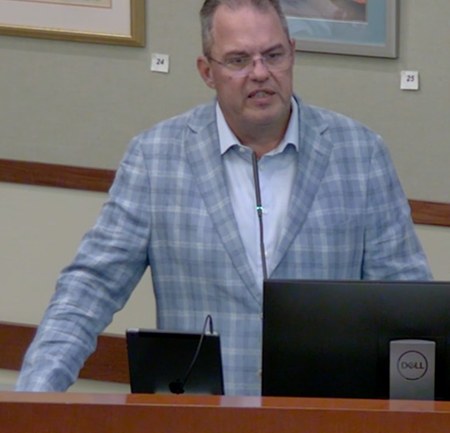
—Ramba is a lawyer and lobbyist whose Tallahassee firm, Ramba Consulting Group, has represented the Town on state matters since at least 2013, according to the agenda memo. He said he began his career at the Florida League of Cities in 1995, has worked in Tallahassee for 30 years and once helped secure Lakewood Ranch its own ZIP code, which he called one of the hardest things he’s ever done.
—The agenda packet does not say what the Town pays him. Ramba described it as an hourly contract.
—His work extends well beyond Longboat Key. Suncoast Searchlight reported in October that political committees Ramba controls, funded in part by developers including Benderson Development and the developer behind Lakewood Ranch, paid $42,000 to the consulting company of Jon Mast, husband of Sarasota County Commissioner Teresa Mast. Ramba told the newsroom he pays Mast to monitor political activity in Sarasota and Manatee counties. The report did not come up at the meeting.
—The precious few
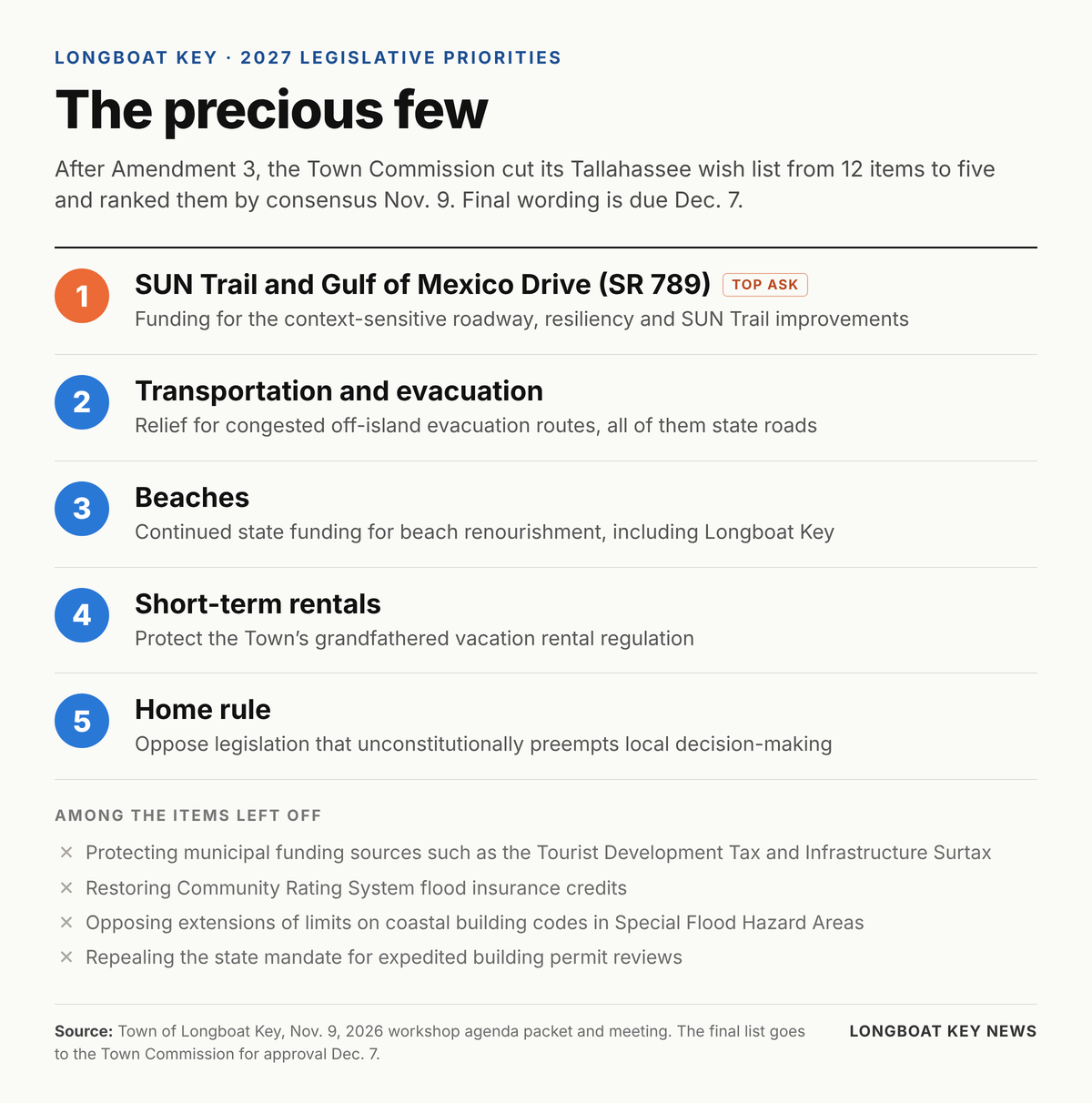
—By consensus, the Commission ranked its 2027 priorities: the SUN Trail and Gulf of Mexico Drive first, transportation and evacuation routes second, beach renourishment third, short-term rentals fourth and home rule fifth.
—Several items from the original list did not make the top five as discussed, according to the agenda packet. They include opposing legislation that compromises municipal funding sources such as the Tourist Development Tax and the Infrastructure Surtax, and restoring Community Rating System flood insurance credits. Also left off were opposing extensions of limits on coastal communities’ building codes in Special Flood Hazard Areas, and repealing the state mandate for expedited building permit reviews.
—Staff, the Town Attorney and Ramba will refine the wording, and the final list goes to the Commission for approval Dec. 7. The mayor and Town Manager will then present it at the Sarasota County and Manatee County legislative delegation hearings.
—Landry called the list “an evolving, living, moving document” and offered the Commission a frank forecast for its first session under a new governor, a new Senate President and a new Speaker.
“We want to shoot for everything we can go after,” Landry said, “but also keep our expectations low because it’s going to be an interesting year in changeover.”
—Ramba put it more simply.
“We work through it each time,” he said. “It’s just whether or not it ends up being something that is helpful for us.”
—By the Numbers
—62%: Statewide yes vote on Amendment 3.
—$30 million: What Ramba said the Florida Realtors spent to pass it.
—$1.4 million: Annual General Fund hit the Town projected before the vote.
—85-35 to 70-50: Republican-Democrat split in the Florida House before and after Nov. 3, by Ramba’s count (pending a Brevard recount).
—48 or 49: Freshmen in the Florida House, by Ramba’s count.
—30 to 5: Minutes Ramba expects the Town will now get with Senate President-designate Jim Boyd.
—12 to 5: Town legislative priorities, September vs. November.
—1.2 million: Cubic yards of sand lost islandwide since 2021.
—5.5% to 4%: Longboat Key’s share of Manatee County revenue, 2021 to 2026, by the mayor’s figures.
—2013: Ramba’s tenure as Town lobbyist dates to at least this year.

