
After three hard years, two hurricanes and a supply chain that wouldn’t cooperate, the City Island bird hospital unveils $300,000 in campus improvements and new homes for 21 resident birds
After three hard years, two hurricanes and a supply chain that wouldn’t cooperate, the City Island bird hospital unveils $300,000 in campus improvements and new homeThe string lights came on just before sunset.
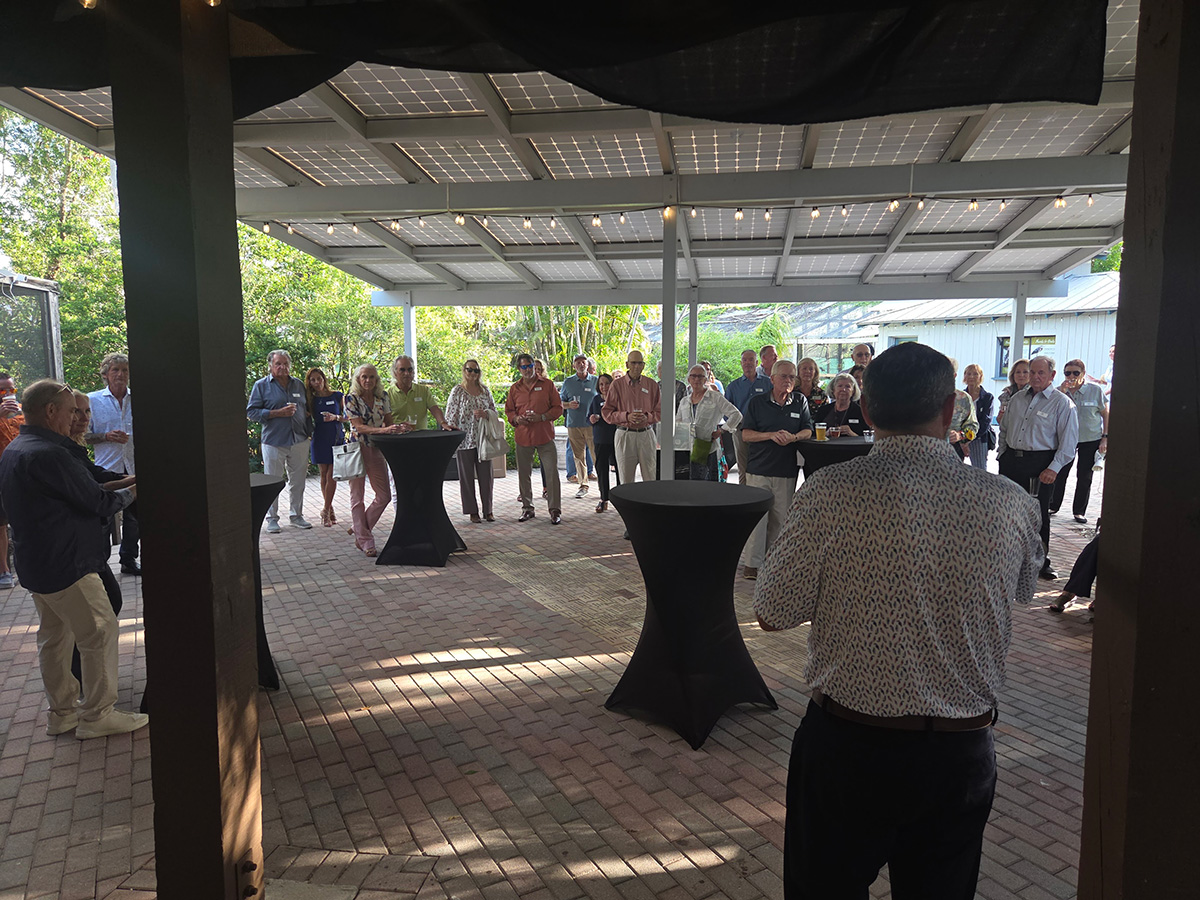
—Beneath a canopy of solar panels on City Island, a crowd of donors, volunteers, board members and neighbors gathered Sunday evening, Oct. 25, champagne in hand, to celebrate something Save Our Seabirds has been promising, and chasing, for three long years: a campus that finally looks like the work being done inside it.
—The occasion was a ribbon cutting for five new aviaries, now home to 21 resident birds, and the dedication of the Gaynes Education Center, named for longtime supporters Dr. Philip and Suzan Gaynes. Add eight renovated habitats and 60 new interpretive signs along the public bird walk, and the improvements top $300,000.
—It is, the organization is quick to say, only Phase 1.
—But the numbers don’t capture what it felt like to walk in.
—From Weathered Wood to Gleaming Aluminum
—For years, a visit to Save Our Seabirds came with an unspoken caveat. The mission was extraordinary. The facility was tired. Many enclosures dated to the Pelican Man era, built of wood that had spent decades soaking up salt air, summer downpours and the occasional hurricane. The place looked, frankly, as though it needed rehabilitation nearly as badly as its patients.
“The facility was tremendously aging, original wooden structures throughout all of the aviaries,” Board Chair Linda Mitchell told LBK News in an earlier interview.
—On Sunday, the caveat was gone.
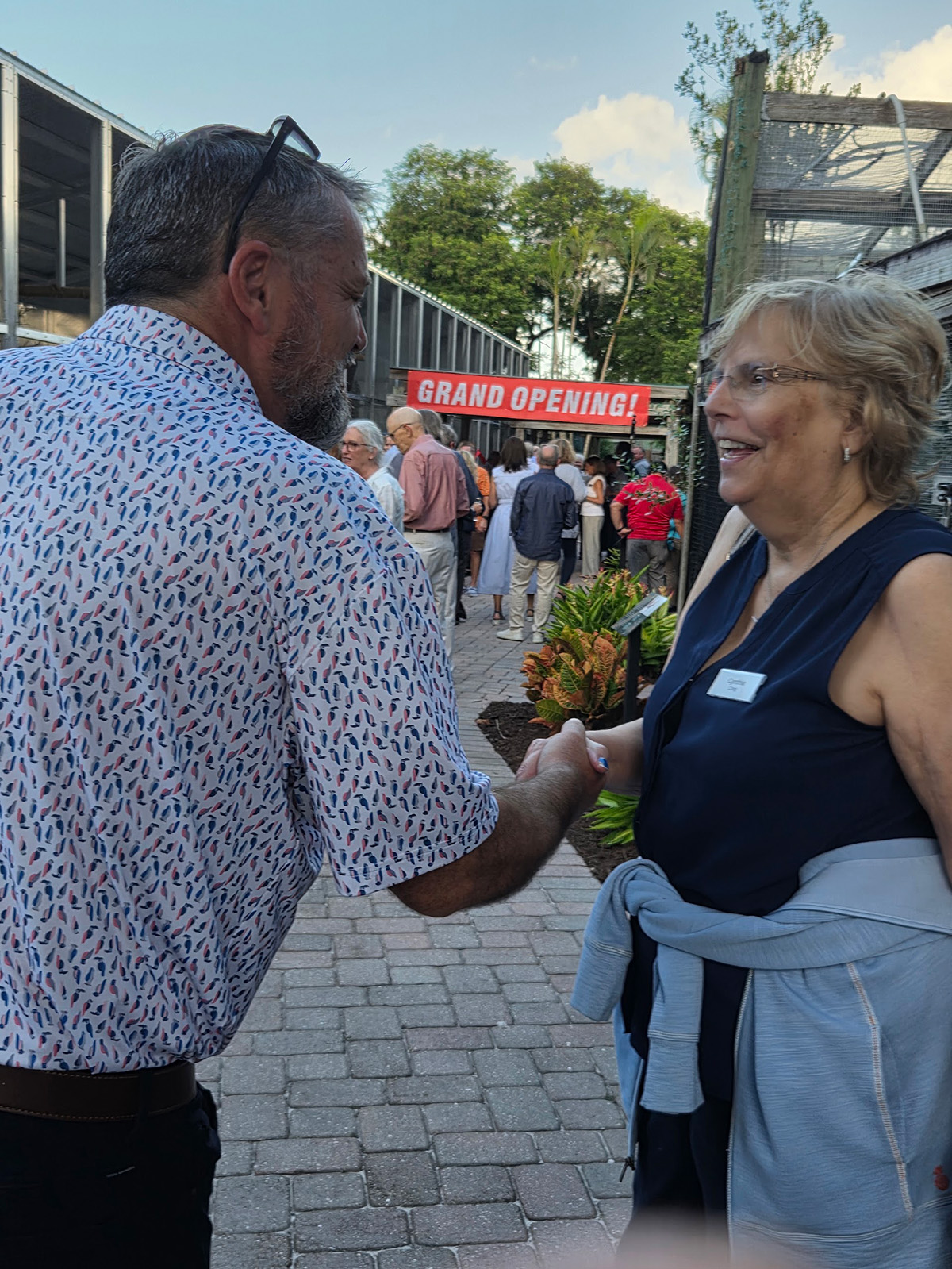
—Guests stepped onto fresh brick pavers and into something closer to a botanical garden than a bird hospital. The new aviaries rise in clean silver lines: crisp aluminum frames, taut mesh, floors of sand and stone, weathered tree snags for perching, a birdhouse tucked into a branch. New plantings line the walk, and each enclosure carries an interpretive panel introducing its residents by name and species.
—The structures were fabricated by Mullet’s Aluminum Products, the Sarasota family company Butch Mullet started in a garage behind his home in 1978 and built into one of the largest architectural aluminum manufacturers in the Southeast. Mullet’s usual portfolio runs to condominium railings, metal roofs and pedestrian bridges. Here, the same exacting craftsmanship went into homes for terns and bluebirds, and it shows. Every line is square, every panel true, and the aluminum won’t rot in the salt air the way the old wood did.
—The effect is transformative in the most literal sense. You arrive off Ken Thompson Parkway carrying the day with you: the traffic, the inbox, the endless list. A few steps later you are eye to eye with a black-bellied whistling duck, and the list has gone very quiet.
—First, a Hospital
—It would be easy to mistake all this for a small zoo. It isn’t. Save Our Seabirds is, first and always, an avian hospital, and the aviaries exist because of what happens behind them.
—The organization answers more than 5,000 distress calls a year, roughly 14 a day, and admits more than 1,400 injured and orphaned birds annually. The goal for every patient is the same three words on the mission statement: rescue, rehabilitate, release. Roughly 100 birds that can never safely return to the wild become permanent residents and, in effect, ambassadors for the ones that do.
—Many of the injuries trace back to us: fishing line, vehicle strikes, rodent poison that climbs the food chain into hawks and owls.
“We have to intercede because of what we have done to their natural environment,” Mitchell has said. “Somebody has to help.”
—The work began on this site in 1988, when Dale Shields, “The Pelican Man,” opened what became one of Florida’s largest bird sanctuaries. It closed in 2006. Two years later, Lee Fox and Ann Anderson founded Save Our Seabirds to carry the mission forward. Admission has stayed free, 365 days a year.
—For Longboat Key, the connection is personal. The pelican tangled in monofilament off a Bay Isles dock, the gull struck on Gulf of Mexico Drive: this is where they go.
—Meet the Residents
—Each aviary was underwritten by donors, who together contributed $160,000 and whose names now appear on the structures. And each comes with a cast of characters whose names suggest a staff with a sense of humor and a deep bench of pop culture.
—Aviary No. 1: Ducks (Waterfowl). Sponsored by Dean and Janice Scarborough. Residents: Pebbles, a wood duck; Betty and Veronica, two black-bellied whistling ducks of whom Archie Andrews would surely approve; and Mama, a Muscovy duck.
—Aviary No. 2: Nonnative/Invasive Songbirds. Sponsored by Jeff and Tacy Telego. Residents: Ace, Maverick and Iceman, three European starlings (someone on staff has seen “Top Gun” more than once); Frank, a fancy pigeon; and Jasmine and Briar Rose, Eurasian collared-doves. This aviary carries one of the campus’s subtler lessons. North America’s starlings descend from birds released in New York’s Central Park in 1890, and they compete with native woodpeckers and bluebirds for nesting cavities. Birds like these can’t responsibly be returned to Florida’s wild, so they stay, and they teach.
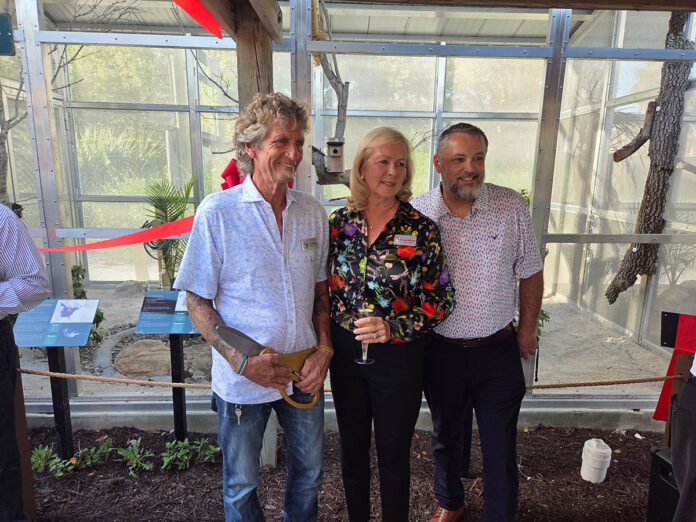
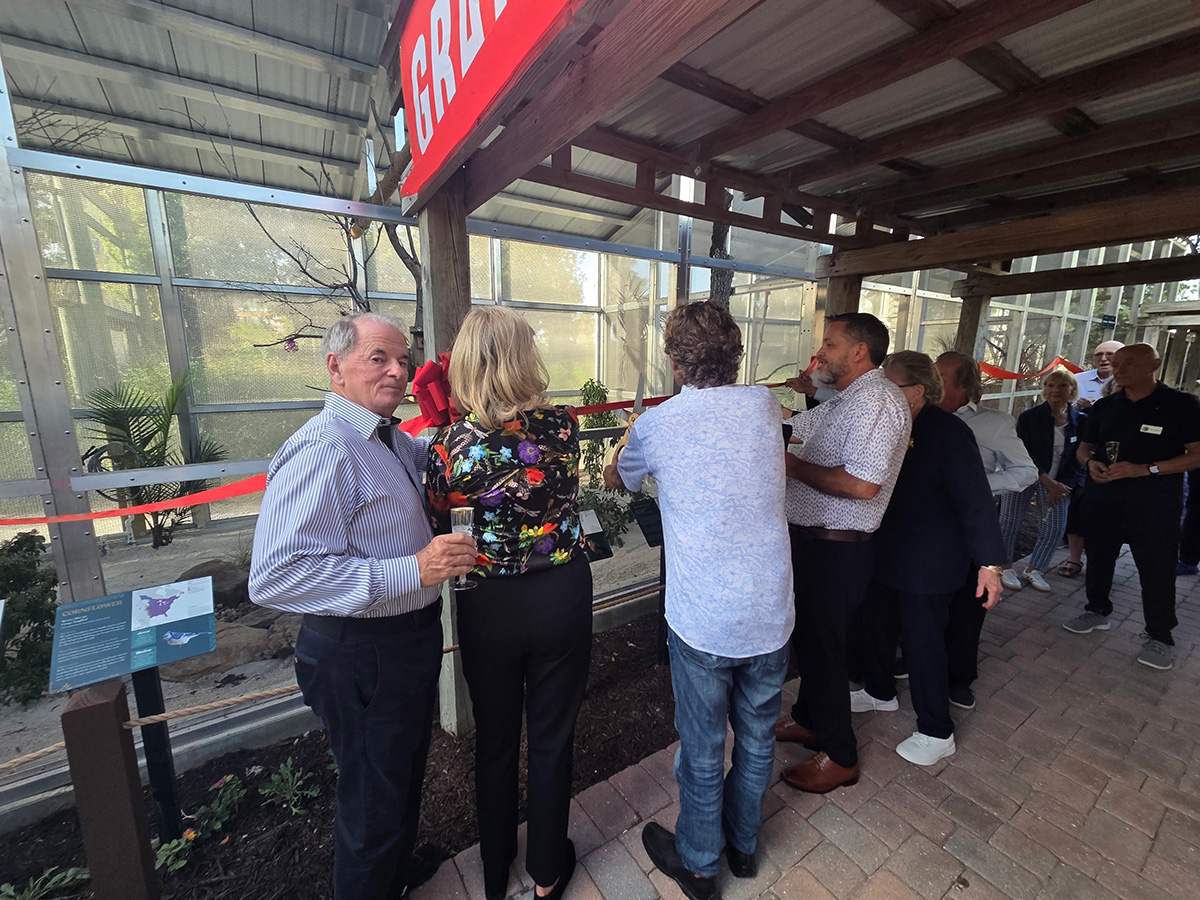
—Aviary No. 3: Native Songbirds. Sponsored by Jon and Kris Berg and Paul and Sharon Steinwachs. This is the garden aviary, its residents named like a seed catalog: Cornflower, a blue jay; Bluebell, an Eastern bluebird; Buttercup, a mourning dove; Tigerlilly, a gray catbird; Cypress, a downy woodpecker; and, breaking the botanical theme with characteristic grackle attitude, Mississippi, a boat-tailed grackle. It was here, beside Cornflower’s sign, that the red ribbon was cut.
—Aviary No. 4: Shorebirds. Sponsored by Linda and Bill Mitchell of Longboat Key. Residents: Skipper and Gilligan, two royal terns whose three-hour tour became a permanent stay; Harold, an American herring gull; and Abalone, an American oystercatcher, a species Florida lists as threatened. For Longboaters, this aviary is home turf, the birds of our own beaches and passes.
—Aviary No. 5: Yellow-crowned Night-Herons. Sponsored by Ann Anderson and Bill and Janice Farber. Residents: Sokka and Zuko, named for heroes of the animated series “Avatar: The Last Airbender.” These are the stocky, crab-hunting herons that work Sarasota’s mangrove edges, and the sponsorship carries a fitting symmetry: Anderson co-founded Save Our Seabirds in 2008.
‘Life Happens While You Have Other Plans’
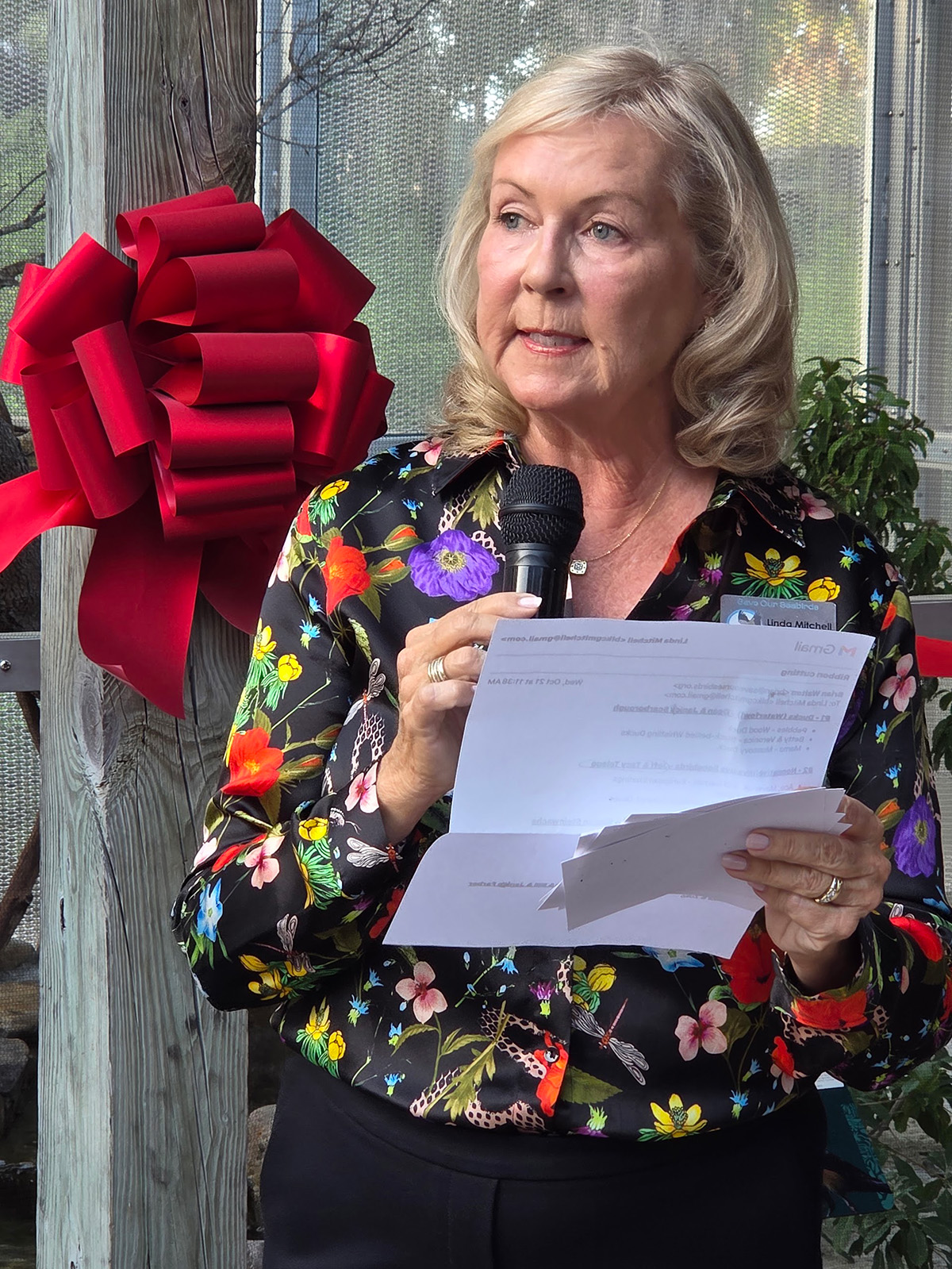
—Before the ribbon fell, Mitchell stepped to the microphone and was candid about what it took to get here.
“It has been a tough three years getting to this point, and it took almost three times longer than any of us could have imagined,” she said. “In this case, the adage ‘Life happens while you have other plans’ was certainly true. We had supply challenges, shipping setbacks, hurricanes, unforeseen irrigation issues, and so on.”
—The hurricanes were not a figure of speech. In 2024, Helene and Milton pushed roughly three and a half feet of storm surge across the campus, flooding enclosures, killing vegetation and forcing emergency evacuations of birds. Staff borrowed a Sarasota Police Department boat just to check on the residents. Every bird survived.
“But we got through it all,” Mitchell said, “and now have five state-of-the-art bird aviaries, and Phase 1 of our campus renovation is finally complete.”
—She thanked “our incredibly generous donors who made these five new aviaries possible,” and offered her “sincere gratitude” to Executive Director Brian Walton “for his tireless efforts to bring these new habitats to fruition,” along with the staff, volunteers, supporters, contractors and board.
—Then she read the roll of sponsors, aviary by aviary and bird by bird. A champagne toast followed, and then the scissors, the oversized gold ceremonial kind. Fittingly, they were in the hands of Leo Kissling, Save Our Seabirds’ director of facilities and grounds, when the red ribbon fell.
—A Name Over the Door
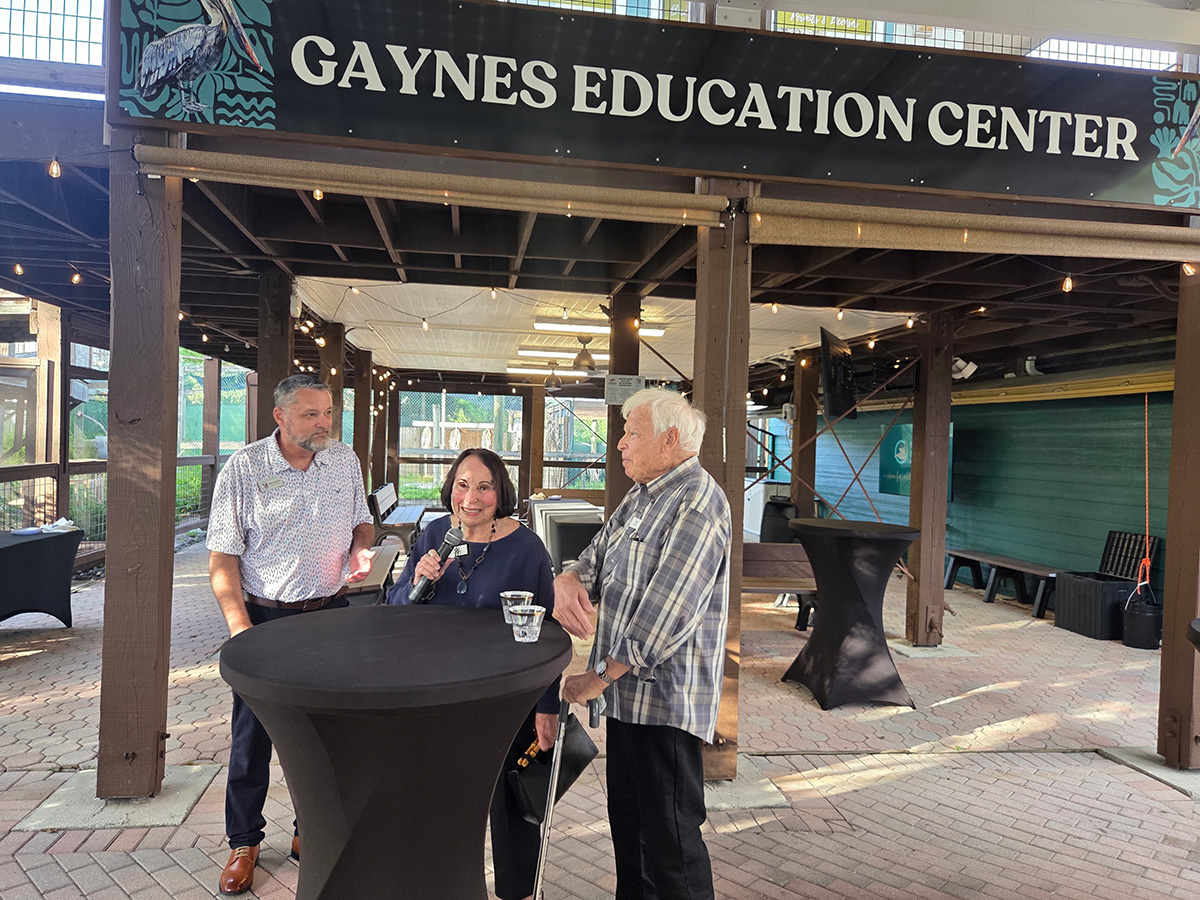
—A new sign now spans the open-air pavilion at the heart of the campus: GAYNES EDUCATION CENTER, framed by stylized pelican artwork.
—The name honors Dr. Philip and Suzan Gaynes, longtime supporters whose generosity is now a permanent part of the place. The couple joined Walton beneath the sign for the dedication.
—The pavilion, with its benches, café lights and big screen, is where the other half of the mission happens. Save Our Seabirds uses the stories of its birds to teach conservation, and this is where those stories get told: why discarded fishing line matters, why rat poison matters, why a grounded pelican on a dock deserves a phone call instead of a shrug.
—Phase 2: Pelicans, Parrots and a Pond
—The next phase stays at the center of the campus.
“From here, Save Our Seabirds is moving towards Phase 2 of our facilities’ renovation, continuing to focus on the center and heart of our campus,” Mitchell said. “We next hope to build a large pelican enclosure, new habitats for our exotic parrots, a gazebo for small groups, required new irrigation that will also result in a beautiful pond, and a new boardwalk.”
—The work follows a 2024 site master plan developed with DSDG Architects, which also calls for significant stormwater improvements and, longer term, a new avian hospital on an elevated footprint built to ride out the next storm. Earlier planning figures put the campus at 32 enclosures needing eventual replacement, at roughly $35,000 apiece.
—Five down.
“Of course,” Mitchell said, “funding by our friends is critical to making these badly needed improvements actually happen.”
—It is not a throwaway line. Animal and environmental causes draw only about 3 percent of U.S. charitable giving, and wild birds compete for a sliver of that. Save Our Seabirds runs almost entirely on individual generosity, which is why the names on those five aviaries matter as much as the aluminum.
—The Point of It All
—A community is measured, in part, by what it chooses to care for when nobody is making it. Longboat Key and Sarasota live among these birds, on every dock, seawall and sandbar.
—Cornflower, the blue jay whose name is on the sign beside the ribbon, will never know what a capital campaign is, or a shipping delay, or a storm-surge evacuation. That is rather the point. The work of the people who gathered Sunday is to make sure the birds never have to know.
—The ribbon is cut. Phase 2 awaits. And the gate, as always, is open.
—If You Go
—Save Our Seabirds: 1708 Ken Thompson Parkway, City Island, Sarasota (near Mote Marine)
—Hours: Open daily, 10 a.m. to 5 p.m., 365 days a year
—Admission: Free
—Information, volunteering and donations: saveourseabirds.org or 941-388-3010
—Found an injured bird after hours? Call 941-416-4967

