
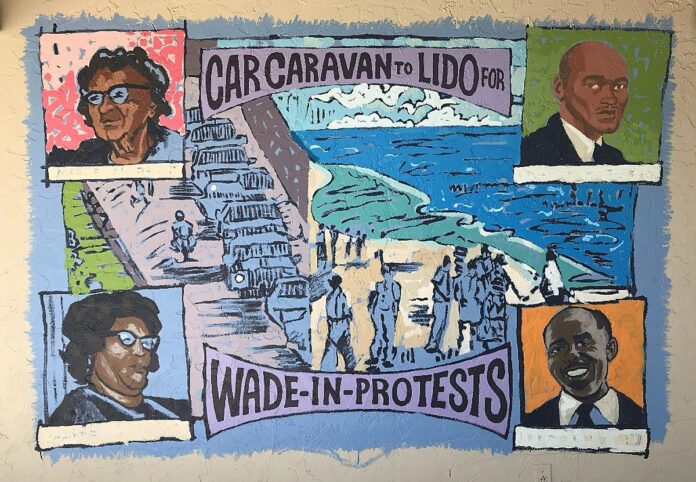
For $4,000, the city would adopt Tim Jaeger’s 2020 murals of the 1955 wade-ins and the lost Lido Beach Casino. Behind them on the public art docket: 153 artists chasing a City Hall wall, a 94-foot canvas in the Rosemary District, postcards for the airport and a successor for Mr. Red.
—The Gulf has its own way of fading things. Salt works under the paint, the afternoon sun takes the blues first, and edges start to chip like a sand castle when the tide comes in. Six years of that have worn on the two murals at the Lido Beach Pavilion. Sarasota’s public art staff now want to step in before the weather finishes the job.
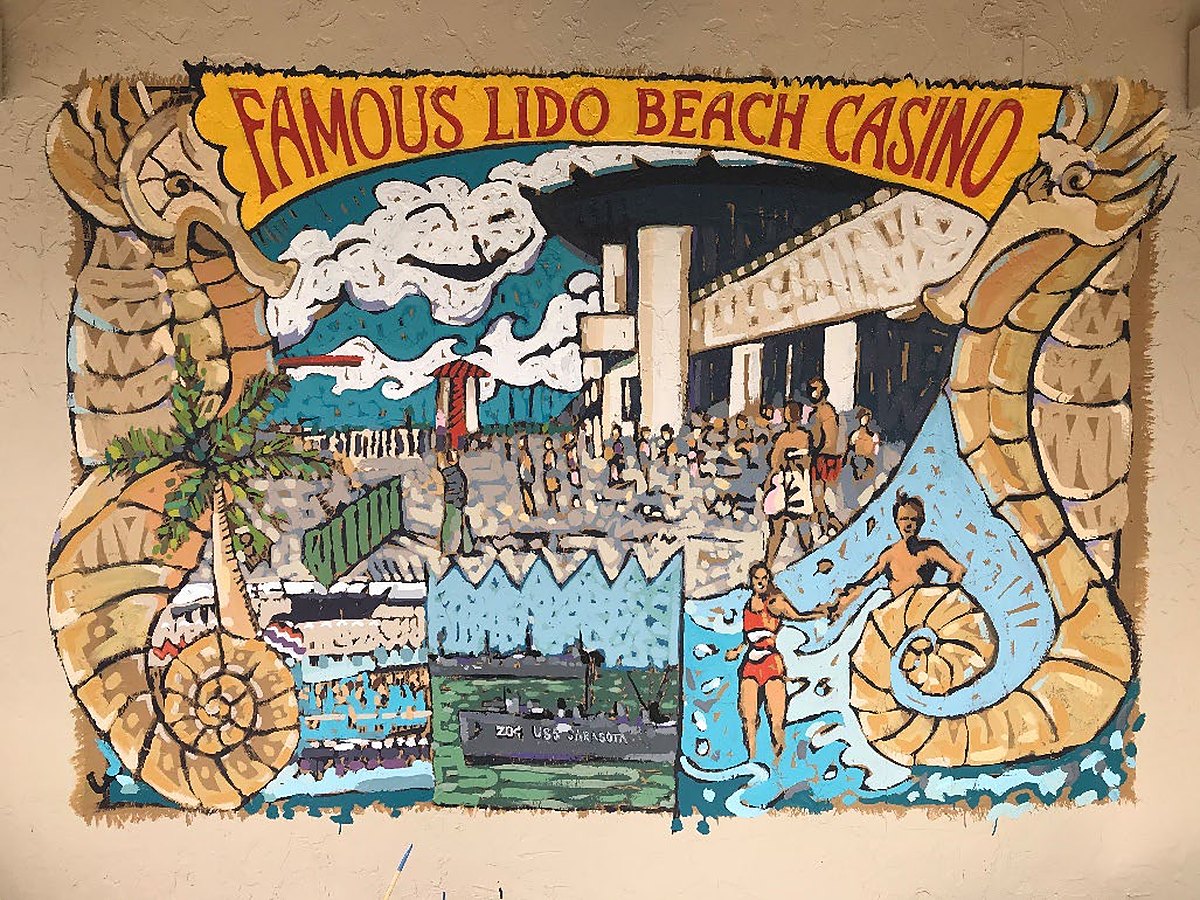
—A proposal headed to the city’s Public Art Committee on Nov. 4 would formally adopt both works by Sarasota artist Tim Jaeger into the City of Sarasota Public Art Collection. One mural honors the wade-in protests, in which Newtown residents drove to Lido Beach in the 1950s and walked into the surf to demand equal access to the shore. The other brings back the Lido Beach Casino, Ralph Twitchell’s Gulf-front landmark, which the city demolished in 1969.
—The total cost is up to $4,000. That is $3,500 for an artist-led restoration and up to $500 for interpretive plaques. It is one of the smallest line items on the committee’s docket this season, and one of the most meaningful.
—The Murals Nobody Signed For
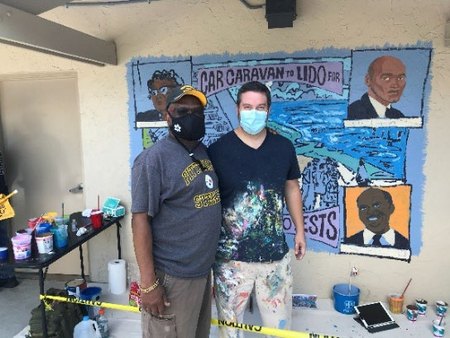
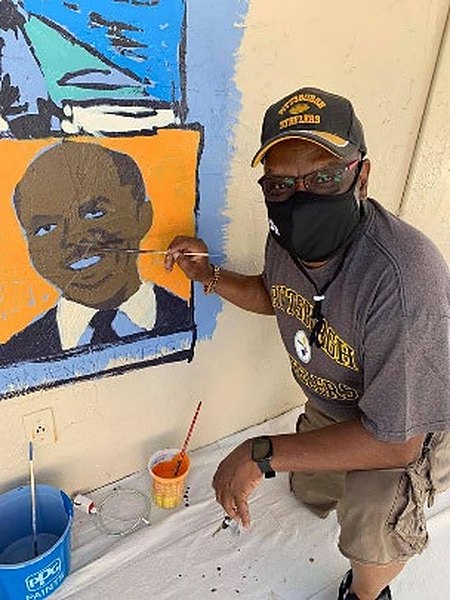
—The murals went up in September 2020, a product of the first pandemic year, when the Arts and Cultural Alliance of Sarasota County and a community task force set out to put artists back to work and give Lido Key some of its history back. Jaeger led the effort. Community members joined in collaborative painting sessions, and then Jaeger and his assistants finished and refined the work.
—There was one gap. The murals sit on city property, but they were never formally accessioned into the city’s collection, and no one ever signed a contract.
“There was never a signed contract/agreement exchanged,” Jaeger wrote to Public Art Administrator Ciera Coleman on Oct. 8, asking whether the city would take the works in. He offered to do the restoration himself.
—That gap matters more than it sounds. Public art without an owner of record has nobody responsible for it. Nobody schedules its inspections, nobody budgets its touch-ups and no plaque tells a passerby what they are looking at. That is how murals vanish. Usually they are not destroyed. They are simply forgotten until a pressure washer or a new paint job erases them.
“Public art can serve as a lasting cultural resource, making meaningful stories accessible to residents and visitors alike,” Jaeger wrote. Preserving the murals, he added, would “honor Sarasota’s history, recognize the stories that have shaped our community, and ensure that this work remains accessible to future generations.”
—Two Chapters, One Strip of Sand
—The two subjects belong together, and the pairing is what makes the murals more than decoration.
—The wade-ins began in the fall of 1955. That was a month after the murder of Emmett Till made national news and two months before Rosa Parks refused to give up her seat in Montgomery. Neil Humphrey Sr. was president of Sarasota’s NAACP chapter and owned Humphrey’s Pharmacy. He led residents in caravans from Newtown out to Lido Beach, where they walked the shoreline and waded into the Gulf.
—They were met with taunts and thrown bottles. On later trips some had to dodge rocks, and some came back to their cars to find the tires slashed. Police sometimes harassed the marchers and sometimes protected them. The caravans continued for years. At the time, fewer than two miles of Florida’s 825 miles of beaches were open to African Americans. It took years more, and the Civil Rights Act of 1964, before Sarasota’s beaches were open to everyone. The U.S. Civil Rights Trail, which now includes Sarasota, credits the Newtown caravans with helping to bring the phrase “wade-in” into the movement’s vocabulary.
—The Casino stood on that same sand. Twitchell, one of the founders of what became the Sarasota School of Architecture, designed it as a Works Progress Administration project, and it opened in May 1940. It had a competition-size pool, the Casa Marina Ballroom, the Sunset Room facing the Gulf, a shipwreck-themed bar called the Castaways and seahorse sculptures along the second-floor balcony. Bandleader Rudy Bundy played clarinet from the bandstand. During World War II, servicemen from the nearby air bases filled the place.
—In 1964 voters approved a $250,000 bond to renovate it. The renovation never happened. City engineers found the building structurally sound, but commissioners reversed course, and by the end of March 1969 the Casino was rubble.
—So one beach holds two memories: Sarasota at its most glamorous, and Sarasota at its most exclusionary. Through much of the Casino’s heyday, Black residents had to organize car caravans just to stand at the water’s edge. Painted side by side on the pavilion, the two murals do not ask you to choose between those memories. They ask you to hold both.
—Reading the Walls
—Seen as art rather than history, the wade-in mural is built like a protest broadside. Four portraits sit in the corners like the faces on a commemorative stamp sheet, set against fields of coral, moss green and marigold. Hand-lettered lavender banners carry the headline: “Car Caravan to Lido for Wade-In Protests.” Between them a road of cars runs diagonally from the upper left down to the shore, where small figures in quick, calligraphic strokes walk into a surf of turquoise and cobalt.
—The thick black contour lines and flat color come from a long civic tradition that runs from New Deal post office murals to the silkscreened movement posters of the 1960s. The style is built to be read at a distance, the way a headline is read, and that is the point.
—The Casino mural is more playful. Two monumental seahorses frame it, an affectionate echo of the sculptures that once lined the real Casino’s balcony. Inside the frame is a collage of the place: the colonnaded pavilion, a crowd of bathers, a lifeguard tower, two swimmers in the waves, a nautilus spiral and, anchored at the bottom, a gray Navy ship labeled USS Sarasota. That ship is a nod to the war years, when the Casino’s dance floor was full of uniforms.
—Neither mural pretends to be a museum object. You can see the community’s hands in the brushwork, a little uneven in places, and that unevenness is part of what they mean. These are civic paintings, made by a civic act, about civic memory.
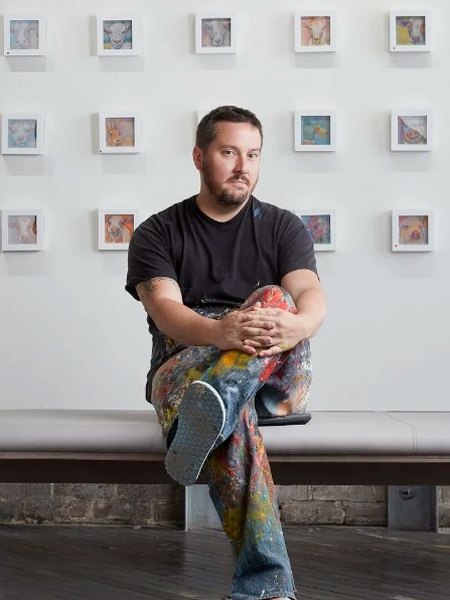
—Jaeger is a Ringling College of Art and Design graduate who now serves as the college’s Director and Chief Curator of Galleries and Exhibitions. He has spent his career on the borders between making art, curating it and putting it in front of the public. These two walls may be his most public work.
—What $4,000 Buys
—The staff proposal makes the murals part of the city’s Florida Legacy Arts mural series. The series already includes Truman Adams’s “Amphitrite” on the lift station along South Gulfstream Avenue, David Lee’s “The Performers” and “Fun in the Sun” in a downtown alleyway, and the Reverend Lewis and Irene Colson mural in the Rosemary District. The proposal covers:
—A formal artist agreement covering ownership, artist rights, restoration duties, maintenance expectations and the city’s right to use images and interpretive text.
—An artist-led restoration for $3,500, including surface preparation, color restoration, touch-ups and a protective coating. It would take several days.
—Interpretive plaques for up to $500, naming the artist, the subjects, the year, the project partners and the works’ place in the public collection.
—A permanent record, with the murals added to the city’s GIS art inventory and its Otocast audio tours, before-and-after documentation of the treatment, and an inspection schedule suited to an exterior coastal installation.
—Staff recommends approval, subject to legal and ownership terms, city contracting rules and coordination with Parks and Recreation.
—The timing has a quiet irony. City Manager Karie Friling has said decisions on repairs to Lido Pool, a few steps from the pavilion, would wait for the results of the Nov. 3 statewide property-tax vote. Sarasota’s public art program, by contrast, is funded by developer contributions rather than property taxes. Starting in FY27, even its administrator’s salary moves out of the general fund.
—A City That Paints Its Own Portrait
—To see why a $4,000 line item deserves a cultural reading, step back and look at the whole canvas.
—Sarasota has been an art town nearly as long as it has been a town. The Sarasota Art Association, its first arts organization, formed in 1926. In 1927 John Ringling moved the circus’s winter headquarters here. In 1931 the Ringling’s galleries opened to the public, and an art school with 75 students opened its doors. That school is now Ringling College. In the 1940s the Sarasota School of Architecture emerged, with Twitchell, Paul Rudolph and later Jack West, whose 1960s City Hall still anchors downtown. The Asolo opened in 1957 and the Van Wezel in 1970.
—In 1989 the city created a Percent for Art program requiring developers to pay for public art. Under the Public Art Plan 2030, the city has doubled that obligation from 0.5% to 1% of construction cost for projects of $1 million or more, with affordable housing exempt.
—The arts here are more than ornament. They are a major economic engine. The most recent national Arts & Economic Prosperity study, based on 2022 data, put the economic impact of Sarasota County’s nonprofit arts and culture sector at $342 million. The sector supports 5,262 jobs and generates $68.1 million in local, state and federal tax revenue. Nearly half of the 2.3 million people who attended arts events came from outside the county, and 90.6% of all attendees said they would feel a great sense of loss if those events or venues disappeared.
—Murals are where that economy meets the sidewalk. A symphony ticket costs money. A wall is free, it is open at 2 a.m., and it speaks to whoever walks by. Public art is the part of Sarasota’s culture that belongs to everyone.
—And Yet: The Storms, the Vetoes and the Warehouse
—The comeback is real, and so are the setbacks.
—In 2024 Gov. Ron DeSantis vetoed all $32 million in state arts and culture grants. This year he signed $20 million in arts programming support but vetoed about $3 million in small Culture Builds Florida grants for nonprofits and individual artists, plus a $250,000 grant for Venice Theatre. Sarasota County groups on the state’s initial grant list fell from 11 to eight.
—Hurricanes Ian and Milton took their own toll. Milton tore David Langley’s painted-aluminum “Mr. Red” off its base at Gulfstream and Cocoanut avenues in 2024, after the city had already restored it once from Ian damage. John Henry’s 70-foot red steel “Complexus” was moved off Gulfstream in 2021 to make room for a roundabout, and by 2024 it was, in the words of the city’s public art manager at the time, “rusting from the inside out.” The roundabouts themselves, meant to be pedestals for sculpture, have produced more arguments than art. Pieces have spent long stretches in storage, which this newspaper has noted before.
—Even the plinths have become a problem. The minutes of the committee’s Aug. 5 meeting record that installation of two approved sculptures, “Spinning Dancers” and a life-size bronze of shark scientist Dr. Eugenie Clark, is delayed while staff looks for cheaper ways to design and build their bases. Staff also studied adding sculpture bases for a seasonal bayfront exhibit, but the cost of the bases already approved showed how big and expensive that project would be.
—Seen against all that, the Lido proposal is a small act of stubbornness, and an admirable one.
The Rest of the Docket
—153 Artists, One City Wall
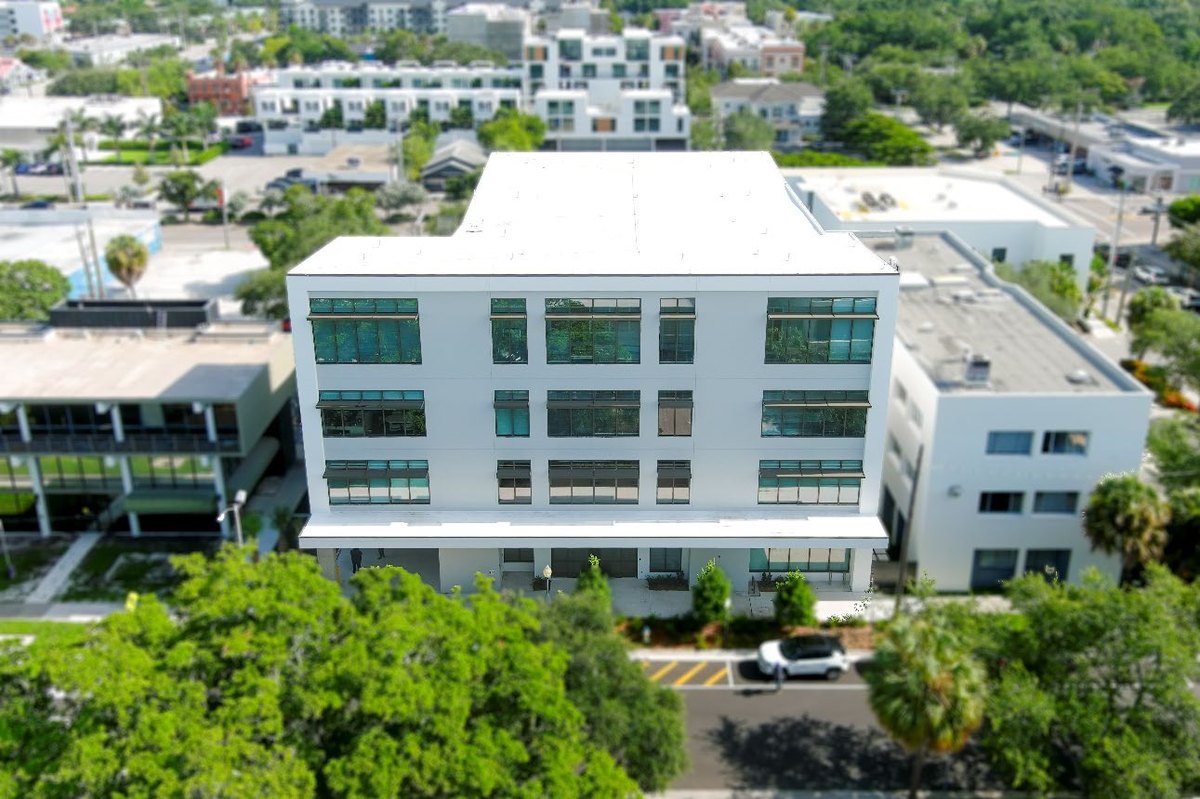
—The city’s call for artists to dress up the One Stop Shop, the white municipal building at 1575 Second St. that houses frontline city departments, drew 153 applications between July 1 and Aug. 31. The budget is up to $100,000, all costs included. The applicant list runs from Sarasota and Bradenton to Barcelona, Croydon, Padua, Luxembourg and Fuzhou, China.
—The process has also hit a reset. The original plan called for a stakeholder panel to review proposals and recommend three finalists. But any shortlisting has to happen at a publicly noticed meeting, and the original plan did not include one. Staff dropped it, and all 153 applications are now back under equal consideration before the full committee.
—The committee’s options:
—Option 1: Shortlist three artists or teams and pay each a $1,000 stipend, separate from the $100,000, to develop a site-specific concept and feasibility package. Concepts that pass technical review would go to the public on the city’s EngagementHQ site before a final pick.
—Option 2: Select one artist directly and move to design, with public comment shaping refinements rather than the choice of artist.
—Option 3: Carry the item to a later meeting, or set another process that is fair and applied consistently.
—The site comes with Sarasota-specific complications. The west wall sits on a zero lot line next to private property, so the art cannot project past the building face. As the staff report puts it, “future development on the neighboring property could partially or completely obscure it.” That is a very 2026 Sarasota problem: commission a work of art and then watch the next building block it.
—Artists were invited, though not required, to draw on Sarasota Modern and the architecture of Jack West. Anyone using generative technology had to disclose it.
—A 94-Foot Canvas on Boulevard of the Arts
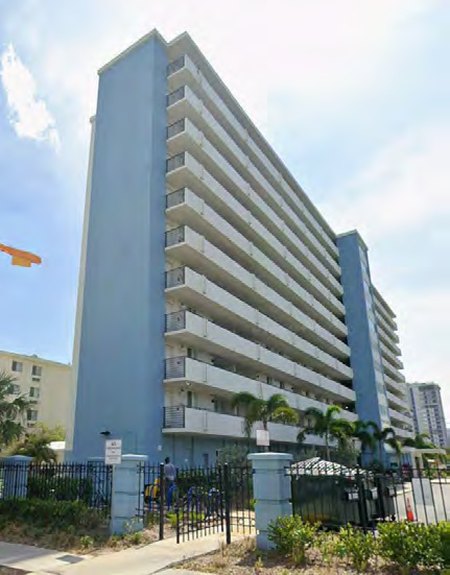
—The biggest canvas in the program belongs to McCown Towers, the Sarasota Housing Authority building at 1300 Boulevard of the Arts. The committee approved the partnership 4-0 on Aug. 5 with up to $90,000: $75,000 from the program’s Affordable Housing public art budget and $15,000 from the Rosemary Residential Overlay District public art budget.
—Melissa Laughlin, president of the Rosemary District Association, told the committee the wall serves as a gateway to the Rosemary District and surrounding neighborhoods.
—The scale has changed the approach. Staff now recommends an invitation-only process limited to artists who have painted at least one mural on a wall taller than 80 feet and have worked with municipal public art programs. Staff identified a dozen qualifying artists from the One Stop Shop applications. They include:
—Hiero Veiga of Bradenton, who has painted “Truth Seeker” and “Timucua Native Americans” in the Rosemary District.
—Britt Paints A Lot (Brittany Johnson), whose family has long called Sarasota home.
—Sonny Behan, who already has a project in progress with the city.
—Adden Joule of Denver, whose 90-foot “Everglade Herons” rises over Homestead’s Seminole Theatre.
—Mr Cenz of England and ZuriK of Barcelona, the international names on the list.
—The committee is asked to invite three to five. The Housing Authority board can hear no more than five presentations. Invited artists receive no stipend and will not be asked for concept designs at this stage. Instead, a citywide online survey will gather public preference on the artists and on what the mural should say, and the Housing Authority board will review the proposals publicly and make recommendations. The committee’s final artist selection is set for Feb. 3, 2027, with final design approval anticipated in spring 2027.
—The wall will look out on more change soon. The Housing Authority is also pursuing a 96-apartment senior housing expansion at Cocoanut Avenue and Boulevard of the Arts, wrapped around a new public parking garage.
—The Spirit of Sarasota, by Mail
—Before there were Instagram grids, there were postcards, and Sarasota is bringing them back.
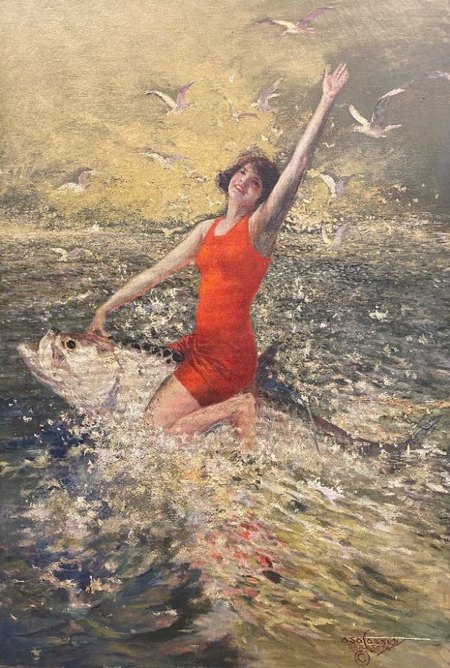
—The “Spirit of Sarasota” Postcard Project, a partnership with Sarasota Bradenton International Airport, takes its name from a painting by Asa Cassidy. Cassidy was a New York lithographer who moved to Florida in 1921 to paint full time and kept a studio in Sarasota’s Blackburn Building in the 1920s. His roughly 3-by-5-foot painting shows a bather in a red suit riding a tarpon through a gull-filled spray, the city’s sales pitch rendered in paint.
—The new version is open to everyone. The call opens at noon Nov. 16 and closes at 11:59 p.m. Dec. 18. It is open to artists and teams living in Sarasota or Manatee County at any skill level, with no professional or public art experience required. Four finished designs will be chosen, one for each season, starting with a spring release in late March 2027. The postcards will be free at the SRQ Welcome Desk, City Hall, the Visit Sarasota downtown visitor center and the Arts and Cultural Alliance.
—Staff is asking to raise each award from $1,000 to $1,500, which would bring the program’s share to $7,000. The airport pays for printing.
—A four-member panel will deliberate in public on Jan. 20 before the committee makes final picks on Feb. 3. The panel includes Planning Director Steven Cover, SRQ marketing manager Emma Klostermyer, Visit Sarasota’s Jennifer Dolgetta and the Arts Alliance’s Sheila McKoy. In August, Chair Heather Gorman asked that copies go to the Sarasota County History Center to be archived in perpetuity, and member Bianca Clyburn suggested the artists sign the first few copies.
—After Mr. Red
—Mr. Red is not going back to the bayfront. The site at Gulfstream and Cocoanut is, in the city’s words, “highly exposed to salt air, strong winds, and storm surge.” The city’s plan is to repair the sculpture and move it to City Hall instead.
—On Aug. 5 the committee approved a call for artists of up to $80,000 for a successor at the corner. Member Jonathan Parks made the sharpest point of the afternoon. The new piece, he said, should ideally be more vertical than the old one, because the buildings around the site are much taller than they used to be.
—Sarasota’s skyline has outgrown its sculpture. The art now has to grow just to be seen.
—Light on Palm Avenue
—For November’s Fresh Fridays, the city is turning the Palm Avenue Parking Garage into a screen. The committee approved up to $3,500 for a projection-mapping show by Ringling College Department of Motion Design students, produced with the Sarasota firm LightMural. Ed Cheetham and Kelly Warner of LightMural and Ringling’s Dante Rinaldi presented the plan. Gorman recalled the strong response to the students’ earlier work.
—Murals in the Neighborhoods
—North Water Tower Park: “Soaring Skyward” by local emerging artist Ginger Kreithen was approved for $3,000 with the backing of the Bayou Oaks Neighborhood Association. It is designed to complement the neighboring mural “Harmony in Motion,” and painting was expected to begin this fall. Vice Chair Maria Schaedler-Luera suggested inviting students to watch.
—Amaryllis Park Place, “Where Home Takes Root”: Zulu Painter (Carlos Culbertson) accepted a second wall along 21st Street. Contracts with the Housing Authority were in the works, with installation expected in late summer.
—Canned Ham Vintage, “Bloom and Become”: The contract with artist Annie Dong was executed, and painting was scheduled to start Aug. 10.
—The Civic Galleries Indoors
—“Echoes of Sarasota” fills City Hall and the Van Wezel with 19 paintings of local history through May 2027, timed to the nation’s 250th anniversary. They include Regan Dunnick and Frank Hopper murals commissioned for the airport terminal in the 1980s and taken down in its 2021 renovation. A virtual tour is at SarasotaFL.gov/Echoes.
—The Florida Highwaymen, the Black landscape painters who sold Florida’s luminous skies out of their car trunks in the Jim Crow era, get an exhibit on the One Stop Shop’s second floor. The budget is capped at $1,000. When Parks asked about lighting, Coleman said the space is naturally well lit.
—“Now You See Us,” an installation honoring the Petticoat Painters, is going in at the One Stop Shop. Martha Hartman founded the group in 1953, three years after she won first place in a Sarasota exhibition and was handed a certificate while the male winners took home prize money.
—The Conservator’s Ledger
—“Complexus” by John Henry: Restoration complete.
—Palm Avenue Parking Garage murals: Small repairs to “Opera” are complete, and a full restoration of “Film” was set to begin in September.
—City Hall sculptures: Bases repainted.
—“Unconditional Surrender” by Seward Johnson: Staff is evaluating two restoration bids.
—“SWING” by Michael DiCarlo: Installed at the Payne Park Tennis Center and dedicated July 30.
—Who Minds the Museum Without Walls
—A citywide collection of murals, sculptures and exhibits is managed largely by one public art administrator. In the FY27 budget, Planning Director Cover said, Coleman’s position moves out of the general fund and into the Public Art Fund.
—In August, Gorman opened a discussion about how to give her more help. Coleman said her main need is committee members to help with artwork condition surveys. Clyburn floated a volunteer recruitment effort, and Parks suggested creating a “public artist alumni” group so the program’s institutional memory doesn’t walk out the door.
—Back at the Beach
—Sarasota is adding towers faster than it is adding memory. The developers’ public art fee exists because the city long ago decided that growth should pay something back to the culture that made the place worth building in. Call it cultural concurrency: for every new skyline there should be a new story on a wall, and the old stories should be protected.
—The Lido murals are the old stories. They were painted by many hands in a hard year and left to the weather without an owner. They remember a beach that was once a fight and a building that was once a party. Four thousand dollars buys them a caretaker, a plaque, a place on the map and a few more decades of turquoise.
—The next time someone pulls into the Lido lot, walks past a road of painted cars leading to the water and wonders who those four faces are, there should finally be a plaque to tell them.
—The Public Art Docket at a Glance
| Project | Where | Budget | Where It Stands |
|---|---|---|---|
| Lido Beach Pavilion murals (adoption and restoration) | North end of Lido Beach | Up to $4,000 | Staff recommends approval |
| One Stop Shop public art | 1575 Second St. | Up to $100,000 | 153 applicants; selection process restarted |
| McCown Towers Signature Mural | 1300 Boulevard of the Arts | Up to $90,000 | Invitational pool of 3–5 artists; final pick Feb. 3, 2027 |
| “Spirit of Sarasota” postcards | SRQ, City Hall, visitor center, Arts Alliance | $7,000 proposed | Call runs Nov. 16 to Dec. 18 |
| Mr. Red successor | Gulfstream and Cocoanut | Up to $80,000 | Call for artists approved |
| Fresh Fridays projection mapping | Palm Avenue Parking Garage | Up to $3,500 | Approved |
| “Soaring Skyward” mural | North Water Tower Park | $3,000 | Approved; painting this fall |
| Florida Highwaymen exhibit | One Stop Shop, 2nd floor | Up to $1,000 | Approved |
| “Spinning Dancers,” Dr. Eugenie Clark bronze | TBD / City Island | Not stated | Delayed over base costs |
—Artists, Take Note
—“Spirit of Sarasota” Postcard Call: Opens Nov. 16 at noon and closes Dec. 18 at 11:59 p.m. Eastern
—Who can enter: Artists and artist teams living in Sarasota or Manatee County, at any skill level
—Awards: Four designs, one per season, at $1,500 each if the increase is approved
—Details: SarasotaFL.gov, Public Art

