
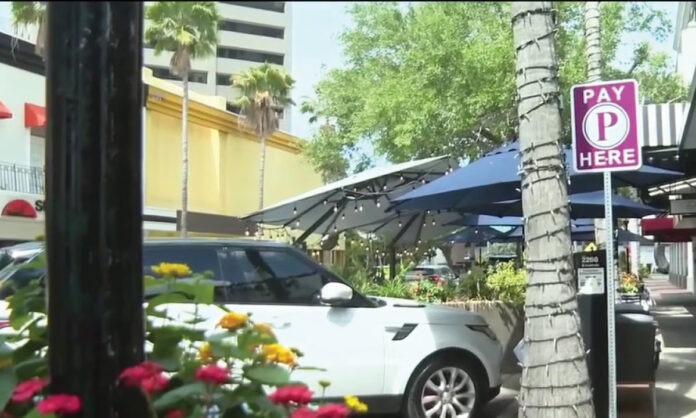
Nine speakers, a boycott, a viral video with 435,000 views and a restaurant now paying its customers’ parking bills. The July 20 commission meeting turned Sarasota’s expanded meter hours into a full civic crisis, and by day’s end one commissioner had forced the issue onto Monday’s agenda over the objections of her own colleagues and a brand-new city manager pleading for time.
The revolt over Sarasota’s expanded paid-parking program arrived at City Hall on July 20 in two waves. The first came at 9 a.m., when a procession of downtown’s best-known merchants, one after another, told the City Commission that the meters now running from breakfast to midnight are strangling their businesses, driving customers to UTC and Lakewood Ranch, and emptying the very streets the program was supposed to monetize. The second came nearly seven hours later, at the tail end of the meeting, when the commissioners themselves fractured over what to do about it.
—By adjournment, Commissioner Jen Ahearn-Koch had unilaterally placed the parking program on the Aug. 3 agenda for a formal public discussion, exercising a prerogative that requires no one’s consent but her own. She did it over the polite but unmistakable resistance of Mayor Debbie Trice, who spent the afternoon defending the program, and of new City Manager Karie Friling, who all but begged the commission to wait for a full month of data before touching anything.
—The result is that Monday’s commission meeting, Aug. 3, is now the first official venue where the city will confront the question downtown has been shouting for a month: roll it back, or ride it out.
—What lit the fuse
—The numbers behind the anger have not changed. Effective June 29, paid on-street parking on Main Street and Palm Avenue runs from 8 a.m. to midnight Monday through Saturday, with Sunday enforcement starting at 1 p.m. City garages and lots now charge 24 hours a day except Sunday mornings. That replaced a 10 a.m.-to-8 p.m. enforcement window, adding two hours to the morning, four to the night, and folding in Sundays. Citation fines rose $5 across the board. The hourly rate stayed at $1.50.
—The commission chose that package in March as the gentler alternative to a 50 percent rate hike, a way to close a parking enterprise fund shortfall projected to reach roughly $2.8 million by 2028. Four weeks into the new hours, almost no one who spoke on July 20 was calling it gentle.
“Strangling us”: the sandwich-shop math
—Chip Beeman, who has owned the Main Bar Sandwich Shop for 22 years and Pastry Art on Main Street for eight, opened the assault with the most granular profit-and-loss statement of the morning. In the first two months after the city implemented the downtown parking program, he told commissioners, his business lost $10,000 in sales month over month, year over year, and he has cut his staff from 18 employees to 15.
“We are the golden goose of downtown, yet we’re being treated without consideration,” Beeman said, describing policies “that are strangling us.”
—Then he did the arithmetic out loud. A customer today faces a minimum parking charge of $2.50, plus another 35 cents if they use the app. Stack a mandatory $2.85 minimum parking charge on a $12.50 sandwich, Beeman said, and the city has imposed “an immediate 23% tax” on top of the 7 percent sales tax. His sandwich sales have dropped by 75 sandwiches a day, and the customers, he said, are being driven “straight to the arms of places like UTC,” where parking is free and ticket anxiety does not exist.
—Beeman saved a shot for the city’s separate proposal to remove more than a hundred angled spaces on Main Street in favor of parallel parking and wider sidewalks. “A wider sidewalk does not sell me one more sandwich,” he said.
—The video the whole region watched
—Katherine Hermes, who owns a wellness practice downtown and lives on Cocoanut Avenue, told the commission her morning trade has simply evaporated. Until a month ago, she said, 10 to 15 clients came in every morning between 9 and 10 a.m. for treatments and left before parking cost anything. Under the new 8 a.m. start, with an enforcement officer stationed nearby, that business “is gone. It’s completely dried up.”
—So Hermes walked outside with her phone, filmed a completely empty street, and posted it with a simple message: look what happened, you drove everybody away. That video, she told the commission, has drawn 435,000 views, in a city of roughly 58,000 residents.
—She also came with a forensic accounting question. In 2017, she said, the city ran a $700,000 operating deficit on its roughly 3,000 managed parking spaces. By 2022 the operation had swung to a $700,000 surplus. By 2025, the cost of managing those same 3,000 spaces had climbed 40 percent, with staffing up 22 percent, ticketing up 22 percent and rates up more than 25 percent. Hermes asked the commission to appoint a fully independent citizens’ commission to answer one question: what happened between 2017 and 2025 that drove the cost of running the same spaces up 40 percent?
—A boycott, three struggling storefronts and a plea
—Darci Jacob, who owns a women’s clothing store on Main Street and sits on the board of the Downtown Merchant Group alongside Ron Soto and Harmoni Krusing, described a summer that has curdled from mediocre to alarming. Since the parking changes, she said, online reaction “has exploded with negativity,” and the locals who keep downtown alive through the off-season “are now boycotting downtown.” She knows of one store closing on Palm Avenue, another on Pineapple, and a Main Street owner who has taken a second job to supplement his income. She brought roughly a hundred of the online boycott comments with her.
—The open house scheduled for Aug. 24 and the workshop on Aug. 31 are too far away, she said: “Our businesses cannot wait until the end of August. I’m here today to beg this commission to please go back to the old parking program until this is further discussed.”
—Café Amici starts paying its customers’ parking
—The most dramatic announcement of the morning came from Nicholas DiIelsi, manager of Café Amici, the downtown institution of 27 years. Since the midnight enforcement began, he said, the restaurant has lost its night crowd, with longtime clients telling him directly they will no longer come downtown and would “rather go to UTC Mall, Lakewood Ranch, where there is free parking.”
—So the restaurant is taking the city’s cost onto its own books. “As of today, Café Amici will be paying three hours of parking for anybody that dines with us,” DiIelsi announced, casting it as a survival move to pull locals back into town. “We’ll take the hit as much as you’re hitting us right now.”
—He coupled it with a warning aimed squarely at the city’s revenue projections: “Empty businesses means empty parking spots. Empty parking spots means no money in your pockets.” And he layered on a grievance about the city’s treatment of the restaurant generally, saying Café Amici gave up its outdoor street dining after being told it would cost $4,000 a month to keep seating on parking spaces while other restaurants were grandfathered in.
—The economists of Main Street
—Chris Voelker, the commercial property owner who helped lead the July 6 charge, returned with a sharper frame. He thanked the commission for scheduling the workshop and open house, then asked it to judge the program by a single test: “Have these parking changes made downtown more attractive of a place to visit, or less attractive?” Downtown no longer exists in a vacuum, he said, and now competes with regional districts offering good restaurants, attractive retail and free parking. “Parking is no longer just a transportation issue. It’s an economic and human issue.”
—His ask was specific: if the evidence shows the program is discouraging visitors while the review is underway, grant temporary relief by restoring two hours of free parking, free Sundays and the previous enforcement hours until a final plan exists. “Parking should be a tool that supports downtown,” he said, “not an obstacle that keeps people away.”
—Brian Mattison, who operates Mattison’s City Grill at Lemon and Main, said the announcement of expanded enforcement backfired before the first ticket was written, because it “chased people away from coming down in the first place.” He pronounced himself baffled that the city is still pursuing the parallel-parking conversion downtown, noting Florida dropped parallel parking from its driver’s test years ago, and that the demographics of Sarasota do not favor asking patrons to park on the third floor of a garage in disrepair and walk several blocks after dusk. His prescription: “at least a moratorium on whatever things have just changed recently until workshops can be completed.”
“Light a fire underneath them”
—John Harshman, the commercial real estate broker now running for City Commission, distilled the political moment in one line: “If you ever want to wake people up this summer, light a fire underneath them, talk about parking. Better yet, change the rules on parking. Obviously, you’ve done that. You’ve gotten everybody’s attention. Unfortunately, it is not the positive kind of attention you want to get.”
—His fix matched the letter he sent commissioners three days earlier: roll back the ordinance now, restore the status quo, and use the workshop process to build something the public will actually support. The sight of open parking spaces at 8 and 9 in the morning, spaces once filled by coffee-shop customers, “really is disheartening,” he said.
—The morning’s final word went to Ross McGaw, a downtown resident on Cocoanut Avenue whose work truck does not fit in his garage. For years he parked it on the street. Under the new rules, with two-hour limits now enforced until midnight, he cannot. “My options are buy another vehicle that won’t suit my business, or move out of the city,” he said, suggesting a monthly residential permit, “because I can’t go out at 9:00, 10:00 and move my truck to another parking spot, because I’m asleep.”
—Seven hours later, the dais cracks open
—The commission absorbed all of it in the morning and said almost nothing until the meeting’s final minutes, when Commissioner Liz Alpert pulled the pin during commissioners’ comments.
“I wanted to talk about actually some of the suggestions about the parking, to roll it back to our previous parking ordinance until we resolve how we’re going to handle this,” Alpert said. “Is that something that we could put on another agenda?”
—The answer from City Auditor and Clerk Shayla Griggs was that the Aug. 3 agenda deadline had already passed. Ahearn-Koch pushed back immediately: “Why would that be too soon? I don’t think it’s that complicated. Backup material are the comments from today.”
—The new city manager pumps the brakes
—That drew a lengthy, careful intervention from Friling, presiding over one of her first meetings as city manager. Her first concern was practical: “We just replaced all the signs and everything in the actual built environment.” Her second was empirical. The Aug. 24 open house and the tentative Aug. 31 workshop, she explained, were deliberately timed so staff could collect a full month of real data, from the city’s GIS system and visitor-tracking software, on what the extended hours are actually doing on the ground.
“My only word of caution would be to not move too quickly to roll this back yet,” Friling said. “I understand the concerns we heard today at the commission meeting, but I really wanted time to really get a full month of impacts.” She noted that she has 18 separate items in motion with staff to prepare for the workshop and open house, none of which will be complete by Aug. 3, and closed with a line that framed the whole exchange: “Again, I don’t set policy. You guys do. But those are just my recommendations.”
—There was one more complication she disclosed near the meeting’s end: Broxton Harvey, the Parking Division general manager who designed and championed the extended hours, has resigned and is moving home to Atlanta, leaving the division without its chief just as the program he built goes on trial.
—The mayor isn’t buying the outrage
—If Ahearn-Koch spent the afternoon channeling the merchants, Mayor Trice spent it cross-examining them in absentia. When Ahearn-Koch described theatergoers who park in a free two-hour space at 7 p.m., go to dinner and a show, and now must leave mid-performance to move the car, Trice’s answer was blunt: they could park in the garage. “They would pay the three dollars and they wouldn’t have to leave the show,” she said, adding later, “If you’re spending $200 on a meal, why are you quibbling over $2 parking fee?”
—The mayor argued the deeper problem is a public that refuses to acknowledge the free options. “What I’m hearing in the e-mails is people are not acknowledging that there are free spots,” she said. “It’s like, just walk around the corner and it’s free.” She noted two downtown restaurants are already offering customers $3 to $4 rebates off their checks for showing a parking charge, evidence, in her telling, that the actual dollars at stake are small. And she vented about the quality of the complaints themselves, citing a letter from someone ticketed for overstaying in the Whole Foods customers-only garage, a private facility, “and they are blaming us because they got a ticket. Potshots at the city now.”
—Ahearn-Koch’s rebuttal drew the line the two sides will fight over Monday: “I don’t think it’s quibbling over the parking fee. I think it’s the inconvenience of the two-hour parking being enforced before 10 a.m. and after 8 p.m. I think that’s where a lot of suffering is happening.”
“She can add it if she wants it. I tried.”
—The exchange grew testy enough that Vice Mayor Kathy Kelley Ohlrich twice tried to gavel it down, reminding her colleagues, “Folks, we are not here to discuss parking. This is commissioners’ comments.” From the dais came a push to hold the item until Friling could compile real backup material rather than have information “foisted” on the commission at the meeting.
—Ahearn-Koch was unmoved. Sarasota’s rules give any single commissioner the power to place an item on the agenda, and after briefly saying “I’ll think about it,” she used it. “I would like to add it to August 3rd for a discussion,” she said, “so that this discussion that we just had, we can have officially announced.” Her reasoning was as political as it was procedural: “We would also show our businesses downtown that we hear them. We know that summer is tough, and we’ve just made it even harder for them. It’s like salt in the wound.”
—Griggs closed the matter with the driest line of the day: “She can add it if she wants it. I tried.”
—The item now sits on Monday’s agenda as New Business XII.1, presented by Ahearn-Koch herself, with the administration recommending a discussion of the purpose behind the extended hours and the citation fee increases that took effect June 29. The backup packet attached to it contains the stack of protest letters this newspaper detailed last week, from the Gonzmart family of the Columbia Restaurant, the Sarasota Opera’s Richard Russell, the Southside Village Business District, chef Paul Mattison, Harshman and aggrieved residents, along with something more pointed: a step-by-step legal guide to repealing a Sarasota parking ordinance.
—What the commission actually can and cannot do Monday
—That repeal guide is the sleeper document of the week, because it defines the battlefield. The extended hours were enacted by Ordinance 26-5590, and in Sarasota an ordinance generally can only be undone by another ordinance. The clean path runs through commission direction at a public meeting, legal review, a drafted amending or repealing ordinance, a state-required business impact estimate, newspaper notice at least ten days before adoption, two advertised readings on separate days, a recorded majority vote, and a ten-day wait before the change takes effect. Even moving at maximum speed, a rollback launched Monday would take well over a month to reach the street.
—There is one potential shortcut. If the original ordinance delegated details such as enforcement hours to administrative control or rates to resolution, those pieces could move faster. But the city cannot use a resolution or administrative act to contradict what the code itself says, which means the commission’s real room to maneuver Monday depends on exactly how 26-5590 was drafted. Any repeal would also have to decide what happens to citations already issued, appeals pending and fees already collected.
—And behind all of it sits the constraint commissioners aired on July 6: the city’s contractual obligation to charge for parking on St. Armands to service the roughly $16 million bond on the Circle’s garage, an arrangement built on the understanding that downtown would charge too. Simply shutting the meters off is not just a policy choice. Commissioners have warned it is a lawsuit.
—The stakes on both sides of the ledger
—What makes Monday genuinely hard is that both sides are holding real numbers. The merchants have theirs: a sandwich shop down $10,000 a month and three employees, a wellness practice that lost its entire morning clientele, store closings on Palm and Pineapple, a 27-year-old restaurant paying its customers’ parking to stop the bleeding, and a boycott movement with six-figure social media reach in a city of 58,000.
—The city has its own: a parking fund that lost $270,784 this budget year and is projected to fall roughly $2.8 million short by 2028, elevator replacements at the State Street and Palm Avenue garages priced at $750,000 apiece, a $650,000 meter overhaul, and a free Bay Runner trolley the parking fund has been carrying at more than $924,000 a year. Roll back the hours, and that math reverts to the March menu the commission already rejected: raise the rate 50 percent, or let the general fund eat the loss.
—Three dates that will decide it
—The calendar now runs like this. Monday, Aug. 3, the commission holds its first formal public discussion of the program under Ahearn-Koch’s agenda item, with the letters in the backup and the merchants certain to fill the chamber again, but with Friling on record that she will not have complete data and cannot support an informed vote that day. Aug. 24 at 5:30 p.m., the city hosts its parking open house in the commission chambers. And Aug. 31, the commission convenes the dedicated parking workshop where staff will finally present the full month of revenue figures, citation counts and utilization data, along with responses to the validation, signage and garage-incentive ideas floated in July.
—Between now and then, the pressure machine keeps running. Ronnie Shugar’s threatened petition of commercial property owners remains in the wings. Harshman’s citizen advisory committee proposal, with its Oct. 15 report deadline, offers the commission a ready-made structure if it wants one. Café Amici is paying parking tabs. The videos keep circulating. And the commission that chose extended hours in March precisely because it seemed like the option that would hurt less now must decide, on the record and in front of the people it is hurting, whether to hold the line for four more weeks of data or hand downtown the rollback it came to City Hall to demand.
Monday, the meters will still run to midnight. The only question is for how much longer.


I cannot tell you how many times I have wanted to run into a store on St. Armands for a quick errand or to shop but decided not to because I didn’t want to spend $3 plus to park my car. So I just drove home. It is a big negative to pay for the parking on the circle.