
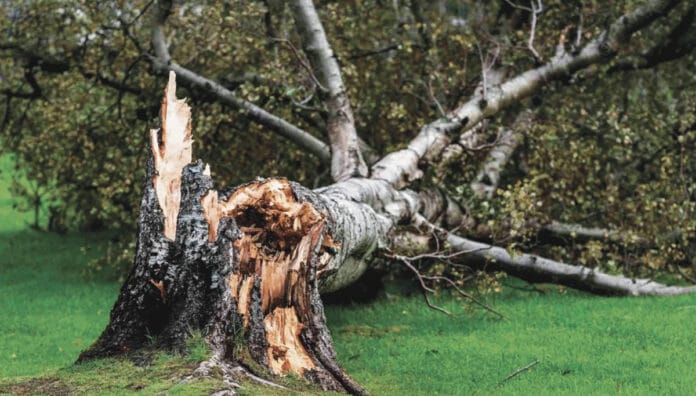
When the Town Commission takes up Ordinance 2026-11 at its Sept. 14 meeting, it will be voting on the most sweeping rewrite of Longboat’s tree regulations since the code was adopted in 1974.
—When the Town Commission takes up Ordinance 2026-11 at its Sept. 14 meeting, it will be voting on the most sweeping rewrite of Longboat Key’s tree regulations since the code was first adopted in 1974. The ordinance arrives wrapped in the language of storm recovery and modernization, and much of it is exactly that. But buried in the middle of a dense staff memo from Planning, Zoning & Building Director Allen Parsons is a change that has nothing to do with hurricanes and everything to do with how green this island will be in 20 years: the town proposes to cut its tree replacement requirement in half.
—Under the current code, anyone who removes a mature tree under a town permit must plant two in its place. Under Ordinance 2026-11, the minimum drops to one. Permanently. For every permitted removal, storm or no storm.
—That single sentence deserves more scrutiny than the entire rest of the ordinance combined.
—What the ordinance actually does
—The package, recommended unanimously by the Planning & Zoning Board on June 16 after more than a year of workshops, touches nearly every section of Chapter 98. The honest inventory looks like this.
—The everyday replacement ratio falls from 2:1 to a minimum of 1:1, with the actual ratio to be set by species type. The fee a property owner pays into the town’s Tree Fund when replacement trees will not fit on site more than doubles, from $300 to $700 per tree, the first increase since 2010. A new section requires that trees destroyed by a declared natural disaster be replaced at 1:1 within three years on every property in town, including single-family homes that have been exempt from the tree code for 52 years. New definitions arrive for terms like Critical Root Zone and Hazardous Tree. Construction sites must now erect durable, highly visible tree protection barriers around root zones. The strangler fig, a Florida native long misfiled among the invasives, comes off the prohibited plantings list. And a new hazardous-tree section lets the town order removal of dead or diseased trees that threaten life or property, then do the work and bill the owner if the owner refuses.
—Some of this is unambiguously good housekeeping. The protection barriers, the updated species tables with salt tolerance and cold hardiness data, and the hazardous-tree enforcement authority all strengthen the code. The question is whether the good housekeeping is providing cover for the one change that weakens it.
—The math of a shrinking canopy
—Here is why the ratio matters more than anything else in the ordinance. A 2:1 replacement requirement is not punitive excess; it is the engine that grows a canopy back. Every permitted removal under the current code produces a net gain of one tree. Over decades, that compounding is how a barrier island recovers from the losses that hurricanes, salt intrusion and disease inflict between permits.
—A 1:1 ratio, by contrast, is a treadmill. At absolute best, the canopy holds level. In the real world it shrinks, because young replacement trees die at meaningful rates in coastal conditions, and a two-inch caliper sapling delivers a tiny fraction of the shade, stormwater absorption and habitat value of the mature tree it replaces. Plant one small tree for every large one removed and the canopy declines by definition, even with perfect compliance.
—The staff memo presents the change as flexibility, paired with language “encouraging” owners to replace removed trees with comparable species and size categories. Encouragement is not a requirement. The requirement is being halved.
—And the timing is the part that should give commissioners pause. The town is proposing to reduce its canopy-rebuilding mechanism at precisely the moment the canopy is at its thinnest in a generation, after successive storm seasons stripped the island. Recovery arithmetic runs the other direction: after major losses, communities that want their trees back plant more than they lost, not the same number.
—The $700 question
—The fee increase, from $300 to $700 per mature replacement tree, looks like a toughening measure and was framed as one, pegged to current nursery costs. Look closer and it cuts both ways.
—The fee is what an owner pays to not plant a tree when replacements will not fit on site. It is a buyout. And $700 per tree, on an island where the median single-family sale routinely clears several million dollars, is not a deterrent. It is a rounding error on a landscaping invoice. Tampa officials recently acknowledged that the true cost of getting one tree actually planted, established and maintained through its first year runs three to four times the nursery sticker price. If Longboat’s fee is meant to make the Tree Fund whole for a lost tree, $700 is likely still short of the real number. If it is meant to discourage cashing out instead of replanting, it does not come close.
—The P&Z Board did recommend, and staff supports, revisiting the fee every three years rather than letting it sit frozen for another 16. That is genuine progress.
—The part that actually tightens
—To be fair to the P&Z Board, one piece of this ordinance imposes an obligation where none has ever existed. New Section 98.10 requires that trees removed, destroyed or irreparably damaged by a declared natural disaster be replaced at 1:1 within three years, and for the first time since 1974, that duty lands on developed single-family properties, which have otherwise enjoyed a blanket exemption from the tree code since its adoption.
—That is a real change, and homeowners should understand it. Lose a tree to the next declared storm and you owe the island a tree, on your dime, within three years.
—But the provision contains its own escape hatch. If another declared disaster strikes during the three-year window, the clock resets from the most recent declaration. On a barrier island that has seen declared storm events in repeated years, the replanting deadline could roll forward indefinitely, storm after storm, with the replacement obligation perpetually deferred and the canopy perpetually waiting. A hard backstop, some outer limit past which replanting is due regardless of intervening declarations, would close that loop. The ordinance does not have one.
—Who is being given the break, exactly
—The staff memo’s origin story for this entire effort is sympathy for storm-battered property owners, particularly condominiums, which occupy roughly a quarter of the town’s land and were not covered by the old single-family exemption. Ordinance 2025-04 already solved that acute problem last year by exempting disaster-killed trees from permitting.
—What remains in this ordinance is a permanent, economy-wide reduction in replacement obligations that applies to condominium associations, commercial properties and developers on every ordinary, non-disaster removal from now on. The affordability argument is genuinely thin here. This is one of the wealthiest ZIP codes in Florida, a community whose property owners chose the island in no small part for its tunnel-of-green character along Gulf of Mexico Drive, and whose associations maintain seven-figure reserve accounts. The cost of planting a second replacement tree has never been what stands between Longboat Key and its canopy. What stands between them now would be this ordinance.
—The Tree City USA snub
—Then there is the recommendation the Town Commission is being asked to quietly decline. After a year of study, the P&Z Board recommended the town pursue Tree City USA designation, the Arbor Day Foundation program that has recognized committed urban forestry communities since 1976. Staff recommends against it, citing budgetary impacts.
—Consider what the town would be declining, and what it would cost. The program’s four standards are a tree board or department, a tree ordinance, an Arbor Day observance with a proclamation, and a community forestry program spending at least $2 per capita annually. Longboat Key already has the ordinance. With a year-round population around 7,500, the spending threshold works out to roughly $15,000 a year, and the program counts staff time, contracted tree work and even volunteer hours toward that figure, meaning the town almost certainly spends multiples of the threshold already through its existing landscaping and tree operations. The tree board could be as simple as assigning the function to an existing advisory committee.
—Meanwhile, look around. Sarasota County has held the designation for 42 consecutive years. The City of Sarasota holds it. So do Manatee County, Bradenton and Venice. Florida counts roughly 150 Tree City USA communities. Longboat Key, the barrier island that markets its lush residential character in every real estate listing and tourism brochure, would be a conspicuous green-branded holdout declining a designation its far less affluent neighbors find worth the paperwork.
—Staff calls the recognition well-intentioned but not worth the cost. The P&Z Board, which spent a year immersed in this subject, disagreed. The Commission will have to pick a side.
—What other storm-struck communities did instead
—Longboat is not the first Gulf Coast community to rewrite tree rules after hurricanes, and the comparisons are unflattering to the direction of this ordinance.
—Tampa, after Helene and Milton shaved roughly 5% off its canopy and erased four years of planting gains, responded by expanding its ReLeaf program, launching 11 canopy projects expected to plant more than 3,000 trees, and debating how to spend a $6 million tree trust fund on restoration, not by cutting its mitigation requirements. St. Petersburg, which by some estimates lost a staggering 20% of its canopy to Milton, threw its weight behind community replanting drives. The Arbor Day Foundation pledged 10 million trees across six states to replace what those storms took.
—Sanibel offers the closest analogue to Longboat’s situation: a wealthy barrier island whose vegetation was devastated by a direct hit. Sanibel’s answer after Ian was to temporarily streamline emergency removals through mayoral proclamation while leaving its underlying standards intact, including its requirement that landscaping remain 75% native vegetation. The island eased the crisis-moment paperwork. It did not lower the bar for what must grow back.
—And when it comes to everyday replacement standards, Longboat’s proposed 1:1 minimum would slide toward the permissive end of the Florida spectrum. Orlando requires mitigation at three replacement inches for every inch removed, and up to five-to-one for its oldest specimens. Jacksonville requires inch-for-inch replacement of live oaks, the signature canopy species of this coast. Against that backdrop, Longboat would be moving from a middle-of-the-pack standard to one of the softer ones on the Gulf Coast, at the exact moment its peers are moving the other way.
—A revealing footnote on state law
—One more detail in the staff memo rewards a careful read. In declining the P&Z Board’s separate request to study folding landscaping standards into the tree code, staff cites recent state legislation that freezes local governments from adopting more restrictive land development regulations until October 2027. Yet the same memo, two pages earlier, reports the Town Attorney’s guidance that the tree code itself is not subject to that prohibition, which is precisely why this ordinance can proceed at all.
—In other words, the town has a rare and legally confirmed lane to strengthen tree protection right now, while most land development tightening is frozen statewide. Ordinance 2026-11 uses that lane to loosen the code’s central requirement instead.
—The bottom line
—There is much to like in this ordinance: real protections during construction, teeth for hazardous trees, honest species science, a first-ever replanting duty for single-family homes after disasters, and a fee finally dragged out of 2010. The P&Z Board and staff did serious work, and it shows.
—But the headline change runs the wrong direction. Halving the replacement ratio is a permanent structural decision that will outlast every storm that prompted it, and it converts a code designed to grow the canopy back into one that, at best, manages its decline. Before the Nov. 9 second reading, commissioners should be able to answer three questions on the record. Why is a ratio cut that applies to every ordinary removal being justified by disaster hardship the town already addressed last year? What is the projected canopy trajectory under 1:1 replacement with realistic sapling mortality? And why should the greenest-branded town on this coast be the only jurisdiction in the neighborhood that decides Tree City USA is not worth $2 a head?
—Longboat Key’s canopy took decades to grow and two storm seasons to thin. The code that rebuilds it is being written right now. This is the moment to plant more, not less.

