
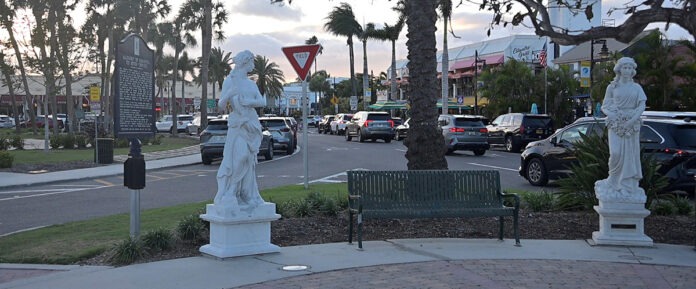
For nearly a century, St. Armands Circle has operated as the undisputed commercial and cultural crown jewel of Sarasota’s barrier islands. Today, less than two years removed from a devastating hurricane season, the upscale residential and shopping district finds itself at an existential inflection point, caught between a booming post-storm renaissance and the creeping pressures of commercial hyper-development.
According to a sweeping “Year in Review” address delivered by St. Armands Residents Association President Chris Goglia—and echoed by mounting public outcry across the barrier islands—the focus has fundamentally shifted. If the immediate aftermath of the storms was about survival, the 2025–2026 season has become a fierce, highly orchestrated battle for the very soul of St. Armands.
—At the center of the debate: hardening the island’s aging infrastructure, navigating strict federal flood regulations, fending off aggressive pushes for hotel zoning, and answering a deeply philosophical question about what exactly St. Armands wants to be in the 21st century.
—Nowhere is the tension over the island’s future more pronounced than in the renewed battle over commercial density – specifically, the push to introduce boutique hotels and short-term rentals to the Circle.
—The catalyst for this renewed push is deeply entangled with the aftermath of the 2024 hurricanes and the strict enforcement of the FEMA “50% Rule.” Under federal guidelines, extensively damaged properties must be elevated to meet modern flood codes—an exorbitant engineering and financial undertaking. To make these post-storm investments pencil out, developers are increasingly looking upward.
—Most notably, the team seeking to rebuild the popular Shore restaurant at 24 and 28 N. Boulevard of the Presidents has proposed a “flagship” concept that combines lower-level retail and dining with a highly controversial new third floor designated for residential units or a boutique hotel.
—For residents, this proposal is a flashpoint. St. Armands is inherently a traffic chokepoint, serving as a critical state evacuation route and the primary artery connecting mainland Sarasota to Lido Key and Longboat Key. Introducing high-turnover lodging to the Commercial Tourist (CT) district—where hotel usage is currently explicitly prohibited—is viewed by many as a fatal blow to the area’s livability.
“If this concept is financially successful for this one developer, why won’t more and more commercial properties on St. Armands do the same thing?” Goglia warned residents. “Once zoning changes are made for this one property, they then apply to all properties.”
—A ‘Trojan Horse’ and the Visioning Backlash
—To address the growing friction, the City of Sarasota initiated a series of “visioning sessions” in early 2026 to chart the district’s future. However, to resident leaders, the municipal framework of community roundtables looked less like an olive branch and more like a Trojan horse designed to manufacture consent for density increases that have historically been fiercely opposed.
—Tensions flared after it was revealed through public records requests that city planning staff had initially attempted to hold an invite-only meeting with a select group of commercial property owners before public outcry forced a pivot to an open workshop.
—When the first public session convened on February 26 at the Mote Marine Keating Education Center, roughly 150 stakeholders gathered under the guidance of independent sociologist Dr. David Brain. Asked to envision the Circle in 2046 using sticky notes and voting stickers, the community delivered a unified, resounding directive that sharply diverged from the developers’ proposals.
—Attendees overwhelmingly rejected the concept of “hotel houses” and high-density lodging. Instead, they demanded the preservation of the Circle’s century-old tradition: a quaint village-center feel defined by small boutique shops, strict code enforcement, and improved storm resilience.
—Echoes of Past Proposals
—The fierce pushback is rooted in a well-established history of residents defending the island from commercial expansion. Just four years ago, development interests lobbied the City Commission to authorize hotel use and increase commercial height limits across the Circle. The Commission voted 5–0 to reject the idea. Around the same time, a separate, highly contentious plan to build a hotel on the publicly owned Fillmore Parking Lot behind Alvin’s Island also collapsed under the weight of resident opposition.
—Despite these past victories, residents remain on high alert. The upcoming summer months—when many seasonal homeowners migrate north—are widely viewed as a vulnerable window when developers might quietly advance zoning variance requests through the city’s Development Review Committee.
—A Renaissance on the Street, A Blight on the Corner
What may ultimately work against the push for rezoning is the empirical reality currently playing out on the street. By all accounts, St. Armands is experiencing a massive post-hurricane renaissance. Buoyed by the recent opening of the St. Regis on Longboat Key and flawless seasonal weather, the Circle is replete with enthusiastic diners and throngs of visitors enjoying outdoor cafés and live music.
—Yet, locals point to one glaring exception: the distressed corners where developers seeking new zoning entitlements have left their hurricane-damaged buildings in a state of disrepair. To neighborhood advocates, the neglect feels less like a symptom of the storm and more like a tactic to leverage municipal zoning concessions.
—Weathering the Storm: A $13.5 Million Win for Resilience
—While the zoning wars rage, the St. Armands Residents Association has successfully pivoted local government focus toward unglamorous, critical infrastructure.
—Following a highly coordinated lobbying effort by the Association, Sarasota County recently allocated $13.5 million in Resilient SRQ federal disaster recovery grants to St. Armands. The funds will prioritize vital stormwater triage, including pump station upgrades, permeable pavement elements, and the installation of tidal check valves to prevent seawater from backing up into the streets.
—To complement the stormwater overhauls, the city is moving aggressively to bury overhead utilities. Power and telecom lines have already been successfully buried on neighboring Bird Key and Longboat Key, proving their worth during the 2024 storms when those underground grids lost power for mere hours instead of weeks. Last October, the City Commission approved a feasibility study for undergrounding utilities on St. Armands, a multi-million dollar cost that property owners appear overwhelmingly willing to shoulder to ensure safety and aesthetic uniformity.
A Demand for ‘Complete Streets’ Parity
With property owners poised to foot the bill for undergrounding utilities, the residential community is demanding civic investment to beautify the existing public realm. St. Armands currently suffers from a fragmented aesthetic, with commercial tenants responsible for maintaining a hodgepodge of varying sidewalks and planters.
While the city recently secured millions in federal and local funds to advance a “Complete Streets” redesign for downtown Sarasota’s Main Street, a similar project for St. Armands was shelved three years ago.
For an island that generates massive tax revenue and serves as the postcard image of Sarasota to the world, residents argue that uniform brick pavers, curated landscaping, and world-class streetscapes are not a luxury—they are the cost of doing business.
As new private investments—like a highly anticipated Pinchers seafood location—begin flowing back into existing retail spaces without demanding height or density increases, the message from the community is clear: St. Armands is open for business, but its historic soul is not for sale.

