
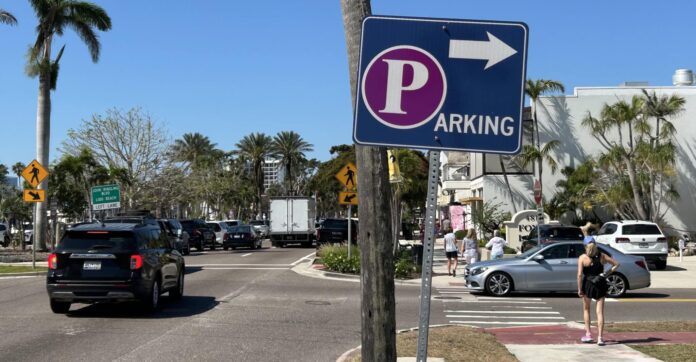
“Think about the psychology of a parking ticket. Giving someone a fine is a punishment. A punishment is designed to stop a behavior from happening again. You get a speeding ticket, you slow down. You get a parking ticket downtown, you stop coming downtown.” — John Beeman
—After nine hours of testimony, confession and arithmetic, the Sarasota City Commission voted 5-0 last week to suspend enforcement of the extended paid-parking hours that have convulsed downtown since June 29. The chamber broke into applause. On Sunday, parking was free again, the two-hour spaces stop being policed at dusk, and the meters go back to the hours merchants spent five weeks begging for. Only one piece of the ordinance survived the night: the higher fines. This is the story of how a program its own architect called financially sound was dismantled by sandwich makers, hairdressers, opera patrons and a petition carried door to door down Main Street.
—The revolt that began as a murmur on July 6 and became a firestorm on July 20 ended Monday night the only way it still could: with the Sarasota City Commission, unanimously and to applause, suspending the very parking expansion four of its five members voted to create.
—The motion came from Commissioner Kyle Battie, the lone member who voted against the program in the first place, and it swept nearly everything off the table. Enforcement of Ordinance 26-5590, the measure that pushed paid parking from 8 a.m. to midnight, extended policing of the free two-hour spaces into the night, and folded Sundays into the enforcement calendar, is suspended until the city completes a public town hall and a dedicated commission workshop and returns with what Battie called “empirical data.”
—The only survivor was the fine schedule. On a 3-2 amendment from Vice Mayor Kathy Kelley Ohlrich, the increased citation charges adopted in the same ordinance will remain in force, a concession to new City Manager Karie Friling, who argued that people who still break the rules under the restored hours “deserve to get a ticket.”
—Everything else goes back to the way it was before June 29. And the meeting that got it there was one of the most remarkable displays of merchant power City Hall has seen in decades.
—The Sandwich Maker Fires First
—The day opened the way the whole saga has run, with Chip Beeman of the Main Bar Sandwich Shop standing at the podium doing math the city did not want to hear. Beeman spoke at 9:43 a.m. because, as he told the commissioners, he hoped to be selling sandwiches by the time they reached the parking item. He was off by roughly seven hours.
—He came loaded. Mayor Debbie Trice’s now-famous July line, that anyone spending $200 on a meal should not quibble over a $2 parking fee, was waiting for him like a hanging curveball.
“Mrs. Mayor, you have lost the plot,” Beeman said. “We are not selling $200 items at my place.”
—Then the 22-year Main Street veteran gave the commission a history lesson. Paid parking, he said, was invented in Oklahoma City in 1935 with a single purpose: to force turnover of parked cars for the benefit of local businesses. “The current program allows a car to occupy a space all day,” he said. “That’s the opposite.”
—He accused a previous city manager of selling the program to the commission “as a financial cash cow” while failing to mention “the critical fact that it be funded entirely at the expense of the local merchants.” His verdict: “The chickens have come home to roost.” He offered a eulogy for the storefronts already lost, “Rest in peace to the toy store and Fork in Hand,” and a behavioral theory the city’s consultants never modeled.
“Think about the psychology of a parking ticket,” Beeman said. “Giving someone a fine is a punishment. A punishment is designed to stop a behavior from happening again. You get a speeding ticket, you slow down. You get a parking ticket downtown, you stop coming downtown.”
—He reminded the dais that he warned city leadership before the program launched, and that “they failed to heed the advice of the sandwich maker. Two of those people sit on the commission today rethinking their decision.” The 2019 program, he said, “was bent, but it wasn’t broken.” His closing plea set the tone for everything that followed: “Save the soul of downtown Sarasota before more storefronts go dark.”
—The Rules of Engagement
—When Item XII.1 finally arrived at 4:41 p.m., Commissioner Jen Ahearn-Koch, who forced it onto the agenda two weeks ago over the objections of her colleagues, wasted no time framing the stakes. She had asked City Attorney Joseph Polzak to spell out, in public, exactly what the commission could legally do that night.
—Polzak’s answer detonated the central excuse for delay. “The simplest action would be to suspend enforcement of the changes,” he said. “If all you want to do is suspend enforcement of certain provisions, you can do that today.” A permanent repeal would still require the full ordinance machinery, but a suspension needed nothing but three votes.
—Friling then put the first real numbers on the program’s performance. In a little over three weeks of actual enforcement, the first week was warnings only, the extended hours had generated $62,078. Sunday collections brought in $23,064. Citations added roughly $20,270. Just over $105,000, in other words, was the entire haul from a program that had provoked a boycott movement, a viral video and a petition drive, and the city could not yet say which streets any of it came from. “We don’t have those detailed numbers broken down so far,” Planning Director Steve Cover admitted when Ahearn-Koch asked for the Main Street figures.
—Friling also disclosed the physical scale of what a rollback would require: reprogramming every kiosk and revisiting roughly 800 signs the city had just finished changing.
—Then Mayor Trice looked at her stack of speaker cards. Twenty people had signed up. “So that’s about an hour,” she said. “Get ready.”
‘Was the Parking System Broken So Bad?’
—Kirk Voelker, city resident and business owner, opened the public comment with the budget autopsy the commission has never performed on itself. The Parking Division’s budget, he said, has swollen from $3.7 million actual in 2025 to $6.7 million proposed, a 79 percent increase achieved without adding a single parking space. The proposed budget pays for that growth, he said, by increasing parking-ticket revenue roughly 71 percent, almost a million dollars, to $2.2 million.
“This accounts for about 33 percent of their proposed budget,” Voelker said. “If you look at other cities like Tampa, Fort Myers, Greenville, it’s about 8 percent of their budget comes from parking tickets.”
—He was careful about where he aimed. “The parking department is not the bad guys,” he said. “They are doing exactly what an enterprise system does. They are coming up with a budget and finding creative ways to pay for it. Unfortunately, those ways to pay for it are on the backs of our customers.”
—His closing line was addressed to five elected officials by name and title: “Leadership isn’t accepting the status quo. Leadership is having a vision in whether a policy is working. And having the courage to change it when it’s not.”
—His brother Chris Voelker, the commercial property owner who has helped organize the merchant resistance since July, followed with the results of a business survey that drew more than 200 responses in four days. The current policies, he said, “are devastating to businesses. They are infuriating customers, and they are deterring visitors.” Twenty years of downtown investment, he warned, is fraying at the edges. “We can’t allow the momentum that we spent 20 years building to just slip away.” Few if any of the surveyed businesses asked for free parking, he noted. “They are simply asking for immediate relief.”

—A Petition With 124 Signatures
—The rawest testimony of the night came from James Reese, who has cut hair at Salon 41 on Main Street for more than 30 years. This was his third trip to the podium, and this time he did not come alone. He came with a petition he carried personally into 122 downtown businesses, gathering 124 merchant signatures demanding the removal of the parking meters and a return to the old 10-to-8 hours with free Sundays.
“90 percent of the local businesses right here, when I walked into them, it was sad stories,” Reese said. “Sad stories what’s happening to their business.”
—Then he told his own. “I’ve lost half of my business. I used to be behind my chair for six days a week. I’m there three days a week. I lost three clients last week. Those are 20 and 30-year-old clients, because of the parking meters.”
—One of those longtime clients, he said, called the city for help with the parking app and was told, in effect, that if she couldn’t figure it out she shouldn’t come downtown anymore. “That’s no way you treat a client,” Reese said. “People are fed up.”
—His demand carried an ultimatum: “If we don’t make a decision today, we ask that you bag the meters until we come up with a decision.”
—Elizabeth Pickett Gray, who cuts hair alongside Reese at Salon 41, followed later with a 30-second version of the same story: “This new parking is hurting my business as well.”
‘Mark My Words, They Will Be Removed’
—Flo Entler, a 37-year city resident, pulled double duty at the podium, delivering her own remarks and then reading a statement from Jeremy Thayer of Thayer Jewelers, who had to leave before the item was called.
—Entler’s own contribution was the night’s best piece of institutional memory. The first parking meters went into downtown Sarasota in 1942, she said, 160 of them, and merchants complained so bitterly they were ripped out within months. “We’ve been doing this dance over 80 years,” she said. “It’s time we get it right for the merchants.”
—Thayer’s statement, read into the record, was not a plea. It was a legal warning. Citing his understanding that the city is preparing to spend more than half a million dollars on new parking payment machines, Thayer demanded the commission “not use one penny of my taxpayer money on this fool’s errand, because mark my words, they will be removed. One way or another, either by you, our elected representatives, doing what you’re elected for, which is representing the will of the people who elected you, or by a court of law.”
—Paid parking, the statement concluded, must go before the coming high season “or the citizens of Sarasota and Palm Avenue and Main Street merchants will see you in court.”
Down 40 Percent, With Employees Working One Day a Week
—Darci Jacob, who has run her women’s clothing store in the 1400 block of Main Street for 11 years and serves on the Downtown Merchant Group board with Ron Soto and Harmoni Krusing, gave the commission the most complete picture of what the extended hours actually do to a retail day.
—The 8-to-10 a.m. window, she said, punishes the coffee crowd and service workers. The 9 p.m.-to-midnight window punishes theatergoers and opera patrons, many of them seniors who cannot walk blocks from a garage, some in heels that do not survive Sarasota’s sidewalks. And the Sunday carve-out the commission granted downtown churches, free until 1 p.m., only sharpened the insult for everyone else. “Instead of being inclusive to all, you chose to charge the clients 1 p.m. to midnight,” she said. “What about the merchants, the restaurants? We all have clients that would go to church and then stroll and dine and shop.”
—Then the numbers. “Since the new parking program has started, my business is down 40 percent to last year’s numbers,” Jacob said. “I have cut my employees’ hours. Each one is working one day a week, and they were working four and five.” The summer, she said, “is almost as bad as April-May 2020.”
—And she delivered a casualty report. A Main Street store 25 years in business is closing its doors, she said, its owner walking into her shop Monday to say goodbye: “Thank you for all your efforts, Darci, but I just can’t do this anymore. Sarasota has spoken. Toy Lab will close at the end of August.”
—Nicholas DiIelsi, manager of Café Amici, the restaurant that made regional news two weeks ago by announcing it would pay its customers’ parking, returned to explain what that gesture actually means. “We choose to pay for it because we need to survive,” he said. “We’re not doing it because we have the funds to do it.” When businesses start paying the city’s parking charges out of their own pockets, he said, “that should send a message that something isn’t working as intended.” His ask matched nearly everyone’s: suspend the changes, return to the previous hours, and build something better with the people who live with it. “There is no harm in pausing, listening, and getting it right for once.”
—The Opera’s Two-Hour Problem
—Richard Russell, general and artistic director of the Sarasota Opera, brought the commission a surgical version of the complaint, one that ultimately reshaped how the mayor herself described the ordinance.
—His focus was the free, non-metered, time-limited spaces surrounding the Opera House and Florida Studio Theatre. Under the new rules, those spaces are limited to two hours and policed until midnight, and because they have no meters, a patron has no way to buy more time. “A typical performance plus arrival and departure time and maybe a meal before exceeds two hours,” Russell said. Patrons face citations “even though there is no opportunity to purchase additional time.”
—The result, he said, is a genuine access crisis for older patrons and visitors with mobility limitations, compounded by a valet operation that has lost lots to construction and a Palm Avenue garage that is too far for some and full on weekends. His request was precise: restore the old 8 p.m. end time and the Sunday exemption for the non-metered spaces in the city’s cultural corridors.
—It landed. Hours later, Trice would identify the extended enforcement of the free timed spaces as the ordinance’s central blunder, citing Russell by name.
‘A Man With an Anvil Around His Neck’
—Katherine Hermes, the downtown wellness practitioner whose empty-street video became the movement’s signature artifact, returned with an update: the video has now been shared more than 1.5 million times, she said, in a city of roughly 58,000 people. Her business is down 25 percent since July. She laid off an employee last week.
—She has also been doing homework on the Parking Division’s books, and she zeroed in on the free Bay Runner trolley, which the parking fund has been asked to carry at a cost approaching a million dollars a year. “Nobody is paying for this Bay Runner, which should be in the transportation budget,” she said. “If it got out of our budget, it would turn this budget right side up. We would no longer be underwater.”
—Her description of the division’s departed general manager presenting that math was the line of the night: listening to Broxton Harvey’s budget presentation, she said, “it kind of had a tone of a man with an anvil around his neck.”
—Her clients, she insisted, were never the problem the city imagined. “My people don’t care about paying for the parking. They really get annoyed with $50 tickets,” she said, noting that several fine categories rose $15, not the $5 the commission believed it approved across the board. She has even contracted with a private lot to cover her clients’ parking herself. Her closing was less policy than prayer: “Please be our heroes and come to our rescue and help us. This is the slowest time of year for all of us, and this is when we need your support the most.”
—Martin Hyde supplied the acid. Noting “a certain irony that the four of you that voted for this are presently sat parked in a taxpayer-funded free parking space,” he itemized the city’s three license-plate-recognition systems at $130,000, invoked Adam Smith on supply and demand, and characterized the administration’s wait-for-data posture as “watching flames licking the drapes in your offices and saying nonchalantly, maybe it will go out on its own.” His prescription: suspend the extended hours immediately and raise the meter rate 50 cents to $2 an hour, which he argued would fully fund the deficit and the capital projects. “Or if you prefer, and I would, start looking for new jobs.”
—St. Armands Hits Its Limit
—Rachel Burns, executive director of the St. Armands Circle Association, widened the lens beyond downtown. The Circle’s merchants, she reminded the commission, are assessed nearly $275,000 annually for city parking. “We do have a stake in the game, and we have hit our limit.”
—Her history of the program since its 2018 inception was an audit in miniature. Rate increases in 2021 were projected to bring in roughly $685,000; the money was absorbed. The elimination of coins in 2024 should have cut two employees and $75,000; absorbed again. “Year after year, cost-saving measures and rate increases are implemented, but the personnel and operating expenses increased,” Burns said. “The Parking Division implies that it cannot meet its obligations, but it’s not true.”
—Her survey numbers were blunt: 90 percent of St. Armands merchants say parking is a significant issue for their customers, and 68 percent report a direct negative effect on their businesses. Her warning was blunter still: “Once a guest finds a new destination, they will not return.”
—The rest of the roster reinforced the chorus from every angle. John Mercer, a former California mayor, walked the commission through the enterprise-fund arithmetic and floated a business-funded parking district as a hybrid option, noting that UTC’s free parking is not free at all: “Somebody is paying for it.” Jim Toale, a 69-year resident who has watched the meters “come and go at least three times, maybe four,” argued the enterprise fund itself is the disease, forcing the city to solve “the problem of balancing the budget… instead of doing what’s right.” Eileen Hampshire, a 20-year downtown resident, merchant, landlord and former parking committee member, reduced the whole saga to one sentence: “In the past, parking was all about turnover. Now it’s about revenue for the city.” Raffaele Perna, whose 17 years on the corner of Main and Palm run back through Sarasota News and Books, asked the commissioners a question none of them answered: “If they charged out there at Benderson, if they charged at the mall, if they charged at Waterside, it would destroy their business, and that’s kind of what’s happening to us.” David Lough urged the city to stop treating parking as an island, pointing to a thousand residential units under construction downtown and 1,500 more in the pipeline: “Please, let’s not be Groundhog Day.”
—Yevgeny Khodorkovsky, one of the commission candidates who filled the chamber’s back rows, closed the public comment with an image that needed no statistics. “You guys invented the time machine,” he said. “I went outside on Main Street, and it’s like 2020. There’s zero people. Well, I ran into two.”
—The New City Manager’s Tightrope
—When the podium finally emptied, Friling, two months into the job and inheriting a crisis she had no hand in creating, walked the narrowest line of the night. “I wasn’t here when these changes were made,” she began, before promising the commission that whatever it decided, “we will honor that.”
—She pushed back where she felt the record demanded it. The parking fund is not currently paying for the trolley, she said, correcting what she called a piece of misinformation that traced back to a workshop comment “that Mr. Harvey did,” a meeting she watched “from 1,200 miles away” before taking the job. And she declined to let parking absorb all the blame for a brutal summer, citing $4-a-gallon gas, a struggling economy, and her own reconnaissance: she has been walking downtown at night photographing the parked cars, and she has visited “the supposedly wonderful place off of 75,” which, she reported, is down too.
—But she did not fight the tide. “I truly believe in the premise of do no harm first,” she said. “I believe there is a way forward.” The solution, she predicted repeatedly, will be a hybrid in which everyone gives something. Somewhere between the merchants and the fund’s obligations, she said with a laugh, the city would have to “split the baby. Maybe we can triple up the baby.”
—She also marked the calendar of her own tenure: “I just celebrated my second month on Friday. Boy, it’s been a doozie.”
—Cover then answered the question every merchant in the room was waiting on: how fast could the machines actually be changed? The vendor quoted two weeks, he said, but his own staff believes they can compress that dramatically. “It could be as little as maybe three, four days or a week or so.”
‘I Didn’t Vote for the Damn Thing’
—The commissioners’ deliberation opened with Battie claiming the vindication he has been carrying since spring.
“I don’t necessarily think I have to speak to those three changes, because I’m the lone person up here that didn’t vote for the damn thing,” Battie said. “Okay. That’s that. I knew we would be here.”
—He complicated the merchants’ narrative even while preparing to hand them their victory. Driving downtown over the weekend, he said, he found the paid spaces full and the free spaces empty. “I was like, wow, this doesn’t make sense.” He rejected the UTC panic outright, noting friends who work there report slow business too, and diagnosed the city’s chronic ailment as a failure of foresight: “Now we’re sort of like trying to build the aircraft while we’re flying it.”
—Then came the confession that reframed the entire night, from Vice Mayor Ohlrich, who voted for the program and spent three minutes explaining exactly how it went wrong.
“The parking general manager came to us with two proposals,” she said. “One was basically increase the hours, and the other one was increase the rates. We had the best of intentions, and we thought extending the hours and keeping the rates low would be the solution. We didn’t talk to our stakeholders. We didn’t talk to the restaurateurs, the retailers, our residents, or our tourists. We talked to ourselves, and we thought we did the right thing. Clearly, it wasn’t the right thing.”
—Her coda was the shortest sentence of the meeting, and maybe the most important: “We didn’t, but we will.”
—Commissioner Liz Alpert seconded the sentiment and admitted her own vote came with a blind spot. “I was actually not for the extended hours. I ended up voting for it because that seemed to be the way everybody wanted to go,” she said, adding that the enforcement expansion on the free spaces “did not occur to me.” Her practical worry, drawn from the COVID suspension, was that people would keep feeding the meters unless the machines were physically reprogrammed. Parking Operations Manager Phil DeVeau assured her they would be: after the restored cutoff, the kiosks will read “no payment due at this time.”
—Trice, who spent July defending the program, performed a public autopsy on it instead. The ordinance made three changes, she reminded her colleagues: extended paid hours, extended enforcement of the free timed spaces, and higher fines. The second, she conceded, was the fatal one. “We made a mistake, because we wanted to have consistency in enforcement hours between the paid parking and the non-paid timed parking,” she said. “That’s where we came up with the unintended consequences.” She cited Russell’s stranded theatergoers and the downtown resident whose work truck does not fit in his building’s garage, adding, “I suspect that’s where a lot of the tickets are coming from.”
—Her preference that night was surgical, rolling back only the free-space enforcement while keeping the paid hours, and her warning about the alternative was the fund’s entire dilemma in nine words: “Who is going to pay for the parking? Somebody is going to pay.”
—The Vote, and the One Piece That Survived
—At 6:14 p.m., Battie read the motion he told colleagues he had drafted before the meeting began: temporarily suspend implementation of the recently approved changes to the city’s parking fees and enforcement hours until the commission has held both a public town hall and a dedicated workshop evaluating the impacts, then decide, on empirical data, whether to affirm, modify or repeal. Alpert seconded.
—Ahearn-Koch pressed for precision: did that include the Sunday hours and the fine increases? “Yes,” Battie answered. “The entirety.”
—That was one entirety too many for Friling, who had already told the commission that rolling back the fines would reward scofflaws: if everything else is restored and people still cannot follow the rules, “they deserve to get a ticket.” Ohlrich agreed and moved to amend the motion to keep the increased fine structure. Battie seconded. Alpert and Ahearn-Koch resisted on messaging grounds, warning that suspending some pieces of the ordinance while enforcing others would make an already difficult public-communication job harder. The amendment squeaked through 3-2.
—The amended motion, formalized by Polzak as a suspension of enforcement of Ordinance 26-5590 with the exception of the increased citation charges, then went to a vote.
—It passed unanimously. The chamber, still holding the merchants who had waited nine hours, broke into applause.
“The people have spoken,” Battie said in speaking to his motion. “We’ve heard them and listened to them.” He closed, with a grin, in four words: “I have a dream.”
—Ahearn-Koch, whose unilateral act of agenda-setting two weeks ago made the night possible, gave the credit back to the room. “When I placed this item on the agenda, nobody was thrilled about it,” she said. “But in two weeks, with your input and your involvement and your voice, we turned around.”
—Trice supplied the closing instruction that doubles as the city’s next challenge: “Let’s make sure the word that goes out is the correct word.”
—The Architect Has Already Left the Building
—Hovering over the entire proceeding, though separate from Monday’s vote, is the fact that the man who designed the program no longer works for the city. Broxton Harvey, the Parking Division general manager who recommended the extended hours and presented the budget math behind them, submitted his resignation on July 9, just three days after the July 6 meeting where the backlash first erupted, and finished his final week as the July 20 revolt was unfolding, a departure first reported by the Sarasota News Leader. Harvey, who joined the city in January 2023 and oversaw roughly 9,000 parking spaces, is returning home to the Atlanta area for a new position. In his resignation letter, he wrote that he was leaving the division “in what I believe is a great position,” with a strong financial outlook, an assessment the past five weeks have put on trial. His exit leaves the Parking Division without its chief architect at precisely the moment the commission has ordered the program he built rebuilt from the ground up, with Cover and DeVeau now fronting the operational questions.
—What Happens Now
—The suspension is not the end of the fight. It is the opening of a 60-day negotiation over what replaces the program, and the calendar is already crowded.
—First comes the mechanical unwinding. Staff must reprogram every pay station back to the old hours, a job Cover believes can be done in as little as three or four days rather than the vendor’s quoted two weeks, revisit the roughly 800 signs changed in June, and get public notice out so residents actually know Sundays are free again. Alpert’s COVID-era warning hangs over all of it: until the kiosks say so, people will keep paying for parking the city is no longer charging for.
—Then come the three dates that will decide the permanent outcome. On Aug. 24 at 5:30 p.m., the city hosts its parking open house in the commission chambers, the first structured chance for merchants to shape the replacement rather than protest the original. On Aug. 31, the commission convenes its dedicated parking workshop, where staff will finally deliver the full data set, revenue by area, citation counts, utilization figures, that Friling has insisted the commission never had. And because no votes can be taken at a workshop, Ahearn-Koch has already flagged the commission’s Sept. 7 meeting as the first opportunity to convert workshop direction into action, noting any single commissioner can place it on that agenda.
—Ahearn-Koch also planted the seed of a revived ad hoc parking advisory group, composed of merchants, residents, landowners and representatives from St. Armands and Southside Village, the kind of stakeholder body whose absence Ohlrich confessed to Monday night. Friling asked that the decision wait until after the open house and workshop; John Harshman, who urged exactly such a committee with a 45-to-60-day deadline, will be watching. Trice, for her part, tossed the valet-parking ideas raised by Hampshire and others to the Downtown Improvement District and the St. Armands merchants to study.
—And underneath it all, the arithmetic that started this war has not moved an inch. The enterprise fund still faces a projected $2.8 million shortfall by 2028. The garage elevators still need $750,000 apiece. The St. Armands bond still requires the city to charge for parking on the Circle. The commission has now rejected the extended hours twice, once by accident in March, when it chose them as the gentle option, and once on purpose Monday night. What remains is the question Trice put on the record before she voted to suspend the program anyway, the question the open house, the workshop and the September meetings must finally answer.
—Somebody is going to pay for the parking. Sarasota has 60 days to decide who.

