
“That is total and complete traffic congestion. They are asking you to approve a document that would say the maximum traffic congestion a developer could put on a road in the downtown area is a hundred percent, bumper to bumper gridlock.” — Dan Lobeck
—For nearly four hours on Aug. 3, the Sarasota City Commission wrestled with the most sweeping rewrite of its transportation rules in a generation. When it was over, the commission had voted 3-2 to transmit the new Transportation Chapter of the city’s comprehensive plan to Tallahassee for state review — over the objections of two of its own members, a parade of angry residents, and a Longboat Key commissioner who drove to City Hall to say her town had been blindsided.
—Buried in the hundreds of pages headed to the state is a deletion with generational consequences for the barrier islands: the city’s long-standing written commitment to support planning for a second bridge connecting Longboat Key to the mainland.
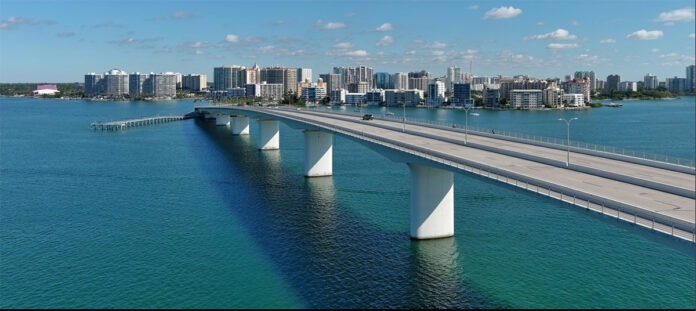
—Policy 6.8 of the current comprehensive plan, titled “Additional Access Serving Longboat Key,” states that the city will support planning for an additional bridge to connect Longboat Key to the mainland in order to relieve traffic congestion on the John Ringling Causeway. The rewrite strikes it entirely.
‘Imagine my shock’
—Longboat Key At-Large Commissioner BJ Bishop stepped to the podium during the public hearing and delivered the sharpest rebuke of the day.
“One of the most important things that has happened in my seven years on the commission is the much improved working relationship that we have with all of you,” Bishop told the Sarasota board, noting the two governments’ next joint meeting is scheduled for October. “So imagine my shock when I received a document over the weekend that vastly changed the transportation comprehensive plan and specifically eliminated three items that all relate directly to Longboat Key.”
“We would hope that those items would have been discussed at our joint meeting, that our staff would have had the opportunity to weigh in on those issues, that our commission and our town manager would have had that opportunity,” Bishop said. “But none of that was afforded to us.”
—Bishop, a former mayor of Leesburg, Virginia, dismissed suggestions that the island simply take its concerns to the regional Metropolitan Planning Organization, recalling the “paralysis” of regional councils when an issue involves just two jurisdictions.
“We have to come through Sarasota city streets to get to the hospital, to get to doctors, to get to performances at the Van Wezel and other places. So it’s not a luxury,” she said. “And quite honestly, while I am a serious cyclist, when I was recently hospitalized, I don’t ride my bicycle to the hospital.”
—Her plea: “Please, please give us an opportunity to have this on our October agenda and give our staff adequate opportunity to provide your staff with what I think would be some very important comments.”
—The commission transmitted the document anyway, roughly three and a half hours later.
—What got cut, and why
After lunch, Capital Projects Manager Alvimarie Corales walked the commission through the three Longboat-related provisions Bishop flagged. Action Strategy 5.1, covering joint planning and coordination with the town, survives. The other two do not.
—Action Strategy 6.2, which encouraged the city to pursue an interlocal agreement with Longboat Key creating a joint traffic concurrency review process for development on the barrier islands, was deleted because, Corales said, “it would be too complex, because we would be subjecting developments to go through two concurrency processes.”
—Then came Policy 6.8 and the bridge. Corales acknowledged what the current plan says, then explained the deletion: “In order for us to do this, it needs to be a commission direction and a coordination among you and the Longboat Key commission. There hasn’t been any coordination so far that actually tells us, put this in the transportation chapter.”
—Planning Manager David Smith offered a modest olive branch, saying that with transmittal approved, “I will be also sending the document to Longboat Key, Allen Parsons,” referring to the town’s Planning, Zoning and Building director. Adoption hearings are expected this fall, likely October — the same month as the long-scheduled joint meeting between the two commissions.

‘The dog days of summer’
—The bridge deletion was one grievance among many in a public hearing that drew eight speakers, none in support.
—Martin Hyde set the tone. “In the middle of the dog days of summer, on a work day, when the obvious hope is that nobody is watching, an important issue is being hidden in plain sight here,” he said, arguing that once the state signs off, “the green — or perhaps more accurately greed — light would be on for developers to make more money” while city streets are “turned into a car park through gridlock.”
“A supermajority is needed here to pass this love note to developers,” Hyde said. “Whoever puts their name to it should be aware that elections come around quickly, and traffic is the number one concern of citizens.”
—At the heart of the rewrite is a technical change with enormous practical stakes: scrapping the familiar A-through-F “level of service” grading system for roads in favor of a volume-to-capacity ratio. Dan Lobeck, speaking for Control Growth Now, called it “a paradigm shift the consultant has said to basically embrace traffic congestion” on the theory that misery will force people out of their cars.
—The new standard, Lobeck said, would allow a volume-to-capacity ratio of 1.0 downtown. “That is total and complete traffic congestion,” he said. “They are asking you to approve a document that would say the maximum traffic congestion a developer could put on a road in the downtown area is a hundred percent, bumper to bumper gridlock.”
—Lobeck and resident John Simon, who read portions of the Control Growth Now analysis that Lobeck ran out of time to deliver, catalogued the casualties of the rewrite: a policy requiring that coastal high-hazard development not cause excessive hurricane evacuation times, deleted; the comprehensive plan’s residential speed limit language, deleted; eight justifications for building and repairing sidewalks, reduced to two; a dozen specific requirements on developers to reduce cut-through neighborhood traffic, deleted; required staff presentations to neighborhood associations on transportation changes, deleted; the Newtown transportation concurrency management area, deleted; and the word “require” swapped for “request” when it comes to developers dedicating right-of-way.
“It screws over Newtown, by the way, Commissioner Battie,” Lobeck called out as he left the podium. His parting judgment on the whole document: “It is a big deal and not ready for prime time.”
—Simon summed up the mood of the room. “You go to the meetings, and you get a lecture from city staff about why what they want to do is right. They take some public input, and then they do what they want to do anyway,” he said. “The public is not heard.”
—Resident Yevgeny Khodorkovsky, a self-described avid cyclist and systems engineer, put it more bluntly: “Basically, you want to plan an entire Orlando in the middle of a largely single-story suburbia. The claim it is not a road diet is a big fat lie.” Even the city’s marquee multimodal project got no love from him: “I hate the Ringling cycle lanes.”
—Longtime downtown property owner John Harshman challenged the philosophical premise. “If you create congestion, then it’s going to force people to find alternate sources of transportation. That may work in a college town where you have a lot of kids that don’t mind getting out and running and dodging raindrops,” he said, “but not in a community like Sarasota, and not in an area where we’re competing with UTC and some other places that have easy access and easy parking.”
And 37-year resident Flo Entler warned that the whole exercise is being rushed past the people who will live with it. “This policy will likely be implemented by a future commission, not this one,” she said. “That makes it even more important that the intent you are approving today is unambiguous and closes any loopholes, because you won’t be here to interpret it later.”
—The meeting that may never have happened
—Resident Ron Collins raised a different kind of alarm: whether the public engagement record itself can be trusted.
—The backup material, Collins told the commission, contains a detailed account of a Feb. 3 public meeting at the City Hall annex, complete with findings presented, goals reviewed and written comments accepted. But a public records request, he said, produced a response from the city’s development applications coordinator stating that no community workshop or other public meeting was held before the Planning Board took up the chapter.
“I’m a little confused why we have such a detailed narrative about public input in the record from staff about a meeting that, as far as I can tell, never occurred,” Collins said. “I have a little question about what else in the report may or may not be supported by actual facts.”
—Staff pushed back hard after lunch. Corales said the Feb. 3 workshop was advertised beginning Jan. 23 on the city’s website, Facebook, Instagram and X, promoted through the city’s email newsletter on Jan. 30, and held at the SRQ Media Studio next to City Hall — and she pointed to a photograph from the session in the staff presentation. Smith displayed the email chain behind the records request and suggested the response had answered a narrower question than the one residents believed was asked.
—Collins had a second objection with legal teeth: the Planning Board, sitting as the city’s state-designated Local Planning Agency, directed staff to bring forward the zoning code regulations that would implement the new chapter. Staff declined, calling it out of scope. “Staff can’t turn away their directions. That direction was just ignored,” Collins said. “That alone is enough to say don’t transmit this.”
—A divided dais
—Commissioner Jen Ahearn-Koch opened the afternoon with a broadside at the process itself. “This is being put forth and has been advertised as an update, and in my mind, this is not an update. This is a major revision to our transportation chapter,” she said. “This did not follow the appropriate process.”
—She also came armed with the plan’s own demographic data: roughly 40 percent of city residents are either disabled or 65 and older, and the share of households without vehicles has declined from 13 percent to 7 percent. “Those are serious numbers that we need to be thinking about and discussing” before designing a system around walking and cycling, she said. Pressed by the consultant on whether she wanted policy geared toward more cars and parking, she answered that she wanted policy geared toward “the population that we have here in the City of Sarasota.”
—Even Mayor Debbie Trice, who chaired the marathon hearing, confessed she wasn’t ready. “Between the commission meeting two weeks ago and the budget hearings last week, I really haven’t had time to really study the documents, certainly not to my satisfaction,” Trice said. “I would love for us to say let’s continue this until maybe a meeting in September.”
—Ahearn-Koch and Vice Mayor Kathy Kelley Ohlrich said they would support a continuance. Commissioner Liz Alpert shut the door: “I would not be supportive of that.”
—Alpert argued the chapter “is so out of date” and “so inconsistent” with the city’s other criteria “that I think it does everyone a disservice,” adding, “It’s been ongoing for a couple of years now. To keep delaying it, I think, doesn’t help us.”
—Commissioner Kyle Battie sided with her, framing transmittal as harmless because adoption comes later. “It gives the commission and the community another bite at the apple,” he said. As for the drumbeat of demands for delay: “This death by a thousand paper cuts type stuff, man, I’m not down with it.”
—Ohlrich, who peppered staff with process questions, ultimately backed the change in traffic measurement itself: “Our city is practically built out. I don’t see us widening some of those streets like Bahia Vista.”
—The city’s consultant, Dr. Jason Collins, acknowledged the political weather while urging the board forward. Asked about the new state growth law, Senate Bill 180, he conceded, “There is a cloud from Tallahassee hanging over this whole process.” But, he said, “there might not ever be a perfect time,” and further delay would just “keep putting it to the curb.”
—What passed, and what comes next
—The final motion, by Alpert and seconded by Battie, passed 3-2, with Trice and Ahearn-Koch dissenting — a split vote on what Ahearn-Koch called “the biggest document this city commission adopts.”
“It should be a stronger vote than a split vote,” she said moments before the roll call.
—Before voting, the commission unanimously added two sweeteners. Ohlrich’s amendment inserts a fifth item into the plan’s parking study directive: examining “the need for parking impact fees,” which would charge developers who receive reduced parking requirements. And the board voted unanimously to fold the Planning Board’s supplemental recommendations into the transmittal, covering heat resiliency, developer accountability, safety and the zoning code implementation analysis residents demanded.
—Trice closed the item by directing City Manager Karie Friling to arrange sit-downs between transportation staff and individual commissioners “to address questions or provide explanations that we did not really have the time to do today.”
—The state’s review agencies now have 30 days to comment. Adoption hearings are expected this fall — setting up a potential collision with the October joint meeting where Longboat Key intends to ask, on the record, why its bridge disappeared.

