
After a year of anticipation, a July Fourth weekend of microphones strapped to trees and balconies, and 1,456 residents pouring their frustrations into a city questionnaire, Sarasota’s hired sound experts have delivered their verdict, and it is not the one downtown’s warring factions expected.
—The enemy of Sarasota’s peace is not the band at the corner bar. It is the guy in the loud car circling the block to make sure you notice him.
—On Monday, September 21, Gainesville-based Siebein Acoustic returns to City Hall with a 262-page Phase 1 report on the Citywide Sound Study, and a request that has become as predictable as a modified muffler at midnight: authorization to proceed to Phase 2. The City Attorney’s office is recommending commissioners receive the report, declare Phase 1 complete, and send the consultants back into the field for another season of measurement, stakeholder meetings and ordinance drafting.
—Before the Commission votes, here is what the city actually bought, what the data says about life on the ground and 11 floors up, and what it will mean for the people trying to sleep, dine and do business in a downtown the city itself designed to be loud.
—The Conundrum Sarasota Built
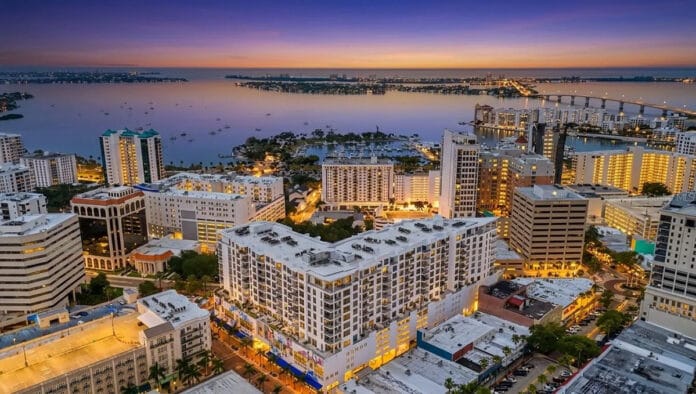
—Start with the geometry, because the consultants did. Sarasota spent two decades approving tower after tower of residential condominiums in its downtown core, then routed every major artery, including US 41, Main Street, Palm Avenue and the roundabout circuit, directly through that same corridor. The result is what the report bluntly calls a “canyon” effect: sound bouncing off high-rise facades, reinforcing itself, and climbing straight up the glass to the balconies above.
—The study identifies a phenomenon it calls reflective amplification, where building surfaces act as giant sounding boards. Add “verticality,” the problem Keely Siebein flagged when the study was commissioned: a code officer with a meter at street level finds no violation, while a resident on the 11th floor has a direct, unobstructed acoustic line of sight into an open-air venue or a revving engine below.
—Then there is the bass. As sound reflects off buildings, passes through trees and penetrates walls and windows, the high frequencies get filtered out. What survives is the low-frequency thump, what the report describes as the “bump, bump, bump” stripped of all musical context, which travels farther, shakes windows, and is felt in the chest as much as heard. The consultants’ 3D computer models show that bass energy spreads blocks beyond where an ordinary A-weighted sound meter says the problem ends.
—In other words, Sarasota built a concrete amphitheater, moved thousands of residents into the balcony seats, ran a state highway across the stage, and is now paying acousticians to explain the acoustics.
—The Verdict: Follow the Exhaust Pipes

—The questionnaire results are lopsided in a way civic surveys rarely are. Of the 1,456 responses received by the end of August, roughly 2.5 percent of the city’s population, approximately 73 percent named car engine revving and loud exhaust systems as their tormentor. Car stereos blasting from vehicles came second at about 50 percent. Amplified music from an actual venue, the thing the sound ordinance wars have been fought over for years, registered with only about 22 percent.
—In the downtown core zip code of 34236, where 926 of the responses originated, the engine-revving number climbs to 84 percent.
—Even the business community, which might be expected to defend every decibel, agrees on the diagnosis. Approximately 92 percent of business respondents described downtown’s soundscape positively, celebrating live music, festivals and outdoor dining as the engine of the district’s vitality. But 77 percent of those same businesses named loud motorcycles, revving engines, modified exhausts and vehicle stereos as the real problem. Restaurateurs report that residents and visitors now avoid outdoor dining because of the vehicle noise, which is a remarkable thing for a city that sells itself on al fresco evenings.
—That confirms what downtown resident Jim Lampl told commissioners back in March, when he described a red Corvette pace car circling downtown at least four times on a Saturday night, “deliberately revving and popping between Palm Avenue and Main Street.” As Lampl put it then: “These are people who are not your customers. These are people who are just there to get noticed.”
—The consultants now have the numbers to back him up. At Palm and Main, their meters logged loud-vehicle events, some reaching 89 to 110 dBA, more than 169 times in a single 24-hour period. Motorcycles were clocked at over 103 dBA. For scale, normal conversation at three feet is 60 to 65 dBA, and every 10-decibel jump is perceived as roughly a doubling of loudness.

—What It Sounds Like on the Human Level
—The most quietly devastating statistic in the entire report is not a decibel reading. Asked what brings relief when disturbing sounds intrude, 37 percent of respondents answered that nothing helps. Another 34 percent said they close their windows and doors, which is to say they seal themselves inside their homes in a city people move to for the weather. Twenty-one percent said they simply leave the area until it is over, and 20 percent resort to headphones or earplugs.
—This is a survey population dominated by the people Sarasota courts hardest: 74 percent are year-round residents, nearly 60 percent are 65 or older, and more than half live in the high-rise condominiums the city approved along the corridor. Over 600 said they hear disturbing sounds daily.
—And most of them suffer in silence, at least officially. Fully 85 percent have never filed a formal complaint. The report draws the obvious conclusion: the complaint logs the city has been using to gauge the problem represent a fraction of the people actually living with it.
—The long-term meters tell the same story in engineering language. On the 11th-floor balcony of The Mark, overlooking the Lemon Avenue and Main Street entertainment cluster, day-night average sound levels ran 67 to 81 dBA. Federal HUD rules require noise mitigation in housing anywhere the figure exceeds 65. During the July 4 Block Party below, that balcony absorbed 80 to 92 dBA, some 20 to 27 decibels above ambient, which the report translates as four to nearly six times louder to the human ear. The event, it should be noted, was entirely legal under a special event permit.
—In Newtown, the complaints center not on venues but on vehicles parked with trunks open and sound systems roaring. A gathering along Dr. Martin Luther King Jr. Way was measured at 100 dBA. The modeling shows that bass rolling over one-story rooftops and vacant lots deep into a neighborhood of wood-frame houses with single-pane windows, long after an ordinary meter at the residence would have registered nothing actionable.
—Why the Cops Can’t Catch It
—The report also explains, with some sympathy, why enforcement has felt so futile. Sarasota Police officers, whom the consultants found well trained on their meters, are required to take a five-minute reading near the offending source. One officer confided that passing cars, loud talkers and other city sounds contaminate the reading so often that measurements must be restarted again and again. Meanwhile the actual offender, a moving vehicle, is gone in eight seconds.
—Police representative Pat Robinson put it plainly in March: with roughly 18 to 22 officers on duty citywide at any hour, the odds of one standing next to a backfiring Camaro at the moment of the crime are, in his words, “very low.”
The Fix List: 14 Tune-Ups and One Big Idea
—So what do the consultants actually recommend? Phase 1 produces no wholesale rewrite. Instead it offers a 14-item punch list to make the existing ordinance enforceable, plus a menu of bigger structural ideas for later phases. The highlights:
—Close the daytime loophole. Astonishingly, Sarasota’s current ordinance sets no sound limit at all for amplified music during daytime hours. The consultants recommend daytime caps of 75 dBA and 80 dBC.
—Shorten the reading. Replace the impossible five-minute measurement with a 15-to-30-second reading using the meter’s fast response, which better matches how human ears actually perceive sound, taken at a specified distance.
—Target the bass. Elevate the C-weighted “max” metric as the enforcement tool for amplified music, because A-weighted readings systematically miss the low-frequency thump that generates the complaints.
—Adopt the Fournier language. The study endorses much of the ordinance rewrite prepared years ago by former City Attorney Robert Fournier, including a “plainly audible” standard kicking in one hour after amplified music must stop.
—Go after the vehicles directly. The marquee recommendation is a new plainly audible standard for deliberate vehicle noise. The draft language would prohibit intentionally created “fluctuating intermittent vehicle noise,” the revving, popping, backfiring and crackling, plainly audible at more than 50 feet. No meter, no five-minute reading; an officer’s ears become the instrument.
—Rein in special events. Enforce the newly adopted event limits of 85 dBA or 90 dBC, measured 100 feet from the loudspeakers, with mandatory end times. The July 3 Fresh Fridays event at Five Points Park was measured at 90 to 100 dBA at 164 feet, with four subwoofers pushing bass more than two blocks.
—Test noise cameras. The consultants suggest a trial of automated devices that detect loud vehicles and can be paired with ticketing systems, technology now deployed in New York City, Knoxville and Paris. There is a catch, and it is a big one: city staff told commissioners in March that Florida preempts using the cameras for actual ticketing, limiting them to monitoring. Any Sarasota trial would be data collection, not enforcement, unless Tallahassee changes its mind.
The bigger structural ideas, deferred to Phases 2 and 3, include a dedicated sound enforcement unit staffed on nights and weekends, a possible “Soundscape Office” to liaise with residents and businesses, formal soundscape zones with different limits for different districts, and, most consequentially for developers, acoustic design requirements written into the zoning and building codes for new construction, so the next tower is built to keep the corridor’s sound out.
Every change, the consultants urge, should launch as a six-month soft opening: three months with no penalties, three months of warnings.
—The Tab, and the Blank Line on Monday’s Agenda
—When the Commission authorized the study in March, the estimated budget for the full three-phase effort ran between $175,000 and $250,000, a figure that prompted resident gadfly Martin Hyde’s memorable review: “Word salads are very expensive.” Hyde urged the city to “call this one a hundred grand and call it quits.”
—Monday’s agenda request asks commissioners to authorize Phase 2, including continued stakeholder engagement, development of regulatory standards, measurement protocols and enforcement procedures, and a return trip with a proposed ordinance amending Chapter 20 of the City Code. What the agenda request does not do is fill in its own “Funding Source and Amounts” field, which sits blank. Residents watching the meter run on this study, in every sense, may want to ask what Phase 2 costs before the vote.
—The consultants’ scientific case for Phase 2 is straightforward: they measured Sarasota in July, when the snowbirds and the season are gone. The plan calls for returning between October and March to capture the city at full volume, testing trial ordinance changes, and delivering near-final recommendations in Phase 3.
—How the Other Half Regulates
—If Sarasota is looking for company among America’s upscale enclaves, the comparison is instructive, and a little humbling.
—Miami Beach, the model Sarasota’s own December ordinance rewrite explicitly borrowed, enforces a plainly audible standard: sound that can be clearly heard 100 feet from its source between 11 p.m. and 7 a.m. is prima facie evidence of a violation. A federal appellate court upheld it, which is precisely why Sarasota copied it.
—Naples, Sarasota’s rival for the title of Gulf Coast gentility, caps amplified sound from radios and similar devices at levels as low as 50 dBA at night measured at the property line, roughly the volume of a quiet conversation, and pairs it with a live entertainment permit system for its commercial districts.
—Collier County goes a step further with an interior standard: amplified sound that exceeds 53 dBA inside a neighboring condo unit, windows closed, is a violation. That approach regulates what the resident actually experiences in bed, not what a meter reads on the sidewalk.
—Tampa prohibits nighttime sound plainly audible at just 50 feet, the same distance Siebein now proposes for Sarasota’s vehicle standard.
St. Pete Beach is weighing plainly audible limits of 200 feet at night and 500 feet by day near residential areas, after concluding its decibel-based ordinance was unenforceable, a lesson Sarasota has now paid handsomely to learn independently.
—The Town of Palm Beach, the platinum standard of Florida quietude, regulates all the way down to the hours and equipment of lawn maintenance crews.
—And for the revving-engine problem specifically, the frontier is automated. New York City’s noise cameras, live since 2021 and since expanded, mail fines starting at $800 to owners of illegally loud vehicles. Paris runs a similar program. Florida law currently blocks that path for its cities, leaving Sarasota’s officers with their ears, a 50-foot rule if the Commission adopts it, and the state’s own statute making a car stereo plainly audible at 25 feet a traffic infraction.
—What Happens Monday, and What Doesn’t
—To be clear about what Monday is not: it is not an ordinance vote. No sound limit changes, no new enforcement rules take effect. The Commission will be asked to receive the report, acknowledge Phase 1 is complete, and turn the consultants loose on Phase 2, with an ordinance to follow at a future meeting.
—Which means the red Corvette gets at least one more season of open-throttle laps between Palm and Main, the residents of The Mark get another winter of measuring their evenings in dBC, and the city gets to decide whether a study that has already told it exactly who the villain is needs another lap of its own.
—The engines, at least, will be warmed up.

