
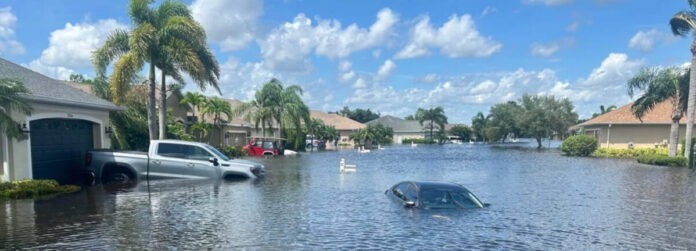
Eleven Gulf Coast governments fixed their codes so flood-weary homeowners can lift their houses. Sarasota still hasn’t.
—Amid a marathon Aug. 3 meeting consumed by parking rage and a traffic-plan brawl, one St. Armands resident delivered the quietest and perhaps most consequential three minutes of the day: a documented case that the City of Sarasota is now an outlier among Gulf Coast governments in refusing to clear the zoning obstacles that keep flood-damaged homeowners from elevating their houses.
—Henry Kahwaty, a St. Armands resident since 2012, was making his third trip to the podium on the subject since February. This time he brought a law firm’s research with him.
“I asked Williams Parker to look at jurisdictions up and down the Florida west coast,” Kahwaty told the commission, gesturing to a slide. “You’ll see 11 jurisdictions listed here. Those jurisdictions have all made zoning text amendments since Helene and Milton to facilitate coastal construction, and in particular have positive effects on those people trying to elevate their properties.”
—Eleven local governments, in other words, have already rewritten their rules since the twin 2024 hurricanes drowned neighborhoods from Siesta Key to Anna Maria. Sarasota, whose barrier island neighborhoods on St. Armands, Lido and Bird Key took some of the region’s worst surge, is not among them.
—The barriers, spelled out
—The obstacles are not the building code. They are the zoning code, and Kahwaty has been itemizing them at City Hall since winter.
“I came before the commission and talked during the public comment section on February 2nd to raise the topic of the barriers that our zoning ordinance has for home elevation projects to mitigate flood risk by elevating properties,” he said. “I only had three minutes to talk at that time, so very limited in what I said.”
—That first appearance drew a response from the dais. “At the end of the meeting, Commissioner Alpert requested the city manager investigate the issues, and she did not know what the barriers were,” Kahwaty recounted. “I took that as an invitation to come back two weeks later and talk about setbacks, daylight plane issues, building coverage issues that are barriers to home elevation projects.”
—The problem, in plain terms: when a homeowner jacks a flood-damaged house up onto a new elevated foundation, the taller structure can suddenly violate height and “daylight plane” restrictions designed for the old, lower house. Stairs, landings and lifts can push into setbacks. New foundations and entry structures can blow past lot coverage limits. A homeowner doing exactly what federal flood policy begs them to do — get the living space above the water — can find the zoning code standing on the hose.
—The Williams Parker memorandum, dated July 9, covers precisely those three subjects: height and daylight plane restrictions, setback restrictions and lot coverage restrictions. Kahwaty said the full version, with roughly 200 pages of the other jurisdictions’ actual text amendments attached, was hand-delivered to the city’s Development Services staff back in July. It now sits in the commission’s own backup packet.

—The Longboat Key mirror
—Then Kahwaty turned to the neighbor across the bridge, and the comparison was not flattering to Sarasota.
“I’d also like to comment on Longboat Key,” he said. “In your packet is a five-page memo prepared by Allen Parsons, building and zoning director there, where they set out in detail the issues that are creating issues for residents. Currently 30 properties on Longboat Key are homeowners trying to elevate their properties.”
—The Parsons memo, Kahwaty said, “is a very good summary. It covers the same type of things I’ve been talking about: setbacks, building coverage, daylight plane issues. They also talk about pool elevation, which is not something I got into.”
—And critically, the town is doing something about it. “The town commission had a workshop on this subject on June 22 and instructed staff to come up with recommendations,” Kahwaty said.
—That was as far as he got.
“Thank you, Mr. Kahwaty. Your time has expired,” Mayor Debbie Trice said, and the meeting rolled on to the next speaker.
—Six months, three appearances, no action
—No commissioner responded to Kahwaty’s presentation, and because he spoke during citizens’ input rather than on an agenda item, no action was possible. That is precisely the problem he keeps returning to point out: six months after the issue was first raised, and after a sitting commissioner asked the city manager’s office to investigate, home elevation relief has yet to appear on a single Sarasota agenda.
—The stakes for the city’s island neighborhoods are hard to overstate. Elevation is the gold-standard flood mitigation for the thousands of older, ground-hugging homes on St. Armands, Lido and Bird Key, many built decades before modern flood maps. It is what FEMA grant programs fund, what insurers reward and what the 50 percent “substantial improvement” rule effectively forces on owners of badly damaged houses. Every month the zoning code stays frozen, more storm-scarred homeowners face a grim menu: rebuild low and pray, fight for variances one hearing at a time, tear down and build new at far greater cost, or sell to someone who will.
—Meanwhile, the region is moving without Sarasota. Eleven west coast jurisdictions have amended their codes. Longboat Key has a staff directive and a detailed diagnosis of its own barriers, down to the swimming pools. The research is done, attached and sitting in the city’s files, delivered by a resident at his own initiative.
What Sarasota has, so far, is a man with a stack of memos, a three-minute timer and an apparently open invitation to come back and try again.

