
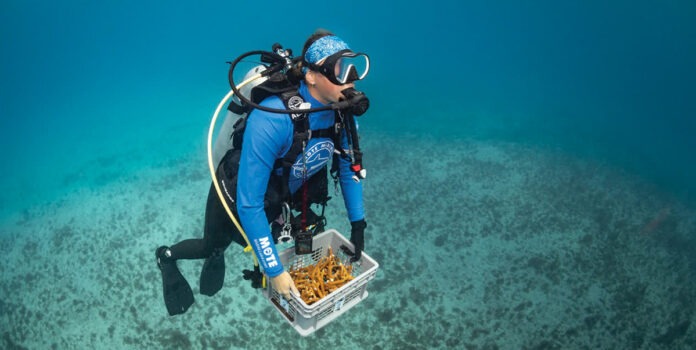
The divers went back in the water this month, and once again they were not planting coral. They were taking it out.
—Along Florida’s Coral Reef, the 350-mile arc running from the Dry Tortugas to Martin County, Mote Marine Laboratory has launched a Keys-wide evacuation of thousands of corals from its offshore nurseries, moving threatened and endangered colonies into land-based tanks before this summer’s heat kills them where they sit. At the University of Miami, scientists hauled 30 elkhorn fragments ashore into a hatchery. The Coral Restoration Foundation is awaiting regulatory approval to shift vulnerable colonies to deeper, cooler water off Elbow Key.
—It is the second full-scale coral rescue in three years. It is happening roughly 200 miles south of Longboat Key. And it should still matter here, because the heat driving the evacuation is only half the assault. The other half is arriving quietly, dissolved in the water itself, and it does not stop at the county line.
—Ninety Degrees and Counting
—Water temperatures above about 87 degrees, sustained, push corals past their tolerance. Under that stress they expel the symbiotic algae living in their tissue, the zooxanthellae that supply most of a coral’s food through photosynthesis. The colony turns white. Bleached coral is not dead coral, but it is starving coral, and if the heat holds, it dies.
—NOAA raised its bleaching alert for parts of the Florida Reef Tract in mid-July, weeks earlier than the historical pattern. Federal scientists have already documented paling at Cheeca Rocks off Islamorada. USGS researchers photographed bleached starlet and lobed star coral at Newfound Harbor in the Lower Keys on July 12. South Florida has now run more than 45 consecutive days of triple-digit heat indices.
—The water off our own beaches is not cool either. Sea surface temperatures at Longboat Key touched 89 degrees in mid-July, roughly three and a half degrees above the seasonal norm, in a Gulf whose broad, shallow shelf heats faster and holds heat longer than deep ocean.
—The Slow Burn Nobody Photographs
—Bleaching makes for arresting photographs. Acidification does not, which is precisely the problem.
—The ocean has absorbed roughly a quarter of the carbon dioxide humanity has put into the air. That CO2 does not simply vanish into the blue. It reacts with seawater to form carbonic acid, driving down pH and stripping out the carbonate ions that corals, oysters, scallops, clams and stone crabs need to build skeleton and shell. Scientists track this through the aragonite saturation state, and where that number falls far enough, calcium carbonate structures stop forming and eventually begin to dissolve.
—In June 2025, a team led by Plymouth Marine Laboratory and NOAA published findings in Global Change Biology concluding that average global ocean conditions crossed into the ocean acidification “planetary boundary” by 2020, with more than 40 percent of the surface ocean and as much as 60 percent of the subsurface ocean already past it. Their analysis found habitat suitable for tropical reef corals has contracted by roughly 43 percent. That September, the annual Planetary Health Check added acidification to the list of planetary boundaries humanity has breached, bringing the total to seven of nine.
—Heat and acid are not separate problems politely taking turns. Laboratory and mesocosm work has repeatedly shown the two act together: corals often tolerate elevated CO2 at normal temperature, but calcification falls off sharply when both climb at once. A landmark study found acidification erodes skeletal density rather than upward growth, meaning reefs can keep extending while quietly becoming more brittle, more erodible, less able to hold a line against waves.
—The Tipping Point Nobody Wanted
—In October 2025, 160 scientists across 23 countries released the Global Tipping Points Report and delivered a conclusion that has not gotten nearly the attention it deserves in a state built on reef-fed beaches. Warm-water coral reefs, they found, are the first Earth system to cross a climate tipping point.
—The threshold was estimated at 1.2 degrees Celsius of warming. The planet is running near 1.4. More than 80 percent of the world’s reefs have bleached since January 2023 in the fourth global bleaching event on record.
Florida has already paid part of that bill. A NOAA-led study published in Science confirmed the 2023 marine heatwave, the ninth mass bleaching on Florida’s reef since 1987, drove elkhorn and staghorn coral to functional extinction in state waters. Around the Keys and Dry Tortugas, 98 to 100 percent of those colonies died. Of the original wild elkhorn genotypes in the Keys, roughly 100 remain. Thirty years ago they numbered in the thousands.
—What Sarasota Loses When the Keys Burn
The case for caring is not sentimental. NOAA values Florida’s reef system as an $8.5 billion asset generating $4.4 billion in annual sales, $2 billion in income and more than 70,000 jobs. Healthy reef dissipates as much as 97 percent of incoming wave energy, and federal estimates credit Florida’s reefs with protecting more than $650 million a year in property and economic activity from flooding.
—Barrier islands do not get to opt out of that arithmetic. Longboat Key and Lido Key have spent decades and tens of millions of dollars on renourishment, groins and inlet management. Every structure that absorbs wave energy offshore is a structure the beach budget does not have to replace.
—The fisheries argument is just as direct. Half of all federally managed U.S. fisheries depend on coral reef habitat. The grouper and snapper that anchor charter fleets out of New Pass and Longboat Pass move through reef and hardbottom habitat at different life stages, which is exactly why the Sarasota Bay Estuary Program has deployed more than 3,000 artificial reef modules at nine sites since 2000, and why Sarasota County runs one of the more active artificial reef programs on the coast.
—The Bay in Our Own Backyard
—Here is the part that rarely makes it into national coverage. Acidification is not only an open-ocean story.
—A study of more than 80,000 measurements across ten Florida shellfish estuaries found statistically significant pH declines in eight of them, with Gulf-side estuaries acidifying at a measurable annual rate. Separate work tracking surface CO2 on the West Florida Shelf between 1996 and 2017 documented steady increases in coastal waters off our own coast.
—Local processes make it worse. Dr. Emily Hall, who manages Mote’s Ocean Acidification Program from Sarasota and built the lab’s OASys experimental system here, published research finding that red tide blooms themselves can trigger localized biological acidification events. Stormwater, fertilizer runoff and nutrient loading feed those blooms. Karenia brevis was detected at background concentrations offshore of Sarasota County in late July.
—Translation: the same bay where we are rebuilding oyster reefs and counting scallops is a place where shell-building organisms face a chemistry problem partly authored by what runs off our own lawns and parking lots.
—Mote’s Two-Front Fight
—Mote has invested in coral restoration for more than 30 years, outplanting over 275,000 corals in the last decade with roughly 75,000 fragments still growing in Keys nurseries. Its International Coral Gene Bank holds approximately 10,000 unique genotypes across 34 species, one of the largest living collections of Caribbean coral outside the reef itself. During the 2023 emergency, some rescued corals were trucked to Mote’s 200-acre Aquaculture Research Park in eastern Sarasota County.
“Protecting genetically diverse corals during these events is essential to advancing restoration science,” said Dr. Michael P. Crosby, Mote president and CEO, citing the lab’s long-term investment in land-based infrastructure.
—The lab is also treating the crisis as an experiment, deliberately leaving representative samples of multiple genotypes in the offshore nurseries to see which ones endure. In 2023, some not only survived but never bleached at all.
“Every extreme heat event provides an opportunity to improve our understanding of coral resistance and resilience,” said Dr. Jason Spadaro, who manages Mote’s Coral Reef Restoration Research Program.
—That work has produced genotypes showing resilience to heat, disease and acidification alike, which is the only version of restoration that makes sense in an ocean that is not going back to 1985.
—What Actually Moves the Needle
—Rescue operations buy time. Nobody at Mote or NOAA pretends otherwise. Coolers and tanks preserve genetic material; they do not restore a reef.
—The levers within reach of a Sarasota County commission or a Longboat Key town commission are the local ones: stormwater retrofits, fertilizer ordinances that get enforced rather than announced, septic-to-sewer conversion, seagrass and mangrove protection, and continued investment in the artificial reef and oyster programs already in the water. None of those fix atmospheric CO2. All of them reduce the local nutrient load that amplifies acidification and feeds the blooms that make it worse.
—The corals in the tanks this summer are, in a real sense, a savings account. Whether there is ever anywhere to spend it is a decision being made somewhere else, and mostly not by us.

