
—The campaign signs got to the schoolhouse before some of the students did.
—They crowd the corners of downtown, stand sentry along the streets around Southside Elementary and Bay Haven, and multiply daily near every school-zone crosswalk in the city. Brandt. DeWitt. Glover. Tennimon. Mayberry. Pozzie. Names that in any ordinary August would mean nothing to a family fighting the morning carpool line. Not this August. Sarasota’s public schools have just finished the first week of the 2026-27 school year, and on Tuesday, Aug. 18, the county decides who will govern them.
—The collision of those two calendars gives this opening a charge no first week in recent memory has carried. The celebration is easy to find: Sarasota County Schools has just posted its 23rd consecutive “A” grade from the state of Florida, a streak unmatched on the Gulf Coast, and every single district-managed school earned an “A” or a “B.” The consequence is harder to miss: the district opened the year having eliminated hundreds of positions, trimmed teacher supplements, tightened health benefits and absorbed the expiration of $115 million in federal pandemic relief. And now, with backpacks unzipped and the new bell times already reshaping island mornings, voters will settle a school board election with three open seats, seven candidates and the ideological direction of Florida’s most decorated district hanging in the balance.
—Here is the full picture as the second week of school begins on the barrier islands and the mainland, and the final ballots come due.
—Still the Pride of the Suncoast: 23 Straight Years of ‘A’
—Start with the number that defines this district. When the Florida Department of Education released school grades this summer, Sarasota County Schools earned an overall “A” for the 23rd year in a row, a run that stretches back to the first years of the state’s accountability system. One hundred percent of district-managed schools received an “A” or “B” grade, a distinction few large Florida districts can claim.
—That academic pedigree is not an abstraction for island families. It is baked into real estate values from Longbeach Village to Bird Key, cited in every relocation brochure and repeated by every Realtor walking a prospect through a St. Armands listing. The district serves roughly 44,000 students across more than 50 schools countywide when charter schools are included, with about 36,600 students expected in traditional district-run classrooms this year.
—The schools that serve the island communities, including Southside Elementary, Bay Haven School of Basics Plus, Booker High and Sarasota High, all sit inside that A-and-B universe, and the district’s magnet and specialty programs, from Pine View to the Sarasota High MaST Research Institute, continue to collect statewide honors. A Sarasota High teacher, MaST director Andy Harshman, was named the county’s 2026 Teacher of the Year and is Sarasota’s nominee for Florida Teacher of the Year.

—Terry Connor: The Steady Hand Steering Through the Storm
—Superintendent Terry Connor begins his fourth school year at the helm, and by most measures the former Hillsborough County deputy superintendent has become one of the more secure figures in Sarasota public life, no small feat in a county where school politics has chewed up administrators and dominated cable news.
—Connor arrived in July 2023 after a career that began in a science classroom and ran through principalships and the chief academic officer’s post in Clay County. He inherited a board famous for shouting matches over masks, library books and inclusion policies, and he has largely kept the district’s academic machine humming while the political weather raged around him.
—His standing is notable across the spectrum. Board conservatives have praised his budget discipline in recent cycles, while the board’s more progressive members credit him with protecting classrooms during painful cuts. When the district faced criticism this spring over staffing reductions, Connor took the presentations himself, framing the situation in a March workshop with a phrase that has since become the district’s fiscal mantra: this is a “financial correction, not a crisis.”
He has also shown a willingness to fight. Connor has publicly sparred with Sarasota County Tax Collector Mike Moran over Moran’s claim, first raised last summer, that the district owes collection fees on its voter-approved millage dating back more than two decades. More than $2 million has been withheld during the dispute, money Connor insists belongs in classrooms. The standoff remains unresolved as the new year opens.
—Is he popular? By the standards of Florida superintendents in 2026, remarkably so. Parents’ groups on both ends of the political divide have found reasons to grumble, but no organized effort to unseat him exists, and his contract extensions have come without drama.
—The 7:30 Bell: A New Morning Rhythm for Island Families
—The change island families felt most immediately this week was on the clock. To comply with Florida’s school start time law, the district adopted new bell schedules approved by the board in February. High schools now begin at 7:30 a.m., elementary and K-8 schools at 8:30 a.m., and middle schools at 9:30 a.m., with limited exceptions.
—For Longboat and Lido parents making the drive over the Ringling Bridge, that means high schoolers leave in the dark-early hours while middle schoolers get a comparatively leisurely morning. The district spent months surveying families and running community workshops before landing on the schedule and filed its compliance documentation with the state in April.
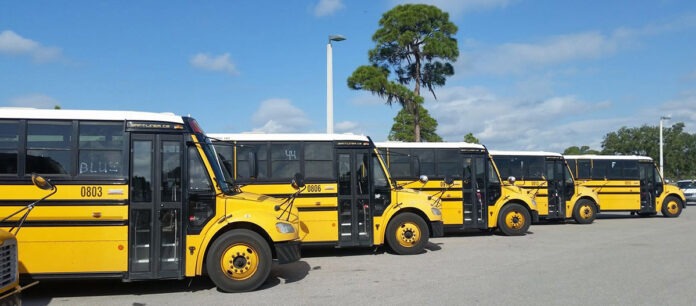
—Paired with the new bell times is a new transportation platform called My Ride K-12, an app the district is urging every bus family to download. It shows a child’s bus assignment and stop, tracks the bus in real time and pushes alerts about delays or substitute buses, a welcome upgrade for parents who have spent years squinting down Gulf of Mexico Drive wondering where the bus went. Transportation requests run through the Focus Parent Portal; the guarantee deadline for first-day routes has passed, but the district continues processing applications.
—Four Elementaries Become K-8s, and Brookside Is Reborn as an AI Academy
—Structurally, this is the most ambitious reshuffling of Sarasota’s school portfolio in years. Four elementary schools, Brentwood, Gulf Gate, Wilkinson and Alta Vista, are converting from K-5 to K-8 campuses, adding sixth grade this year and a grade each year after. Connor has said the conversions answer parent demand for educational continuity and put underused buildings back to work; the four campuses had been hovering around half capacity.
—Meanwhile, Brookside Middle School, a familiar name to generations of Sarasota families, has been reinvented as the Gulf Coast Academy of Innovation and Technology, with a curriculum built around artificial intelligence and cybersecurity at the middle school level, feeding students into the district’s expanding high school STEM pathways.
—In South County, the district cut the ribbon on Wellen Park High School in Venice just weeks before opening day, part of a building program that has also delivered the Skye Ranch K-8 east of Interstate 75, the district’s first new schools in more than 15 years.
—Athletics expand too. Middle school boys and girls soccer launches this fall, boys and girls flag football arrives at middle schools in spring 2027, and girls flag football will be offered at every district-managed high school beginning next spring. The district continues its partnership providing $20 ECG heart screenings for student-athletes, with financial help available.
—The Budget: A Correction With Teeth
—Now the harder arithmetic. The school board approved a tentative 2026-27 budget in late July totaling roughly $1.3 billion, with an operating budget about 2.2 percent smaller than last year’s. The final budget and millage adoption comes at a September public hearing.
—The revenue structure explains why Sarasota’s district behaves differently from most in Florida. About 86 cents of every dollar the district spends comes from local property taxes, with only about 10 cents from the state and 4 cents from Washington. That heavy local funding, driven by the county’s formidable property values, including the assessments on Longboat Key, Lido and downtown’s condominium towers, is precisely what has insulated Sarasota schools for decades. It is also why the voter-approved supplemental millage, renewed by referendum every four years since 2002, remains the district’s crown jewel and why the fee fight with the tax collector over collecting that millage has drawn such a sharp response.
—The pressures stacking up against that local wealth are real and compounding. The $115 million in federal COVID-19 relief that propped up staffing and programs has fully expired. District officials estimate Florida’s universal school voucher program, which no longer carries income limits, siphoned roughly $45 million from district revenue this year alone as scholarship dollars follow students to private and home schooling. Enrollment in traditional schools is flat to declining, squeezed by falling birth rates, the county’s punishing housing costs for young families and the growth of charter and private options. State per-student funding has stagnated. And operational costs, from health insurance premiums to fuel, food and utilities, keep climbing.
—Connor’s own framing is telling: a decade ago the district educated almost exactly the same number of students it expects this year, roughly 36,600, but with nearly 500 fewer employees. The correction, in his telling, is about realigning staffing to the students the district actually generates.
—Teacher Cuts, a Surplus List and a Softer Landing Than Feared
—The human cost of that correction dominated the spring. In April, the district announced it was cutting 136 teaching positions, part of a broader plan that at one point contemplated eliminating 180 instructional positions and 79 classified jobs. Teachers on the “surplus list” faced a summer of uncertainty, and the Sarasota Classified Teachers Association described heartbreak at not being able to protect everyone.
—The compensation changes stung as well. The district’s top-tier PPO health plan, previously free to teachers, now costs $200 a month, though the HMO and lower-tier PPO remain free. Supplemental pay for teachers in high-need assignments was slashed: the annual boost for Title I school teachers dropped from $3,000 to $1,200, and teachers of exceptional student education students at Title I schools saw their supplement fall from $6,000 to $1,500.
—The good news arrived just before opening day. Connor said the surplus list, once 136 names long, has been whittled down as retirements and resignations opened slots. Speaking days before the first bell, he said the district has “gotten that number down into the teens,” with nearly every displaced teacher finding a landing spot for this year.
—That distinguishes Sarasota from the national teacher-shortage narrative in an ironic way: while districts elsewhere scramble to fill empty classrooms, Sarasota’s problem this year was too many teachers for its funded positions. Still, hiring continues in chronic shortage areas, including exceptional student education, and the district opens the year with dozens of posted vacancies across instructional and support roles.
—Tuesday: Three Open Seats, Seven Candidates and a Majority in Play
—Which brings us to the ballots, some already returned by mail, the rest due by 7 p.m. Tuesday. The Aug. 18 school board election is the most consequential in years, and every voter in the county, regardless of where they live, votes in all three races.
—None of the three conservative incumbents whose seats are open, Bridget Ziegler in District 1, Karen Rose in District 4 and Robyn Marinelli in District 5, is on the ballot. Their departures end an era in which a reliable conservative majority steered the board through fights over masks, book challenges, an ICE cooperation resolution and penalties for student walkout protests, often before packed and raucous chambers.
—The races are officially nonpartisan, but nobody is pretending, least of all the sign-makers. The Republican Party of Sarasota County has endorsed a slate, the Democratic Party has endorsed its own, and the money, mailers and forums have taken on the flavor of a full partisan campaign. If the Democratic-aligned candidates sweep, the board flips outright, joining sitting members Tom Edwards and Liz Barker. If the Republican-endorsed slate holds all three seats, the conservative majority survives the incumbents’ exit.
—For all the polarization, the candidates broadly agree on the diagnosis: the district’s finances, declining enrollment and early literacy are the urgent issues. They diverge sharply on the cure, especially on Florida’s voucher program.
—District 1: The Coastal Seat, and the Race Closest to Home
—District 1 is our district, the coastal north county seat that covers the barrier islands and much of the city of Sarasota, and it has drawn the most crowded field.
—Heidi Brandt carries the Republican Party endorsement along with backing from state Rep. Fiona McFarland and state Sen. Joe Gruters. A Southside Elementary PTO president with an elementary-age child, Brandt has made early literacy her signature, proposing low-cost volunteer reading mentorship programs. Notably, she has broken with the outgoing board majority, saying she would have voted against both the ICE cooperation resolution and the student protest penalties, arguing the ICE measure accomplished nothing except stirring fear. She supports vouchers in principle but calls the current system broken and favors income-based sliding scales. She has raised more than $66,000.
—Teresa DeWitt, a therapist endorsed by U.S. Rep. Greg Steube and Sheriff Kurt Hoffman, has ties to Moms for Liberty activism and conservative training organizations. Declining most media interviews, she has campaigned on literacy, financial stability, televising the district’s financial and audit committee meetings, campus security cameras and volunteer programs to ease staffing gaps. She has raised about $19,000.
—Jimmy Glover, the lone registered Democrat in the race and the only African American candidate countywide, would be the first Black member ever elected to the Sarasota County School Board. A 30-year United Airlines flight attendant who raised his children in district schools and chairs the board of the Star Lab Montessori-style school, Glover emphasizes college and career readiness and mentorship for underserved students, and wants the district to lobby Tallahassee to restore income caps on vouchers. He is the race’s fundraising leader at more than $118,000, with endorsements from the county Democratic Party, Equality Florida and board members Edwards and Barker.
—District 4: The Entrepreneur vs. the Teacher
—In northeast county’s District 4, insurance agency owner Frank DiCicco, Republican-endorsed and backed by Sheriff Hoffman, has campaigned on rooting out budget bloat, publishing a more detailed district budget and bulk-purchasing school supplies for families. He acknowledges he currently lives outside the district following a divorce and says he will move in if elected, as the law requires. He opposes the state’s Schools of Hope charter co-location law and has raised about $18,000.
—Megan Tennimon, a former elementary teacher and mother of three district students, runs on academic achievement, teacher support and transparency, framing herself as the rare candidate who has stood on both sides of the classroom door. She blames the voucher program’s uncapped expansion for much of the district’s financial strain and wants income limits restored and the district rejoined to the statewide school boards association for lobbying muscle. She has raised more than $51,500 with endorsements including board member Barker.
—District 5: The Retired Teacher vs. the Firebrand, and the Race’s Biggest Controversy
—The south county District 5 contest has produced the campaign’s sharpest fireworks. Beth Mayberry, who retired in 2025 after more than 13 years teaching math and science in the district, has raised more than $71,600 with Democratic Party, Edwards and Barker endorsements. She calls chronic underfunding the central threat, wants arts programs strengthened to attract and retain families, and has criticized the outgoing majority for spending its energy on resolutions she considers distracting and damaging.
—Her opponent, Michelle Pozzie, is a longtime conservative activist, Turning Point USA chapter director and conservative media host who has spoken at board meetings for years. Republican-endorsed alongside Steube and Hoffman, she has focused on student discipline and literacy and argues the district should out-compete vouchers through aggressive marketing rather than reform.
—Pozzie has also generated the race’s defining controversies. She drew broad condemnation in June for comparing unmasked students during the pandemic to Jews persecuted by the Nazis. Then investigative reporting revealed she had claimed at a public forum to have been executive director of a Sarasota Family YMCA branch overseeing a multimillion-dollar budget; archived YMCA records and former colleagues identified her role as recreational gymnastics director, and she subsequently revised her own description of the job. She has raised about $15,900 and stopped responding to interview requests.
—What Tuesday Means on the Islands
—So the second week begins with a paradox worthy of this singular school district: academically triumphant, financially squeezed, politically contested. Island families feel it in small ways, a 7:30 a.m. high school bell, a bus-tracking app, a forest of campaign signs on the morning drive, and in one large way that never changes. The A-rated Sarasota school system remains among the most powerful engines of this community’s prosperity, the quiet justification behind every property value from the Village to Bird Key.
—Twenty-three straight years of excellence bought this district enormous goodwill. Tuesday’s ballots, and the nine months that follow, will test how it spends it.

