
You can’t order it off any menu in Florida. That law is exactly why the 22,000 lab-raised snook slipping into local waters this summer carry the weight of a multibillion-dollar fishery. There is a particular kind of evening that belongs to this coast. A blackened snook fillet on the table at a Gulf-side restaurant, the light going pink over the water, and somebody at the table still rattled from the fish that nearly spooled them an hour before. It is one of the quiet luxuries that make Longboat Key and Sarasota what they are — not only the dining, but the catching, the line tearing off the reel as a big linesider bolts back under a dock piling.
—Here is the part most visitors never learn: you cannot buy that fillet. Not anywhere. Florida declared snook a gamefish in 1957, ending all legal commercial fishing — no market, no menu, no exceptions, save one. A restaurant may keep a snook only to cook it for the recreational angler who legally caught it, and only if it arrives tagged with that person’s name and address. Every snook anyone eats on this island was fought, landed and carried to the dock by a person holding a rod. The entire economy of snook — every dollar it moves — runs through recreational fishing.
—That is precisely why what Mote Marine Laboratory is doing this summer matters more than a routine fish release.
—A fish with no price tag — and an outsized footprint
—Because snook never reaches a commercial dock, its economic value is easy to underestimate and hard to overstate. Statewide, the numbers are enormous: the American Sportfishing Association estimates recreational fishing contributes roughly $13.9 billion in economic impact in Florida each year, and the state counts about 4 million anglers. Snook sits near the top of the inshore wish list driving that spending — guide charters, tackle, fuel, boats, hotel rooms, restaurant tables.
—Mote puts a finer point on it. In a recent state funding request, the lab estimated that angling tourism in the regions hit hardest by fish kills and habitat loss supports more than 30,000 jobs and about $2.4 billion in value-added economic impact. An older regional assessment framed it bluntly: on Florida’s west coast, snook, tarpon and redfish together are worth hundreds of millions of dollars. Lose the fish and you do not just lose a weekend hobby. You lose working waterfronts.
—What Mote is doing this summer
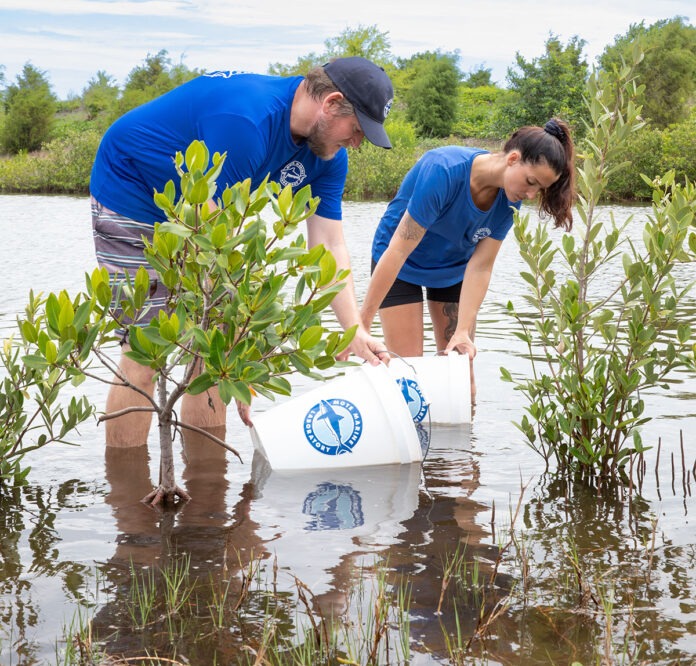
—Across this summer, Mote scientists will release roughly 22,000 juvenile snook into strategic estuarine habitats around Southwest Florida — tidal creeks, mangrove-lined shorelines and sheltered coves chosen for the food, cover and structure that young snook need to survive. The fish were raised at Mote Aquaculture Research Park, the inland facility where researchers also work on the broader puzzle of farming marine fish sustainably.
—It is not a new effort. For nearly three decades, Mote has been developing and refining responsible stock-enhancement methods for snook and other native sportfish. “These releases reflect the continued growth and refinement of Mote’s fisheries enhancement capabilities,” said Dr. Ryan Schloesser, who manages the lab’s Fisheries Ecology and Enhancement Program. “Our focus remains on producing healthy fish, releasing them strategically, and collecting the scientific data needed to better understand how stock enhancement can support resilient wild populations.”
—The science is the point. Before release, the fish undergo health assessments, and the program is built around hard questions: How many survive? Where do they go? Do hatchery fish actually add to wild numbers, or simply replace them?
—The genetics breakthrough
The most interesting work is happening at the molecular level. Rather than relying only on physical tags, Mote is building a genetic catalog of its broodstock — the parent fish — so that any young snook recovered later in the wild can be traced back to its origin from nothing more than a small fin clip.
“We have the genetic profiles of the parents and are developing the tools needed to match offspring recovered in the wild back to their source,” Schloesser said. “This approach will allow us to evaluate stocking success while minimizing handling and stress associated with traditional tagging methods.” In plain terms: a paternity test for fish, one that lets scientists measure whether the releases are working without stressing the animals they are trying to help.
—Threat one: the cold that can erase a decade
—Snook are a subtropical species living near the cold edge of their range, and they face a punishing set of pressures — each of which this region has felt directly. The first is temperature. Snook are highly sensitive to cold; the first sign of stress is that they stop feeding, followed by loss of equilibrium and death. Trouble begins when water drops below about 50 degrees. The cautionary tale is 2010, when thousands of snook died in a severe freeze and the state took the unusual step of closing the snook season for three years on the west coast.
—Recent winters have renewed the worry. Winter Storm Enzo brought record cold and fish kills to the coast in January 2025, and a prolonged cold event in early 2026 again left anglers reporting dead and cold-stunned snook, with some fearing the worst since 2010. The reality proved gentler. An FWC snook researcher reported only minor die-offs this time — “small kills, but nothing like what we expected” — in part because snook have expanded northward and shown surprising resilience. It is exactly that kind of regional cold-stun event that has pushed Mote to expand its monitoring and rapid-response work into neighboring counties and waterways.
—Threat two: the blooms that close the water
—The second threat is red tide. The 2017–2019 bloom was severe enough that the FWC made snook, redfish and spotted seatrout catch-and-release only from Pasco County through Collier County — a restriction that held in the Sarasota Bay area into 2022. The economic damage rippled well beyond the fish: the 2018 bloom shut down fishing guides for roughly six months and triggered hotel and restaurant cancellations. Karenia brevis blooms recur along this coast nearly every year, and low-level cells were detected in Sarasota County waters as recently as this spring.
—Threat three: the grass that nearly disappeared
—The third, and quietest, threat is habitat. Seagrass is the nursery and pantry of the inshore system — and around here it nearly collapsed. Sarasota Bay’s seagrass fell from a peak of 13,473 acres in 2016 to 9,962 acres in 2022, a loss of more than a quarter of its meadows in six years. Tampa Bay lost close to 30 percent over a similar span, and Charlotte Harbor declined 23 percent between 2018 and 2021, driven by nutrient pollution, wastewater problems and red tide.
—The recent news is genuinely better. By 2024, Sarasota Bay had rebounded to 11,876 acres, a 19 percent gain over 2022, though still about 12 percent below the 2016 peak. Scientists credit improving water quality, and note the bay weathered the brutal 2024 hurricane season without the collapse seen in milder years past. Still, the director of the Sarasota Bay Estuary Program cautioned that there is “a long way to go before we can say the bay is fully healthy.” When the grass goes, the fish factory goes with it.
—Recovered, but not safe
—The encouraging headline is that snook, the species, is not on the brink. The FWC reports snook stocks have rebounded and now exceed the agency’s management goal of 40 percent spawning potential on both the Gulf and Atlantic coasts, a turnaround from 1985, when the fish was considered severely depleted. Careful regulation — the slot limits, the closed seasons, the no-sale rule — worked.
—But “recovered” and “safe” are different words. A single hard freeze, a bad bloom or a decade of creeping habitat loss can undo years of gains, as 2010 proved. That is the gap Mote’s program is built to fill: not to replace the wild fishery, but to give it a buffer and, just as important, the data to manage it intelligently.
—What it means for Longboat and Sarasota anglers
—For readers who fish the passes, the bridges and the mangrove edges of Sarasota Bay and the Longboat Key Intracoastal, the rules remain strict and the math simple. In our region the slot is 28 to 33 inches, the limit is one fish per angler per day, and a snook permit is required on top of a saltwater license. Season dates shift by region and year, so it is worth checking MyFWC.com/Snook before keeping one.
—And the restoration story is not only Mote’s. Just up the coast in Manatee County, a former farm became Robinson Preserve, where about $17 million transformed 700 acres into mangrove and wetland nursery habitat that now draws roughly 240,000 visitors a year and generates millions in economic activity. It is proof that the inshore fishery is something a community can rebuild — fish, dollars and all.
Which brings it back to that pink-lit dinner table. The snook on the plate is a luxury you cannot purchase at any price. You can only earn it, on the water, with a rod — and only as long as there are snook out there to catch. This summer, 22,000 of them are getting a head start.

