
A Penetrating Investigation Into the Most Important Joint in Sports, the Boringest Man to Ever Win Everything, and Pickle Juice.
—I want to begin this column with a hard-hitting piece of investigative journalism, which is that men’s tennis is currently being held hostage by a 23-year-old’s wrist.
—I am not making this up. Carlos Alcaraz — the Spaniard who plays tennis the way a golden retriever plays with a sprinkler, i.e., with no plan and total joy — tweaked his right wrist in April at his hometown tournament in Barcelona. This is like injuring yourself doing a victory lap. And the wrist, being the diva of the human skeleton, has since announced that it will be missing the clay season, the French Open, the entire grass season, and Wimbledon, and is “evaluating” the U.S. Open the way I evaluate whether to go to the gym.
—Tennis experts have responded to this news with the calm, measured tone you would expect, which is to say they are running through the streets screaming. One former world No. 1, Jim Courier, helpfully compared the situation to Juan Martín del Potro, a man whose wrist betrayed him so thoroughly that he eventually had to hit backhands by gently sawing at the ball like he was opening a difficult package. This is the kind of reassurance you want during a health scare. (“Don’t worry, it’s probably nothing! Just like the Hindenburg!”)
—A Brief Scientific Explanation of the Wrist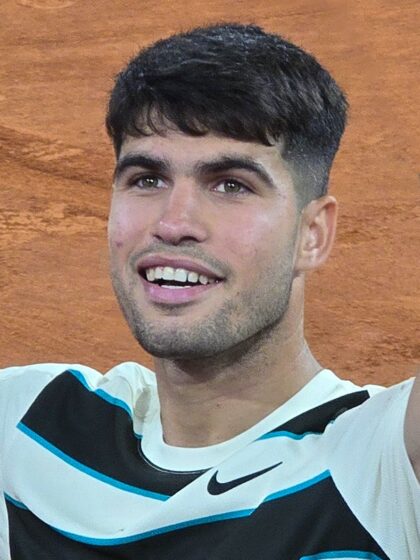
—The wrist is a complex structure consisting of approximately 8,000 tiny bones, all of which are named after Renaissance painters, and all of which can fail simultaneously and without warning. Doctors do not actually know how the wrist works. What they do know is that when a tennis player injures one, the correct medical procedure is to issue a series of Instagram statements containing the words “prudent,” “cautious,” and “stronger,” in escalating combinations, until the fans calm down or the season ends, whichever comes first.
—The complexity here is real. A wrist is not a hamstring. A hamstring you can sort of bully back into service. A wrist is the part of your body that decides whether a tennis ball goes screaming into the corner or gently into the back of a spectator named Gerald. Rush it, and you don’t just lose matches — you lose the thing, the magic flick, the shot that made Gerald put down his $19 stadium beer and go “WHOA.” Alcaraz’s whole game is built on that flick. Asking him to play without trusting his wrist is like asking a magician to do card tricks with oven mitts.
—Meanwhile, In The Land Of The Living
—With Alcaraz sidelined, the entire tennis world now belongs to Jannik Sinner, a man who is currently ranked No. 1 and who plays tennis with the warm, spontaneous flair of a high-end Scandinavian dishwasher. I say this with respect. He is magnificent. He wins everything. He has a Masters 1000 win streak that recently passed Novak Djokovic’s record, which is the tennis equivalent of out-stubborn-ing the world’s most stubborn man.
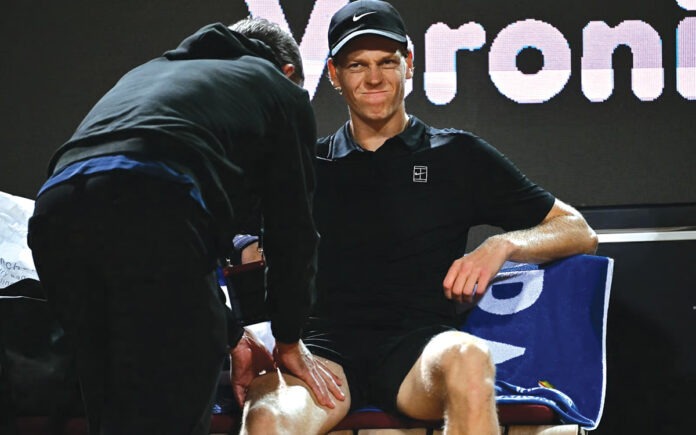
—But — and here is where I must put on my Serious Journalist Hat — at the recent Italian Open in Rome, Sinner played a semifinal against Daniil Medvedev and something interesting happened. Sinner won the first set easily. Then Medvedev won the second. Then, in the third set, while leading but visibly struggling, Sinner suddenly required a MEDICAL TIMEOUT, during which physios massaged both of his quadriceps while a look of profound suffering crossed his face.
—Medvedev, who is the most relatable man in sports because he is permanently one bad bounce away from filing a formal complaint with the universe, immediately began arguing — in French, which is the official language of tennis grievances — that you are NOT ALLOWED a medical timeout for cramps. A commentator agreed, noting, and again I am not making this up, that Sinner appeared to be “sipping on his pickle juice,” which is a real anti-cramp remedy and also would be an excellent name for a rock band.
—Now. I am not saying that the modern champion has perfected the art of developing a sudden, mysterious, hydration-adjacent ailment at the exact moment a match tightens, in the grand tradition of a certain 24-time Grand Slam champion who could pull a hamstring, a heartstring, and a sympathy violin all in the same changeover. I am simply observing it, the way a nature documentarian observes a lion. Then, as if scripted by a god with a sense of comedy, it started raining, the match was suspended until the next day, and Sinner got to go take a nap. Some guys have all the luck and also the pickle juice.
—But Is Carlos Okay???
This is the question on everyone’s mind, and the answer is: he is doing GREAT, if your definition of “recovering from a serious wrist injury” includes “lying face-down in clay for a fashion magazine.”
—While his ranking points evaporate, Alcaraz has been busy shooting a spread for Vanity Fair in which he poses artistically with clay smeared on his face, dressed in white, looking like a Renaissance painting titled Saint Carlos, Patron of Not Currently Playing Tennis. The internet’s reaction was divided between “he’s gorgeous” and “sir, please pick the racket back up,” with one fan noting that tennis now appears to be Carlos’s “day job.” Which, given the wrist, is technically accurate.
—The greater danger, however, looms on the horizon, and that danger is named Ibiza.
—History tells us that Alcaraz, when freed from the burden of competition, makes a pilgrimage to Ibiza — the Spanish island whose chief exports are nightclubs, sunburn, and questionable decisions — where he has previously been filmed singing “We Are the Champions” at full volume in a state of advanced celebration. His own agent once said of these trips, and I quote a man whose entire net worth depends on this kid’s wrist, “It scares me personally.” That is the sound of a man watching his retirement plan do a conga line.
—How Will His Game And Mind Survive?
—Here is my expert prediction, and remember, I have correctly predicted zero (0) sporting events in my life.
—The body part heals on its own schedule and cannot be negotiated with, bribed, or sung to. The mind is trickier. Alcaraz must now do the hardest thing in sports, which is nothing — sit still, stay composed, resist the urge to grab a racket and “just test it real quick,” and trust that the magic flick will still be there when the 8,000 painter-bones reconvene. He must remain patient while a Scandinavian dishwasher quietly wins everything and the TV ratings, deprived of a shot-maker who makes people gasp, settle into the gentle flatness of a region’s third-most-watched curling final.
—Will he hold it together? Probably. He’s 23, he has roughly nine more careers left, and he genuinely seems to like being alive in a way most champions forgot to learn. Tennis just has to survive the wait — which, like a wrist, will heal slowly, painfully, and only if everyone agrees to stop poking it.
In the meantime: drink your pickle juice, avoid Ibiza, and for the love of God and tennis, somebody get Gerald another beer.

