
For a year, Chuck Whittall fought the Town of Longboat Key with photographs.He fought it from a Town Hall podium, from the driver’s seat of a Ferrari at Sebring, from beneath his own arch on a Sunday afternoon with his arms crossed and his family behind him. He fought it in memos and workshop remarks and one telephone call to a Town Manager. On the afternoon of June 18, 2026, at 3:47 p.m., he began fighting it the only way that will now count. His lawyers filed an Answer.
—The document runs nine pages. It is signed not by Brenda Patten — the zoning counsel who spent the winter trying to persuade Longboat Key to rewrite its own sign code around the arch — but by Morgan R. Bentley and Brian D. Goodrich of Bentley Goodrich Kison, P.A., a Sarasota litigation firm. The change of hands is itself a piece of news. The legislative phase, the phase in which Unicorp asked the Town for a favor, is over. The adversarial phase has begun, and the adversarial phase has different lawyers.
—What those lawyers filed is close to a total denial. Paragraph by paragraph, the Answer concedes almost nothing. It admits the Town’s boundaries “for jurisdictional purposes only.” It admits that the Town issued a building permit in 2022 and again in 2024, but denies the Town’s characterization of what those permits authorized. It admits that Unicorp removed the faux greenery that had covered the sign. Beyond that narrow band of admissions, the recurring refrain of the Answer is a single word — denied — or its lawyerly cousin, the assertion that a quoted document “speaks for itself.”
—Then, past the denials, come the six affirmative defenses. These are the argument. This is what Whittall intends to take to a Sarasota County judge, and, he has promised, well beyond one.

—The Word That Does Not Appear
—Buried in the Second Affirmative Defense is the sentence Unicorp’s lawyers most want a judge to remember. It is not about permits or plans or the mean-high-water line. It is about a gap.
“The words ‘groins’ and ‘jetties,’” the Answer states, “do not appear at all in any part the Code of Ordinances.”
—That is the whole defense compressed into fifteen words. The Town has built its complaint on four numbered code sections — two from the Zoning Code, two from the Sign Code — and asked a court to find that a fourteen-foot marine-stainless arch violates all four. Unicorp’s reply is that none of those sections was written for a structure standing on a rock groin in sovereign Gulf waters, because the Town never wrote such a section at all. You cannot violate a rule that was never enacted, the argument runs. And the Town, on the arch, never enacted one.
—The First Affirmative Defense sets up the same point as a fork, and it is worth reading closely, because it is the architecture of everything that follows. Either, the defense argues, the arch and sign sit outside the Town’s territorial boundaries entirely — on state sovereign submerged land, beyond the reach of any municipal code — or, even if a judge finds the groin technically within the Town line, “the Town has not enacted regulation to implement its jurisdiction over the arch and sign on the groin and therefore cannot prohibit the arch and sign.”
—Heads, the Town has no jurisdiction. Tails, the Town has jurisdiction it never bothered to exercise. Unicorp asks the court to pick either.
The State Permit, and a Certification Nobody Had Mentioned
Whittall’s public argument, for a year, has been four words: it’s in sovereign waters. The Second Affirmative Defense turns that instinct into a statute and adds a fact that has not been part of the public record until now.
—The statute is Section 161.041(1), Florida Statutes, which the Answer quotes at length. It requires a permit from the Florida Department of Environmental Protection for “any coastal construction or reconstruction or change of existing structures … including groins, jetties … upon state sovereignty lands below the mean-high-water line of any tidal water of the state.” The Answer’s point is structural: the Legislature, when it wanted to regulate what gets built on a groin below the high-water line, assigned that job to the state. It named groins specifically. Longboat Key’s code never did.
—And the state, Unicorp says, said yes. DEP issued Permit No. 8031535 to SR LBK II, LLC “to install post, rope and sign per the approved plans” on the groin. The Answer asserts that “the approved plans showed an arch with an embedded sign” — a direct, head-on collision with the Town’s central factual claim that the engineering plans showed only posts and ropes, and that the arch appeared nowhere but in an artistic rendering.
—Then the new fact. After construction was finished, the Answer states, DEP issued a Final Certification. That certification, according to the defense, certified that the “handrail and signage” was “inspected … and was found to be acceptable and satisfactory in accordance with the approved plans and project description and with all conditions of the permit.”
—Read that again, because the Town’s entire complaint is built on the premise that the sign was never approved by anyone. Whittall now says the opposite — that the state did not merely permit the sign in the abstract but sent an inspector, looked at the finished “signage,” and blessed it in writing. In May, standing under the arch on Mother’s Day weekend, Whittall told this newspaper the state had “confirmed” the previous week that “the sign was permitted correctly.” At the time, that read as bravado. The Answer suggests he was describing a document.
—Whether that document says what Unicorp says it says is now one of the central factual questions of the case. The Town has not yet had its chance to reply to it.
—The Yard That Runs the Wrong Way
—The Third Affirmative Defense is the most technical, and the most quietly clever. It takes the Town’s marquee zoning citation — Section 158.094(C) — and argues that the provision points landward, away from the arch.
—Section 158.094(C) governs “Waterfront yard requirements.” It requires every lot fronting the Gulf to maintain a “required gulf waterfront yard” a minimum of 150 feet deep, measured landward from the mean-high-water line or, where one exists, from the Erosion Control Line. The Town’s theory is that the arch, sitting seaward of the Erosion Control Line, violates this setback.
—Unicorp’s answer is that a setback is a distance measured from a line, in a direction, and the direction is inland. The waterfront yard, the defense argues, “runs 150’ landward of the ECL. It does not run backwards into the Gulf.” A yard, under the Town’s own definitions in Section 158.144, is “an open space on the same lot with a building.” A lot is “a parcel of land … occupied or intended for occupancy by a building.” The Gulf of Mexico, the defense continues, is none of these things. It is not a lot. It is not land intended to be occupied by a building. It sits in no zoning district and carries no minimum zoning requirements. “Therefore,” the Answer concludes, “the Gulf of Mexico cannot be a ‘yard.’”
—If there is no yard seaward of the Erosion Control Line, the argument goes, there is no waterfront-yard setback for the arch to violate. The Town’s strongest zoning citation, in Unicorp’s telling, measures a yard that stops at the beach and never reaches the water.
—Estoppel: Turning the Town’s Own Permit Around
—The single most powerful paragraph in the Town’s complaint — the one this newspaper called “the trapdoor” — was about Whittall’s own permits. By applying to Longboat Key for a building permit in 2022 and again in 2024, the Town argued, Whittall himself conceded that the groin was within the Town’s jurisdiction. His signature admitted the very thing he now denies.
—The Fourth Affirmative Defense grabs that same 2024 permit and swings it in the opposite direction.
—If the Town issued Permit PB24-0117 in 2024 for the construction of handrails — timber posts, aluminum boots, ropes — on the groin, the defense reasons, then the Town necessarily believed that Section 158.099(A), the “structure over water” provision, did not prohibit structures on the groin. Otherwise it could not have issued the permit. “The Town issued a permit for construction of these structures on the groin,” the Answer states, “because section 158.099(A) does not prohibit such structures on the groin.” Having permitted structures on the groin once, Unicorp argues, the Town is estopped — legally barred — from now claiming its code prohibits structures on the groin.
—Both sides, in other words, now build their case on the same 2024 handrail permit. The Town says it proves Whittall accepted its jurisdiction. Whittall says it proves the Town’s code permits what he built. A judge will read one permit two ways.
—The Sign Code That Stops at the Zoning Line
—The Fifth Affirmative Defense does to the Sign Code what the third did to the Zoning Code: it argues geography. The Town’s two sign citations — Sections 156.05 and 156.07 — must be read, the defense says, in pari materia, alongside the rest of Chapter 156. And the rest of Chapter 156, Unicorp argues, is written entirely around land and buildings inside zoning districts.
—Section 156.07 lays out detailed sign specifications district by district — residential districts, then the commercial and institutional districts: INS, OI, C-1, C-2, C-3, M-1, T-3, T-6. Every specification is keyed to a zoning designation. The Gulf, the defense argues, “does not lie within a Zoning District and it has no zoning designation.” A code that regulates signs by district cannot reach a structure standing in water that belongs to no district at all. “Since the Gulf does not lie within a Zoning District,” the Answer states, “the criteria of section 156.07 does not apply to the groin, arch or sign.”
—No Survey, and a Thumb on the Scale for the Owner
—The Sixth Affirmative Defense adds two things the first five had left implied. First, a burden: “The Town has not produced a survey proving that the groin lies within the territorial boundaries of the Town.” The Town filed an aerial boundary map as Exhibit 1 to its complaint. Unicorp’s position is that a map marked in red is not a survey, and that the party asking a court to tear down a structure bears the burden of proving, with precision, that the structure sits on land it can regulate.
—Second, a rule of interpretation — and a citation. Florida law, the defense argues, resolves ambiguity in zoning against the government and in favor of the property owner. It quotes Rinker Materials Corporation v. City of North Miami: “Since zoning regulations are in derogation of private rights of ownership, words used in a zoning ordinance should be given their broadest meaning when there is no definition or clear intent to the contrary and the ordinance should be interpreted in favor of the property owner.”
—That canon is Unicorp’s answer to every gap it has identified. Where the code is silent on groins, silent on jetties, silent on structures in the Gulf — the silence, Unicorp argues, must be read for Whittall, not against him.
—Two Readings of One Permit
—Strip the case to its spine and it is a fight over a single eight-page state document, which both sides have filed and both sides quote.
—The Town reads the fine print. The DEP Field Permit, on its face, was “valid only after all applicable federal, state and local permits are obtained,” and it “does not authorize contravention of local setback requirements or zoning or building codes.” A special condition adds: “Structure should be installed per local governmental ordinances.” And Whittall, signing the application in February 2024, personally certified that he “shall obtain any applicable licenses or permits which may be required by federal, state, county or municipal law.” The Town’s argument is a closed loop: the state permit itself told Whittall to go get a Town permit, and for the arch, he never did.
—Unicorp reads the authorization and the certification. The same permit’s project description says the permittee “is authorized to install post, rope and sign per the approved plans.” A special condition contemplates “installation of sign, post and rope.” And after the work was done, Unicorp says, the state came back and certified the “signage” as acceptable. If the state owns the submerged land, permitted the sign, and certified the sign, Whittall asks, what is left for a barrier-island town to prohibit?
—The document is the same. The case is the distance between those two readings.
—And Then, the Court Set a Date
—If the Answer was Whittall’s move, the Court made one of its own. On July 2, 2026 — the same day this account went to press — Circuit Judge Dana Moss entered a six-page order that quietly reframes the entire fight. It sets the case for trial. It sets it a long way off.
—The order designates Town of Longboat Key v. SR LBK, LLC and SR LBK II, LLC, Case No. 2026-CA-002703-NC, to the court’s General Track and sets it for a nonjury trial — no jury, a judge deciding both the facts and the law. Docket sounding is scheduled for January 13, 2028. The three-week trial period opens January 24, 2028, in Courtroom 7-C of the Lynn N. Silvertooth Judicial Center on Ringling Boulevard in Sarasota.
—That is roughly nineteen months from now. And it carries an irony that sits at the heart of this case. The Town’s complaint leans on Ware v. Polk County, the 2005 decision holding that in a code-enforcement injunction suit, irreparable harm is presumed — the Town need not prove the arch is causing measurable damage, only that it violates the code. The legal theory is built for speed. The docket is not. Absent an earlier ruling, an earlier trial, or a settlement, the arch that the Town says causes irreparable harm will stand, undraped, through two more winter seasons.
—The order does leave the Town a faster lane if it wants one. Paragraph 10 provides that a party may seek an earlier trial period, free of the usual strict requirements, if it moves within 30 days of the last defendant being served. Whether the Town pushes for that — or whether it is content to let the case ripen — is now a strategic choice with real consequences for Longboat Key taxpayers, who are financing the litigation.
—Two other features of the order matter. First, it refers the case to mediation, with a deadline of November 23, 2027. Before any trial, both sides will be required to sit in a room with a neutral and attempt to settle. Given a defendant who has said the fight “could take years” and a Town Attorney who has warned commissioners she cannot guarantee recovery of the Town’s costs even in victory, that mediation deadline may prove to be the most consequential date on the calendar.
—Second, the order refers all discovery motions and all motions directed to the pleadings to a magistrate, the Honorable Medisa M. Turner — meaning the early trench warfare of the case, the fights over depositions and documents and the sufficiency of Whittall’s defenses, will be argued in front of the magistrate rather than the judge, unless a party objects to the reference. The order also holds each side to a single expert witness per specialty, and lays down a cascade of 2027 deadlines: pleadings amended by May, fact and expert discovery closed by late September, summary-judgment motions heard by late October.
—The practical translation: this is now a slow, fully litigated circuit-court case with a 2028 trial, a 2027 mediation, and a magistrate riding herd on the paperwork in between. The phone call to the Town Manager was in May. The reckoning is scheduled for the winter of 2028.
—What the Town Quietly Amended
—Between the original complaint and Whittall’s Answer, the Town filed a second version of its lawsuit — and it is worth being precise about what changed, because the answer is: almost nothing.
—On June 11, 2026, special counsel Martin Garcia filed an Amended Complaint for Mandatory Injunctive Relief. A footnote explains why. The original complaint, filed May 15, “contained two Paragraph 34s and two Paragraph 52s.” The amendment corrects the numbering. It is housekeeping — a scrivener’s fix, not a change in strategy or substance. The four alleged code violations are identical. The exhibits are identical. The theory is identical.
—Two small things did travel with the renumbering. The amended complaint now refers throughout to the “Gulf of America, f/k/a Gulf of Mexico,” adopting the federal relabeling. And it resets the procedural clock: because a defendant answers the operative complaint, it was this amended version, not the May original, that Whittall’s lawyers answered on June 18. The substance of the Town’s case did not move an inch. But the pleading that now governs the lawsuit is the June 11 version, and the Answer on file responds to it.
—The Parcel Made of Lawsuits
—None of this — not the arch, not the six defenses, not the promise to fight to the Florida Supreme Court — is a departure from the history of the eighteen acres on which the St. Regis stands. It is the continuation of it. On this parcel, litigation is not an interruption. It is the bedrock. Strip away the porte-cochère and the wedding lawn and the boardwalk and the groin, and what you find underneath is three-quarters of a century of Longboat Key trying to decide what may exist on its most contested piece of sand.
—The story begins gently. In 1952, Sarasota developer Herb Field opened a collection of beach cottages on the site, with a nine-hole golf course and, at first, no tennis at all. Then, in 1969, a Buffalo orthodontist named Dr. Murray “Murf” Klauber — who had detoured to Longboat Key on a whim and fallen for the island — bought the place with a partner for a reported $3.5 million and set out to build America’s first “tennis-centric resort.” He succeeded beyond any reasonable expectation. Tennis magazine named the Colony Beach & Tennis Resort the number-one tennis resort in the United States eight years running. Nick Bollettieri launched his academy on its courts. Bud Collins hosted his Hackers tournament there for the better part of two decades. President George W. Bush spent the night of September 10, 2001, at the Colony; the next morning he was reading with schoolchildren in Sarasota when the towers fell, and for the following day the resort became an impromptu national command post.
—It was, for forty years, the thing that put Longboat Key on the world map — the reason a certain kind of affluent visitor came, played, and bought a house nearby. And then it came apart, in court, exactly the way it is coming apart again now.
—The unraveling began with money for repairs. Between 2004 and 2006, Klauber asked the condominium owners who held the individual units to fund a renovation the aging resort badly needed. Three times they refused. In 2007, an angry ownership faction seized control of the association board and stopped paying operating costs. Klauber sued the owners to force the assessments. The association filed for Chapter 11 bankruptcy. Klauber, eventually, threw his own Colony companies into Chapter 11 as well. In 2009, Bank of America filed to foreclose on Klauber and a string of his corporations. In August 2010, the Colony closed its doors. Its bankruptcy was converted to a Chapter 7 liquidation, the Klauber partnership was dissolved, and the family’s four-decade grip on the property was pried loose by a federal judge who, by several accounts, had lost patience with the whole convoluted war.
—Klauber had tangled with the Town, too — and won. In an earlier era, after Longboat Key pulled his building permit for a luxury spa-condominium project, Klauber sued the Town for civil-rights violations. A federal jury awarded him nearly $9 million, and in 1997 the Town settled for $6.5 million in cash. The lesson of that verdict has never entirely left Town Hall: this parcel has taken Longboat Key to court before, and the last time it did, the Town wrote a very large check. Town Attorney Maggie Mooney’s careful, repeated warnings this spring that she “cannot guarantee” recovery of the Town’s costs are the words of an institution that remembers.
—Then came Whittall. Unicorp National Developments bought the shuttered recreational property in August 2016 for $22 million and inherited the parcel’s genius for conflict. To assemble clean title, Whittall spent roughly five years at war with a Tennessee developer, Andy Adams, who controlled a bloc of holdout units and would not sell at Whittall’s price — a fight the local press dubbed the Colony’s “Battle of Gettysburg.” Other unit owners filed their own claims and their own threats to challenge the Town’s approvals. A Sarasota judge spent years untangling the mess before the condominium association was judicially terminated in 2021. By the time Whittall settled with Adams that spring, he estimated his total outlay on acquisition and demolition — before a single new wall rose — at roughly $80 million.
—What rose, finally, was the St. Regis Longboat Key: a roughly $800 million resort-and-residential complex on some 17.6 acres, with a 168-room hotel and 69 luxury residences, that broke ground in 2021 and opened on August 16, 2024 — fourteen years, almost to the week, after the Colony closed. It has been, by the measures its owner cares about, an extraordinary success. One combined condominium at the property sold for $21.24 million, the largest residential sale in Sarasota County history. Whittall calls it a “half-billion-dollar” investment and points, not without justification, to the jobs, the tax base, and the business it has pushed up and down St. Armands Circle and Gulf of Mexico Drive. He is not wrong that he built something remarkable. That is precisely what makes the current fight so hard for the community to resolve: two true things, a preserved island and a transformative resort, pulling against each other on the same beach.
—How the Arch Got to Court
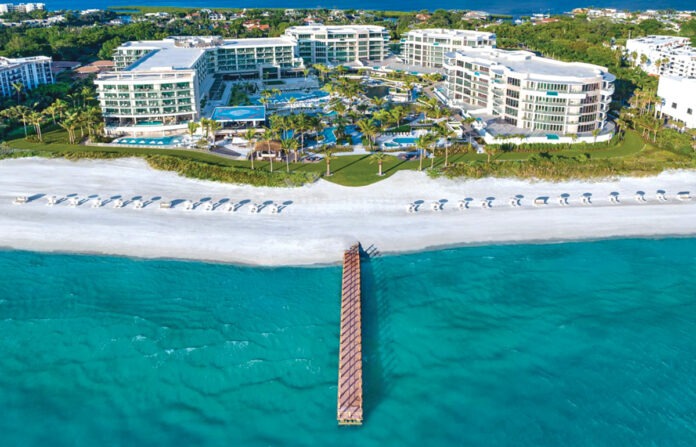
—The groin itself is a relic of the Colony — a rock structure the old resort built in the 1960s to fight beach erosion, and the only privately owned groin in the entire Town. Whittall rebuilt it, permitted the repair with the Town in 2022, added a boardwalk and rope railings under a 2024 Town permit, and then, in August 2025, crowned it with something no Town permit covered: a gleaming, roughly fourteen-foot arch of welded marine-grade stainless steel, bearing the St. Regis crown medallion and the words “ST. REGIS — LONGBOAT KEY,” framing an open view to the horizon. He has said it cost about $16,000, that it is rated for 150-mile-an-hour winds, and that it was “built to outlast my lifetime.”
—Longboat Key told him to take it down. What followed was a year of escalating civic theater. Unicorp asked the Town to amend its sign code to permit the arch. In November 2025, the Commission declined. In December, after Whittall came to Town Hall and made his case in person, the Commission reversed itself and voted 4-3 to have staff draft two ordinances — 2026-07, amending the Zoning Code, and 2026-08, amending the Sign Code — that would legalize the structure. On March 17, 2026, the Planning and Zoning Board recommended denying both. The hearing turned combustible: board members dismissed Unicorp’s claim that the arch served a “public safety” wayfinding purpose as “legal gymnastics” and worse, and they fact-checked, from the dais, a sworn application statement that the arch had “withstood hurricanes Milton and Helene” — storms that struck in September 2024, nearly a year before the arch was built. Whittall apologized and said his team had misinformed him. The false claim remains in the Town’s permanent record.
—On the Friday before the Commission’s scheduled May 4 vote on the ordinances, Unicorp’s counsel abruptly withdrew the application altogether — closing the legislative door the company had spent six months prying open. Mayor Debra Williams announced the withdrawal to a half-emptied meeting room. The Town Manager, Howard Tipton, gave Unicorp until 5:00 p.m. on Friday, May 8, to remove the arch. At 5:00 p.m., Whittall called Tipton and said he would not. Over Mother’s Day weekend, he posed beneath the structure for a photograph, arms crossed, and told this newspaper he was prepared “to litigate to whatever extent necessary.” On Friday, May 15, at 2:19 p.m., the Town filed suit. On June 11, it amended the complaint. On June 18, Whittall answered. On July 2, a judge set the trial.
—Each step narrowed the room for anything but a courtroom. There is no room left.
—What Happens Next
—The case now moves onto a track measured in seasons. Discovery will open, and the early motion fights — over documents, over depositions, over whether Whittall’s six defenses are legally sufficient — will be argued before Magistrate Medisa Turner. Expect the paper to reach deep: into Unicorp’s correspondence with DEP, into the “approved plans” both sides describe so differently, into whatever the state’s Final Certification actually says, into the file at K&G Marine of Davie, which drew the arch in April 2025, months before it was installed and, the Town notes, never submitted for Town review.
—Somewhere in that stretch, before the November 2027 deadline, the parties will be ordered to mediate. That is the off-ramp, if one exists. A developer who has framed this as a matter of principle and a Town that has framed it as a matter of code do not obviously meet in the middle — but mediation has settled less likely cases than this one, and the alternative is a three-week nonjury trial in January 2028, followed, if Whittall keeps his word, by an appeal to Florida’s Second District Court of Appeal and a run at the Florida Supreme Court beyond that.
—For now, the pleadings are joined. The Town says the arch violates four sections of its code and must come down. Whittall says the code never reached the groin, the state already approved the sign, and the Town cannot even prove the structure sits on land it governs. Both positions are on file, under oath, in the Twelfth Judicial Circuit. The arch stands where it has stood since August 2025 — no longer draped, no longer the subject of a favor Unicorp is asking, but the subject of a lawsuit that a judge has now promised to decide.
—It took generations of tennis and generations of litigation to build the ground this arch stands on. It will take, by the Court’s own calendar, at least until the winter of 2028 to learn whether it stays.

