

A five-way primary for two at-large seats, an island-defining county race a jurisdiction away, and a November tax question that could quietly reorder the region’s finances. A voter’s guide to the season ahead — for the people who live where the cranes and the storm surge meet.
—Sarasota likes to think of itself in superlatives, and it has earned most of them. It is a capital of the arts and a capital of letters — a place where a Renzo Piano concert hall can be debated in the same breath as a barrier-island library, where the season’s currency is measured as much in ticket subscriptions as in tee times. It is also, as anyone who watched the water climb over St. Armands twice in thirteen days in the autumn of 2024 can attest, a city that conducts its cultural life at the pleasure of the Gulf of Mexico.
—Both of those Sarasotas are on the ballot this year. On Tuesday, Aug. 18, city voters open a municipal season that runs through the November general election and will remake a City Commission that touches every question the region argues about: how tall downtown should grow, whether the bayfront gets its grand new stage, what the islands do about the water, and — the question now looming over all of it — how much property tax the community is prepared to collect from itself.
—This is a round-up of what is at stake, who is running, and why the outcome matters as much on Bird Key and Lido as it does on Palm Avenue.
—The mechanics: five for two, in two rounds
—Two at-large seats on the five-member Sarasota City Commission are up this cycle. Because more than three candidates qualified, the contest runs in two acts.
—Act one — the primary, Aug. 18. Every voter inside the city limits may cast ballots for two of the five candidates. The top three vote-getters advance.
—Act two — the general, Nov. 3. The three finalists face the full electorate again, and the two who draw a majority are sworn in Nov. 6 to serve four-year terms.
—A crucial fact frames the whole race: at least one new commissioner is guaranteed. One-term commissioner and current mayor Debbie Trice is not seeking re-election, leaving her seat open. That makes incumbent Jen Ahearn-Koch — first elected in 2017 and now pursuing a third term — the only sitting member in the field, and the only name most voters will already know.
The at-large seats are, by charter, nonpartisan. As we will see, the candidates’ choice of campaign treasurers tells a more textured story.
—The field: five names, five theories of Sarasota
—Jen Ahearn-Koch — the neighborhoods’ incumbent
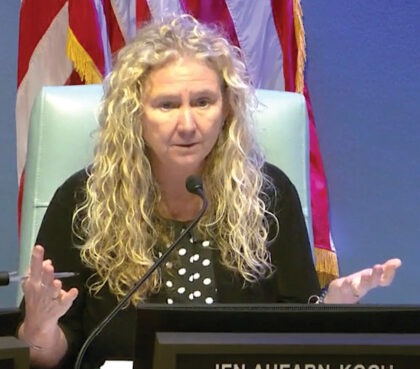
—If there is a through-line to Ahearn-Koch’s near quarter-century in civic life, it is the neighborhood. She came up through the Tahiti Park Neighborhood Association and the Coalition of City Neighborhood Associations, spent six years on the Planning Board, and entered politics in opposition to a development — a fact she wears as a credential, not a footnote. A former art director at the Asolo who founded her own marketing firm, she has served as mayor and vice mayor and casts herself as the voice residents send to the dais when they fear being “left out” of the room where decisions get made.
—Her record supplies the sharpest policy contrast in the race. She has been the commission’s most pointed skeptic of the proposed bayfront performing arts center, calling its price tag “exorbitant” and questioning whether the city can afford to build it, let alone operate it. On downtown growth she has consistently pressed to preserve older buildings and to keep public hearings — rather than staff-level “administrative review” — in the path of larger projects. She leads the field in money raised.
—Flo Entler — the activist from Arlington Park
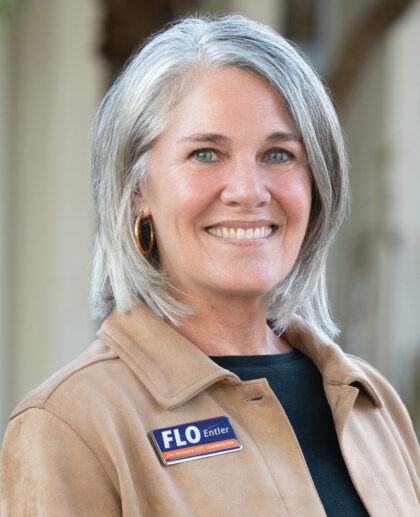
—A Long Islander who has called Sarasota home for some thirty-seven years, Entler is the current president of the Arlington Park Neighborhood Association and a former second vice president of the CCNA, a post she gave up to run. She is a fixture at the public-comment microphone, and her pitch is fluency in the quality-of-life issues that cut across every neighborhood — flooding, traffic, construction, affordability, parks. A small-business owner who works as a fitness instructor and personal trainer, she has kept her campaign local, right down to her Sarasota-based CPA treasurer.
John Harshman — the downtown businessman
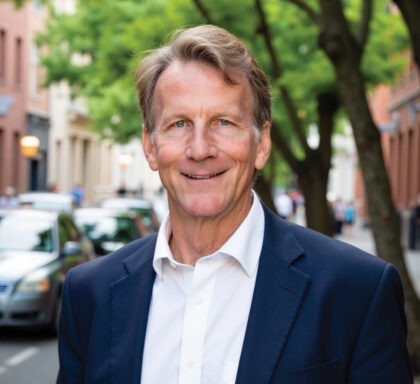
—Harshman’s is the classic Sarasota arrival story, which he tells often: he says he came to town at eighteen with twenty dollars and built a life, founding the commercial brokerage Harshman & Co. in 1989. Four decades of downtown business and a long roster of civic boards — the chamber, the Downtown Sarasota Alliance, arts and environmental panels — underwrite a platform organized around workforce affordability, the arts as an economic engine, fiscal responsibility, and a “clean and safe” downtown. His treasurer, a West Palm Beach political operative who also handles a statewide political committee, signals a campaign built with an eye beyond the county line.
— —Yevgeny Khodorkovsky — the last-minute technologist
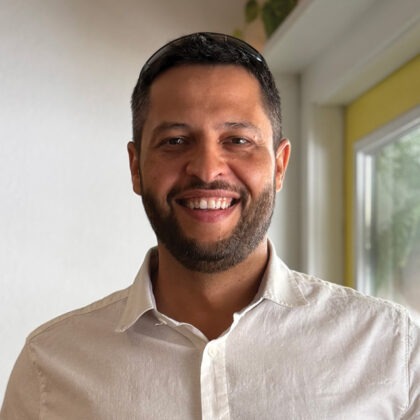
“Yev” Khodorkovsky filed on June 11, one day before qualifying closed — late enough that he missed the neighborhood-association forum entirely and had no fundraising to report. A software engineer who has built teams for Cisco, Salesforce and the Apache Software Foundation and chose Sarasota in 2019, he runs as the anti-overdevelopment insurgent. His language is the most combative in the field: he warns against a “Tampa-style” downtown and “concrete mountains” that strain infrastructure without adding real housing, and against what he calls parking-fee “cash grabs.” His remedies are granular and quality-of-life — better-timed traffic signals, streamlined dealings with City Hall, public art and green space, and a reminder that “there’s more to the city than Downtown and the Key.”
—Rob Rominiecki — the arts-world newcomer
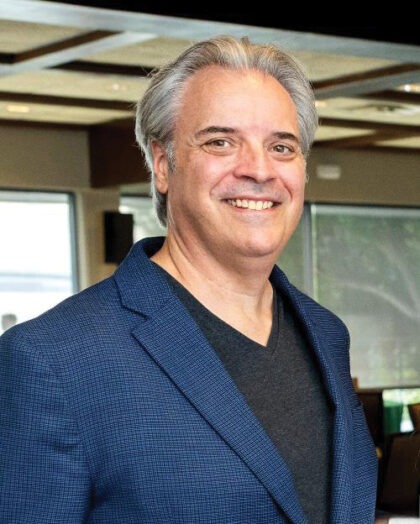
—Rominiecki carries one of the more recognizable surnames in local culture as the husband of Marie Selby Botanical Gardens president and CEO Jennifer Rominiecki. A Brooklyn native who spent fifteen years at the Guggenheim, rising to director of security and safety before the family moved to Sarasota, he has since consulted pro bono for Selby’s transformation into a “living museum.” His priorities read as consensus-friendly: attainable housing, a stronger creative economy, coastal preservation, less traffic, and a “future-ready” city. His treasurer is a Tallahassee firm long associated with Republican campaigns across Florida — a tell, in a nonpartisan race, about where his organizational support originates.
—The field that was: one door closes, another opens late
—Worth noting for the record: the June 6 candidate forum featured a sixth contender, physical therapist and clinic owner Jaime Loomis, a 2022 transplant who did not ultimately qualify by the deadline. The candidate voters actually got instead — Khodorkovsky — never appeared at that forum, having filed five days later. The season’s opening act, in other words, has already swapped a cast member.
—The race the islands are really watching
—Here is where readers on Longboat Key, Lido, St. Armands and Bird Key should pay close attention, because the most consequential contest for the barrier islands is not, strictly speaking, a city race at all.
—The Sarasota County Commission’s District 2 seat is on the same August ballot, and District 2 is the islands’ district. Its boundaries run from University Parkway down to Stickney Point Road and out across the sand — from roughly the southern half of Longboat Key, through Lido, St. Armands and Bird Key, to the northern half of Siesta. It is the seat that most directly represents the coastal corridor across the jurisdictional lines that otherwise divide these communities, and it commands the levers islanders care about most: beach renourishment, stormwater, the tax-increment financing that underwrites downtown’s cultural ambitions, and the county’s posture toward island hotel development.
—Two Republicans are contesting it. Incumbent Mark Smith — a Siesta Key architect, founder of Smith Architects, and the current commission vice chair — has built an island-friendly record: he has opposed major hotel projects on Siesta Key and has publicly resisted committing county dollars to the bayfront performing arts center, citing a “fiduciary responsibility” for the money. His challenger, Kristina Sargent, is a Pinecraft-based attorney and former prosecutor who served fifteen years in the Army National Guard; she argues the current board has spent unwisely and lets growth outrun infrastructure, and she has made stormwater and the flooding of 2024 the spine of her campaign.
—The twist that should concentrate island minds: after both Democratic candidates fell off the ballot, the seat is now set to be decided in the Republican primary on Aug. 18. For a barrier-island electorate that skews fiscally conservative, this is the ballgame — and it is being played in August, when turnout is thin and a few hundred votes on the islands can carry real weight.
—For clarity, because the geography confuses even longtime residents: St. Armands, Lido and Bird Key sit inside the city, so those voters get both the five-way at-large race and the District 2 county race. Longboat Key, as its own town, votes in neither the city contest — but its Sarasota County residents very much have a say in District 2. It is the one seat on which the whole island chain, city and town alike, speaks together.
—Issues to watch, community by community
—St. Armands and Lido: the water comes first, and everything else waits on it
—If the visioning sessions held this spring at Mote produced a single verdict, it was this: until the flooding is solved, nothing else on St. Armands really matters. The Circle and the key were inundated twice in 2024, first by Helene’s four-to-six-foot surge and then, less than two weeks later, by Milton. A six-plus-foot dune line is due along Lido Beach, and roughly $13.5 million in federal Resilient SRQ money — matched by the city — is in the earliest stages of being programmed against freshwater flooding that, in a best case, is years from a fix. Storm surge that crests those defenses remains, as everyone acknowledges, nearly impossible to stop.
—That uncertainty drives a second, quieter fight: whether to raise heights and densities on the Circle. A long-simmering push to lift the Commercial Tourism height cap from thirty-five to forty-five feet and to allow denser hotel and residential development has resurfaced through the visioning process, and it alarms the residents’ associations, who see traffic, evacuation risk and the erosion of the Circle’s very charm on the other side of it. Underneath sits an awkward dynamic that one island leader has named aloud — that aging, un-reinvested buildings may become the argument for tearing down and building higher.
—And then there is parking, the island’s perennial. The paid-parking program on St. Armands and Lido — first hour free, modest hourly rates, free on Sundays — was knocked offline by the 2024 storms and restored in January 2025 because the bonds that built the garage do not pause for hurricanes. Merchants, residents and City Hall have never fully agreed on it, and no barrier-island commissioner will avoid the subject for long.
—Bird Key: a quiet island with a traffic problem it did not create
—Bird Key’s concerns are the concerns of a serene residential enclave astride a causeway: the through-traffic that funnels across it toward St. Armands and Lido, the resilience of the John Ringling corridor, and the same rising-water anxieties that shadow every low-lying address on the bay. What happens to density on the Circle and to the flow across the causeway is felt here first, even though Bird Key itself is not where the arguments are staged.
—Downtown Sarasota: growth, the state, and a half-billion-dollar stage
—Downtown’s defining fight is now a fight with Tallahassee as much as with any developer. Using the state’s Live Local Act to bypass the city’s downtown height limits — while stacking the city’s own density bonuses on top — a Naples developer has advanced a nearly 190-unit project on barely two acres at the century-old U.S. Garage building, marketed as The Adagio, with only a handful of its units truly affordable. Preservationists, denied a hearing, are headed to circuit court. It is the sharpest local expression yet of the Home Rule–versus–state-preemption tension, and it will shadow every candidate’s answer on how tall and how dense downtown should become.
—Looming over the same blocks is the Sarasota Performing Arts Center — the roughly $300 million successor to the aging Van Wezel, envisioned within The Bay park to a Renzo Piano design. After commissioners sent it back to the drawing board, a scaled-down “Concept 2.0” won a favorable nod in March: fewer seats, a site shifted south of the boat canal, resilience achieved by raising the grade. But the money remains the question. The public half leans on the city-county TIF, and the county has shown little appetite to pay its share — which is precisely why Ahearn-Koch’s affordability objections, and District 2’s Mark Smith’s reluctance, sit at the center of the project’s fate. Add the unresolved matter of where audiences will park once the Van Wezel lot becomes green space, and the bayfront’s grandest idea is, for now, a decision deferred.
—The question that binds them all: the November tax vote
—Every one of these debates — the library, the concert hall, the dune, the flood project, the services that keep an upscale city upscale — runs on the same fuel: the property tax. And on the November ballot sits a state measure, HJR 1F, that would change the arithmetic.
—Passed by the Legislature in June, the amendment would raise the homestead exemption from $50,000 to $150,000 in 2027 and to $250,000 in 2028, with a constitutional path toward eliminating non-school homestead taxes altogether. To a homeowner, it reads as relief. To a city and county treasury — and to the TIF that underwrites the performing arts center and the revenue that would operate a new island library — it reads as a slow-acting solvent on the very base that funds the region’s ambitions.
—For the fiscally conservative property owners who populate the islands, the measure carries a particular double edge. Many barrier-island homes are second homes rather than homesteads, so the exemption’s direct relief would fall unevenly — even as the erosion of the broader tax base threatens the beach, stormwater and cultural projects those same owners prize. It is the rare question on which “cut my taxes” and “protect my island” do not point in the same direction, and it will test every candidate’s ability to speak honestly to both instincts. No one in local government wrote it, and no one in local government can stop it. But whoever wins these seats will have to govern in its aftermath.
—What to watch, and when
• July 20 — voter-registration books close for the primary.
• Aug. 18 — the at-large primary (top three advance) and the effectively decisive District 2 county primary.
• Oct. 5 — books close for the general.
• Nov. 3 — the general election; the two at-large finalists with a majority win, and the same ballot carries the property-tax question.
• Nov. 6 — the new commissioners are sworn in.
—The season’s real stakes
—Strip away the forums and the finance reports and this cycle asks Sarasota to decide what kind of place it intends to remain: how much growth it will trade for how much charm, whether it will build the cultural monuments it keeps designing, and how it will pay for the ordinary competence — clean streets, dry ground, a beach that stays put — that an extraordinary city takes for granted right up until the water arrives. The candidates offer five different answers. The islands, watching from across the causeway, have every reason to insist on being heard.

