
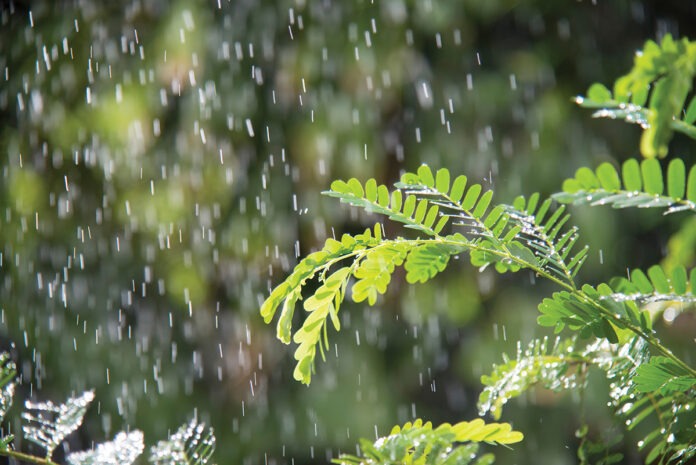
With the wet season off to one of its driest starts in memory, regional water managers have extended one-day-a-week sprinkler limits clear through October — and the science suggests relief may not arrive on schedule.
—By the calendar, Southwest Florida should be soaked right now. Late June is supposed to be the heart of the rainy season, the stretch when towering afternoon thunderheads roll in off both coasts and drop an inch on the lawn before the evening news. Instead, the sky has mostly kept its hands in its pockets.
—On June 23, the Governing Board of the Southwest Florida Water Management District responded to the stubborn dry spell by extending its Modified Phase III “Extreme” water shortage order through Oct. 1. For Longboat Key, Sarasota and the surrounding barrier islands, the headline is simple and unchanged: outdoor irrigation stays capped at one day a week — and that applies to everyone, including homeowners drawing from private wells.
—The numbers behind the order
—The district’s case is written in rain it never got. When the Phase III order was first declared on March 24, the region was already running a 13.7-inch deficit against its typical 12-month total. By the end of May, the shortfall stood at 11.4 inches. Sarasota County has collected just 11.82 inches so far this year against a calendar-year average of 20.79 — roughly 57 percent of normal.
—The most alarming figure is the freshest one. With a week still left in June, the county had logged only 1.03 inches for the month, about 13 percent of what June usually delivers. Rivers, lakes and public supplies are all running low, district staff reported, with several water bodies described as severely below normal. The permitted watering windows remain narrow and deliberately nocturnal: 12:01 to 4 a.m., or 8 p.m. to 11:59 p.m. Properties smaller than an acre — which is most of them out here — get just one of those windows, not both.
—Why a dry June is a big deal
—Here is the part that makes this drought genuinely unusual rather than merely inconvenient. In Florida, well over half the year’s rain falls between June and September, and almost none of it arrives as a gentle, all-day soaking. It comes from convection: the peninsula bakes in the summer sun, sea breezes push inland from the Gulf and the Atlantic, the two air masses collide somewhere over the middle of the state, and the rising, moisture-laden air erupts into thunderstorms. It is the same engine that makes central Florida the lightning capital of the country.
—That engine is the region’s recharge system. A dry winter is survivable; a dry summer is not, because there is no second act. When the wet season sputters — as it has now for two years running — the deficit doesn’t merely hold steady, it compounds, because the months that were supposed to refill the tank are the ones coming up short.
—The El Niño wrinkle
—The atmosphere may be partly to blame, though not in the way most people would guess. The deficit was built largely during a dry cool season, and the climate pattern now taking shape points to a wetter winter ahead — not a wetter summer.
—In mid-June, NOAA declared that El Niño, the periodic warming of the equatorial Pacific, had officially formed, and forecasters expect it to strengthen, possibly to a rare “very strong” event, by the winter of 2026–27. El Niño runs strongest in the cool months, when it nudges the storm track south and historically hands the Gulf Coast a wetter, cooler dry season. That is encouraging for October and beyond.
—The catch is that the same pattern tends to suppress the Atlantic hurricane season by ramping up the wind shear that tears storms apart. NOAA is forecasting a below-normal 2026 season, and Colorado State University recently trimmed its outlook to roughly 11 named storms — well under the long-term average. Tropical systems and their trailing rain bands are one of the region’s most reliable drought-busters; a quiet season removes one of the wildcards that often ends a dry stretch. In short, the climate driver promising winter relief may also keep the near-term tap turned low.
—Where the island’s water actually comes from
—For all the talk of sprinklers, it is worth remembering where the water in them originates. Longboat Key doesn’t pump its own — the town buys finished water wholesale from Manatee County, a blend drawn from the Floridan Aquifer and the Lake Manatee Reservoir. Sarasota County leans heavily on the Peace River, supplemented by deep wells reaching the intermediate and Floridan aquifers. Both surface sources are exquisitely sensitive to drought, which is why the district has separately authorized the Peace River/Manasota Regional Water Supply Authority to increase its withdrawals from the shrinking river.
—Living on a barrier island adds a wrinkle of its own. Coastal freshwater floats in a lens atop denser seawater, and the balance is delicate: every foot the freshwater table drops can allow the salt beneath it to rise many times that distance. Over-pumping during a drought is precisely how coastal and shallow-well aquifers turn brackish — a slow, expensive problem that conservation now helps head off later.
—Enforcement has teeth this time. To protect what supply remains, Sarasota County stopped issuing courtesy warnings on April 17; violators now go straight to a citation.
—Within the one-day rule, though, there is more latitude than the headlines suggest:
• Hand-watering and micro-irrigation of flower beds, shrubs and other non-lawn plantings is allowed any day — but only before 8 a.m. or after 6 p.m.
• New lawns and plants get a 60-day grace period: water any day for the first 30 days, then three days a week for days 31–60 (keep a written schedule), split by address — even numbers on Tuesday, Thursday and Sunday, odd numbers on Monday, Wednesday and Saturday.
• Washing the car at home is fine, but only on your assigned watering day and only with a shutoff nozzle. Pressure washing is permitted when prepping a surface for paint or sealant. Boats may be rinsed and engines flushed after each use to clear saltwater.
• Restaurants may serve water only when a diner asks, and charity car washes are off the table unless they were scheduled before the restrictions took hold.
—The clause your HOA needs to read
—One provision deserves special attention in a community as association-governed as ours. The district’s order expressly bars any HOA or similar body from enforcing deed restrictions or aesthetic standards that would require residents to use more water — no demanding a lush green lawn, no mandating replacement plantings, no ordering a pressure-wash to satisfy a community-standards letter. If a board’s rulebook collides with the water shortage order, the order wins.
—And if there is consolation for anyone watching their St. Augustine grass go dormant, it is this: agronomists generally agree that one deep weekly soak grows a healthier, more drought-tolerant lawn than frequent shallow sprinkling, which only trains roots to stay lazy near the surface. The pre-dawn and after-dark windows the district mandates also happen to be when the least water is lost to evaporation. The rules, in other words, are nudging the region toward the way lawns should have been watered all along. For the full order, the district points residents to WaterMatters.org/Restrictions, with conservation tips at WaterMatters.org/Water101.

