
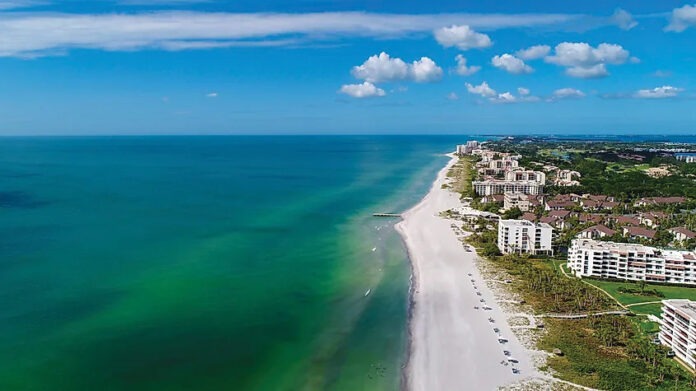
—Your home on Longboat Key is, for most of the people who own one, the most consequential investment of a lifetime — the final, hard-won place to live out the good years against ten miles of bronzed sand, with the Gulf of Mexico on one side and the noise of the mainland safely on the other.
—So when the property appraisers speak, the whole island leans in. What are the valuations? What is the market doing? And how does all of it flow, dollar by dollar, into the Town’s coffers?
—This week the answer arrived in two envelopes — one from Sarasota County, one, just Friday morning, from Manatee. And the answer is more reassuring, and more complicated, than the early headlines suggested.
—The headline that only told half the island’s story
—When the Sarasota County Property Appraiser’s Office released its preliminary June 1 figures on May 22, the regional read on Longboat Key was blunt: the Town was the only municipality in the county to lose taxable value, slipping roughly 1.15% from its 2025 certified figure to a June estimate of $6,979,174,983. In a county where North Port jumped 5.61%, the City of Sarasota rose 3.17%, and even slow-growing Venice eked out 0.07%, Longboat looked like the lone outlier headed the wrong way.
—But Longboat Key does not live in one county. It straddles the Sarasota–Manatee line, and any number drawn from a single county tells only half the island’s story.
—The number that matters: up 2%
—“These are the files I received from Sarasota, and I just received Manatee’s this morning,” Town Finance Director Susan Smith told Longboat Key News on Friday. “I am still compiling the numbers, but overall we have a combined increase of 2%.”
—That single figure reframes everything. Where the Sarasota-side estimate dipped about 1.3%, the Manatee-side estimate surged 10.81% — climbing from a 2025 taxable value of roughly $2.67 billion to a 2026 estimate of $2.96 billion. Stitch the two halves together and the Town’s combined taxable value rises from $9.74 billion to a $9.94 billion estimate: a gain of nearly $194.5 million, or 2%.
—At the Town’s current operating millage of 1.9600 — unchanged from last year — Smith said those new values “would produce $366,911 of new tax revenue using the same mill rate as in the prior year.”
—It is real money. It is also a fraction of last year’s haul, and therein lies the real story.
—A mirror image of last year
To understand FY27, look at how completely the two counties have swapped roles in a single budget cycle.
—A year ago, Manatee County was Longboat’s problem child. Battered by Hurricanes Debby, Helene and Milton — three storms inside three months — Manatee-side values collapsed 9.96%, dragged down by structural damage and a tax-rebate program for significantly damaged homes that, as Town Manager Howard Tipton noted in his budget transmittal, alone cut more than $268,000 from General Fund property tax revenue, “mostly from Manatee County.” What saved the FY26 budget was Sarasota: the new St. Regis Resort came onto the 2025 tax rolls, adding an estimated $540 million in taxable value and lifting the Sarasota side 13.53%. The combined result was a healthy 5.96% increase that generated $1,029,235 in new revenue.
This year the mirror flips. The storm-scarred Manatee homes are coming back onto the rolls — hence the 10.81% rebound — while the Sarasota side, having already banked its once-in-a-generation St. Regis windfall, settles back to earth and slips about 1.3%.
—Nowhere is the cooling more visible than in new construction. On the Sarasota side, the market value of new construction in the Town fell to just $52,917,900 this year — less than one-tenth of last year’s $546,945,100. The crane-driven growth that powered the FY26 budget has, for now, gone quiet.
—The fine print: a quiet $78,000 already gone
—There is a second, less obvious wrinkle buried in the county worksheets — the darker-purple “Final 2025 Adjusted” values that Smith flagged.
—After the FY2026 budget was already adopted, both counties revised their 2025 numbers downward through lawful corrections and Value Adjustment Board modifications. Manatee trimmed its 2025 base by about $22.6 million (-0.85%); Sarasota by roughly $17.4 million (-0.25%). Modest as percentages, those after-the-fact corrections quietly reduced Town revenue by $44,313 on the Manatee side and $34,020 on the Sarasota side — nearly $78,000 the Town had counted on and will not collect.
—It is the kind of footnote that rarely makes a headline but matters enormously to a finance director balancing a budget to the dollar.
—Why the growth engine cooled
—Three forces are pressing down on Longboat’s tax base at once.
—First, the one-time events have washed through. St. Regis can only be added to the rolls once; that 13.53% Sarasota surge was a sugar high, not a trend.
—Second, new construction has thinned to a trickle — the lifeblood of “new” tax revenue that doesn’t require raising anyone’s rate.
—Third, the state’s own forecasts have turned cautious. Across the region, revised state estimates for the coming fiscal year came in dramatically below earlier projections, as multiple economic models replaced the single rosy forecast governments once relied on. Longboat is not immune to that broader chill.
—The upshot: even with values up 2%, the Town is looking at roughly a third of the new revenue it enjoyed a year ago — at a moment when costs are still climbing.
—A leaner budget, built for the squeeze
—The good news is that the Town saw the squeeze coming. The FY26 General Fund budget Tipton recommended actually shrank — to $24,126,852, a $612,162 (2.5%) reduction — though that headline decline is mostly an accounting artifact of lower capital transfers (FY25 carried a $2 million transfer for a fire ladder truck; FY26 required just $234,000). Strip out capital, and operating expenditures rose about 5%, driven by the reality that wages and benefits make up roughly 80% of the budget. Even so, the Town built the plan so that revenues exceed expenditures by $161,787 — money earmarked to begin rebuilding the reserves the hurricanes drained.
—Resilience, by the numbers
—If the valuation reports are the worry, the Town’s mid-year financial update — delivered to the Commission on May 18 — is the reassurance.
Fiscal 2025 was, in Tipton’s framing, a trial by fire. The unassigned fund balance plunged from a comfortable $15.3 million to $9.4 million — a near-$6 million hit. But aggressive insurance recoveries, sharp contract bidding and departments operating under budget clawed back about $2.3 million, and the Town’s reserves still sit at 156 days of operating expenses — squarely inside the Commission’s 120-to-180-day policy target.
—Meanwhile the Town has played offense with outside money. It secured a staggering $23.66 million to replace the aging Subaqueous Forcemain — a $9.58 million zero-interest loan, a matching $9.58 million principal-forgiveness grant from the State Revolving Fund, and a $3 million federal EPA grant — sparing residents the full weight of a critical infrastructure bill. Add $1.2 million from the State Beach Management Program, $924,897 for center turn lanes, and grants for police body cameras and pedestrian safety, and a picture emerges of a small town punching well above its weight in the grant arena.
—The Police Department, when its deputy chief retired, reallocated the savings to hire two additional patrol officers without adding a dollar to the budget, and put new shallow-water Sea-Doos — funded by WCIND grants — into congested waters. The building department, in the wake of Florida’s post-collapse condo-safety laws, logged 198 of 198 required milestone reports for older high-rise condominiums, with zero major structural issues found.
—What it means for FY27
—The timing is no accident. These June estimates land just as Tipton’s team begins drafting the FY27 budget, and they sketch its central tension plainly: a tax base that is still growing, but slowly; a new-construction pipeline that has all but emptied; reserves that are healthier than feared but thinner than before the storms; and roughly $366,911 in fresh revenue to absorb rising wage, insurance and public-safety costs — at an unchanged 1.9600 mill rate.
—For Sarasota-side readers watching their own county’s numbers, Longboat is a useful cautionary tale: a single-county snapshot can badly mislead. For Longboat residents, the message is steadier. The island did not lose ground this year — it gained a little, on a two-county ledger that the early reports missed. But the era of effortless, construction-fueled windfalls is, at least for now, behind it.
—The character of a town, as the mid-year report put it, is measured not when the seas are calm but in the aftermath of the storm. By that measure, Longboat Key enters its next budget season bruised, disciplined, and — on the only number that counts the whole island — still moving forward.

