
—
Field notes from the most unhinged French Open in living memory, in which the three best men on Earth are removed from the premises by a heat wave, a teenager, and Jannik Sinner’s own legs.

—Back When This Tournament Had the Decency to Be Boring
—There was a time — a calmer, dumber time — when the French Open was the most predictable event on the sporting calendar, somewhere between the sunrise and your brother-in-law explaining crypto at Thanksgiving. The tournament itself was a filthy spectacle: red clay that gets into everything you own, lunatic bounces, no roof, grown millionaires sliding around in what is essentially expensive dirt. And presiding over all of it, every single year, with the grim inevitability of a tax audit, was Rafael Nadal, who won the thing fourteen times — which is not so much a record as a hostage situation.
Then Rafa’s knees finally unionized and he retired, and just as we braced for anarchy, the universe sent backup: Iga Swiatek dropkicking the entire women’s tour into the following Tuesday, and Carlos Alcaraz, who plays tennis the way other people do parkour, waving his little magic wand and out-running, out-hitting, out-grinning, and out-charming every human in the building. There was also Jannik Sinner, the Italian who hits the ball flat and straight and obscenely hard, like a ball machine that gained sentience and, as we’ll get to, a lawyer. For two years the men’s game was those two and a list of polite extras.
—And Then the Wheels Came Off, All of Them, at Once
—Then came 2026, the year Roland-Garros looked at all that lovely order and said: no thank you.
—Let us take attendance. Alcaraz, the two-time defending champion, did not make it to the starting line — out with a wrist injury, meaning the man could not defend a title he had won twice, which is roughly like the reigning hot-dog-eating champion phoning in with a sore jaw. Fine, you think. That clears the runway for Sinner, the world No. 1, who showed up in Paris on a 30-match winning streak as a minus-300 favorite, meaning the betting markets rated his victory somewhere between “sure thing” and “law of physics.”
—How to Lose a Match You Have Already Won
—I am not making this up, and I would like that on the record, because what follows is hard to believe even with photographs.
—Sinner won the first two sets. He went up 5-1 in the third, serving for the match — which in tennis is the part where you have, for all practical purposes, already won and are mentally selecting a postmatch beverage — and then his body resigned, cleaned out its desk, and left the building. He lost fifteen consecutive points. FIFTEEN. He stood doubled over the clay looking dizzy and nauseous, wearing the exact expression I last achieved at a Sarasota Golden Corral.
—The Rules Apply to Everyone (Some Restrictions May Apply)
—This is where it gets, as my grandchildren say, spicy. Because only last week, in this very column, I noted that Jannik Sinner appears able to cramp on demand — the way other people can cry on cue or suddenly produce a doctor’s note. At the Italian Open he cramped against Daniil Medvedev, called for a timeout, got it, recovered, and won, after which Medvedev more or less suggested the tour treats its marquee names like Fabergé eggs. And here in Paris: same gag, sadder ending. Sinner asked the chair umpire, on a live microphone, whether he was permitted a medical timeout — a question carrying real “is it cool if I head out early, I’m not feeling great” energy — and then vanished off court for eighteen minutes, which is not a timeout, it is a layover.
—Jim Courier, watching from the TNT booth and declining to be a good sport about it, called the whole performance “absolute baloney.” He observed that cramping is not technically an injury, that the rules theoretically apply to all 128 players in the draw, and that they nevertheless seem to relax, stretch, and recline whenever the gentleman who moves the merchandise is in trouble. Which brought to mind the last occasion on which the rulebook did yoga on Sinner’s behalf: the doping business. He tested positive — twice — for clostebol, a banned anabolic steroid. The official explanation, which I am not making up and frankly could never have invented, is that his physiotherapist sprayed the steroid onto his own cut finger and then gave Sinner a massage, transmitting the substance the way one might transmit a head cold. The authorities accepted that he never meant to cheat and handed him a three-month ban — a ban so exquisitely scheduled, so artfully draped across the one stretch of the calendar containing exactly zero Grand Slams, that it qualifies less as a suspension than as a wellness retreat. Three months off, no majors missed, back in plenty of time for the clay. The Church hears the confession, assigns three Hail Marys, and books them for a Tuesday afternoon when you weren’t doing anything anyway.
—None of it saved him. Sinner dropped the final three sets 7-5, 6-1, 6-1 to a man named Juan Manuel Cerundolo, ranked somewhere in the mid-50s, who had never won a match remotely this big and is now the most famous Cerundolo on Earth — narrowly edging out his own more successful brother, Francisco, a development I assume is landing beautifully at the family dinner table. Sinner’s postmatch diagnosis? He hadn’t slept well. We have all slept poorly, Jannik. Most of us do not respond by coughing up a two-set lead on international television.
—Old Man Yells at Clay, Loses to Child
—This left precisely one legend upright: Novak Djokovic, who is 39, which in tennis is roughly 73, and in clay-court tennis in direct sun is roughly Methuselah. And here I must confess a humiliating fact about my entire demographic. We — the Longboat Key crowd, the men who still mist up over Federer’s backhand the way other men mist up at weddings — have developed a sappy, indefensible tenderness for elderly athletes, including the ones we openly loathed in their prime. I rooted for Tom Brady at the bitter end. I have caught myself thinking, heaven help me, well, I’m 57, and if Novak can still do it at 39, perhaps it is not too late for me — a thought I have while physically struggling to open a jar of pickles. When a fellow on the courts asked, “Think Novak’s got one more in him?”, three of us went silent, thought of Roger, and a man in a visor finally said, “I sure as hell hope not.”
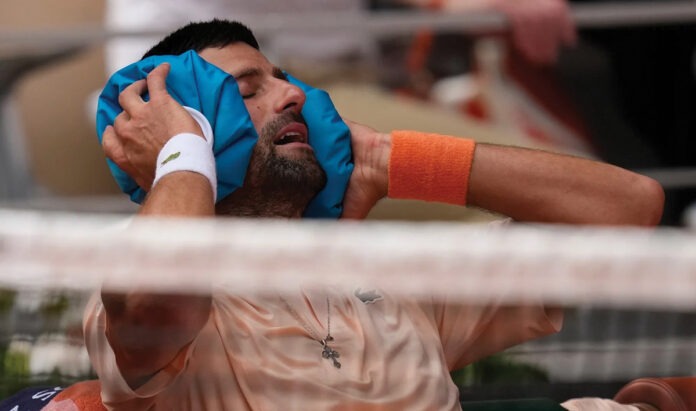
—The day after Sinner imploded, Djokovic kindly imploded too. He went up two sets on a nineteen-year-old Brazilian named Joao Fonseca — a teenager, a child, a person who has never once paid a property tax — and then, over four hours and forty-nine minutes in ninety-degree heat, the most famous legs in tennis quietly became linguine. Fonseca won in five. It was Djokovic’s earliest French Open exit since 2009, back when Fonseca was in roughly first grade, and it made the kid the first teenager ever to beat Djokovic at a major, where the old man had previously gone 18-0 against opponents who cannot legally rent a Camry.
—Now Hiring: World’s Best Tennis Player, No Experience Necessary
—So let us tally the carnage. The three best men alive are home on their respective couches, and Roland-Garros is now contractually obligated to manufacture a first-time champion. The new betting favorite — and he got the gig the way you get promoted when everyone above you quits on the same chaotic afternoon — is Alexander Zverev, the most decorated bridesmaid in the sport, a man who has blown a two-sets-to-love lead in a major final and lost another final to Alcaraz, and who now finds the door to greatness not merely open but unhinged, sold for scrap, and the frame hauled off too. Is this, at long and weary last, the Year of Zverev? Nobody knows. That is no longer a turn of phrase. Nobody, anywhere, knows anything.
—The Women’s Bracket Is Also a Dumpster Fire, Thanks for Asking
—The women’s draw, lest you suspect the chaos of sexism, is its own slow-motion building collapse. Aryna Sabalenka, the world No. 1, is still chasing a first French title after losing last year’s final to Coco Gauff by approximately one atom; Gauff, the defending champ, is grinding forward; and Iga Swiatek — four-time champion, self-declared and widely ratified Queen of Clay — is somehow both a tournament favorite and a woman who appears to have misplaced her entire game over the spring, and who may now collide with Jelena Ostapenko in the third round. Ostapenko, I should note, is 6-0 against Swiatek lifetime. Six and oh. Watching Iga’s path is like watching someone whistle cheerfully toward a visibly haunted house while the whole theater screams at the screen. Meanwhile Elena Rybakina, reigning Australian Open champion and Moscow-born howitzer, went out in the second round — confirming the ancient wisdom that nobody ever takes Moscow, especially in a war, although in this case Moscow appears to have self-deported before the enemy so much as arrived.
—Naomi Osaka Will Be With You After the Costume Change
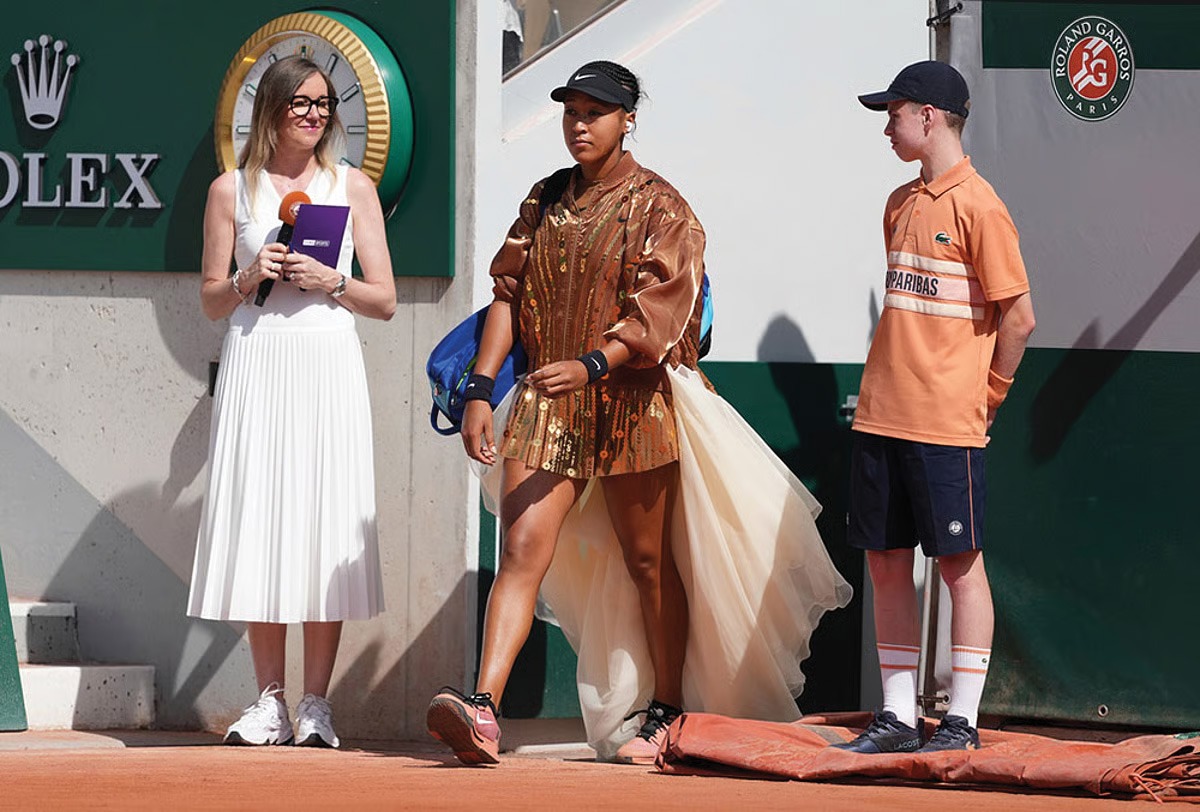
—And then, blessedly, there is Naomi Osaka, who did not fly to Paris to play tennis so much as to stage a fashion intervention. For each match she emerges in a bespoke couture “walk-on” look layered over a gold sequined dress, one of them topped with an ivory train so colossal she had to unclip it and hand it to a small child before she could play tennis — a thing that physically happened, on a tennis court, in front of God and several thousand baffled French people. (At the Australian Open she arrived dressed as a jellyfish, with a parasol. A PARASOL. INDOORS.) Osaka, to her eternal credit, is fully committed to the bit: “Athletes are in show business,” she declared, explaining that because she doesn’t much enjoy talking, she prefers to “talk through my clothes” — a sentence that quietly explains a great deal. Her first-round opponent, Laura Siegemund, was conspicuously less enchanted, grousing that this was “yet another example of big names being treated differently,” since the headliner gets ten leisurely minutes to disrobe at the net while everybody else is frantically unzipping a duffel to avoid a time violation.
—It is, to be fair, a proud tradition. Serena Williams once returned to this very tournament after a dangerous childbirth in a black compression catsuit she said made her feel like a superhero — at which point the French Tennis Federation, displaying all the nerve and judgment for which French bureaucracy is justly famous, banned it, having gravely concluded that the single greatest threat to the dignity of clay-court tennis was a new mother in functional Lycra. So the runway, like the trophy, is wide open. The future of this entire tournament is on absolutely anyone’s racket.
—To Watch Any of This, Please Consult an Accountant
—Which leaves the one mystery that keeps me up at night: how does a person actually watch this thing? In America, the matches are flung across TNT, truTV, and TBS, while every match streams on HBO Max — which used to be called Max, which used to be called HBO Max, and which I fully expect to rename itself twice more before the trophy is lifted. Or you can get it through YouTube TV, or Sling, or DirecTV, or Hulu, at prices running from eleven dollars to eighty-five dollars a month — unless you happen to have Fubo, in which case you are simply out of luck, out of tennis, and apparently being punished for something you did in a past life. There is also, the listings note with a perfectly straight face, free radio.
—Free. Radio. For a sport whose entire dramatic appeal this fortnight consists of watching beloved millionaires fall over in the heat.
—I’ll sort it out eventually — probably the very afternoon they hand the trophy to whichever total stranger wins the thing. In 2026, your guess is exactly as good as mine, which, after thirty straight years of this tournament being the safest bet in all of sports, is the most fun I have had with it since Nadal’s knees were still under warranty.

