
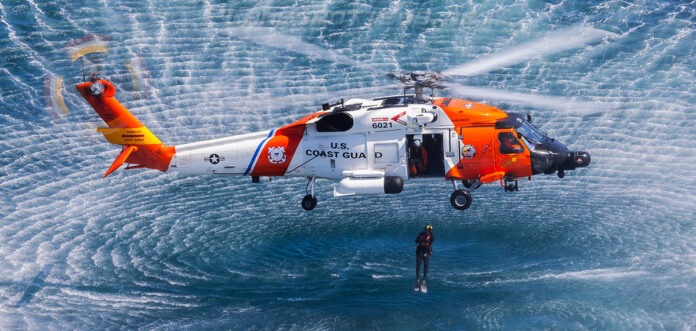
Out where the water turns from green to a bottomless blue-black, where the West Florida Shelf finally surrenders and plunges toward the deep Gulf, a fishing captain stood on a heaving deck on Tuesday, May 12, with a badly injured hand and a hard truth setting in: help was a long way off.
About 122 miles, to be exact. That is roughly the distance from Longboat Key to Miami — except there is no highway out here, no exit ramp, no hospital around the bend. There is only saltwater in every direction, the horizon unbroken, and a depth gauge that, this far out, reads in the hundreds of feet. The captain, a 56-year-old man hauling line aboard a commercial fishing vessel, had reached one of the loneliest working environments left in America.
—Then he heard the rotors.
—The call
—The chain of events that would carry the captain back to dry land began with a single radio request that crackled into the watch floor at Coast Guard Sector St. Petersburg. A crewman was hurt. The wound — sustained while hauling line, the punishing, repetitive heart of commercial reef fishing — was beyond what a deckhand and a first-aid kit could manage at sea.
—Watchstanders did the math fast. After consulting with the patient’s condition, they determined he needed a higher level of care than anyone aboard could provide, and they made the call that turns an ordinary Tuesday into a race: launch the helicopter.
—At Air Station Clearwater — the busiest Coast Guard air station in the country — an MH-60T Jayhawk crew spun up. The Jayhawk is a four-person, twin-engine machine built precisely for moments like this: designed to fly up to 300 miles offshore, hold station over a target for up to 45 minutes, and bring people home with fuel to spare. It cruises around 140 knots — better than 160 mph — which still meant the better part of an hour of nothing but water sliding beneath the cabin before the fishing boat would ever come into view.
—What it’s like out there
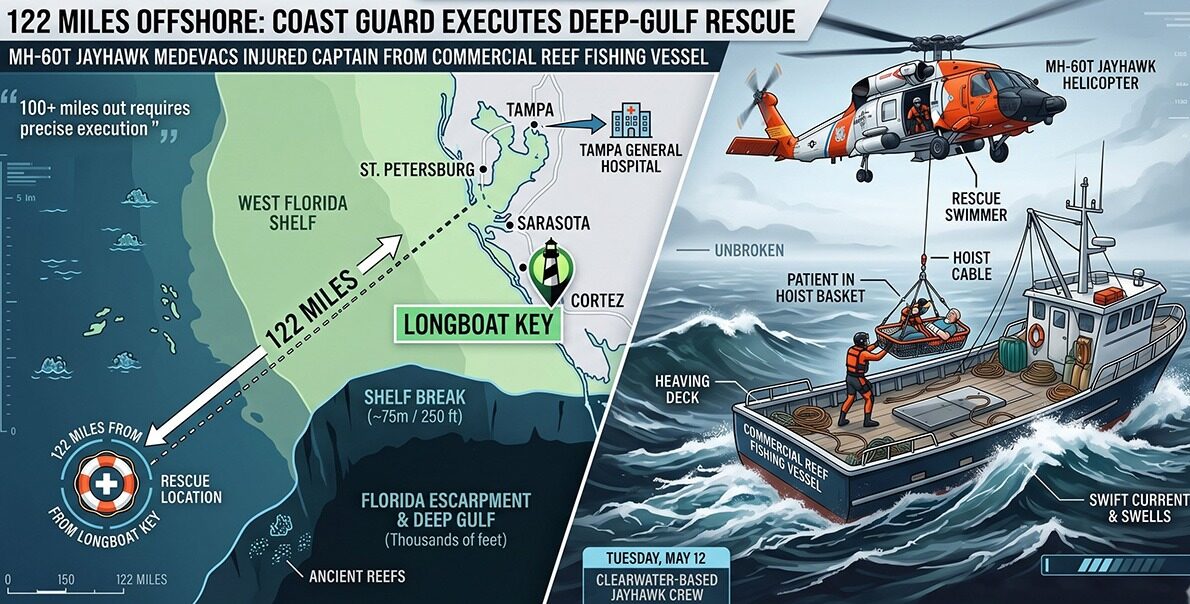
—To understand the distance is to understand the danger. Closer to shore, a hurt fisherman can be reached in under an hour by a fast response boat from a station like Cortez. But 122 miles is a different country.
—This is the shelf edge — the place where the broad, relatively shallow West Florida Shelf, which reaches roughly 120 miles off Tampa Bay, drops away into the true deep. Oceanographers put the shelf break off this stretch of coast at around the 75-meter line — about 250 feet down — and just beyond it the bottom falls toward thousands of feet along the steep face known as the Florida Escarpment. These shelf-edge waters are studded with drowned, ancient reefs that have drawn fishermen for more than a century, prime grounds for grouper, snapper, and tilefish. They are also the reason a captain would steam two days from port, working long lines up from the bottom by hand and machine, far from anyone who could help if something went wrong.
—Out here, weather builds with nothing to stop it. Swells roll in unbroken from across the Gulf. A fishing vessel becomes a small, moving, pitching target — and the helicopter has to thread a hoist cable down to it without ever touching down.
—The hoist
—Once the Jayhawk arrived overhead, the crew put their rescue swimmer into the equation — the Coast Guard’s most physically demanding rating, a person trained to drop from a hovering aircraft into open water or onto a rolling deck. The swimmer reached the captain, assessed his injury, and readied him for the lift.
Then came the part that looks effortless on the news and is anything but: the rescue basket, lowered on a cable rated to 600 pounds and just 200 feet long, swinging beneath a 21,000-pound helicopter that is itself fighting wind, rotor wash, and the up-and-down motion of the boat below. The pilots hold a hover by feel and instrument. The flight mechanic runs the hoist. Inches matter. The captain was loaded into the basket, hoisted clear of the deck, and brought safely aboard.
—From there the Jayhawk turned east for the long run back to the mainland, delivering the captain to Tampa General Hospital. The Coast Guard did not release his name or condition, and the hospital declined to discuss it, citing privacy. The name of the fishing vessel was not made public.
—Precise execution
—For the people who do this work, the long odometer reading is exactly the point.
“Executing a medevac more than 100 miles out in the Gulf requires precise execution,” said Chief Petty Officer Sean Deaton, a command duty officer at Sector St. Petersburg. “The quick and decisive actions by both our command center and air station personnel led to this successful rescue, demonstrating the proficiency and readiness of our crews to respond whenever and wherever they are needed.”
—It is a readiness this stretch of coast has leaned on before. Just last year, during Hurricane Milton, a Clearwater-area aircrew found a fishing captain 30 miles off Longboat Key clinging to a floating cooler after an overnight ordeal in 20-foot seas. The Jayhawk fleet has saved more than 13,000 lives since entering service in 1990.
—On this Tuesday, the tally rose by one — a captain who left port to work the deep reefs, got hurt where help is hardest to reach, and came home anyway.
—The U.S. Coast Guard urges all mariners heading offshore to carry reliable, redundant communications — a working VHF radio and an EPIRB emergency beacon can be the difference between a rescue and a tragedy. More information is available at uscg.mil.

