

City leaders see local control as a fix for years of weekend chaos at South Lido Beach — but the mayor warns the county ranked it as its worst park for a reason.
—For years, Ted Sperling Park has occupied an awkward jurisdictional limbo: a roughly 150-acre stretch of beach, mangrove and nature trail at the southern tip of Lido Key that sits squarely inside the City of Sarasota but is owned and operated by Sarasota County.
—Now city leaders are seriously weighing whether to take the park off the county’s hands — a move that surfaced repeatedly at the City Commission’s May 18 meeting and that supporters say could finally bring order to one of the region’s most contentious public spaces.
—The idea is tied to a broader conversation about creating a city parks district, and it drew support from both residents and commissioners. But the discussion also laid bare why the county may be willing to let the park go, and why the city should think carefully before saying yes.
—A park nobody seems to fully control
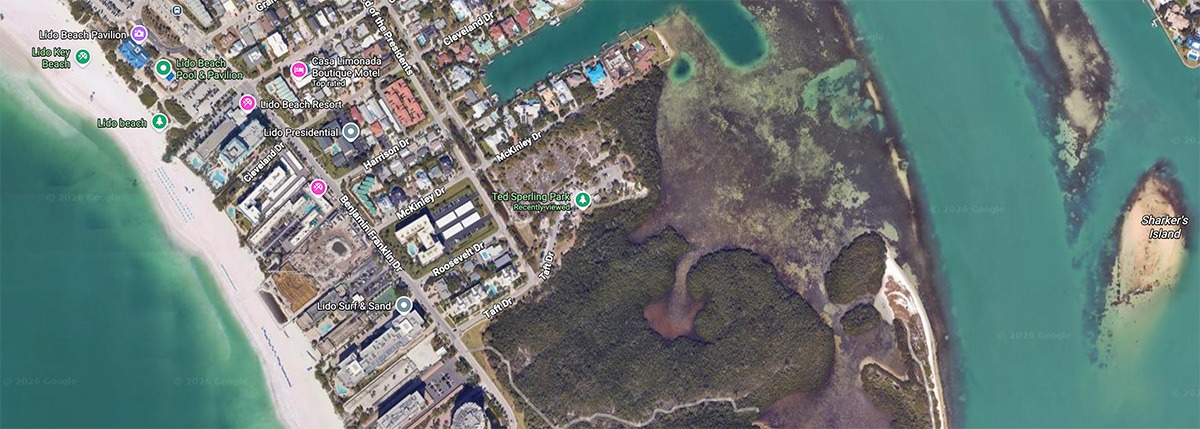
—The central problem with Ted Sperling Park is structural. Because it is county property within city limits, the county has no enforcement arm of its own and must rely on the Sheriff’s Office, the Sarasota Police Department, or the Florida Fish and Wildlife Conservation Commission to police it. The result, residents say, has been years of weekend chaos along South Lido Beach: reckless jet ski operators, party boats anchored offshore with blaring stereos, and what neighbors describe as a destination that has spun out of control.
—Speaking during public comment, David Rayner — a former resident of the Orchid Beach condominium next to the park and a board member of the Lido Key Residents Association — told commissioners he had been raising concerns about the park for nine years before finally giving up and moving. He praised the prospect of a city purchase but was blunt about his experience with the county, which he called “horrendous to deal with” over the prior seven to nine months. According to Rayner, the county had at one point asked staff to compile a list of its problem parks, and he told the commission that Ted Sperling Park ranked at the top of the 16 parks identified. Rayner also claimed the park generated more than 360 substantive police complaints in 2022 and 2023 — incidents he said ranged from suspicious persons to marine accidents and fires. “Buy the park,” he urged the commission. “Create the park district. Don’t let parks be the last thing on the agenda.”
—A death that intensified the stakes

—Looming over the entire debate is a tragedy. In June 2025, 19-year-old Luis Guevara, an infielder in the Baltimore Orioles’ minor league system, was killed in a head-on collision between two personal watercraft off South Lido Beach. Guevara, a Venezuelan native who signed with the Orioles as an international free agent in 2023 and was playing his first season in the United States, died of his injuries after all four occupants of the two jet skis were thrown into the water. Rayner referenced the death directly, linking it to what he described as illicit jet ski rentals operating at the park.
—The fatality galvanized both governments. In July 2025, the city and county each directed staff to draft ordinances restricting the beaching and mooring of motorized vessels within 300 feet of shore and to examine unlicensed commercial watercraft rentals. The county had already approved an ordinance regulating commercial activity in its water-access parks, though implementation was suspended after the 2024 hurricane season damaged boat launches and bulkheads. County Commissioner Mark Smith championed an exclusion zone around the park, but that effort hit a wall in late 2025 when the FWC signaled it would require “substantial competent evidence” before permitting a 300-foot motorboat exclusion zone — leaving the regulatory fix potentially a year or more away.
—Why the city thinks it could do better
—At the May 18 meeting, Commissioner Jen Ahearn-Koch made the case for a city takeover most forcefully. She pushed back on the framing of Sperling Park as simply a “problem park,” arguing the label reflects the county’s circumstances, not the park’s inherent character. “It’s one of their top problem parks list because it’s difficult for them to manage it,” she said. “It’s not a priority for them to manage it because it is so far out of the scope for them.” For the city, by contrast, “since it’s in the city and it’s right there… it will be far more efficient for the city to do it.”
—Ahearn-Koch pointed to the city’s existing parks operation as a model, praising the work of city parks staff and arguing the city could bring the same standard to Sperling. She suggested practical tools the city could use to get the park “under control” — limiting hours, capping occupancy, and similar measures — while protecting the preserve. The goal, she said, would be to “protect the nature, protect the preserve, protect the turtles and the birds and the beach,” and protect the public, including swimmers she described as repeatedly getting into trouble in the water.
—Mayor Debbie Trice was supportive but injected a note of caution, twice flagging the realities the city would inherit. “The county put that on the top of their problem parks list,” she reminded colleagues. “So we should bear that in mind.” She also raised the physical nature of the land itself: “It is a large, swampy area” — a reminder that the park’s mangrove preserve and beach come with real management demands.
—Where it goes from here
—City Attorney Joseph Polzak told commissioners the park has been the subject of both internal and external discussions, “especially now with the parks district discussion,” and offered to open formal talks with his counterpart, the county attorney, if the commission directed him to. He noted he already had “kind of a dialogue” going with the county attorney on the topic and would coordinate with the incoming city manager, who was set to start within two weeks. Vice Mayor Kathy Kelley Ohlrich said she would be interested in pursuing those conversations as well.
The commission did not take a formal vote to acquire the park at the meeting; the discussion was directional, with Ahearn-Koch noting, “I do [want to move forward]. But we are five people” — an acknowledgment that any acquisition would require full commission action. The practical effect was a green light for staff to keep exploring a transfer and to fold the question into the larger parks-district planning effort.
—The bottom line
—Ted Sperling Park is at a crossroads. It is a beloved and ecologically significant piece of public land — popular with kayakers paddling its mangrove tunnels and beachgoers watching the sunset — that has also become a flashpoint for public safety, a jurisdictional headache, and the site of a young athlete’s death. The city’s interest in acquiring it reflects a belief that local control could finally deliver the enforcement and stewardship the park has lacked. But as the mayor’s cautions suggest, taking ownership would mean inheriting a swampy, sprawling, hard-to-police preserve that a resident told the commission the county ranked as its most troublesome park. Whether the city can succeed where the county struggled — and whether the long-delayed watercraft restrictions ever clear their regulatory hurdles — will determine what the future actually holds for South Lido Beach.

