
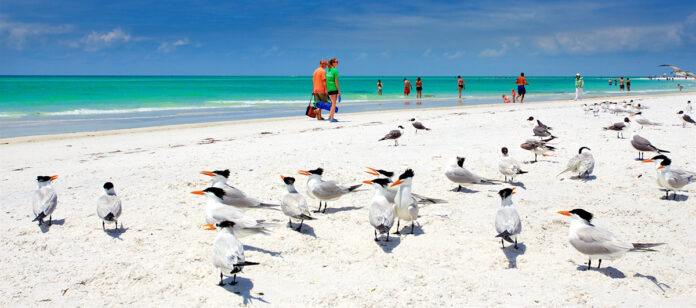
Crews mobilize Sept. 14 to build 1.2 miles of vegetated dunes, the final phase of a federally funded campaign to rebuild a shoreline that back-to-back hurricanes nearly erased
—Beginning next Monday, heavy equipment will rumble onto Lido Beach. A week later crews will begin sculpting roughly 3,000 cubic yards of sand into over a mile of dunes and plant them with native vegetation whose roots will knit the whole system together.
—It is the final act in one of the most consequential public works campaigns on Sarasota’s barrier islands in a generation, and it is aimed squarely at the two forces that define life at the water’s edge: the Gulf of Mexico’s relentless appetite for sand, and the hurricanes that in 2024 showed just how quickly the Gulf can take back what the region depends upon.
—When the roughly 60-day dune project is complete, the city will have spent more than $13 million in combined federal and local money to rebuild, widen and fortify Lido Beach, one of the most visited, most photographed and most economically vital stretches of shoreline on Florida’s west coast.
—A Beach That Nearly Vanished
—To understand why the city is building dunes, start with what happened in the fall of 2024.
—Hurricane Helene never made landfall here. It passed roughly 100 miles offshore in late September on its way to the Big Bend, yet it shoved a wall of Gulf water across the barrier islands, burying Benjamin Franklin Drive under sand as much as four feet deep, buckling sidewalks, wrecking the Lido Pavilion concession area and forcing the city to close the beach entirely on Sept. 25. Public Works crews spent weeks hauling away what the city described as mountains of sand just to uncover the road and the public access points.
—Two weeks later, on Oct. 9, Hurricane Milton made landfall just south of here, driving storm surge that city officials estimated at up to seven feet across the beachfront. The one-two punch compounded erosion that had been accelerating since Hurricane Ian in 2022. By the time engineers surveyed the damage, portions of Lido Beach had lost 50 to 100 feet of width. In some stretches, longtime beach walkers found they simply could not pass at the waterline anymore.
—For a barrier island whose beach is both its economy and its armor, that was an emergency.
—First the Sand, Then the Dunes
—The response came in two phases.
—Phase one was the Lido Beach Renourishment Project, which ran from January through late May of this year. The U.S. Army Corps of Engineers dredged approximately 300,000 cubic yards of sand from New Pass, the channel separating Lido Key from Longboat Key, and pumped it south through a network of floating, submerged and beachfront pipelines onto 1.2 miles of shoreline. The $12 million project was fully federally funded and restored the beach to roughly its pre-storm width. City officials cut the ribbon in late May, with Congressman Greg Steube marveling that where he once surfed at the shoreline, there now stood a broad expanse of new beach.
—Phase two is what begins this month. The Lido Beach Dune Restoration Project takes sand from that same New Pass maintenance dredge and shapes it into a continuous vegetated dune line along the renourished beach. Once the dunes are graded, contractors will plant Florida-friendly dune vegetation, the sea oats and native ground covers whose deep roots anchor sand in place, and install post-and-rope barriers with signage to keep foot traffic from trampling the new plantings.
Public access to Lido Beach will be maintained throughout the roughly two-month construction window, and when the work is finished the beach will feature more than 30 access points threading through the protected dune system.
—Why Dunes Are the Whole Ballgame
—A wide, flat beach is lovely to look at, but by itself it is a temporary condition. Dunes are what make a beach a defense system.
—Vegetated dunes absorb wave energy before it reaches roads, seawalls and building foundations. They trap windblown sand that would otherwise migrate inland onto streets and parking lots, exactly what happened along Benjamin Franklin Drive during Helene. And during a surge event, a healthy dune line functions as a natural levee, forcing the Gulf to spend its energy chewing through sand rather than through the ground floors of condominiums.
—The stakes behind that dune line could hardly be higher. Lido Key and neighboring St. Armands Circle sit on some of the most expensive real estate in the region, and St. Armands’ shops and restaurants, which flooded during the 2024 storms, sit only a few blocks behind the beach. Every foot of dune elevation is, in effect, insurance for hundreds of millions of dollars in Gulf-front property, the tourism economy that feeds the entire city, and the tax base that flows from both.
—The dunes also serve a quieter constituency. They provide shelter, feeding grounds and nesting habitat for shorebirds and sea turtles, which is why Mote Marine Laboratory and the Sarasota Audubon Society are partners in the project. With sea turtle nesting season running through the end of October, monitoring will continue as the work proceeds.
—Follow the Money
—The renourishment’s $12 million price tag was covered entirely by federal disaster relief dollars secured through the Army Corps: $8 million appropriated in 2022 following Hurricane Ian, and another $4 million in 2025 to cover cost increases driven by inflation and evolving design standards after Helene and Milton.
—Those dollars did not fall from the sky. The city’s federal lobbying partner, Color Nine Group, worked the appropriations process in coordination with the offices of U.S. Rep. Greg Steube and Sen. Rick Scott to keep Lido on the Corps’ priority list, no small feat when every storm-battered coastal community in the Southeast was competing for the same shoreline protection funds.
—The dune phase is a comparative bargain at roughly $1.2 million, including about $700,000 in construction costs, drawn from a mix that includes local tourist development tax revenue and state environmental grant support. Measured against what a single breached shoreline can do to beachfront property values, it may be the highest-leverage $1.2 million in the city’s capital plan.
—The Paperwork Behind the Sand
—Projects like this run on easements as much as on dredges. In May 2025, the Sarasota City Commission approved a temporary access and work-area easement and assigned 21 perpetual beach storm damage reduction easements to Sarasota County, agreements the County Commission formally accepted the following month. Those documents satisfied the federal real estate certification requirements that allow the Army Corps to build on the beach, and the temporary easements remain in effect through the end of 2026.
—The renourishment itself operates under a 50-year partnership agreement between the city and the Army Corps that calls for Lido Beach to be renourished roughly every five years. The previous cycle came in 2021; the current one arrived in 2026, right on schedule and, as it turned out, not a moment too soon. The next is expected around 2031.
—A Bonus for Boaters
—There is a side benefit for anyone who runs a boat between Sarasota Bay and the Gulf. New Pass has long been one of the trickiest cuts on this stretch of coast, with shifting sandbars and unpredictable depths that have claimed their share of props and hulls. The dredging that supplied Lido’s sand also deepened and leveled the federally authorized channel, making the pass markedly safer for the sailors, anglers and cruisers who thread it daily between Longboat Key and Lido.
—What Comes Next
—The dune work is expected to wrap up by late November, weather permitting. Following behind it is a related project to remove and replace three aging beach walkovers, one at the Lido Pavilion, one at the north end of the pavilion parking lot and one at the North Lido Beach access near the curve of John Ringling and Benjamin Franklin boulevards, with that work expected to finish by mid-2027.
—Taken together, the renourishment, the dunes and the walkovers amount to a wholesale rebuilding of Lido’s shoreline defenses, a recognition that on a barrier island, the beach is not an amenity. It is infrastructure, as essential as the water mains and the bridges, and considerably more exposed.
—Helene and Milton proved the Gulf can undo decades of investment in a single tide cycle. The sand now being shaped into dunes along those 1.2 miles is the city’s answer, and its bet that the next time the water rises, Lido will be ready.
For more information, visit Engage.Sarasotafl.gov/lido-beach-renourishment.

