
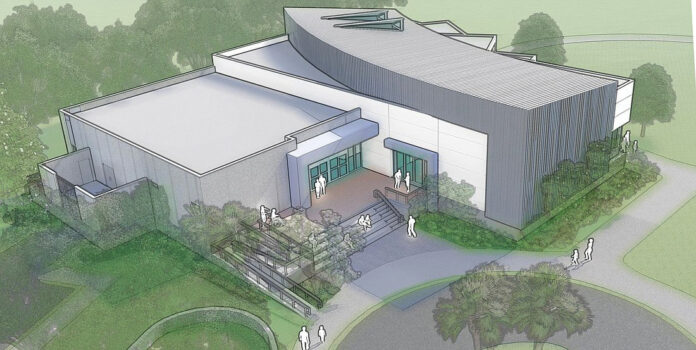
The county has advanced the design. Donors have met their pledge. But the recurring expense of keeping the doors open runs on the very tax now facing Florida voters — and that arithmetic is suddenly anything but settled.
—There is a difference, rarely discussed in the celebratory language of groundbreakings and ribbon cuttings, between a building and an institution. A building can be financed once — with impact fees, a bond, a benefactor’s gift. An institution requires something far more demanding: a standing subscription to the future, renewed every fiscal year, paid in the steady currency of property tax. Sarasota County has all but secured the money to build the Longboat Key Public Library. What it cannot yet promise is that it will be able to afford to keep the lights on once the building exists.
—That distinction, abstract in ordinary times, has become the central financial question hanging over one of the most patiently assembled civic projects in the island’s history — and it now turns, improbably, on a single line on the November 3 statewide ballot.
—A Project Advanced Without a Vote
—During Sarasota County’s most recent budget workshop, the County Commission advanced the preliminary Capital Improvement Program for the coming fiscal year, moving a slate of projects forward as a block. The library was among those that no commissioner chose to pull aside for individual scrutiny, redesign, or cancellation. In the procedural grammar of municipal budgeting, that silence is itself a decision: the project survives, the drawings continue, the architects proceed.
—Carolyn Eastwood, the county’s Director of Capital Projects, confirmed to the board that the library has reached the 70 percent design threshold — the stage at which a building stops being an idea and becomes a specified, costed, nearly buildable thing. The work will continue through completion.
—But “the design will be finished” and “the building will be operated” are two different sentences, and the gap between them is precisely where the anxiety now lives.
—The Costs That Cannot Be Endowed
—The construction of the library — roughly $11 million for the core facility — is already accounted for through library impact fees, the one-time charges levied on new development specifically to fund the capital cost of growth. A determined philanthropic campaign on Longboat Key has met and exceeded its $3.5 million target for enhancements: a community hall capable of seating two hundred, and an outdoor terrace designed to knit the building into the Town Center Green and the adjacent Karon Family Pavilion. The total project approaches $14.5 million, and on the capital ledger, it is essentially solved.
—It is the operating ledger that gives the commission pause — and operating costs, unlike construction, cannot be paid once and forgotten. They recur, indefinitely, for as long as the institution draws breath.
—Steve Botelho, the county’s Deputy Administrator and Chief Financial Management Officer, laid the figures before the board with clinical precision. A partial first year of operation in 2028 would cost the county on the order of $740,000 — for staffing, utilities, maintenance, and programming. That figure climbs to roughly $1.1 million in 2029 and reaches approximately $1.4 million by 2031. None of it can be drawn from impact fees. None of it can be covered by the donations already raised. Every recurring dollar must come from the county’s general fund — the pool fed, overwhelmingly, by property tax.
—And the property tax is exactly what Florida is preparing to reconsider.
—The Measure on the Ballot
—On June 2, the Florida Legislature passed HJR 1F — styled the “Save Our Homes from Excessive Property Taxes” amendment — by decisive margins in both chambers. The measure now goes before voters on November 3, where it requires the approval of 60 percent of the electorate to be written into the state constitution.
—Its mechanics are straightforward and its consequences are not. The homestead exemption, currently $50,000, would rise to $150,000 in 2027 and to $250,000 in 2028, indexed thereafter to inflation. The amendment further establishes a constitutional pathway toward the eventual elimination of non-school property taxes on homesteaded property altogether. For a great many full-time Florida homeowners, the levy that funds their local government would shrink toward zero.
—What is offered to homeowners as relief arrives at the county treasury as subtraction. Sarasota County’s Office of Financial Management has already modeled the loss: should the referendum pass, the county projects forgoing roughly $87 million in property tax revenue by fiscal year 2029 — an amount equal to 28.5 percent of the property tax revenue it expects to collect in 2027, and some 17 percent of the entire general fund within a projected $509.4 million budget. Statewide, the Florida Policy Institute estimates the $250,000 exemption alone would cost counties on the order of $4.8 billion annually, a figure that could approach $8.65 billion under full homestead elimination.
—These are not the numbers of belt-tightening. They are the numbers of structural retrenchment — and a recurring $1.4 million annual obligation for a barrier-island library is precisely the sort of discretionary commitment that does not survive a contraction of that magnitude.
—What the Amendment Permits — and What It Omits
—The deeper threat is not merely that revenue would shrink, but that the amendment dictates how the diminished remainder may be spent. The constitutional framework directs local governments to prioritize a defined list of essential functions: public safety, infrastructure, schools, debt service, and pensions.
—A public library does not appear on that list.
—This is the quiet detail with the loudest implications. A county struggling to fund police, fire, emergency services, and basic infrastructure on a property tax base reduced by tens of millions of dollars may find itself not merely disinclined but constitutionally constrained from underwriting a new cultural amenity — regardless of how complete its design, how generous its donors, or how long its community waited. The instrument that was meant to deliver the library would, in that scenario, forbid the county from operating it.
—Commissioner Teresa Mast captured the board’s predicament without ornament, speaking of the necessity of re-examining beloved projects that carry heavy recurring costs. The commissioners, she said, were not questioning the importance of such projects, only confronting the discipline of prioritizing among them when the means to fund them all no longer exist.
—County Administrator Jonathan Lewis offered the board a measure of procedural calm: because the operating dollars will not be required until after the November vote, no irreversible decision is needed now. But Lewis was candid about the horizon beyond it. The long term, he allowed, is anybody’s guess — which is, in the careful idiom of a county administrator, an admission of considerable unease.
—A Quarter-Century in the Making
—To grasp what stands to be lost, one must reckon with how long it took to arrive here.
—The project did not begin as a library. It began, some two decades ago, as the island’s yearning for a permanent home for arts and culture — a successor to the vitality that had once animated the north end before the Longboat Key Center for the Arts closed in 2017. For years, the favored vehicle was a partnership with Ringling College of Art and Design: a roughly $13 million center, raised through philanthropy, with Ringling managing the facility on land the Town would provide. That arrangement collapsed when two commissioners turned against it and Ringling’s president withdrew.
—The vision narrowed and, in narrowing, became attainable. Rather than an arts center the Town would struggle to operate, Longboat would invite Sarasota County — which had not opened a new library since 2018 — to build and run a county library on town-owned land at the Town Center Green, the 4.8-acre parcel east of Publix that the Town had acquired for $3.7 million and developed, all told, at a cost of some $5.6 million. The county would fund the building; the island would raise private money for the enhancements that would distinguish it from a generic branch. In the interim, beginning in November 2023, a county pop-up library began visiting the island on the first and third Thursdays of each month — a placeholder, and understood as one.
—What the Campaign Survived
—The fundraising was never a sure thing, and the autumn of 2024 nearly broke it. Hurricanes Helene and Milton inflicted more than $225 million in damage across Longboat Key, costing the campaign roughly four months as residents turned, rightly, to recovery. A jittery stock market and a season of economic uncertainty further dampened the appetite for giving.
—And yet the island delivered. By the spring of 2025, then–Town Manager Howard Tipton reported pledges totaling $2.8 million, with the Town itself guaranteeing the remaining shortfall of some $700,000. The donor roll was the portrait of a community willing itself toward a goal: a $1 million lead gift, a half-million-dollar commitment, a $350,000 pledge, two gifts of $250,000, four of $100,000, two of $50,000. On June 4, 2025, the County Commission formally approved the project and authorized final design. The Library Foundation for Sarasota County has since received the bulk of the donations and transferred the proceeds to county government.
—Tipton, who shepherded the effort through every reversal, called the library the crowning piece of the Town Center — the element that would, at last, make the whole composition cohere.
—What the Money Was Meant to Build
—The private dollars were never destined for shelving or circulation desks. They were meant to purchase the difference between a county facility and a civic gathering place. The two-hundred-seat community hall would give the island a venue it has never possessed; the existing Town Hall chambers seat no more than eighty, and the most consequential public meetings have long been exiled to borrowed rooms. The outdoor terrace, added during final design, was conceived to dissolve the boundary between building and park, drawing the library outward into the Town Center Green and toward the Karon Family Pavilion, itself the product of private giving anchored by a $500,000 gift.
—This was, in other words, never merely a library. It was the long-deferred answer to the island’s oldest civic ambition.
—The Donors’ Safety Net — and Its Cold Comfort
—Should the project ultimately be abandoned for want of operating funds, county officials have confirmed that the $3.5 million in private contributions held by the Library Foundation would be returned to the donors who gave it. No benefactor would lose a gift.
—It is genuine reassurance, and it is also a hollow one. The dollars would be made whole; the years would not. The relationships cultivated, the pledges secured through a pandemic, two hurricanes, and a volatile market — all of it would resolve into a refund and a flat parcel of ground beside a pavilion, the most expensive vacant lot on the island’s civic conscience.
—A Decision That Belongs to Strangers
—The near-term calendar is procedurally unremarkable. Design continues. A budget workshop is set for August. Public hearings on the fiscal 2027 budget follow in September, with final adoption to come.
—But the date that governs all the others falls on November 3, when Florida’s voters — in Jacksonville and Tampa, in Tallahassee and Pensacola — will decide whether HJR 1F enters the constitution. If it does, the fiscal architecture beneath every county library, park, and cultural facility in the state shifts at once, and Sarasota County’s calculus on whether it can staff, power, and program a new library on Longboat Key ceases to be a matter of will.
—It becomes a matter of permission and of means.
—The Longboat Key library is 70 percent designed, fully funded to construct, and surrounded by the goodwill of a community that spent a generation and several million dollars willing it into being. Whether it ever opens its doors may rest not with a county commission, a contractor, or a donor — but with an electorate spread across sixty-seven counties, deciding a question that has nothing to do with a barrier island and everything to do with it.
—The building, in the end, was the easy part. Keeping it alive is the harder arithmetic — and Florida is about to do the math out loud.

