
The two projects could hardly differ more in scale. One is a $14.5 million library for several thousand island residents; the other is a $288 million cultural landmark on the downtown waterfront. Yet they are bound by a single, unforgiving fact of public finance.
—It is tempting to read the Longboat Key library’s predicament as a local story — a barrier island, a modest building, a county hedging its bets. It is not. It is the leading edge of a regional reckoning, and the same fiscal weather now gathering over Town Center Green is bearing down, with far greater force, on the most expensive civic undertaking Sarasota has ever contemplated: the new performing arts center meant to succeed the Van Wezel.
—The two projects could hardly differ more in scale. One is a $14.5 million library for several thousand island residents; the other is a $288 million cultural landmark on the downtown waterfront. Yet they are bound by a single, unforgiving fact of public finance. Both depend on the steady yield of the property tax. Both rely on a Sarasota County government edging toward the exit. And both await the verdict of the same November ballot — a referendum that functions, on the regional balance sheet, as a slow-acting solvent on the revenue that has underwritten the cultural coast for half a century.
—A Purple Landmark, Slowly Losing Its Footing
—The Van Wezel Performing Arts Hall opened on Sarasota Bay in 1970 — a great purple shell in the organic tradition of Frank Lloyd Wright, designed by the Taliesin studio he founded, its hue famously chosen to echo a seashell. For fifty-five years it has been the cultural anchor of the Gulf Coast, drawing touring Broadway productions, major orchestras, and marquee performers to its 1,741 seats and lending a city of modest size a cultural reputation of immodest reach.
—It is also, increasingly, a building at war with its own location. Hurricane Milton made the point in 2024 with brutal clarity, driving as much as four feet of storm surge through the doors and into the grand foyer, the orchestra pit, the dressing rooms, and the electrical systems, darkening the hall through the end of the year. Engineering assessments have placed the cost of preserving and protecting the structure at roughly $17 million.
—A citizen panel — the Purple Ribbon Committee — studied the hall’s future and reached a measured conclusion: the Van Wezel is structurally sound, can be floodproofed, and should continue to operate. But it is aging, inadequate to the largest touring productions, and exposed to a bayfront that the rising Gulf will only render more perilous. The committee’s recommendation was to keep the hall alive until a worthy successor stands ready. Whether that successor will ever rise is the question that now consumes downtown.
—A Renzo Piano Vision, Twice Drawn
—For the better part of a decade, the Sarasota Performing Arts Foundation — until recently the Van Wezel Foundation — has labored toward that successor: a new center on The Bay, the 53-acre city-owned waterfront park taking shape around the existing hall. Its architect is the Renzo Piano Building Workshop, the Genoese firm responsible for the Pompidou Center in Paris, London’s Shard, and the Whitney Museum in New York — a pedigree that signals, by itself, the magnitude of the city’s aspiration.
—Aspiration, however, must survive contact with municipal arithmetic, and this project has spent years learning how punishing that contact can be. The first concept — four buildings raised on twenty-foot piers and cantilevered partly over the 10th Street Canal — carried a price beyond $407 million, and the City Commission sent it back to be reconsidered.
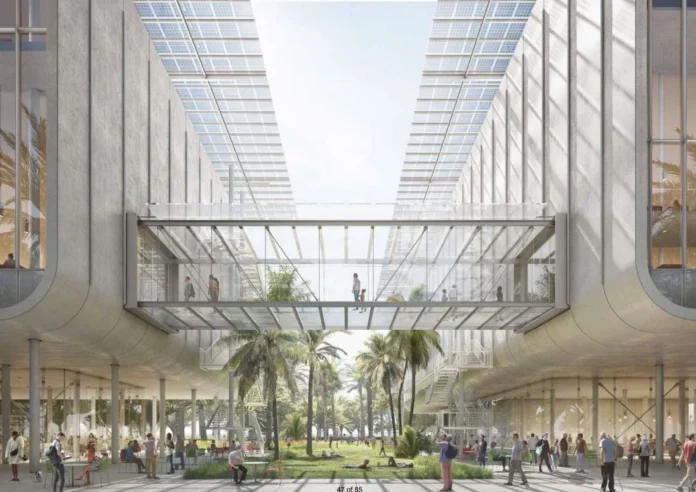
—What returned in March was leaner and shrewder. In Concept 2.0, the buildings descend from their piers; instead, the ground itself is raised to between twenty-two and twenty-six feet for resilience. The complex shifts south of the canal and turns perpendicular to Tamiami Trail to resolve a protected view corridor. The main auditorium contracts from 2,700 seats to 2,200 — a capacity the Foundation deems better matched to the community — and is joined by a flexible theater of 250 to 300 seats and a learning lab, the whole comprising some 110,500 square feet beneath two parking structures. The revised cost: approximately $288 million, lighter by $120 million, and still the most expensive building the city has ever proposed to construct.
—The commission received the design warmly. The financing it rests upon is another matter entirely.
—The Anatomy of a Fragile Funding Stack
—The proposed financing stands on a public-private partnership split evenly down the middle. Roughly half the cost is to be raised through private philanthropy by the Foundation, which has committed to a campaign of between $172 million and $207 million. The other half is public, drawn principally from the city of Sarasota’s share of a Tax Increment Financing district established around The Bay in 2020, with the city pledging $88 million from TIF revenue and allied sources.
—A tax increment district is an elegant instrument and a fragile one. It captures the growth in property tax revenue from a defined area — here, the downtown parcels surrounding The Bay, including The Quay and the Rosemary District — measured against a 2019 baseline, and directs that increment back into the district. Both the city and the county participate, under an interlocal agreement, with the district running through 2049. Early projections placed its combined yield near $200 million; more aggressive forecasts, premised on continued downtown appreciation, run far higher.
—The instrument’s elegance, however, depends on two assumptions: that downtown property values keep rising, and that the property tax itself remains intact. The November referendum imperils the second, and the county’s wavering imperils the partnership built on the first.
—The Partner Who Will Not Commit
—For the performing arts center, the county is not a reluctant funder but, increasingly, an absent one. Not a single commissioner now seated voted to create the 2020 TIF agreement, and the present board has been conspicuously cool toward directing its share of the district’s revenue to a new hall. The county has at times deposited less than its full portion into the improvement district, and some members have raised the prospect of withdrawing from the TIF before its term expires.
—Commissioner Mark Smith framed the county’s posture in the language of stewardship, telling Suncoast Searchlight that the county’s thirty-year participation could not be guaranteed and that the board bore a fiduciary responsibility for the tax dollars in question. It is a defensible position, and a costly one for the city, because the burden does not vanish when the county steps back. It shifts.
—Were the county’s projected contribution — by some estimates in the range of $180 million over the life of the district — to disappear, a public share always meant for two governments would fall to one. The city’s portion of a $288 million project could double, before reckoning with the tens of millions more required for site preparation, parking, and infrastructure. A city commissioner has already objected publicly to letting the county off the hook on a regional project whose audiences and economic benefits will plainly extend well beyond the city line, going so far as to suggest a surcharge on non-city residents should the county walk away. The county, to date, has not reconsidered.
—The Common Thread — and the Larger Stake
—Here the two stories converge, for the rope drawn tight around the bayfront is the same one wound around the island.
—The TIF that funds the public half of the performing arts center is, at bottom, property tax revenue — and HJR 1F, passed by the Legislature on June 2 and bound for the November ballot, would raise the homestead exemption from $50,000 to $150,000 in 2027 and to $250,000 in 2028, with a constitutional path toward eliminating non-school homestead taxes altogether. The district is fed chiefly by commercial and high-end residential property, so the effect on TIF receipts is not identical to the effect on a county general fund; but a measure that erodes the broad property tax base and constrains the permissible uses of what remains casts a chill across every public financing structure in its reach.
—That constraint is the part too easily overlooked. The amendment confines property tax spending to a defined roster of essentials — public safety, infrastructure, schools, debt service, pensions. A performing arts center, whatever its economic yield, is nowhere on the list. The city of Sarasota has already instructed its legal staff to determine whether, under the amendment, property tax dollars may lawfully be spent on parks at all. Its longest-serving commissioner has counseled the city to prepare as though the measure will pass, and has acknowledged plainly that capital projects — the performing arts center among them — may have to wait or may never be built. Everything, she has said, is on the table for cutting.
—This is the insight that ought to give the region’s most sophisticated readers pause, because it inverts the usual logic of a tax cut. The relief that flatters a homeowner’s annual bill draws down, over time, the public capital that sustains the very amenities — the concert halls and libraries, the parks and the waterfront — that make the surrounding real estate worth what it commands. On the Sarasota side of Longboat Key alone, taxable value stands near $5.7 billion, a figure that rests in no small part on the premium the cultural coast confers. To erode the mechanism that funds that culture is, in the long arithmetic, to begin disinvesting in the asset itself. The bill arrives not as a line item but as a slow diminishment of the thing that made the place desirable.
—A Campaign Waiting on a Signature
—While its public partners hesitate, the Foundation confronts arithmetic of its own. By the most recent accounting, it has secured something over $23 million in announced gifts — barely a tenth of its goal, and, at the pace of recent years, a sum that would take generations to complete. The reason is a standoff that has become self-reinforcing: major donors are reluctant to commit without a firm public commitment from the city, and the city declines to sign the implementation agreement — the procedural hinge that would carry the project from concept into schematic design — until the November ballot reveals whether its funding base survives.
—The Foundation has answered with a new chief development officer and an enlarged fundraising team, and it speaks, reasonably, of being poised to engage transformational philanthropy. But transformational philanthropy is a creature of confidence, and confidence is precisely what a deferred ballot withholds. The most that can be said with assurance about the grandest cultural project in the city’s history is that it remains, for now, alive.
—Two Halls, One Verdict
—The symmetry between the island library and the bayfront center is exact in its particulars. Each has private money in hand or nearly so. Each has a public partner that pledged its participation and then watched the political ground shift. Each carries a funding obligation tethered directly to the property tax. Each waits on the same November vote.
—The library is the smaller story by every conventional measure — a fraction of the cost, a fraction of the square footage, a community of thousands against the region’s urban core. Yet it is the further along: its design nearly complete, its private dollars already transferred. The performing arts center, for all its grandeur, has spent years in revision, still awaits its most elementary procedural step, and has raised barely a tenth of its philanthropic target.
—And in both, Sarasota County is the partner declining to commit. On Longboat Key it is building the library while warning that it may be unable to operate it. On the bayfront it is building nothing, content to let the city absorb whatever it cannot bring itself to abandon.
—For a generation, Sarasota has financed the cultural infrastructure of its future on the assumption that property tax revenue would always be there to carry it — a barrier-island library for an underserved community, a performing arts center for the waterfront that defines the region’s very identity. Both are designed. Both are approved in principle. Both rest on the trust of donors who believed government promises enough to write real checks.
—And both now sit in the same waiting room, watching a single question travel toward the ballot box — a question no one in local government wrote, and no one in local government can stop. Should the answer come back as the homeowner’s relief and the treasury’s loss, Longboat Key may never witness a ribbon cutting at Town Center Green, and downtown Sarasota may spend another two decades patching the flood damage of a purple landmark it could not bring itself to replace.
—The date is November 3. For a region that built its name on the arts, the curtain is already rising — and no one yet knows whether there will be a stage left to light.

