
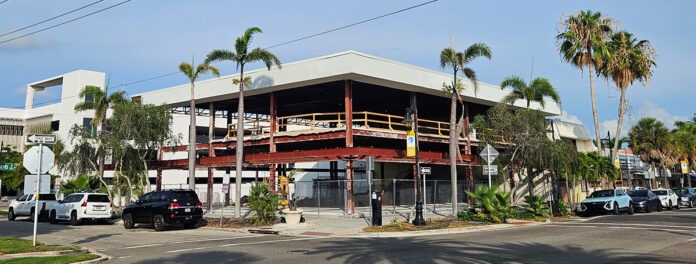
The developer who once tried to put a hotel behind these buildings now owns the buildings. The city that twice rejected him is buying him parking. And the third floor nobody can quite explain is back.
—There is a particular kind of Sarasota story that arrives wearing the costume of good news. A beloved restaurant is coming home. A blighted corner will be revived. The flood-gutted hulk of an old bank will become something gleaming, resilient and tax-generating. Everyone, the press release assures us, wins.
—And then you read the site plan.

—On June 16, a development application landed at City Hall proposing to knock together two vacant parcels on the northeastern lip of St. Armands Circle — 24 and 28 N. Boulevard of the Presidents — into a single three-story, mixed-use building. The ground floor would hold more than 7,000 square feet of retail and an 1,820-square-foot café. The second floor would house a roughly 8,500-square-foot fine-dining restaurant under the Shore name. And the third floor — the floor that has, in one form or another, started two wars on this island in five years — would hold a single residential condominium wrapped around a private pool, its roof cut open to the sky.
It is a lovely rendering. It is also the latest move in a campaign that residents, a former Longboat Key mayor, and the city’s own paper trail suggest has been running, more or less continuously, since 2021: the steady effort to add height, density and — the word nobody on the applicant’s side will say out loud anymore — hotels to the most protected commercial acre in Sarasota.
—The case goes before the city’s Development Review Committee on July 15.
—Two Families, One Project
—The first thing to understand about this proposal is that the operator and the landlord are no longer the same person — and that the separation is doing a lot of quiet work.
—The restaurant brand belongs to Tom Leonard, who co-founded Shore with his wife, Susan Leonard. Shore opened its first retail store on St. Armands in 2008 and grew into a full restaurant on the Circle by 2012, before flood damage from Hurricanes Helene and Milton forced its closure at 465 John Ringling Blvd. in December 2024. (That space is now leased to Tommy Bahama.) “St. Armands has always been home for Shore,” Susan Leonard told the Sarasota Herald-Tribune, calling the return “incredibly meaningful after such loss and devastation.” Tom Leonard, for his part, framed it in the register he favors: “It’s time for a little love on the Circle.”
—The land, however, now belongs to the Kauffmans. The property owner of record is Mindy Kauffman, through Kauffman Shore Properties LLC. Her father, Dr. Mark Kauffman, is one of Sarasota’s most prolific property owners and developers; the family’s entities — United Associates Ltd. and Kauffman Family Partnership #1 Ltd., alongside Sarasota-based Red Property Management — recur throughout the filings. In a transaction that tells you something about how these things are arranged, Kauffman Shore Properties acquired the two parcels on Jan. 6 from other Kauffman-linked entities for $100 apiece — a pair of dollar-store deeds that move flood-ravaged real estate from one family pocket to another while the public-facing story stays focused on grouper and key lime pie.
—This division of labor matters. When the brand talks, it talks about homecoming and hospitality. When the land entity files, it files for entitlements. And when the third floor draws fire, each side can gesture at the other. It is a structure that diffuses accountability by design.
—What They Are Allowed to Do — and What They Want
St. Armands Circle sits in the Commercial Tourist (CT) zoning district, a category that has, for decades, drawn a hard line: no hotels. City code defines a hotel as a building with six or more guest rooms rented to travelers on a daily or weekly basis — precisely the use the CT district was written to keep off the Circle. Redeveloping the ground-floor commercial space — restaurant, café, retail — does not, by itself, require rezoning. The city has confirmed as much; the project would need Planning Board approval but not a City Commission vote, and rezoning from CT “will not be necessary,” according to staff.
—So why does any of this feel like a fight?
—Because of the third floor. The current application describes it modestly: one condominium unit with a pool. But that is not how this project was introduced to the public. In December, Shore’s own materials described a three-story “flagship” anchored by what was characterized as luxury residential space “that could evolve into a boutique hotel” — the first, in the brand’s phrase, “fully immersive Shore lifestyle destination.” A residential third floor on commercially zoned property is, in the words of former Longboat Key Mayor Terry Gans, “heretofore unhallowed.” A boutique hotel on that floor would be flatly illegal under current code.
—The gap between what is filed and what has been pitched is the whole story. File for a condo. Pitch a hotel. Build the box. Argue about the use later, once the structure exists and the sunk cost makes denial feel churlish. Residents have seen this choreography before.
—The FEMA Wall: The 50% Rule
—If zoning is the political obstacle, the federal flood code is the physical one — and it may be the single most important number in this entire saga.
—Under FEMA’s so-called 50% Rule, any improvement to a structure in a flood zone that costs 50% or more of the building’s pre-improvement market value triggers a requirement to bring the entire structure up to current flood-resistant standards — which on a barrier island means elevating it to base flood elevation. At the Dec. 17 pre-application conference, the city’s Development Review Committee warned the applicant’s consultants, Bill Waddill and Dominic Pardue of Kimley-Horn, that ordinary floodproofing would not clear the bar. Deputy Building Official Mike Taylor pegged the combined existing structure value at roughly $1.2 million and was blunt: “It doesn’t sound like this project can be built for under 50% of the value of that,” he told Waddill. “Even with a private property appraiser, it would be difficult to meet those numbers and still be able to get what you want out of this.”
—Here is the economic logic that turns a flood rule into a density argument. Once the 50% Rule forces a developer to gut and elevate — to spend, in Leonard’s own description of his Longboat Key floodproofing, on water-resistant windows that run “$500 per linear foot” and “basically make your building an aquarium” — the only way to make the math pencil out is to build up. The federal regulation designed to protect property becomes the developer’s best argument for adding stories. As the residents’ association has framed it: to make post-storm investment work, developers are looking upward. The third floor isn’t an amenity. It’s the return on a code-mandated cost.
—The June application, notably, lists the estimated construction value as “TBD.” The most important number in the project is the one the applicant has declined to put on paper.
—The Parking Maneuver
—Then there is the matter of the parking spaces — eleven behind the property, plus eight more the developer would need to satisfy the zoning code. And it is here that the relationship between the City of Sarasota and the development community comes into sharpest, least flattering focus.
—The application notes, almost in passing, that “coordination has been conducted with the City of Sarasota staff regarding the potential to purchase” eight additional spots from the St. Armands public parking garage. Read that again. A private developer, short on the parking his own project requires, proposes to buy public spaces — paid for and maintained by the public — to make a private mixed-use building with a rooftop pool conform to code.
—This is not a new species of maneuver on St. Armands; it is practically the house style. Years ago, a push to build a hotel and gourmet market on the publicly owned Fillmore parking lot collapsed only when it emerged that municipal bond covenants legally prohibited eliminating the lot’s paid spaces. One of the developers behind that effort, per the St. Armands Residents Association’s own records, was the owner of Shore. The public parking supply has long been the soft asset that private projects reach for when the numbers don’t work — and the city staff, residents note, has shown a recurring willingness to entertain the reach.
—A Pattern, Documented
—What gives this proposal its charge is that almost none of it is unprecedented. Lay the filings end to end and a decade-long pattern emerges.
—2021–2022: As chair of the St. Armands Business Improvement District, Leonard helped lead a “Vision 2026” campaign to raise the Circle’s height limit from 35 to 45 feet, permit hotels at up to 150 units per acre, and increase residential density. The City Commission rejected taller buildings on the Circle by a 5–0 vote in November 2022. The BID, which had spent months lobbying for entitlements on behalf of a handful of property owners, was subsequently disbanded after it emerged it lacked the authority to seek the zoning changes it was pursuing.
—The Fillmore lot: The hotel-and-market scheme on public parking land, killed by bond covenants.
—Winter Fest, 2022: As Gans recounts, the appropriation of public parkland and right-of-way in the median of John Ringling Boulevard for ice skating and lights — an effort, he writes, “almost cloaked in darkness fete accompli before residents caught wind of it,” undertaken with Ride Entertainment, the same firm tied to an earlier pitch for a permanent carousel on that same public patch and a move on Ken Thompson Park.
—August 2025: A closed-door meeting between Planning Director Steven Cover, his staff, and “many of the largest property owners” — scheduled for Sept. 8, invitation-only, not noticed to the public, the merchants’ association president, or most property owners. When St. Armands Merchants Association President Rachel Burns and others began asking why a meeting about the Circle’s future was being held in private, Cover confirmed it was “just for those who are invited.” Within 48 hours, after a flurry of emails, the city reversed course, canceled the meeting, and announced a public “community conversation” instead — while Deputy City Manager Pat Robinson urged staff to “make haste” in scheduling, over summer, when, as Resident’s Association President Chris Goglia pointedly noted, many residents are away and least able to participate.
—The visioning sessions, 2026: Out of that backlash came two public “visioning” workshops, in February and April, facilitated by independent sociologist Dr. David Brain. Roughly 150 stakeholders gathered at Mote Marine’s Keating Center for the first. The verdict was not close. Attendees wanted landscaping, outdoor dining, code enforcement and storm resilience — and were, in the reporting at the time, overwhelmingly opposed to adding hotel uses or changing the scale of the Circle. Asked to imagine St. Armands in 2046, they voted for the century-old village they already have: small boutique shops, low buildings, the quaint center that makes the place worth fighting over.
—The community, in other words, has now said no to hotelization three times — at the ballot of a 5–0 commission vote, and twice at the city’s own workshops.
—What Is at Stake
—Goglia, who leads the residents’ association, has reduced the danger to a single mechanism that ought to worry anyone who owns or loves property on the Circle: precedent. “If this concept is financially successful for this one developer, why won’t more and more commercial properties on St. Armands do the same thing?” he asked. “Once zoning changes are made for this one property, they then apply to all properties.”
—That is the quiet truth beneath the rendering. A condo over a restaurant is a curiosity. A legal pathway to a third residential or hotel floor on the Circle is a template — one that every flood-damaged building owner facing the 50% Rule will have every financial incentive to copy. The barrier island’s evacuation routes, its chronic traffic, its failure-prone stormwater pumps, and the simple fact that storm surge crested it twice in 2024 are not abstractions. They are the reasons the density line was drawn where it was.
—Jim Ludwig, a Lido Key resident and Coalition of City Neighborhood Associations vice president, put the obligation plainly when the closed-door meeting unraveled: “St. Armands is too important to not spend the necessary time and effort to look at its future viability.” The question is whether a process that keeps producing the same public answer — no — will be allowed to keep producing it, or whether the answer arrives instead one $100 deed, one “TBD” construction value, and one quietly purchased block of public parking at a time.
—The Last Word, for Now
—Credit where it is due, and Gans is right to give it: Tom Leonard builds and operates good restaurants, the still-thriving Longboat Key Shore among them. Sandwiched between the public pier and Mar Vista on 400 feet of bayfront, with its stadium seating and retractable roof, it is a genuine asset to the north end. Nobody serious wants the Circle corner to stay a gutted bank.
—But there is a difference between revitalization and conquest, and the difference lives on the third floor. The community has been clear about what it wants: resilience, beauty, and the scale it has always had. What it keeps being offered, in Gans’s memorable phrase, is “continued fires to be responded to and put out, started by a developer that seems intent to keep throwing things against the wall until one sticks.”
—On July 15, the wall gets another throw.

