
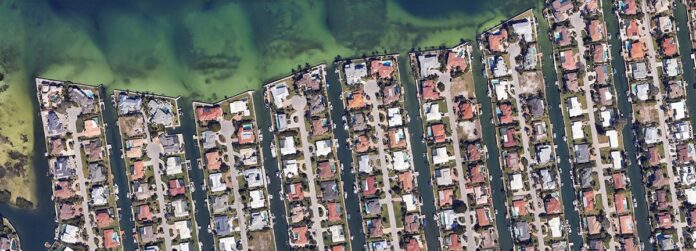
After a quarter-century of deferral, the commission passes the canal navigation maintenance program 6–0 — pulling a Catholic church off the roll, fixing two misassigned parcels, and brushing past pleas from Shore’s Tom Leonard and a room of fixed-income retirees.
—It took twenty-three years to get the can to stop rolling. It took the Longboat Key Town Commission about half an hour Monday afternoon to bury it for good.
—In a special meeting called to order at 1 p.m. on June 22, the commission voted unanimously — 6–0, with Commissioner B.J. Bishop absent — to adopt Resolution 2026-14, the final assessment confirming the town’s Canal Navigation Maintenance program. The vote locks in a roughly $9 million effort to restore all 88 of the island’s silted canals and, with it, a recurring non-ad-valorem assessment of $620 per equivalent benefit unit that will appear on November property tax bills and renew, as the notices warned, year after year.

—The dredging itself was never in dispute. The money was a war. And when the roll was called, the program passed over the formal objection of a Catholic diocese represented by outside counsel, the operator of one of the area’s best-known restaurants, a marina manager paying rent to the state for his own water, and a room of residents — many retired, many storm-battered — who came to ask for more time and walked out with a bill.
—The commission heard them. Then it voted yes.
“We’ve been kicking this can down the road”
—Town Manager Howard Tipton, weeks from his own retirement, set the table. This was an item “under discussion for a number of years,” he told the dais — eighteen months of meetings with the board and the community over how to fund a canal maintenance program “that last was touched in 2003,” and how to address resiliency, including “how quickly do we drain after a storm once the tide goes down.” It was, he noted, the second of two required public hearings.
—Public Works Director Charlie Mopps then made the case he has made, by his own count, in some fifteen meetings. The town deferred canal maintenance for more than two decades, and the can, in his recurring phrase, has gotten flat — it’s not rolling anymore. He arrived flanked by the consulting and canal team: Mark Stroik of First Line Coastal, Tara Hollis of Willdan, and financial analyst Jamie Thomas, whose months of outreach Mopps detailed at length — two town-hall-style meetings, two more at Bayfront Park, some fifteen public events with HOAs and civic clubs, more than 450 printed flyers, over 9,000 social-media views, targeted email to more than 1,200 individuals, and 83 residents attending virtually. The point was unmistakable: nobody, the town wanted on the record, could say they weren’t told.
—Crucially, Mopps reframed the night’s narrow question. The hearing concerned “only a portion of how we’re paying for this” — the non-ad-valorem assessment side. The other portion, roughly 20 percent, rides on the townwide millage, “which makes it like a community approach to maintaining yet another piece of infrastructure just like our beaches that we maintain.”
—Program, not project
—Pressed by Tipton to clarify, Mopps drew the distinction the town has leaned on throughout: this is funding for a program, not a project. The town projects collecting about $9 million across years one through five to restore the canals — early years heavy on studies, permit updates, specifications and procurement, with the actual dredging and a seagrass mitigation area built roughly in years three through five. After that, in year six, the cost drops sharply. “We’re looking at having to collect half as much,” Mopps said — halving both the assessment and the millage once the program shifts from restoration to maintenance.
—It was the reassurance the town offered against every affordability complaint in the room: the $620 is front-loaded, and relief is built into year six.
—The church comes off the roll
—One of the most consequential moments came not in a speech but in a clarification. Vice Mayor Penny Gold flagged two parcels on page four of the resolution — units C1 and C3 at 408 Gulf of Mexico Drive — that had been assigned equivalent benefit units their own governing documents said they could not have. Human error, Mopps conceded, had failed to catch them; they would be reassigned to the correct unit next year when the roll is recertified.
—He then volunteered a third correction, and it is the one that matters most for the story this paper has been chasing. “There was a church that also had an observation deck that was not a dock,” Mopps said. Because of how the deck was built and how close it sat to the shoreline — and a property-boundary limit — it “could not accommodate a boat and was never intended to.” So the church parcel “got removed as well.”
—That church is St. Mary, Star of the Sea, whose assessment had drawn a withering legal objection from the Diocese of Venice (more below). When Gold asked the obvious question — the church doesn’t pay taxes, so how would it pay an assessment? — Town Attorney Maggie Mooney drew the line that will matter in future fights: a tax-exempt property “can’t pay a millage. However, they could pay an assessment for a service if they’re getting that rendered.” In this instance, the town concluded no service was rendered — and pulled the parcel rather than litigate it.
“Today is their day”: the appeal question
—Commissioner Steve Branham asked what recourse residents have. The answer, from Tipton, was blunt and procedural: “Today really is the appeal process. Today is, if folks are here that feel that they should not be included or feel like there should be a reduction, today is their day to declare that to the board.” There would be no separate tax-appeal track waiting in the wings. The hearing was the venue. Object now, or pay.
—Commissioner Gary Coffin pressed a practical point he said had come up across fifteen meetings: whether homeowners could use the mobilized dredger to dig out under their own docks. Not written into the resolution, Mopps said, but a practice the board could direct staff to facilitate — with the key caveat Mooney underscored repeatedly: any dockside dredging would be a private contract between the homeowner and the contractor, with no town involvement, no town liability, and no town-drafted release. The homeowner’s benefit is avoiding the mobilization cost and using the town’s spoil sites; everything else, the town stays out of.
—The man from Shore stands up first
—When the floor opened to the public, the first speaker was a name LBK News readers know well: Tom Leonard, 800 Broadway Street, owner of Shore and the proposed St. Armands Circle redevelopment this paper has covered for months.
“I hate going first,” Leonard began, “but I’ll try to keep it short and sweet.” He didn’t keep it short, and it landed. The town, he argued, should “do more research before they just take a wave of the wand and assess people” — a charge that for his property “could be as much as $12,000 a year.” He raised the specter of seawall failures triggered by dredging next to homes that “didn’t want this,” and the sea life at stake. Then the line with real bite, and one this paper can confirm from its own reporting: “For us at Shore Longboat, we don’t even own our shorefront. We lease it from the Army Corps of Engineers.” Had the town, he asked, even approached the Corps about participating? “You’re asking us to pay for a part of the property of our waterfront that we don’t even own.”
—He closed on the same irony hanging over the whole room: “A state’s talking about doing a waiver of property taxes, yet here we all sit, we’re gonna get jabbed on the other side.” More research, more time, more pursuit of state and federal dollars — that was the ask.
—The voice for it: “an investment in the character of our entire town”
—The most eloquent voice of the afternoon argued the other way. Jeff Wray, 510 Harbor K Drive — who reminded the commission he had stood at the same podium years earlier to fight a three-story parking garage on Gulf of Mexico Drive — rose in full-throated support of spreading the cost.
“I support sharing the cost of canal dredging among all Longboat Key taxpayers,” Wray said. “The canals are more than a benefit to the homes that border them. They are a benefit to the entire community.” They are infrastructure, he argued, “just like our roads, just like our parks, our beaches” — supporting navigation, emergency access for first responders, water circulation and the health of the waterfront. We routinely share costs we don’t each use equally, he said, reaching for an image that drew a smile: “There are roads that are maintained that we will never actually drive our cars on. We’re paying for schools and we don’t have kids that go to those schools. People in the state of Iowa pay for the Coast Guard through their federal taxes, and yet the Coast Guard is never going to show up.” Preserving the canals, he concluded, “is not simply a private benefit. It is an investment in the character, value and future of our entire town.”
A second resident, Marlene McBriar of Gulf of Mexico Drive, used her time to pin down a point the letters had circled for weeks. If she’s paying 20 percent of the dredging, she asked, and she kayaks up and down the canals, will anyone tell her they’re private? No, ma’am, came the answer from the dais — the canals remain public.
“People are still recovering”
—If the meeting had an emotional center, it was Dick Smith of 6601 Bayou Hammock Road. His street, he told the commission, had 13 homes before the 2024 storms; it has eight now, and five have never been rebuilt. The program “may be a good idea in the long run,” Smith allowed — but with neighbors still climbing out of catastrophe, “to have assessments going at this particular time is, I would say, not appropriate by the town.” His request echoed Leonard’s: postpone it a couple of years, study it more. (Smith referred to the storm as “Katrina”; the 2024 hurricanes that battered the island were Helene and Milton.)
—Then Fred Bez, association manager for Gulf Shore of Longboat Key, added an angle that rhymed with Leonard’s. The association pays the state “$4,500 a year for the riparian rights at our marina,” he said — “so I’m not so sure that we own that area, because we do lease it from the state.” And like Leonard, he wondered aloud whether the Army Corps of Engineers bears responsibility for maintaining certain waterways, such as Buttonwood Harbor. Two property owners, in one hearing, telling the town it was about to assess them for water they rent from a government.
—The objections the speakers didn’t have time to make
—What residents compressed into three minutes at the podium, dozens more had spelled out in writing — and the public record the commission carried to the dais was thick with it.
—The most formidable was the one the town had already partly defused. On June 16, attorney Joseph A. DiVito of Trenam Law, writing as General Counsel for the Diocese of Venice, filed a strenuous objection on behalf of St. Mary, Star of the Sea. His argument was constitutional, not financial: the church “is not even on a canal and can make no use of it for navigational purposes.” For an assessment to be valid, he wrote, “it must have a reasonable nexus to the purpose of the assessment, otherwise it is a tax” — and a tax on a 501(c)(3) ministry whose funds “cannot be used to support private uses of the canal.” He warned the charge “will create a substantial burden on the church which will impact the free exercise of religion… and such burden is prohibited by the US Constitution.” By removing the parcel Monday, the town quietly conceded the narrow point without conceding the principle.
—Timothy and Elena Radabaugh of 7160 Gulf of Mexico Drive arrived with case citations of their own, conceding Canal #01 “needs to be better maintained” before attacking the funding as “an unconstitutional shift of a public burden onto a small subset of private citizens.” They invoked the Submerged Lands Act of 1953 — the state owns the submerged land but “exempts itself from maintenance,” a deal they summarized acidly as “What a deal for the State” — and Lake County v. Water Oak Management for the rule that an assessment is valid only when “fairly apportioned” to a “special measurable benefit.”
“More than the taxes themselves”
—The human arithmetic in the letters was unsparing. Susan Rinehart of 253 Bird Key Drive, who owns ten dry-storage boat-slip units at the Boathouse on Longboat, calculated that at $620 a unit her assessment would run at least $6,200 — against a total property-tax bill on all ten slips of $5,205.35. The dredging fee alone, she wrote, “would equal approximately 119% of my current total property tax bill — more than the taxes themselves.”
—Don Marshall of 3510 Mistletoe Lane, 77 and boating “two to three times a year,” objected to being billed twice — once for his canal home, once for his boat on a rack at the Boathouse: “Longboat Key property owners already pay more than their share in property taxes and now we are asked to get charged TWO times.” Peter Snyder, the Boathouse association president, found his landlocked second-floor office assessed at 2.25 EBUs — $1,395 — and got the town to concede the error and remove it. Mark and Terri Fishman objected to being assessed on a marina dock where, as Mark put it, all they own “is the land under the water.”
“Insult and injury”
—The sharpest equity wound came from the Gulf Shore mobile-home community. Daniel B. and Lisa A. Dexter hand-delivered a formal appeal stamped at 11:12 a.m. on June 4, calling a mobile home on Longboat “an oddity” that “does not benefit from canal dredging,” and noting that Gulf Shore and Twin Shores are “the only ‘affordable’ housing on the island,” home to retirees “being taxed and assessed out of their homes.” The 8 percent collection fee, they wrote, “adds even more insult and injury.” Their plea: “A minor gesture of fairness is in order.” The town’s own figures show why it stung — the Dexters’ annual tax bill on the parcel is $585.66, less than the assessment itself, and an internal staff email captured a strikingly blunt view: “They may have to start getting used to that if that’s what we have to move toward.”
—The principle, the math, and the missing millions
—Other letters fought on principle. Carla and Pete Rowan of Broadway dismantled the 80/20 split, arguing only one of the town’s six claimed benefits — “access for recreational boaters” — is real, and that the program’s “simple 80/20” lacked the parcel-by-parcel rigor the town applied to its undergrounding project. Even at “$30 per year,” they wrote, “it is the principle that is the point here.” Thomas and Robyn Choate of 598 Lyons Lane turned the town’s own logic against it: if canal owners must pay directly for an island-wide benefit, then “canal-front property owners should not be required to subsidize beach refurbishment efforts if they are being separately assessed for canal maintenance.”
—Andy Forstenzer of Fairway Bay, who lives across a small canal, accepted paying his share but pointed to the gap nobody on the dais wanted to discuss — the people who actually use the canals. He floated “a user fee for anyone with a vessel which has access to and may use the canal waterways,” noting that nowhere in the town’s materials did he find “the idea of a contribution from those who actually use the canals.” It was the written version of the question Marlene McBriar would put to the commission in person: the people paddling and motoring these waters aren’t all the people being billed for them.
—Susan Fradkin, who doesn’t even own a boat, took aim at the calendar itself: “Holding a meeting of this importance during the summer when people are away does not allow for a fair representation of the population” — a barbed reminder that the most consequential vote in years was held in June, when much of the island is up north. The canals “are not private property,” she argued; boats whose owners live nowhere near them “travel through the canals whenever they like.” Spread the cost across all residents, she wrote, and “it would be much more manageable and fair.”
—Nancy and John Gornto raised the accountability question that lingers: the undergrounding project “publicized a $6 million cost savings in 2025 and there has been no publicized information on where the $6 million funds were eventually budgeted.” Patrick and Christy Gaughan of 500 Spinnaker Lane called the 8 percent collection fee “totally outrageous.” And James G. Haft of 761 Lands End Drive accused the town of giving Jewfish Key owners “a free pass.”
—On the other side, James S. LeBaron, president of the Country Club Shores I & II Homeowners Association, wrote of “overwhelmingly positive” support among residents who have “watched water depths diminish, navigability decline” — concerns, he said, “central to the lifestyle and property values that drew them to Longboat Key in the first place.” Scott L. Petersen argued that failing to maintain navigable depth “could be viewed as neglect” of the town’s duty.
—Why Longboat can’t pass the hat to the county
—The town’s answer to “why us, why now, why alone” came largely from financial analyst Jamie Thomas’s months of correspondence. Longboat can’t tap the funding its neighbors use: the federal Resilient SRQ dollars funding Phillippi Creek require benefit to low-to-moderate-income areas — a bar an island of multimillion-dollar homes can’t clear — and the 88 canals are legally “upland-cut residential canals” that fail the West Coast Inland Navigation District’s threshold for a public navigation project. To offset the burden, the town is pursuing a $3 million federal appropriation through the Water Resource Development Act of 2026, backed by Congressman Vern Buchanan and Representative Greg Steube.
—The vote, and what it means
—After the last speaker, Mayor Debra Williams asked for comment from the dais. There was none. “The public hearing is closed,” she said. The motion to pass Resolution 2026-14 was moved and seconded, and the clerk called the roll: Coffin, yes; Karon, yes; Williams, yes; Gold, yes; Branham, aye; Gladding, yes. Six votes, no dissent, Bishop absent. The motion passed, and the commission moved immediately to its next order of business — the unanimous appointment of George Landry as the town’s next manager.
—The practical consequences begin now. The first assessments hit November 2026 tax bills — arriving, by no small irony, in the same envelope and the same season that Florida voters will use to decide HJR 1F, the statewide measure promising to cut their property taxes. Relief on one line, a brand-new charge on the next, exactly the squeeze Leonard named from the podium.
—For canal-front owners, $620 buys a guarantee the island has never actually had: water deep enough to use, maintained on a schedule instead of after a disaster, with the rate set to fall by half in year six. For the church — now off the roll — the marina lessees paying the state for their own water, and the retirees on Bayou Hammock Road still rebuilding from the last storm, the vote settled the question that has hung over the canals since the 1990s. It was never whether to fix them. It was who pays. After a quarter-century, Longboat Key finally has its answer.
—The program was adopted 6–0, Commissioner B.J. Bishop absent. The meeting adjourned at 1:37 p.m. The first assessments are due with November 2026 property taxes.

