
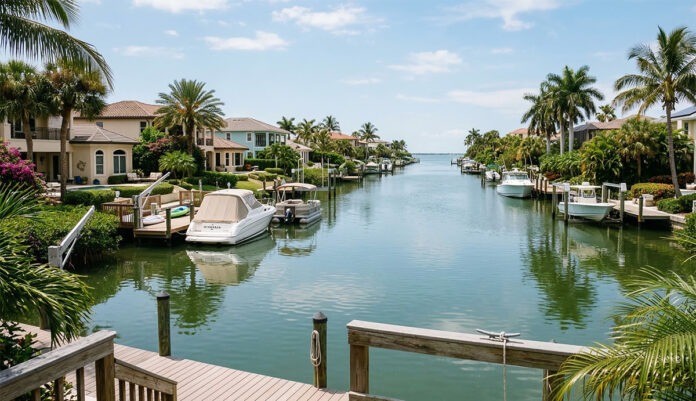
The appeal of Longboat Key has always come down to a single, simple promise.
For the snowbird trading a Buffalo winter for a dock on the bay, or the retired executive who spent thirty years dreaming of a skiff and a sunset, the appeal of Longboat Key has always come down to a single, simple promise: step off your back porch, drop the boat in the water, and go.

—Fishing the grass flats at first light. Idling out through the pass for grouper and snapper. A cocktail cruise up the Intracoastal as the sun drops behind Anna Maria Island. This is the life the island sells, and in large measure it is the life that built its blue-chip real estate market. People do not pay seven figures for a canal lot because they like the view of a seawall. They pay for the water, and for what the water lets them do.
—But somewhere between the brochure and the boat lift, a good deal of that promise has quietly run aground.
—Twenty-three years of silt
—Longboat Key’s canals have not been dredged since 2003. In the two decades since, runoff, storms and the slow patient work of tide and time have packed the canal bottoms with muck, leaving many of the island’s waterways shallow, tide-dependent and, in the worst stretches, simply impassable at low water.
—Boaters have learned to read tide charts like scripture. They time departures and homecomings around the water, and more than a few have had the particular experience of motoring out on a high tide only to find themselves stuck outside their own canal hours later, idling in the bay and waiting for the water to come back so they can get home. Others have watched props chew the bottom, replaced lower units, and shortened their boats to match their depth. The dream of spontaneity — jump in the boat and go — has given way to logistics.
—The numbers tell the same story. When the town hired coastal engineering firm First Line Coastal to survey and grade all 88 canals, the report card came back ugly. More than half scored below a C. Eighteen canals were graded D. Four were graded F, which in the firm’s grading system means not navigable at all.
—Now that long, slow decline has reached a reckoning.
—The decision before the commission
—After more than two decades of study, conversations that began in the 1990s, and what Public Works Director Charlie Mopps has counted as more than thirty commission meetings on the subject since 2013, the Longboat Key Town Commission has reached the decisive stage of a roughly $9 million program to dredge all 88 canals — and, just as consequentially, of settling the far more contentious question of who pays for it.
—In May, the commission gave the funding plan unanimous approval on first reading. Under the town’s two-step ordinance process, a single step now stands between the plan and enactment: a second and final reading. If the commission grants that final approval, the first assessments will appear on residents’ November 2026 property tax bills. It is the last real hurdle for a program town leaders have spent years trying to push across the finish line.
“We’ve been kicking this can down the road quite a bit,” Mopps told residents at one of a series of town hall briefings. “It’s pretty flat; it’s not rolling anymore.”
—It is, in the town’s careful phrasing, “a program, not a project” — a distinction Mopps has repeated almost as a mantra. The point is that the canals would not simply be dredged once and forgotten, as they effectively were in 2003, but maintained on a rolling basis so the island never again wakes up to a 23-year backlog. The dredging itself, residents have been assured, would look nothing like the heavy machinery now chewing sediment out of New Pass; the work in the canals would be quieter, smaller and incremental, moving from one stretch to the next. The plan calls for restoring the canals to a roughly five-foot depth, the permitted baseline.
—The first round of dredging is estimated at about $9 million, and as much as $9.66 million across the first five years — a figure that has actually fallen sharply over time. An earlier estimate, built on older surveys, ran as high as $16.8 million before consultants re-scoped the work. The town’s share in the 2026-27 fiscal year is pegged at roughly $1.46 million.
—The 80/20 question
—The dredging was never really in dispute. The money was, and is.
—The funding plan now before the commission is modeled on the same 80/20 framework the town uses to pay for beach renourishment, a structure officials chose in part because residents already understand it. Under the plan, properties with direct canal access carry about 80 percent of the cost, and the rest of the island carries the remaining 20 percent on the theory that navigable, healthy canals benefit everyone.
—The mechanics work like this. Canal-facing parcels — those with an existing boat ramp or the potential for one — would pay a flat annual fee of $620 per “equivalent benefit unit,” billed as a non-ad-valorem assessment on the property tax bill. That flat fee does most of the heavy lifting, raising roughly 70 percent of the program’s revenue. The balance comes from a modest ad-valorem millage of 0.0623 mills assessed on every property on the island for the first five years — about 10 percent of the total from canal-facing owners and about 20 percent from everyone else.
—For a non-waterfront home assessed at $500,000, that island-wide millage works out to around $31 a year. Properties without canal access pay no flat fee at all — only that small millage.
—Crucially, the plan promises relief on the back end. After the initial five-year restoration push, the program shifts into maintenance mode and the costs are projected to fall by roughly half: the flat fee drops to about $318, and the millage to 0.032. Whether 80/20 is the right division remains, by commissioners’ own admission, a starting point rather than settled doctrine — a reasonable and familiar place to begin the conversation, not the final word.
“Why should we pay?”: the fairness fight
—That is exactly where the friction lives, and the letters arriving at Town Hall make clear the debate is far from one-sided.
—The objection comes in two flavors. The first is the Gulf-side argument: canals are private amenities that lift the value of the homes that front them, the reasoning goes, so why should a beachside condo owner who has never owned a boat help pay to dredge them? As one resident put it, a non-canal homeowner can reach those canals only by boat in the first place.
—The more sophisticated critique is not that non-waterfront owners should pay nothing, but that the cost should track the benefit far more precisely than a blunt 80/20 split allows. Residents have pointed to the town’s own undergrounding project, where the benefit to each parcel was analyzed in fine detail before costs were assigned, and asked why the canal program settles for a single flat fee instead. If a $2 million home gains more in value from dredging than a $1 million home, the argument runs, the two should not pay an identical flat assessment — which is one reason some owners favor a value-based ad-valorem approach over the flat EBU fee.
—Andy Forstenzer, who lives in the Fairway Bay community of Bay Isles in a unit overlooking the bay across a small canal, raised a different gap altogether: the people who actually use the canals.
“We do not think it’s fair for those of us with a view of the canal to bear a disproportionate expense any more than it would be fair asking those with a view of the Gulf to pay a disproportionate share of the cost of maintenance and repairs to the beaches,” Forstenzer wrote to the commission. He went on to suggest that anyone with a vessel that can access the canals — not only the owners of the lots that happen to abut them — be asked to contribute, perhaps through a user fee. “Neither of us recall in the materials we have seen to date the idea of a contribution from those who actually use the canals,” he wrote. “Just adding our voice to the discussion.”
—The mobile-home appeal
—The sharpest equity objection has come from the island’s least likely waterfront address.
—Dan Dexter, a resident of the Gulf Shore mobile home community since 2020, hand-delivered a letter to Town Hall in early June formally appealing any assessment on his property and his neighbors’.
“A mobile home on Longboat Key is an oddity, and does not benefit from canal dredging costs as other properties on the island,” Dexter wrote. He noted that the Gulf Shore and Twin Shores parks are among the only attainable housing left on the island, home to many retirees in a 55-and-over community for whom the property tax bill is already a strain before any new line item is added. He also objected to what he described as an 8 percent collection fee layered on top of the assessment, calling it added “insult and injury.”
“Please consider removing all mobile homes located in Gulfshore and Twin Shores from the proposed subject assessment,” he wrote. “A minor gesture of fairness is in order.”
—The appeal lands on a genuine tension in the program’s design. The flat EBU fee is keyed to the potential for a boat ramp, not to a household’s ability to pay — a feature that makes the assessment simple to administer but blind to the difference between a multimillion-dollar canal estate and a retiree’s mobile home on a fixed income.
—The case for dredging: floods, FEMA and red tide
—If the debate over who pays has been loud, the case for doing the work at all has been notably quiet, because almost no one disputes it.
—Not every voice at Town Hall has been a complaint. Writing on behalf of the homeowners of Country Club Shores I and II — one of the island’s prime boating neighborhoods — association president James S. LeBaron told the commission his community stands firmly behind the plan.
“Many have lived along these canals for years and have watched water depths diminish, navigability decline, and the overall health of the waterway suffer as a result of accumulated sediment,” LeBaron wrote. “The sentiment I hear consistently is one of gratitude that the Town is taking meaningful action.” Canal access and water quality, he added, “are not abstract concerns for our residents — they are central to the lifestyle and property values that drew them to Longboat Key in the first place.”
—Town Manager Howard Tipton has framed the program less as a luxury and more as infrastructure. Deeper canals mean greater stormwater capacity, and on a barrier island that has just absorbed two of the worst storms in its history, anything that moves floodwater off the island faster and out to the Gulf and the Intracoastal is, in his telling, a public-safety priority rather than a boater’s perk. There is a financial dimension to that argument as well: by formally maintaining the canals, the town becomes eligible for FEMA reimbursement for storm-related canal debris, closing a loophole that has historically left taxpayers holding the bill.
—There is an environmental case, too. The nutrient-rich “bio-loads” sitting on the canal floors feed harmful algae blooms, and removing that sediment is one of the few tools a town actually has to blunt red tide. The program also carries a built-in efficiency: before major dredging can begin, environmental permits require the town to build a three-acre seagrass mitigation area needing some 24,000 cubic yards of fill, and the town intends to supply that fill with clean sand pulled straight from the canals. “It is a win-win project,” Tipton said.
—To soften the blow to taxpayers, the town is also pursuing a $3 million federal appropriation through the Water Resource Development Act of 2026, with the backing of Congressman Vern Buchanan and Representative Greg Steube. Permitting safeguards — turbidity curtains to contain clouded water within the work zone, and a dedicated manatee monitor required aboard every dredging barge — are written into the plan.
—What navigable water is worth
For all the talk of fairness, the financial logic underneath the program is the island’s real estate market, and that market draws an unusually sharp line between water you can use and water you can only look at.
—Longboat Key is one of Florida’s most exclusive barrier islands, with 2026 median home prices running roughly $1.9 million to $2.5 million depending on neighborhood and water access. To put that in perspective, the median single-family home in neighboring Sarasota sells for around $490,000 — the island commands a multiple of the mainland precisely because of what surrounds it: more than 25 miles of Gulf and bay frontage and a network of private canals threading the interior.
—But not all of that waterfront is created equal, and the gap is widening. Bayfront and bay-view homes generally trade between $1 million and $5 million, with deepwater lots that can float a large vessel attracting a distinct and deeper-pocketed buyer than shallow-draft canal homes. Single-family canal and interior properties typically run from about $700,000 to $2 million — and that is the segment of the island market that has softened the most, with some values down roughly 10 to 12 percent from their 2022 peaks. In Country Club Shores, the boater’s neighborhood, canal-front homes generally start around $1.5 million.
—What separates the strong end of that range from the weak end is, in a word, depth. Real estate appraisers who specialize in waterfront property consistently treat usable water depth at mean low tide as a core driver of value, not a footnote. “Deepwater” — meaning reliable boat access even at low water — carries a premium; a home where the boat can only leave on a favorable tide does not. Industry analyses of waterfront markets nationwide put the premium for genuine water access at anywhere from 30 to 50 percent over comparable inland homes, and on Longboat the boating infrastructure itself is priced accordingly: a new composite dock with a 10,000-pound lift can add as much as $250,000 to a canal home’s resale value.
—That is the calculus the dredging program is quietly underwriting. A formally maintained, town-backed waterway converts an open question — will my canal still float a boat in five years? — into a guarantee a realtor can put in a listing. What is boatable today, the pitch goes, will be boatable tomorrow. For owners who have watched their canal homes lag the rest of the island’s recovery, a dredging program is less an amenity than a defense of value.
—How other Florida coasts pay the price
—Longboat is not the first Gulf Coast community to discover that the romance of canal living comes with a recurring bill, and the experience elsewhere offers both a roadmap and a warning.
—In Cape Coral, a city laced with nearly 400 miles of canals, dredging is funded not by a dedicated per-property dredging charge but through the city’s Stormwater Fund, which sets aside roughly $2 million a year for the work. The cautionary tale there is not the cost but the permitting: in 2023, state regulators declined to renew Cape Coral’s citywide dredging permit, forcing the city into a far more complex, expensive and slow re-permitting process and compelling it to carve environmentally sensitive areas out into standalone permits. The first of those, at Redfish Point, only began dredging in early 2026. Cape Coral residents are no strangers to assessment sticker shock either — but it has come mainly through the city’s utilities-extension program, where individual lots have faced one-time bills in the range of $33,000 to $36,000.
—Punta Gorda offers the closer parallel, and the more sobering one. There, canal upkeep has been handled since 1996 through dedicated canal maintenance districts — a model in which waterfront owners in Punta Gorda Isles and Burnt Store Isles pay an annual special assessment to a division that maintains seawalls, dredges canals and trims mangroves, advised by resident committees. The structure is stable and predictable. It is also expensive, and it climbs. The single-family assessment in Punta Gorda Isles has risen from $460 in 2021 to $1,350 in 2026 — nearly triple in five years — driven by aging seawalls and rising construction costs. A 46 percent jump in a single year drew angry residents to a 2022 budget hearing, one of whom, a 40-year resident, demanded to know how the increase had arrived as “such a surprise.”
Two caveats keep that comparison honest. Punta Gorda’s assessments bundle in seawall reconstruction, a major cost driver that Longboat’s program does not carry, since the island’s plan is focused on dredging rather than seawall work. And after Hurricane Ian, roughly 95 percent of Punta Gorda’s seawall repair costs were ultimately covered by FEMA and the state — a vivid illustration of exactly the reimbursement eligibility Tipton has cited as a reason for Longboat to formalize its own program. The lesson Longboat residents may take from the Charlotte County coast is less about whether a maintenance district works than about the durability of the promise that fees will fall: in Punta Gorda, the assessment has only ever gone up.
—The shadow of the November ballot
The canal vote does not arrive in a vacuum. It lands in a year when Florida homeowners are being promised the opposite of a new bill.
—On June 2, the Legislature placed a sweeping property-tax measure on the November 3 ballot. The amendment, branded “Save Our Homes from Excessive Property Taxes” and championed by Gov. Ron DeSantis, would raise the homestead exemption on non-school property taxes from $50,000 to $150,000 in 2027 and to $250,000 in 2028 — enough, by some estimates, to wipe out non-school property taxes for roughly 60 percent of Florida’s homesteaded owners. It requires 60 percent voter approval to take effect, and a state analysis projects it would cut revenue to non-school governments by $4.6 billion a year initially, growing to $8.4 billion.
—The timing is conspicuous. The same November tax bill that carries Longboat’s first canal assessment will land in the same season voters decide whether to slash their property taxes — relief on one line, a new charge on another. For residents already wary of how much government spends, that juxtaposition sharpens every dollar.
—Two facts complicate the politics in ways worth understanding. First, the $620 flat EBU fee is a non-ad-valorem special assessment — it is not a property tax, and no homestead exemption, expanded or otherwise, would reduce it. Canal-facing owners would owe that fee in full regardless of how the November vote goes. Second, the ballot measure’s fine print restricts what local property-tax revenue may fund to a defined list — and that list explicitly includes infrastructure, stormwater control and flood-control projects, the very public-benefit grounds on which the town justifies the island-wide 20 percent share of the dredging cost.
—Longboat, for its part, is better insulated than most Florida towns from the amendment’s bite. Property taxes make up roughly three-quarters of the town’s general fund — about $18.5 million of a $24 million budget — but by the town’s own rough estimate only around a third of island homes carry a homestead exemption at all, and the island’s typical property values sit well above the $250,000 exemption threshold. A measure designed to erase the tax bills of modest homesteads simply does less on an island of multimillion-dollar second homes.
—What happens next
—If the commission grants the ordinance final approval on its second reading on June 22, the assessments will appear on Longboat Key property tax bills in November 2026. The original timeline contemplated physical dredging beginning as late as 2029, but Tipton has been directed to explore short-term financing and is chasing the federal appropriation precisely so the town does not have to wait years for assessment dollars to accumulate. If that money materializes, the dredges could be in the water considerably sooner.
—For now, it comes down to one more vote — the culmination of a quarter-century of meetings about mud. After all that time, the question facing Longboat Key is no longer whether to fix its canals. It is whether the island can agree on a fair way to pay for the thing that made it the island in the first place.

