
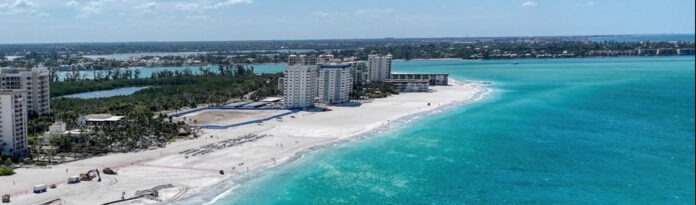
Lido Key just got 300,000 cubic yards of brand-new beach for a relative song. The sand came out of New Pass — which means, by the laws of physics, it came off Longboat Key. And Longboat, staring down a $33 million project of its own, would very much like the next batch back.
—The crystalline white powder that cost millions of dollars and now blankets a stretch of the Florida coast is not cocaine. It is something far more precious. It is beach.
—Roughly 300,000 cubic yards of fresh, sugar-white sand have been spread along the shores of Lido Key — the kind of godlike powder that pulls people in to frolic and swim, to boat and walk and run, to photograph a shoreline and believe, for a moment, that paradise is permanent. The people who use that beach are thrilled.
—But the new sand is more than a postcard. It is armor. Think back two years, to when much of this region’s beach ended up in the roads — when Hurricanes Helene and Milton peeled the dunes off the barrier islands and dumped them onto streets, driveways and sidewalks. Lido Key has now received a fresh blanket of protection. And just to the north, Longboat Key is counting the days until its own turn comes.
—A $400,000 bargain, dredged from the pass
—The U.S. Army Corps of Engineers, Jacksonville District, cut the ribbon on the finished project on May 29, gathering City of Sarasota and Sarasota County officials, stakeholders and Lido Key residents on the new sand. By the Corps’ own accounting, the effort placed about 300,000 cubic yards of sand along nearly 1.2 miles of critically eroded shoreline — and it did so cheaply, because the sand was essentially a byproduct.
—Rather than buy and barge in fresh material, the Corps pulled the sand out of New Pass, the inlet that separates Lido Key from Longboat Key, as part of a federally funded navigation-dredging job that was already on the books. Roughly 80 percent of the project’s design template was built from beach-quality sand generated directly by that New Pass dredging. One dredge, two missions: a safer navigation channel and a rebuilt beach.
—The piggyback approach saved the City of Sarasota an estimated $400,000 and spared local roads an estimated 150 truckloads of hauled material, according to the Corps. The Corps also coordinated to set aside about 3,000 cubic yards of sand for dune-building work the city plans to undertake.
“This project demonstrates how we can deliver multiple benefits to the public through smart, coordinated infrastructure investment,” said Maj. Cory Bell, Deputy Commander for South Florida with the Jacksonville District. “By pairing navigation dredging with beach renourishment, we were able to protect critical shoreline infrastructure, support the local economy, preserve environmental habitat and maximize value for the American taxpayer.”
—Sarasota Mayor Debbie Trice was less technical and more delighted. “Today, thanks to the Army Corps decision to use the sand removed from their dredging of New Pass to renourish Lido Key Beach, we’re gathered on a perfect beach, on a perfect beach day,” she said.
—From Big Pass to New Pass: a tale of two sand sources
—The price tag is what makes this round remarkable, because Lido’s last major refill was anything but a bargain.
—In 2020 and 2021, the Corps renourished Lido by dredging sand out of Big Sarasota Pass — the contested inlet at Lido’s southern end — in a project estimated at roughly $22.7 million. That effort placed some 683,000 cubic yards across about 1.4 miles of shoreline and added two permeable rock groins near the south end of the island to slow the sand’s inevitable march southward.
—This time, by riding the New Pass navigation cycle instead of mounting a stand-alone dredging campaign, the city captured a beach for a fraction of the cost. The lesson, increasingly, is that the cheapest sand in Florida is the sand you can grab while a dredge is already running.
—The groin in the room
—Not everyone on Lido is uncorking champagne. As The Sarasota News Leader has reported, the southernmost of the two groins built during the earlier project has been left uncovered, and the contractor did not spread fresh sand on the stretch of South Lido directly in front of the Sarasota Sands condominium complex.
—In an April email obtained by the News Leader, Corps project manager Andy Cummings told the city’s engineer that additional sand near the southern groins was “unnecessary at this time,” with the expectation that material placed to the north will migrate down and fill the area naturally. Residents have nonetheless questioned both the bare beach and the safety of an exposed structure; the News Leader reported that a person required assistance near the groin on April 11, prompting a Sarasota County Fire Department response that recorded no injuries.
—The Corps’ position is that an exposed groin is doing exactly what it was built to do. “It is completely normal and consistent with standard coastal engineering design for these structures to be exposed,” J.P. Rebello, public affairs officer for the Jacksonville District, told the News Leader. “An exposed groin is still actively performing its intended function.” The structures, he added, remain structurally sound whether fully buried or partially showing, and day-to-day beach safety and signage fall to the City of Sarasota as the local sponsor.
—Whose sand is it, anyway?
—Here is where Longboat Key enters the story — and where some residents start to bristle.
—The sand that piles up inside New Pass does not appear by magic. It washes there through longshore drift, the steady north-to-south river of sediment that runs down Florida’s Gulf coast. In plain terms, the sand the Corps just spread on Lido drifted into New Pass off the beaches of Longboat Key.
—The two communities have a long-standing arrangement to take turns: the City of Sarasota and the Town of Longboat Key alternate dredging New Pass for their respective beaches, much as Manatee County and Longboat alternate on Longboat Pass to the north. This cycle, Lido got the sand. As Longboat Key News has reported, some island residents have begun openly questioning why Longboat keeps handing a share of “its” sand to a neighbor every other dredging cycle.
—The grievance is geologic as much as financial. The sand keeps leaving Longboat. The question is how much of it Longboat gets to keep.
—Longboat’s turn — and the great sand hunt
—Under the alternation, the next New Pass dredging cycle should feed Longboat Key. The timing could hardly be more pointed, because Longboat is preparing for the most expensive ongoing job the town performs: a sweeping beach renourishment long described as a 2028 project.
That timeline is now accelerating. Town Manager Howard Tipton has told Longboat Key News the town is aiming to begin groin construction in the fall of 2027 and start the beach renourishment itself in late fall of 2027 — less than two years out. The scope is enormous: roughly 800,000 cubic yards of sand at a cost in the neighborhood of $32.9 million, paired with a new groin field along Gulfside Road, the chronically erosive stretch just south of the Ohana seawall that public works officials describe as one of the island’s hardest problems to solve.
—The money is being assembled from several directions — about $12.2 million from FEMA, roughly $7 million from the state, about $5 million from tourist-development taxes, and the remainder from funds left over from the 2021 project. But money is the easy part. The hard part is the sand.
—A single New Pass cut yields somewhere in the range of 200,000 to 300,000 cubic yards — useful, but nowhere near the 800,000 cubic yards Longboat needs. So even as the town’s place in the New Pass rotation comes back around, Longboat is spending roughly $340,000 to hunt for offshore borrow areas it can call its own, hoping to identify a sand cache big enough to supply not one project but several.
“Sand is pretty much gold in Florida,” Public Works Director Charlie Mopps has told the Town Commission. “Everybody is fighting for the same sand sources.” Dredging New Pass and Longboat Pass remains the natural solution, but as the town’s coastal engineer, Al Browder, has put it, “there are a lot of hands in that basket.” Add the environmental fine print — sand must meet quality and grain standards so it doesn’t harm sea turtles and nesting birds — and the search narrows further.
—The cost of gold
—The scarcity shows up most starkly in the math. Longboat’s first island-wide renourishment, back in 1993, placed nearly two million cubic yards at roughly $5 a cubic yard. The 2028 project pencils out closer to $41 a cubic yard — eight times the price, for less than half the volume. The 2024 hurricane season alone stripped an estimated 400,000 cubic yards from the island, on top of the 150,000 to 175,000 cubic yards Longboat loses to ordinary erosion every year.
Tipton frames the spending as a bargain in disguise, given the state and federal dollars the beach pulls in. “It’s a small price to pay for the beach,” he has said. And the cost of sand, he notes, only keeps climbing.
—Which brings it back to the powder on Lido. It glitters in the sun, it cushions the storms, it lures the tourists whose dollars keep these islands solvent — and it is quietly worth more, ounce for laundered ounce, than the white powder it resembles. The difference is that beach is legal, the supply is running short, and on this coast everybody wants the same fix.
—Lido just got its hit. Longboat is next in line — if it can find the stash.

