
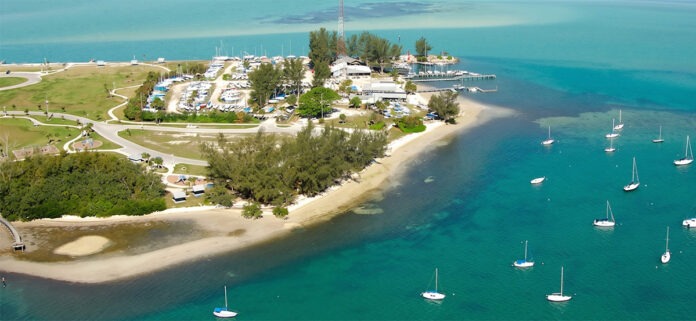
On almost any bright morning off the northern tip of City Island, the same small, everyday miracle plays out on the water. A scatter of pristine white sails tips out from the beach, catching the reliable sea breeze sliding down the bay in the lee of Longboat Key. A fleet of children goes skimming across the flat, glinting shallows of Sarasota Bay as if paradise were not merely a concept, but something you could actively rig, hoist, and steer.
For three generations of Sarasota and Longboat Key families, that singular view has been inextricably woven into the ordinary, beautiful business of raising children on the Gulf Coast. You drop them at the crushed shell lot on a Saturday morning, and somewhere between the complex geometry of the rigging, the inevitable capsizing, and the fierce joy of the racing, they come away with something permanent. It is a hard skill, sometimes the foundation for a collegiate scholarship, but almost always a lifelong, magnetic pull toward the water.
The place responsible for generating that scene is the Sarasota Sailing Squadron. It stands as one of the region’s most cherished and least assuming institutions—a volunteer-driven club that has quietly, steadfastly taught this town how to sail from a low, green wedge of dredged-up earth positioned seamlessly between Longboat Key and St. Armands Circle. It shares City Island with a world-renowned marine laboratory, a vital seabird hospital, and a public park, yet the Squadron laid its roots there before almost anyone else.
Now, the Squadron’s next three decades of existence come before the Sarasota City Commission. The future of this waterfront arrives in two distinct legislative pieces, carrying profound implications not just for the preservation of a community tradition, but for the economic utilization of increasingly scarce public land.
—Two Decisions, One Waterfront: The Policy Machinery
The proposal reaches the dais as two separate agenda items operating on two distinct procedural tracks—a nuance essential for understanding the civic machinery at work.
The first, Item XI.2, represents a quasi-judicial public hearing on a package of land-use applications: a Site Plan (24-SP-19), a Major Conditional Use (24-CU-04), and a Government Zone Waiver (25-GZW-01). This regulatory package governs the physical reality of the building itself. The applicant of record is planner Joel J. Freedman, AICP, acting as the strategic agent for Sarasota Youth Sailing.
The second, Item XII.1, is a New Business item that authorizes the mayor, the city auditor, and the clerk to execute the Eighth Amendment and Restated Lease Agreement between the city and Sarasota Sailing Squadron, Inc. This document governs the earth upon which the building would stand, cementing an economic and legal framework that dictates the terms of engagement for decades.
The two items are inextricably joined at the hip. The master lease is the legal vehicle authorizing the Squadron and its youth partner to tear down an aging structure and erect a new one on city-owned land, while the site plan strictly defines the architectural and functional limitations of that structure. Together, these two votes would lock in the Squadron’s presence on the water until 2055 and clear the final municipal hurdle for a privately funded, multi-million-dollar project that has been methodically inching its way through City Hall since before the pandemic.
—A New Home for the Youth Fleet: Engineering for the Elements
The centerpiece of this ambitious initiative is the Youth Sailing Center. Described formally in the lease’s Exhibit C as an approximately 4,230-square-foot, two-story educational facility, it represents a monumental leap forward in infrastructure.
The proposed facility is designed entirely around the daily, kinetic rhythm of teaching children to navigate the wind: open boat storage will dominate the ground level, while classrooms, administrative meeting spaces, offices, restrooms, and dedicated programming areas are smartly stacked above. It would replace an existing two-story structure that has dutifully done its job and then some. The current boathouse, a weathered relic dating back to 1989, sits directly on the corrosive salt beach where the youngest sailors launch, utterly devoid of climate control. For years, the program’s primary administrative office has been a modest trailer parked unceremoniously on the shell lot.
The new center is engineered to provide a rapidly expanding program its first genuine, enclosed, climate-controlled home, ensuring that the elements remain a variable on the water, not in the classroom.
—The Human Capital: Who Sails There
The architecture, however, is merely a vessel for the human capital it supports. The building would be occupied primarily by Sarasota Youth Sailing, a robust nonprofit that operates on the Squadron’s grounds, serving young people ranging from ages 5 to 18. Its high-demand summer camps draw upwards of 400 children, while its intensive year-round programming carries dozens more.
The organization boasts incredibly deep local roots, particularly drawing on the philanthropic and community-minded backing of neighboring Longboat Key. It grew organically out of the club’s culture decades ago and has consistently sent graduates onto the fiercely competitive stages of collegiate and national regattas. But its stated mission runs far deeper than the pursuit of silver trophies; it is an incubator for teamwork, ethical conduct, self-reliance, and a profound, stewardship-level respect for the fragile marine environment.
What the fiscal numbers and zoning documents fail to capture is how the institution actually breathes. Much of the operation is fiercely volunteer-powered and family-built. It is coached and cajoled along by parents—many from Longboat Key and the mainland alike—who once launched their own prams from this exact beach and now stand on the wooden docks, watching their children undergo the same transformation.
Learning to sail here has evolved into a localized rite of passage. It is the metric by which a coastal family measures the passing of years: the terror and triumph of the first solo, the chaotic thrill of the first regatta, the first dramatic capsize survived and subsequently laughed about over dinner. While some of these young athletes sail on to elite college teams and national podiums, the vast majority simply carry the water with them into their professional and personal lives—perhaps the most valuable, enduring cargo the program produces.
Under a sophisticated sublease signed in June, Sarasota Sailing Squadron, Inc. acts as the master tenant, with Sarasota Youth Sailing, Inc. operating as the sublessee. The sublease perfectly mirrors the master lease’s term and overarching purposes, executed jointly by Squadron Commodore Cathy Tabb and Youth Sailing President Travis Yates. The modern space is also expected to be fluidly shared with the Luffing Lassies—the club’s historic and highly active women’s sailing group—and with the broader Squadron membership.
The Architecture: A Sailboat as a Blueprint
The proposed center was conceptualized by the esteemed Sarasota firm PS Design Workshop, operating in strategic collaboration with the William Olmsted Antozzi Office of Architecture. The resulting design wears its regional influences openly and proudly. It is a brilliant nod to the mid-century Sarasota School of Architecture, leaning heavily into the localized tradition of building for deep shade, passive cross-breezes, and a masterfully blurred boundary between the indoors and the natural environment.
Practical features brilliantly double as interactive teaching tools. Twin butterfly-style roofs are meticulously designed to funnel seasonal rainwater into integrated cisterns, which will then be utilized to wash down the salt-crusted boats. Expansive solar panels, deep structural overhangs for passive cooling, and louvered ground-level walls that permit the bay winds to pass through unimpeded are core components of the environmental scheme.
The existing dock would run directly beneath the structure, serving dual purpose as the functional deck of the ground floor. Most notably, the modern building would finally render the youth program fully accessible under the Americans with Disabilities Act, complete with an elevator, opening the water to a demographic previously sidelined by architectural barriers.
The Economics of Paradise: What it Will Cost, and Who Pays
For an audience keenly attuned to civic spending, the financial mechanics of this project are highly compelling. While the agenda materials before the commission do not formally attach a finalized construction price to the building, the youth center has been consistently described throughout the city’s rigorous approval process as an approximately $3 million project.
The Squadron’s broader, more comprehensive capital plans—which include the urgent replacement of a vital shoreline wave fence destroyed during the brutal 2024 hurricane season, alongside other essential storm repairs to the city-owned property—have been estimated at roughly $4.1 million over the next several years.
Crucially, this is an exercise in private capital achieving public good: not a single dollar is being requested from municipal coffers.
The center is to be constructed entirely through privately raised funds driven by a targeted capital campaign, heavily supported by the philanthropic muscle of Longboat Key residents who view the Squadron as an essential community asset. The organizations have drawn a hard fiscal line: construction will not commence until strict fundraising targets are met in cash.
A unique structural complication has shadowed this effort. The Squadron is formally organized as a 501(c)(7) social club, a tax status that renders direct donations non-tax-deductible. Conversely, Sarasota Youth Sailing operates as a 501(c)(3) public charity. To navigate this, the groups have utilized a partner organization as a legal pass-through for charitable gifts and are actively discussing corporate restructuring to streamline future, high-level fundraising efforts.
The lease, meanwhile, explicitly dictates who carries the burden of simply existing on the island, and the answer is squarely the Squadron. As in all prior iterations, the tenant absorbs 100 percent of all taxes, utilities, insurance, maintenance, and the capital expense of any physical improvements. Under the stringent terms of the lease, every million-dollar improvement built on the leasehold ultimately reverts to outright city property when the lease expires. It is a long-term capital transfer that heavily favors the municipality.
The Non-Resident Tax: A Fiscal Mechanism for Fairness
The restated lease carries a specific fiscal provision that, while drawing less public fanfare than the architecture, may prove just as consequential to the local economy: a strictly enforced resident/non-resident fee differential.
The legal document mandates that the Squadron charge non-resident members base membership and initiation fees that are exactly 50 percent higher than the fees levied on City of Sarasota residents within the identical membership class. Furthermore, the club is required to remit that exact differential directly to the city on a quarterly basis, fully certified by a sworn officer of the club.
The city’s economic reasoning is transparently outlined in the lease’s opening recitals. Prime waterfront land and marine facilities are exceptionally scarce commodities. Non-resident utilization of these assets inherently relies upon public infrastructure—roads, emergency services, water lines—that are funded almost exclusively by city taxpayers. Because a statistical majority of the Squadron’s 800 member families are non-residents (many hailing from adjacent Longboat Key or the county at large) who do not pay into the city’s property tax base, this differential is engineered as a user-fee mechanism. Charging them a premium, and diverting that premium to the municipal general fund, is framed by policymakers as a necessary matter of fiscal fairness and public interest.
To ensure compliance, the differential applies strictly to base membership and initiation fees. The lease explicitly bars the club from utilizing creative accounting to restructure its fee schedule to dodge the payment. Furthermore, should a membership waiting list ever materialize, city residents are legally guaranteed priority placement.
A Lease to 2055: Securing the Horizon
The Eighth Amendment does not simply extend the timeline; it comprehensively consolidates and modernizes a convoluted legal history. The underlying agreement traces back to November 2010 and has been amended a dizzying seven times since.
The commission already secured the long temporal runway in 2025, setting the expiration date for November 28, 2055. This new restatement essentially folds all of that historical legal patchwork into a single, clean, enforceable document. It updates archaic operational language, formally codifies the youth education use, and seamlessly incorporates the new building through Exhibit C.
This 30-year horizon was subject to intense municipal scrutiny. When the extension initially came before the commission, officials demanded—and received—ironclad confirmation that the lease is strictly non-transferable. This legal assurance prevents the commodification of the leasehold, keeping a decades-long grant of premium public waterfront permanently tethered to the specific, community-minded organization the city originally intended to benefit. Furthermore, the lease vigorously preserves the city’s right to commandeer the meeting and auditorium spaces on the property, entirely at no cost, for official public functions.
The restated agreement is ready for execution. It was signed by Commodore Tabb on June 25, and officially approved as to form by City Attorney Joe Polzak on June 29. All that remains is the commission’s authorization and the final signatures of Mayor Debbie Trice and City Auditor and Clerk Shayla Griggs.
Zoning Quirks and the Shell Lot Debate
Despite its serene setting, the property carries an incredibly complex and unusual regulatory profile. It is zoned “Governmental,” burdened with a future land use designation of “Community Office/Institutional,” and sits squarely inside the city’s highly restrictive Coastal Islands Overlay.
Because Governmental zoning automatically borrows its development standards from the most restrictive adjacent district, this youth center must legally meet the yardsticks of the Residential Single-Family 1 zone next door. Consequently, any new vertical construction triggers a Major Conditional Use, providing the city a formal mechanism to weigh whether the facility maintains harmony with its surroundings.
Interestingly, the most fiercely contested technical question is also the most mundane: the parking lot.
The Government Zone Waiver (Application 25-GZW-01) would officially relieve the Squadron from a rigid municipal code requirement demanding that off-street parking be paved with asphalt, concrete, or an equivalent impervious surface. The club has parked its vehicles and trailers on crushed shell since it first arrived on the island in 1958. Its legal representatives and engineers have successfully argued that paving the expansive lot—and subsequently constructing the massive, mandated stormwater retention ponds that would accompany an impervious surface—is not only financially exorbitant but potentially fatal to the project’s tight philanthropic budget.
They argue that occasional storm washout of the shell is merely routine, low-cost maintenance, and that heavy municipal vehicles, including full-sized emergency apparatus and training rigs, navigate the permeable surface without incident.
By the raw data, the site itself changes remarkably little. A comprehensive tree survey identified 10 trees on the parcel—none of them classified as grand specimens, and remarkably, none are proposed for removal. All mandated landscape buffering is fully provided along the building’s perimeter, all vegetative requirements are met, and an initial transportation analysis found the proposed plan’s impact to be strictly de minimis, triggering no requirement for a costly, drawn-out traffic study.
City Island’s Civic Cluster: A Century on the Water
To truly grasp the stakes, one must view the neighborhood from a macro perspective. City Island was literally birthed in the 1920s from the dredged spoil of an adjacent channel. Over the subsequent century, the city systematically leased this newly minted waterfront in strategic parcels, creating a small, brilliant constellation of civic tenants.
Mote Marine Laboratory conducts world-recognized, paradigm-shifting science on the island. Save Our Seabirds rehabilitates injured coastal wildlife just steps away. Ken Thompson Park wraps the eastern edge with a public boat ramp and open water access. And anchoring the northern tip is the Squadron.
This curated cluster is precisely why municipal leases of this nature carry a gravitational weight far beyond a single tenant. The city effectively monopolizes the island’s real estate, and it possesses a finite amount of waterfront to distribute. Every long-term lease executed is a profound economic and philosophical decision about who gets to utilize a scarce, irreplaceable public asset, under what financial terms, and to whose ultimate benefit.
The Squadron’s claim on this ground is both historic and impeccably documented. Tracing its genesis to a scrappy group of teenagers gathering at the old City Pier in the late 1930s, it elected its first commodore in 1942, disbanded during the throes of World War II, and re-formed in 1946. By June 1958, as the city prepared to demolish the aging pier, the club relocated to what was then a desolate spit of made land on City Island, sharing the geography with nothing more than a lone radio station and a dirt airstrip utilized by mosquito-control biplanes.
In the decades since, bolstered by generations of unwavering support from Longboat Key and the mainland, it has evolved into a powerhouse volunteer institution of over 800 member families. Operating seven days a week, it hosts prestigious national and international regattas and has launched world-class, Olympic-caliber racers from its humble wooden docks.
The Stakes for the Future
Approval of these items would set the final, critical piece in motion. With the site plan secured and the master lease formally executed, the Squadron and Sarasota Youth Sailing could immediately transition into the permitting phase, finalize their philanthropic capital raise, and finally begin replacing a 35-year-old, deteriorating boathouse with an architectural asset engineered to serve the next century of Sarasota sailors.
It would also codify the city’s long-term wager on this specific stretch of shoreline—securing a reliable, maintenance-funding community tenant through mid-century, capturing a brand-new revenue stream via the non-resident fee differential, and ultimately adding a multi-million-dollar, privately funded building to the municipality’s own asset inventory.
The inverse scenario carries equally heavy implications. A stumble on the lease execution, or a bureaucratic refusal of the vital shell-lot waiver that the applicants deem fiscally essential, would paralyze a privately funded initiative that has been methodically navigating City Hall for over five years. It would leave one of City Island’s founding civic tenants waiting in regulatory purgatory for a proper, safe roof over its youngest sailors.
For a coastal region that aggressively markets itself on the unparalleled beauty of its water and light, this is ultimately a modest administrative vote dealing with an outsized, deeply emotional subject: whether one of the quiet, defining joys of raising a family on this coast—the sight of your own child skimming out across the bay—is finally granted a structurally sound, economically viable place to happen.

