
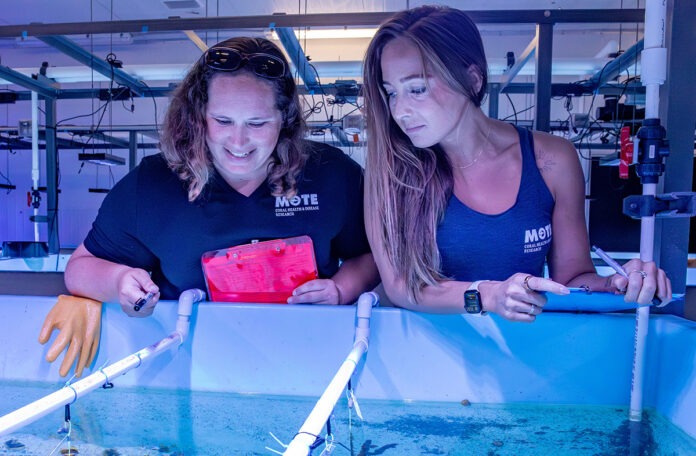
By exposing over 150 genetically distinct corals to Stony Coral Tissue Loss Disease, researchers have identified 12 robust survivors that could serve as the foundation for rebuilding Florida’s devastated reef tract.
—Since its emergence off the coast of Miami in 2014, Stony Coral Tissue Loss Disease (SCTLD) has acted as a silent, highly lethal pandemic beneath the waves. The waterborne affliction burns through Caribbean reefs with unprecedented virulence, stripping susceptible corals of their living tissue at rates of up to 40 square centimeters a day and often leaving behind stark, white skeletons in a matter of weeks.
—For massive, centuries-old foundational species like the mountainous star coral (Orbicella faveolata), the outbreak has been catastrophic. But a vital lifeline has just emerged from the laboratory.
—In a newly published study in Scientific Reports (2026), researchers from Mote Marine Laboratory—alongside NOAA and academic partners—have identified rare, naturally disease-resistant genotypes of mountainous star coral. The findings mark the largest laboratory transmission experiment to date for the disease, offering a critical new strategy for breeding and outplanting resilient “super corals” to rebuild the decimated Florida Reef Tract.
—The Ultimate Laboratory Stress Test
—To find these genetic outliers, the Mote research team evaluated 154 distinct mountainous star corals maintained within their Coral Reef Restoration Research Program. In a grueling gauntlet of four sequential laboratory transmission experiments, scientists intentionally exposed the corals to SCTLD.
—The researchers collected over 2,500 samples, closely monitoring the severity and progression of tissue loss to categorize how individual corals responded to the pathogen. While the vast majority succumbed to the disease—underscoring its devastating lethality—12 distinct genotypes consistently demonstrated natural resistance across multiple experimental replicates.
“This project represents years of collaboration and one of the most comprehensive efforts to understand how an important reef-building coral species responds to stony coral tissue loss disease,” said Dr. Sara Williams, lead author and staff scientist in Mote’s Coral Health and Disease Research Program. “Evaluating more than 150 genetically distinct individuals allowed us to identify patterns of disease resistance.”
—From Lab to Reef: Validating Natural Immunity
—Crucially, this wasn’t just a laboratory artifact. When the team cross-referenced their lab data with the performance of coral colonies previously outplanted in the Lower Florida Keys during the initial SCTLD outbreak, they found a striking correlation.
—Genotypes that survived the lab transmission tests also showed a significantly lower risk of disease in the wild. This proves that rigorous laboratory screening can accurately predict field survival, saving conservationists valuable time and resources.
—Decoding the Biomarker for Survival
—Because these naturally resistant corals represent only a small proportion of the overall population, identifying them early remains a logistical bottleneck.
—To solve this, Mote researchers are currently working to pinpoint a biological marker for SCTLD resistance. Once identified, this biomarker would allow conservationists to rapidly screen future coral fragments for inherent immunity without having to run large-scale, time-consuming infection trials.
—However, researchers caution that disease resistance is just one piece of the complex reef-restoration puzzle. Outplanted corals must also survive rising ocean temperatures, acidification, and other biological stressors. A successful restoration pipeline will require breeding corals that carry a stacked deck of beneficial traits.
—Building a Resilient Future for Florida’s Reefs
“Restoration efforts must increasingly focus on building diverse and resilient coral populations as Florida’s Coral Reef continues to face unprecedented challenges,” Dr. Williams noted. “Identifying and incorporating disease-resistant corals into restoration programs is one important step towards long-term reef recovery and ecosystem resilience.”
—As the race to save the Caribbean’s reefs accelerates, these inherently resistant mountainous star corals are already being strategically propagated and integrated into Mote’s ongoing restoration efforts.
“Mote’s mission is to develop innovative, science-driven solutions that address the growing challenges facing our oceans,” said Dr. Michael P. Crosby, President & CEO of Mote Marine Laboratory. “By improving our understanding of natural disease resistance in corals, studies like this provide critical knowledge to help restoration practitioners build more resilient reefs for future generations.”
Study Information & Funding: The study was led by Mote Marine Laboratory in collaboration with NOAA’s Atlantic Oceanographic and Meteorological Laboratory, the University of Miami, and Stony Brook University. Funding was provided by Florida’s Department of Environmental Protection and the Florida Fish and Wildlife Conservation Commission. The full paper, “Restoration stocks of a Caribbean coral species contain low levels of inherent stony coral tissue loss disease resistance,” is available at www.nature.com/articles/s41598-026-56396-7.

