
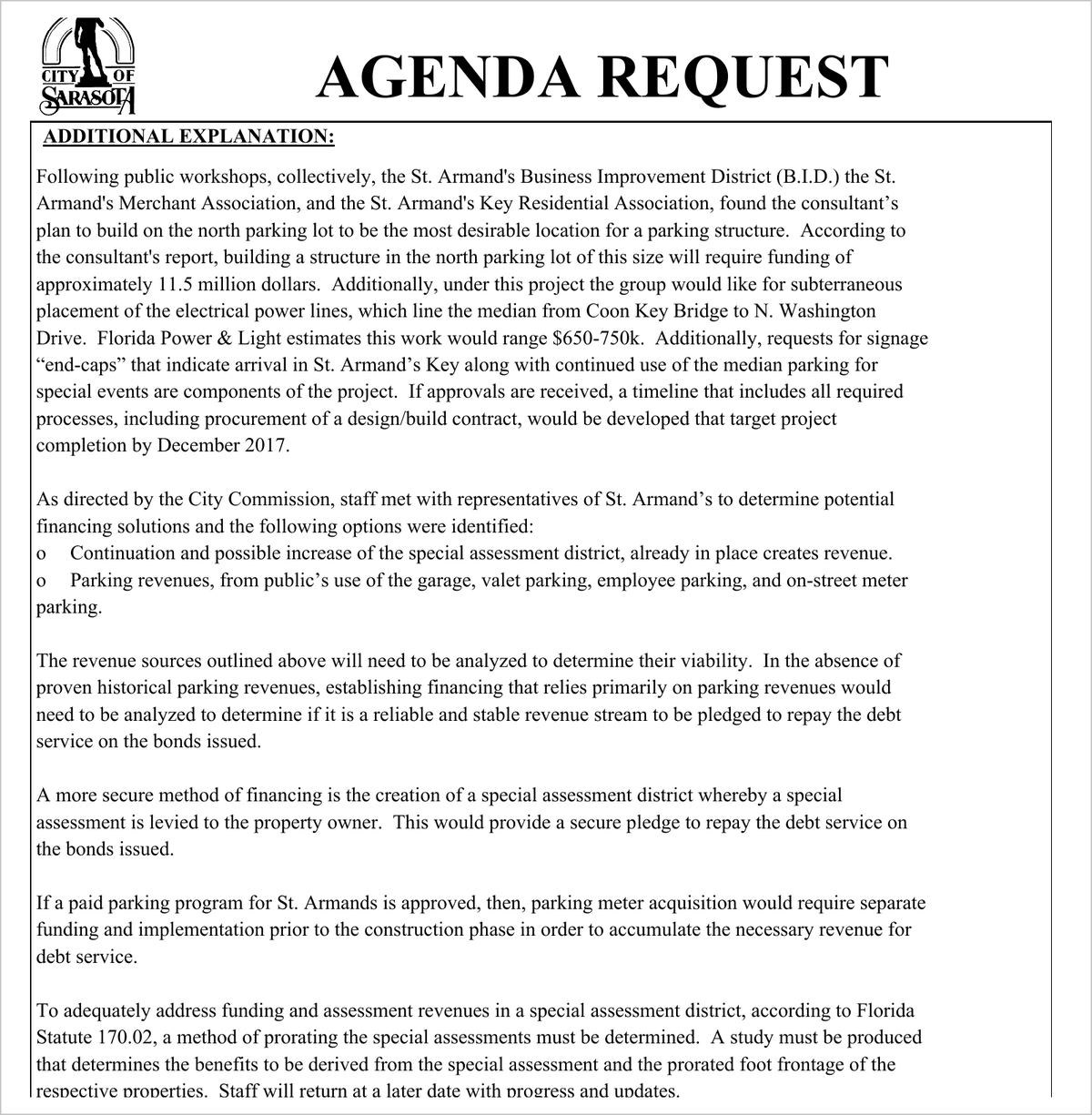
“In the absence of proven historical parking revenues, establishing financing that relies primarily on parking revenues would need to be analyzed to determine if it is a reliable and stable revenue stream.” That sentence was written by City of Sarasota staff in June 2015. Nobody did the analysis. Eleven years later, the city held an open house on the question and would not let the public speak.
The silence was stifling.
Monday evening, in the same chamber where merchants spent nine hours three weeks ago dismantling a paid-parking expansion, the City of Sarasota’s Parking Division held the open house it had promised since the Aug. 3 vote, and the people who showed up to help fix the system discovered they would not be allowed to speak.
The format was a staff presentation followed by a question-and-answer session in which only written questions were accepted. No podium, no three minutes. Residents and merchants who had come with proposals, sell the St. Armands garage, bag the meters, move enforcement to the police, charge for the trolley, filled out cards, and many of them walked out. Katherine Hermes, whose memo to commissioners had anticipated three-minute presentations, wrote the next morning that the open house “was a sham,” and that commissioners had asked the department to let the public speak and been told no.
Café Amici’s Nicholas DiIelsi, who told the commission three weeks ago his restaurant was paying its customers’ parking to survive, said outside City Hall that the open discussion the city had promised a month earlier had turned into the city presenting its own version of its own program. Commissioner Kyle Battie, the lone vote against the ordinance, said residents had every right to be frustrated when they do not feel heard.
Whatever staff gleaned from the cards now goes into the package the commission demanded for its dedicated parking workshop next Monday, Aug. 31, where public comment will not be taken either. The first meeting at which the commission can act, and the first at which the public can address it on the record, is Sept. 7.

Somewhere between now and then the city has to answer the question Mayor Debbie Trice put on the record before voting to suspend her own ordinance: somebody is going to pay for the parking.
What almost no one in that room could do Monday, and what almost no one will do next week, is open the document that started it.
It is 90 pages long, dated June 2014, and it carries the logos of Kimley-Horn and Associates and Jonathan Parks Architect. The St. Armands Parking Feasibility Study is the origin document of Sarasota’s paid-parking era. It produced the number, 320 spaces, that justified the garage. It produced the site. It produced the revenue projection, $751,000 a year, that the city carried into a bond issue. And it produced, in a sentence almost nobody quoted at the time, the precondition that paid parking on the streets of St. Armands would have to come with it.
LBK News read all 90 pages, along with the December 2014 amendment that priced a second garage and the June 2015 agenda request that carried the findings to the City Commission. We laid them against the record since: the 2016 and 2017 votes, the 2019 opening, three rounds of rate changes, the general fund bailouts, the attempt to sell the Fillmore lot, the Shore application, and the revolt of the past two months.
What emerges is not a single villain. It is a chain of custody in which each link took the previous link’s caveat and passed it along as a certainty. The consultant said “sample.” The staff said “estimate.” The merchants said “need.” The commission said “yes.” And the people who never asked for any of it, the residents of St. Armands and Lido, the employees who park, the downtown shopkeepers three miles away, ended up holding the bill.
The Number That Built a Garage
Every public account of the garage begins with the same figure. The city’s June 2015 agenda request states it flatly: the Kimley-Horn study “indicated a deficiency of 320 parking spaces.” Scott Macdonald of the Crab & Fin repeated it to Suncoast Searchlight this month. It is the number that justified a structure of roughly 500 spaces, and it is the number on which everything since has rested.
Here is where 320 came from.
Kimley-Horn did not count 320 missing spaces. It borrowed the figure from a 2013 Sarasota Parking District Study by Walker Parking Consultants, and the borrowed figure was not a measurement. It was the far end of a projection. Walker’s actual peak-season count, taken at 11 a.m. on a Friday in the 2013 season, found 1,121 cars occupying a district supply of 1,135 spaces. That is 99 percent occupancy, and it is the closest thing to a hard number in the entire file.
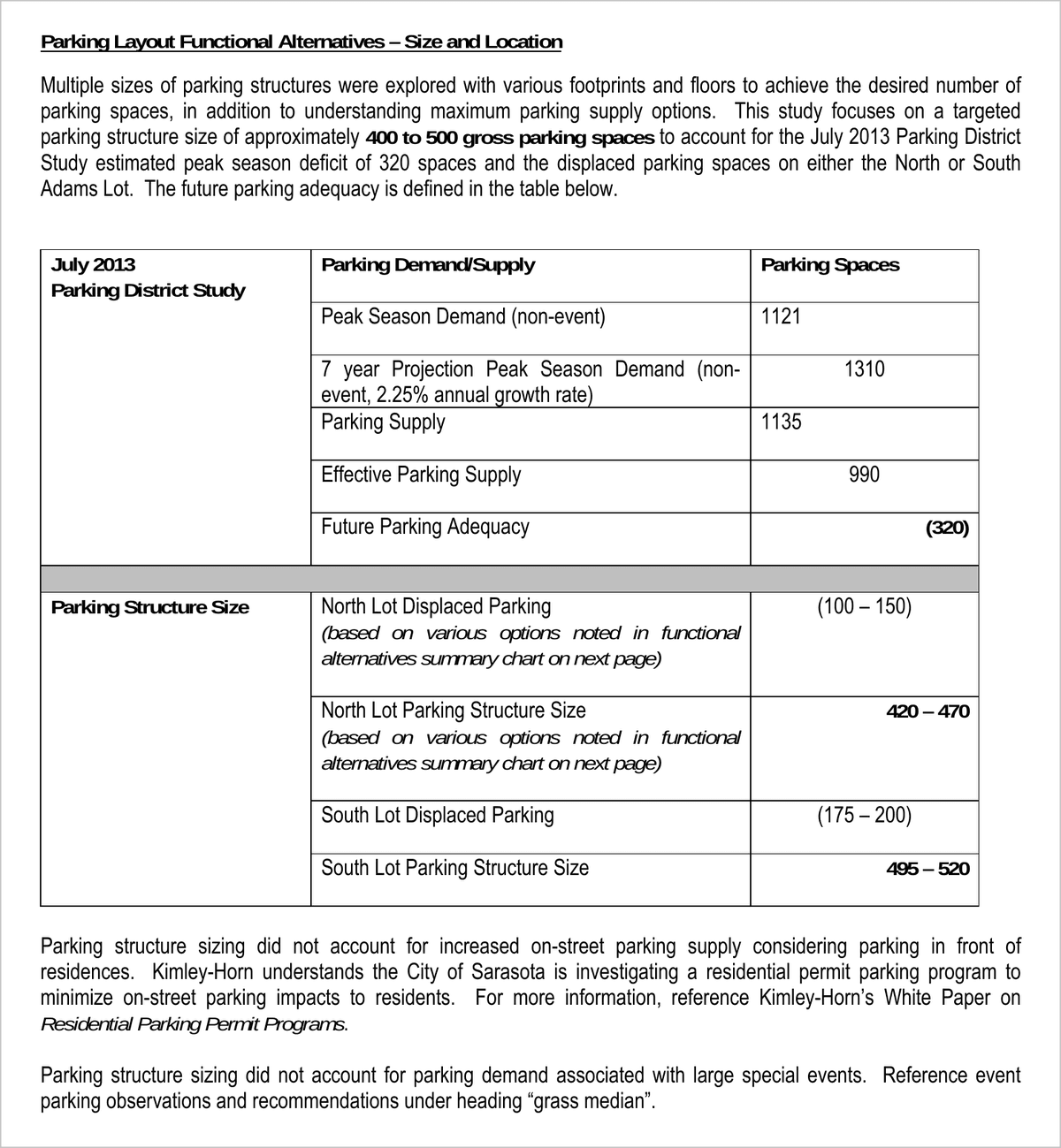
From there, the arithmetic did two things. First, Walker discounted the 1,135 physical spaces to an “effective supply” of 990, a standard industry adjustment for the circling and inefficiency that occur when a district is nearly full. That single adjustment converted a 14-space physical surplus into a 131-space “deficit.” Second, Walker projected demand forward three to seven years at annual growth rates between 1.0 and 2.25 percent, producing a range of future deficits from 165 to 320 spaces.
The city took the top of the range. Seven years out, at the highest growth rate modeled, against a supply discounted by 145 spaces. That is the 320. Kimley-Horn’s own summary table labels it “Future Parking Adequacy,” not present adequacy, and lists the projected 2020 demand of 1,310 cars against the effective supply of 990. Nobody built the garage for 2013. They built it for a 2020 that was assumed to grow every year, without interruption, at the fastest rate the consultant could defend.
The pandemic arrived in 2020. The garage’s revenue never reached a third of its projection.
A Problem That Was Getting Smaller
The study’s own introduction contains a comparison the city never highlighted.
In 2008, Heidt & Associates completed a St. Armands master plan that counted a district supply of 1,050 spaces and estimated a peak-season deficit of 34 spaces on a typical weekend and 287 during a peak event. In 2013, Walker counted 1,135 spaces, 85 more than Heidt, and found a 53-space surplus in the off-season. Kimley-Horn reports both sets of figures on page one without comment.
Read together, they say the physical supply grew between 2008 and 2013, the off-season went from a small deficit to a surplus, and the peak non-event deficit, once the effective-supply discount is stripped away, was somewhere between 14 spaces of surplus and 131 spaces of shortfall depending on how you count. Meanwhile the study explicitly excluded special events from the sizing of the garage: “Parking structure sizing did not account for parking demand associated with large special events.”
So the 287-space event deficit that made the 2008 report alarming was set aside. What remained was a district that was, by the consultant’s own numbers, roughly at capacity for a few hours a day during a few months a year, and comfortable the rest of the time. That is not nothing. A 99 percent full district is a district where people circle. But it is not a 320-space hole, and the study never claimed it was. The city did.
Two Days in November
Kimley-Horn did go to St. Armands and look. Its field observations are the most vivid part of the report, with photographs of cars circling the Adams lots, a fender-bender on John Ringling Boulevard, drivers waiting on pedestrians to reach their vehicles. Those photographs did more to sell the garage than any table.
The dates matter. The consultant observed the district on two days in November 2013, both of them in the off-season. The report’s narrative says Friday, Nov. 7 and Saturday, Nov. 8. Its own data tables say Friday, Nov. 8 and Saturday, Nov. 9. In 2013, Nov. 8 fell on a Friday, so the tables are right and the narrative is wrong, a small error in a document that asked a city to borrow $17.5 million.
The Saturday observation, from 9:30 a.m. to 12:30 p.m., took place during the St. Armands Art Festival and Fall Sidewalk Sale, when every lot, the Circle and the grass median were 100 percent full by 10 a.m. That is the day the accident happened. That is the day the cars circled. And the Friday observation was not clean either: the report notes exhibitor vehicles already occupying half the Circle spaces at 2 p.m. and three-quarters by 6 p.m., with on-street closure notices posted on Boulevard of the Presidents “in preparation for Saturday event.”
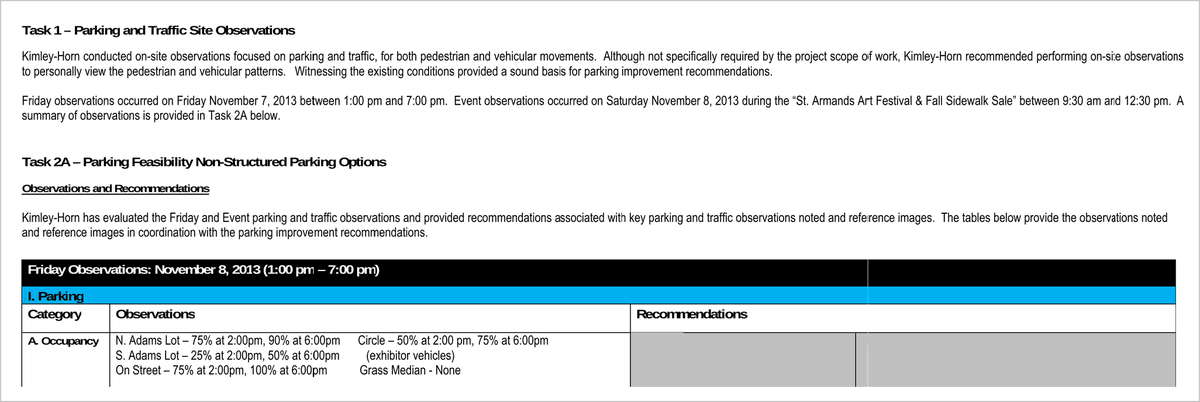
In other words, both days of on-site observation were shaped by an art festival the study said it would not size the garage for. The study did not hide this. It simply presented the festival photographs and the growth projection side by side and let the reader draw the line between them.
The Fixes That Cost $208,000
Buried in the same report is a list of what Kimley-Horn recommended the city do without pouring a single yard of concrete.
Stripe the 651 on-street parallel spaces to the city’s 22-foot standard: estimated cost $9,765, estimated gain about 30 spaces. Remove the three on-street spaces on North Adams Drive that were pinching southbound traffic into the oncoming lane. Take the words “free parking” off the directional signs. Name the lots so visitors could find them. Fix the valet operation, which the consultant found staffed by a single attendant, blocking a travel lane, and routing cars the wrong way down an alley. Install raised crosswalks, flashing pedestrian beacons and speed-limit signs.
The entire non-structured menu, everything on the consultant’s list, totaled about $208,000. The study also notes the city was investigating a residential permit program and that the structure sizing “did not account for increased on-street parking supply” that such a program might free up.
None of that was mutually exclusive with a garage. But the report shows a district with 30 spaces of paint-only capacity, a 53-space off-season surplus and a list of sub-$1 million fixes, and the city’s takeaway was 320 spaces and a four-story structure.
“Should Not Be Considered a Financial Feasibility Analysis”
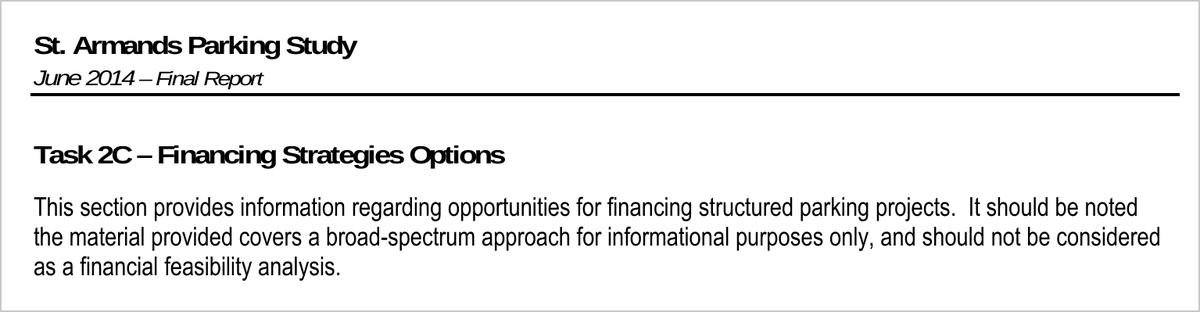
The most consequential section of the study is also the one with the loudest disclaimer.
Task 2C, “Financing Strategies Options,” opens with this: the material “covers a broad-spectrum approach for informational purposes only, and should not be considered as a financial feasibility analysis.” The sample revenue spreadsheet at the end of the section carries a second warning, in italics, that Kimley-Horn “cannot guarantee that financial projections contained in this study will be realized” and that their use “is at the Client’s own risk.”
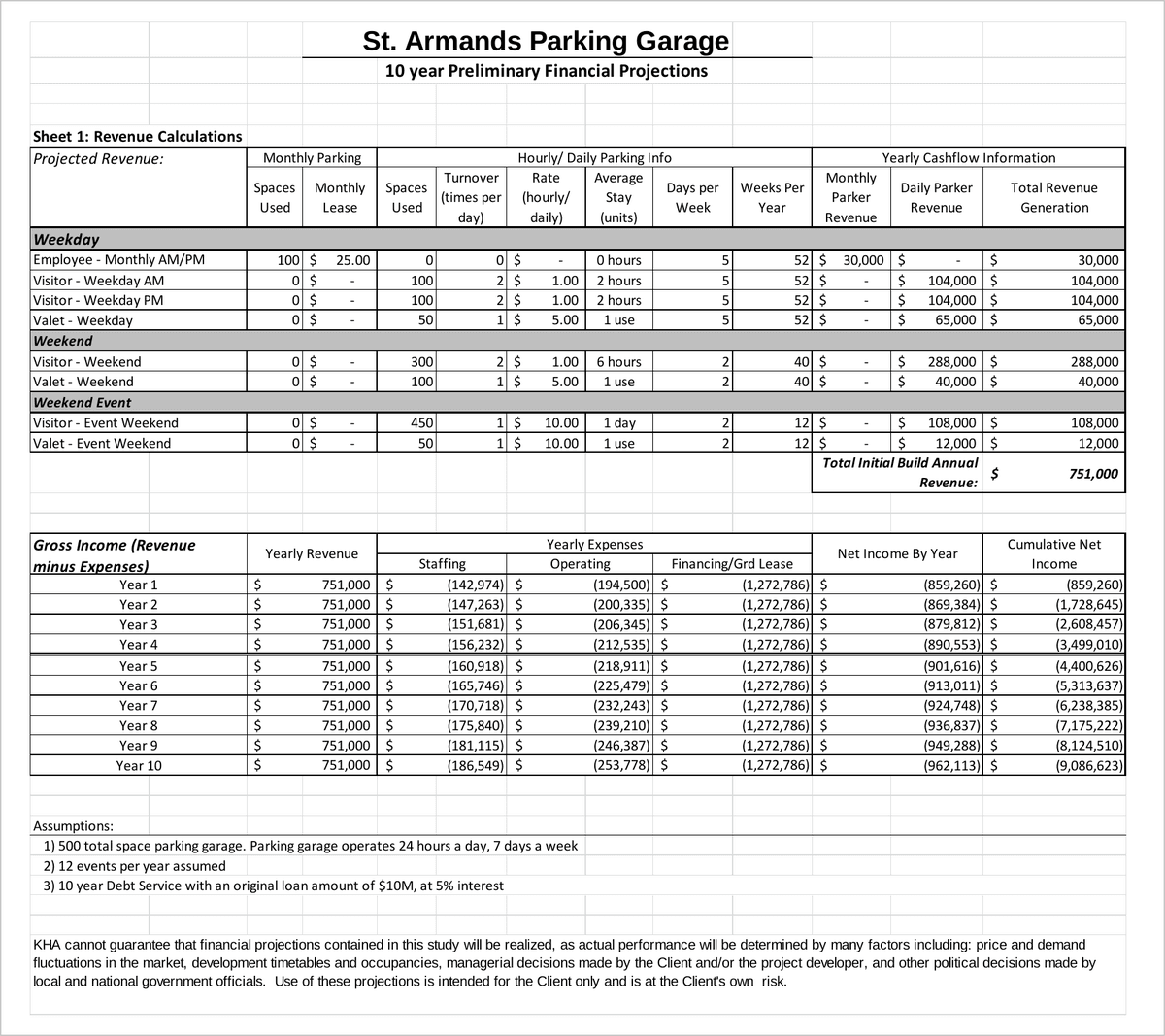
The spreadsheet models a 500-space garage charging $1 an hour to visitors who stay two hours, $5 to valet users, $10 on 12 event days a year and $25 a month to 100 employees. Total annual revenue: $751,000.
That is the figure the city adopted. It is the figure Suncoast Searchlight reported this month as the city’s own projection when the garage opened, and it traces directly to a sample spreadsheet its author told the client not to rely on.
What the spreadsheet says next is the part that never made it to the podium. Against $751,000 in revenue, Kimley-Horn modeled $143,000 in staffing, $194,500 in operations and $1.27 million in annual debt service on a $10 million loan. Net result: a loss of $859,260 in year one and a cumulative loss of $9.09 million over ten years. The consultant’s illustration of the garage’s finances, the only one in the file, showed it losing roughly $860,000 a year with paid parking everywhere and every assumption going right.
When then-Commissioner Shelli Freeland Eddie asked at a commission meeting whether anyone on staff knew how much the garage would need to collect to break even, Searchlight reports that Parking Manager Mark Lyons answered “no.” The answer was in the appendix.
The Precondition Nobody Repeated
One more sentence from the financing section deserves to be read aloud at the Aug. 31 workshop, because it explains how a garage on a barrier island became a meter on Main Street.
“The concept of implementing paid parking at the proposed parking garage assumes paid parking will also be implemented at on-street parking spaces. If on-street parking were to remain free, the projected revenues for the proposed parking garage would be impacted.”
That is the whole logic in two sentences. A garage that charges money cannot compete with free curb space fifty feet away. To make the garage generate anything, the streets around it had to be metered. The June 2015 agenda request said the same thing in bureaucratic form: “If a paid parking program for St. Armands is approved, then, parking meter acquisition would require separate funding and implementation prior to the construction phase in order to accumulate the necessary revenue for debt service.”
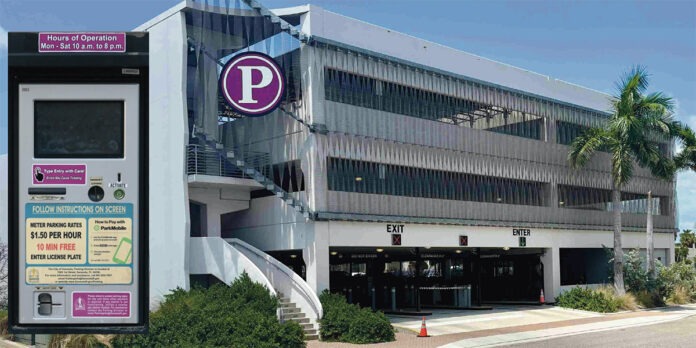
So paid parking on St. Armands was not a policy the city arrived at. It was a structural requirement of the bond. When the garage opened on Feb. 12, 2019, the meters went live the same morning. The city’s own 2021 rate notice put it plainly: the adjustments were “necessary to meet requirements tied to the revenue bonds.” As LBK News noted after the Aug. 3 vote, the bond still requires the city to charge for parking on the Circle. And as Searchlight framed it, the trade-off that came with the garage was a citywide return to metered streets, including downtown blocks that had been free since the meters came out in 2012.
Chip Beeman did not need the appendix. “They failed to heed the advice of the sandwich maker,” he told the commission three weeks ago. But the appendix agrees with him.
The Garage the City Made Free
Then the city undercut its own model.
Kimley-Horn’s $751,000 assumed the garage charged from the first hour. The city opened it at 50 cents an hour. In October 2021, to align with downtown, it made the first two hours free, charged $3 for the third and $1 for each hour after. In June 2025, when the gates came out, the schedule became first hour free, $2 for the second, $1 after that.
Put the consultant’s typical visitor, the two-hour shopper who was supposed to generate the bulk of the garage’s income, through those schedules. In the model she paid $2. From 2019 to 2021 she paid $1. From late 2021 to mid-2025 she paid nothing. Today she pays $2 again. For nearly four years the city gave away, for free, the precise transaction on which the revenue projection depended, while metering the curb at $1.50 an hour to push drivers into the garage that wasn’t charging them.
The results are what you would expect. Searchlight calculated that the garage averaged about $212,000 a year in revenue from 2019 through 2025, and that even in its best years, 2023 and 2024, it reached just over half of the projection. For fiscal 2024-25, the city budgeted $464,000 from the garage and, after the hurricanes shut down collections from Oct. 1 to Jan. 2, projected $142,284. The on-street and lot meters, budgeted at $1.53 million, were tracking to $884,125.
The 2015 agenda request had warned about exactly this: without a track record, staff wrote, financing “that relies primarily on parking revenues” would need analysis to determine whether it was “reliable and stable.” The alternative it recommended as “a more secure method of financing” was a special assessment on property owners, which would “provide a secure pledge.” The city did both, and neither covered the note.
From $11.5 Million to $17.5 Million
The study priced two options for the North Adams lot. Option 1: 403 spaces on four levels, $6.78 million for the core and shell, roughly $7.96 million with façade, landscaping and utility work. Option 2: 521 spaces, $10.27 million core and shell, roughly $11.45 million all-in, or about $22,000 a space.
The June 2015 agenda request carried Option 2 to the commission at “approximately 11.5 million dollars” for a structure of “approximately 520 parking spaces.” By the time the commission voted 3-2 in 2017 to authorize bonds, the number was $17.5 million, and it covered more than a garage: burying the power lines along the John Ringling Boulevard median from Coon Key Bridge to North Washington Drive, entry signage, and the hard-curb “end caps” on the median. Each of those items appears in the 2015 request as something “the group would like,” the group being the Business Improvement District, the merchants’ association and the residents’ association. The garage’s construction cost was later put at $14,060,865; the city called it a $15 million facility at the opening; Searchlight uses $15.6 million.
The garage that opened had 484 spaces, not 521, plus 23 surface spaces beside it. At $14.06 million for 484 spaces, the city paid about $29,000 a space, roughly a third more than the consultant’s all-in estimate for the larger option. And it did so on a lot the study counted at 195 spaces and the 2015 request counted at 187. The net gain, after the surface lot disappeared under the structure, was about 320 spaces. The garage did not add 484 spaces to St. Armands. It added the deficit.
Marlon Brown signed the 2015 agenda request twice, once as deputy city manager and once as acting city manager. This month, as the former city manager, he told Searchlight the arrangement is a budgetary “shell game.”
The Site the Consultant Preferred
The study is unusually candid about which lot was the better site for a garage, and it was not the one the city built on.
The North Adams lot, Kimley-Horn wrote, is “L-shaped,” hemmed in by the fire station and a utility building, with restricted capacity and restricted efficiency. Egress requires a left turn across John Ringling Boulevard traffic. The South Adams lot, the Fillmore lot, was “nearly square,” offered “straightforward egress,” a larger footprint, better solar orientation, direct pedestrian access to the Circle via Fillmore Drive, and, in the consultant’s own words, room for “future liner development, potentially mixed-use or residential.”
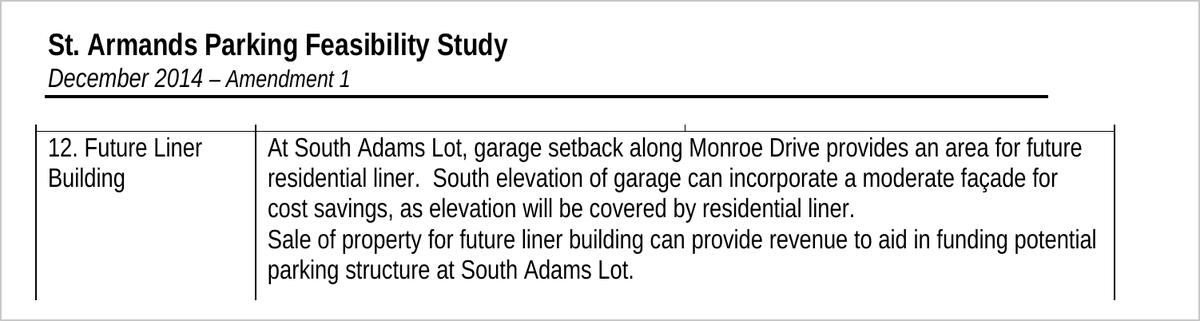
That phrase recurs. Every South lot option includes “potential future liner space” along Monroe Drive. The December 2014 amendment goes further: at the South lot, a garage setback “provides an area for future residential liner,” and “sale of property for future liner building can provide revenue to aid in funding potential parking structure.”
Following public workshops, the BID, the merchants and the residents chose the North lot instead, and the fire department signed off on it. The consultant’s preferred site stayed a surface lot. And then, a few years after the garage opened, the developers came for it anyway. Gavin Meshad, who with the BID had lobbied for the garage and the paid-parking program, made an unsolicited offer to buy the Fillmore lot for a hotel and gourmet market. The commission opened a 90-day window; five proposals came in, one of them from Shore’s Tom Leonard, offering to reimburse the city about $50,000 a year for lost bond revenue and asking that Fillmore Drive be renamed Shore Drive.
The commission said no, 4-1, with Liz Alpert dissenting. City Attorney Robert Fournier explained why: the bonds were “predicated on the existence of the parking spaces,” the Fillmore lot’s revenue was pledged to repay them, and no proposal replaced the parking it would erase. “Bad timing is the crux of it,” he said, noting the bonds could be refinanced in 2027.
The idea of building private development on top of public parking was not imported by developers. It was in the feasibility study.
The Trigger That Never Tripped
Kimley-Horn recommended one garage, not two, and set a condition for the second: “upon full utilization of the initial structure, a second parking structure should be considered.” The 2014 amendment priced the two-garage alternative the public kept asking about and found it 87 percent more expensive per project than the single North lot option, which settled the matter.
The trigger has never tripped. By the city’s own revenue figures and Searchlight’s photographs of empty rows in summer, the garage has never approached full utilization. Under the study’s logic, the Fillmore lot should still be waiting quietly for a demand that has not materialized. Instead, the surplus the garage created became the argument for selling the lot, and now, in Katherine Hermes’ proposal circulating among commissioners, for selling the garage itself.
That is the inversion at the center of this story. In 2014 the district was short of parking and needed a garage. In 2026 the district has so much parking that the garage should be sold. Both propositions cannot be true, and the space between them is where $1.64 million in general fund money went.
The Bond That Became a Shield
For all the trouble it has caused, the bond has done one thing residents did not anticipate: it has protected the public parking supply from the people who paid for it.
The Fillmore sale died on the covenant. In July, when Kimley-Horn’s Bill Waddill and Dominic Pardue, representing Kauffman Shore Properties, told the city that “coordination has been conducted” about buying eight garage spaces to satisfy Shore’s own parking requirement, Chief Planner Briana Dobbs answered that purchase “is not allowed and would be in violation of the parking bond,” and that a lease approved by the commission would be “the only potential option.”
The same firm that sized the public garage in 2014 is now on the other side of the counter, asking to lean on it for a private project. There is nothing improper in that; Kimley-Horn is a large firm with many clients. But it does illustrate how the garage has functioned in practice. It was justified as relief for a public shortage. It has been reached for, twice, as a private amenity. The covenant is the only thing that has said no, and it says no only as long as the debt exists.
Which brings us to the idea that has been circulating among commissioners since last week.
Sell the Garage?
On Aug. 21, Hermes, the downtown wellness practitioner whose empty-Main-Street video became the emblem of the summer revolt, sent all five commissioners and Planning Director Steve Cover a memo built from the Aug. 12 community meeting. Commissioner Jen Ahearn-Koch replied within hours, copied the city manager, and asked to meet before the Aug. 31 workshop. The memo said many of its ideas would be presented to the Parking Division in three-minute segments on Monday night. The division took written questions instead, which is why Hermes was on Facebook Tuesday morning saying the tail is wagging the dog, and why her memo remains the fullest version of the proposal anyone has been allowed to make.
Hermes’ proposal has three parts. Keep on-street parking under city control but move enforcement into the Police Department using civilian staff and eliminate the standalone Parking Division, which she describes as the norm for Florida cities under 60,000 residents. Put the Palm Avenue and State Street garages out to bid for private management or lease. And, when the St. Armands bonds become callable on Oct. 1, 2027, obtain an independent valuation and competitive bids for the sale of the St. Armands garage, “with the goal of using the proceeds to retire the outstanding debt.”
Her arithmetic: the 2017 issuance was $13.595 million, it matures in 2038, a sale of $12 million “would likely retire the debt,” and $15 million or more “would leave excess.” She names the kinds of buyers, parking operators, infrastructure funds and parking-focused real estate investors, and notes that such buyers typically hire the existing city employees. She also puts the Parking Division’s cost at $4.5 million a year and its cost per space at about $1,300, against a national average she cites of $470 to $520. Kimley-Horn’s own 2014 model assumed $675 a space for staffing and operations.
On the underlying diagnosis, she and the study agree: the garage’s debt is the anvil, and the paid-parking regime exists to service it. Searchlight found that 91 percent of the division’s $1.64 million debt to the general fund sits in the St. Armands fund, that the city still owes at least $12.1 million on the project, that debt payments run about $1.1 million a year through 2038, and that even with the merchants’ roughly $275,000 annual assessment the city comes up about $628,000 short each year.
But the cure deserves the same scrutiny the disease never got.
A garage grossing roughly $212,000 a year is not a $12 million asset on the income it produces. A private buyer paying that much would need to either charge far more than the city has been willing to charge, on a Circle whose merchants just told the commission they have “hit our limit,” or value something other than parking revenue: the land, the air rights, the entitlements, the ability to sell or lease spaces to neighboring projects. Once the bonds are retired, the covenant that stopped the Fillmore sale and blocked the Shore purchase is gone. The garage would be private property, and the reach residents have watched for a decade would have nothing left to bump against.
That is not an argument against Hermes’ broader proposal, much of which is a sober audit of a division that has grown from $3.7 million to a proposed $6.7 million without adding a space. It is an argument that the commission should notice the shape of the thing. The garage was sold to the public on a shortage. It would be sold to a buyer on a surplus. And the same handful of interests that wanted it built, wanted the Fillmore lot beneath it, and want spaces inside it, would be the natural bidders.
What Kimley-Horn Got Right
It would be easy, and unfair, to hang all of this on the consultant.
The study told the city the financing section was not a feasibility analysis. It told the city the garage would lose money. It told the city paid on-street parking was a prerequisite. It recommended one structure, not two, and told the city to wait for full utilization before building more. It offered $208,000 in fixes that would have added 30 spaces and untangled the valet. It warned that “a future traffic impact analysis would determine the peak hour volumes,” an analysis it did not perform and, as far as the public record shows, no one did. It even recommended that once a garage existed, the city consider removing on-street parking from the Circle itself to improve circulation and make the park visible again, advice that would have reduced the very meter revenue the bond needed.
Kimley-Horn also flagged, in December 2014, that placing garages on both lots would displace 375 surface spaces during construction and require shuttle service from downtown or Lido. The city built one and displaced about 190. That was the consultant’s advice, and it was sound.
What the study did not do is resist the frame it was handed. The 2013 Strategic Plan directed staff “to assist the community of St. Armand’s in identifying future parking needs and potential funding sources for a public parking structure.” The structure was the premise, not the conclusion. A consultant hired to find funding for a garage found funding for a garage, and put the warnings in the appendix, where warnings go.
The Residents’ Ledger
Tally who has paid.
The residents of St. Armands and Lido got the traffic, the meters and eleven years of construction and signage on their only road out, and are now being asked to fund, through a separate assessment district, the undergrounding the 2015 request said the garage bond would cover between Coon Key and Washington Drive. The medians got done. The rest of the island is a new $8 million program.
The Circle’s merchants pay roughly $275,000 a year for a garage many of their customers do not use, and the Business Improvement District that demanded it could not muster the votes to renew itself. It dissolved on Sept. 30, 2023, with Tom Leonard as its final chairman, leaving the assessment behind and the lobbying to individual owners.
Downtown’s shopkeepers, three miles from the garage, inherited the metered-street regime the garage required and, this summer, the extended hours and higher fines the division proposed to close a gap that is 91 percent St. Armands. Darci Jacob’s revenue fell 40 percent. James Reese lost half his chair. Toy Lab closes at the end of the month.
The city’s general fund has advanced more than $1.2 million and is owed $1.64 million. The division’s proposed budget leans on $2.2 million in tickets, 33 percent of its revenue, against the 8 percent Kirk Voelker found in comparable cities.
And the garage’s chief architect within the city, Broxton Harvey, resigned three days after the July 6 meeting and told the commission in his letter that he was leaving the division “in what I believe is a great position.”
The people who did well are easier to count. The property owners who got a $15 million public amenity behind their buildings. The developers who have twice tried to use it. The consultant, which has been paid on both ends. And the commission of 2016 and 2017, four of whose five members have since left office, leaving Alpert, who told Searchlight she would vote the same way again.
Questions Worth Asking on Aug. 31
Monday’s written questions went into a box, and the Aug. 31 workshop will not take public comment. Here are a few questions the Parking Division should be able to answer at the workshop anyway, since the answers are in its own files.
What was the actual peak-season occupancy of the St. Armands district in 2013, and what was it in 2023, before the storms? If the district was 99 percent full before the garage and the garage sits half empty in season now, what happened to the 320 spaces of projected demand?
Who converted Kimley-Horn’s sample spreadsheet into a $751,000 revenue projection, and did anyone brief the commission that the same spreadsheet showed a $9 million ten-year loss?
Why did the city set the garage rate to zero for the first two hours from 2021 to 2025 while telling the public the rate changes were required by the bond?
What is the current outstanding principal, what is the call provision on Oct. 1, 2027, and what would refinancing at today’s rates do to the annual payment, before anyone talks about selling?
If the garage is sold and the bonds retired, what legal instrument, if any, prevents the buyer from selling or leasing spaces to adjacent developments, and who drafts it?
And the question that has hung over this file since 2014, written by city staff and never answered: is parking revenue on St. Armands “a reliable and stable revenue stream to be pledged to repay the debt service on the bonds issued”?
Eleven years and $1.64 million later, the answer appears to be no. Monday night the public came ready to say as much and was handed comment cards. The question for next Monday is whether the city will finally say so, or whether it will hand the problem to the next consultant.
Timeline: From Study to Standoff
2008 — Heidt & Associates master plan counts 1,050 spaces; estimates a 34-space peak-weekend deficit and 287-space event deficit.
2013 — City’s Strategic Plan directs staff to help St. Armands identify “funding sources for a public parking structure.” Walker Parking Consultants counts 1,135 spaces, 99 percent full at peak; discounts supply to 990 “effective” spaces; projects a 165-to-320-space deficit over three to seven years. Kimley-Horn retained in October; observes the district Nov. 8-9 during the St. Armands Art Festival.
June 2014 — Kimley-Horn Final Report. Targets a 400-to-500-space garage. Sample projection: $751,000 revenue, $859,000 annual loss. Financing section “should not be considered as a financial feasibility analysis.”
December 2014 — Amendment 1 prices dual garages at $14.9 million versus $7.96 million for a single North lot structure; notes South lot land could be sold for a “residential liner.”
April-June 2015 — Findings presented to the commission; staff carry Option 2 forward at “approximately 11.5 million dollars.” Staff flag that parking revenue is unproven and recommend a special assessment as “a more secure method of financing.”
2016-2017 — Commission approves the garage; votes 3-2 to authorize $17.5 million in bonds covering the garage, median undergrounding, signage and end caps.
May 2018 — Groundbreaking at 47 N. Adams Drive.
Feb. 12, 2019 — Garage opens with 484 spaces plus 23 surface spaces; on-street paid parking begins the same day at up to $1.50 an hour; garage charges 50 cents.
2020-2022 — BID’s “Vision 2026” seeks 45-foot heights and hotels at 150 units per acre. Meshad proposes buying the Fillmore lot; five proposals follow; commission rejects them 4-1 on bond-covenant grounds. Commission rejects BID zoning study 5-0 in November 2022.
October 2021 — Garage goes to first two hours free; on-street set at uniform $1.50; city says changes are “necessary to meet requirements tied to the revenue bonds.”
Sept. 30, 2023 — BID fails renewal and dissolves.
2024 — Helene and Milton. No St. Armands parking collections from Oct. 1 to Jan. 2, 2025.
June 2025 — Gates removed; garage goes to first hour free.
Sept. 2025 — Commission approves $400,000 general fund loan for St. Armands debt service.
Dec. 2025-July 2026 — Shore files for 24 and 28 N. Boulevard of the Presidents; staff say buying garage spaces would violate the parking bond.
May 18, 2026 — Commission votes to extend paid hours to 8 a.m.-midnight, add Sundays and raise fines, effective June 29.
July 2026 — Merchant revolt; Parking GM Broxton Harvey resigns July 9.
Aug. 3, 2026 — Commission suspends the extended hours 5-0; fines survive 3-2.
Aug. 21, 2026 — Hermes memo to commissioners proposes selling the garage when bonds become callable Oct. 1, 2027.
Aug. 24, 2026 — Parking Division open house: staff presentation, written questions only, no public speaking. Many attendees submit cards and walk out.
Aug. 31, 2026 — Commission parking workshop, 9 a.m. No public comment permitted.
Sept. 7, 2026 — First regular meeting at which the commission can act and the public can address it.
Oct. 1, 2027 — St. Armands bonds become callable.
2038 — Scheduled final maturity.
The Document
St. Armands Parking Feasibility Study, Kimley-Horn and Associates with Jonathan Parks Architect, Final Report June 2014, with Amendment 1 (December 2014), as attached to the City of Sarasota agenda request for June 1, 2015, Item VI.3. 93 pages. Key pages: the 320-space table (study p. 20), the financing disclaimer (p. 32), the sample revenue projection (p. 35), the dual-garage cost comparison (Amendment 1, p. 7). Read the Full Parking Study and Agenda Packet here.
This story has been updated to reflect accounts of the format of Monday night’s Parking Division open house.

