
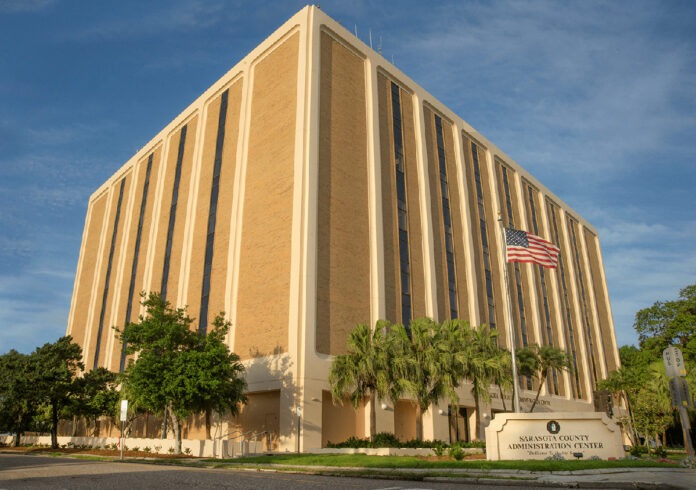
For 21 years a zoning line ran through the middle of the former Sarasota County Administration Building like a crack through a foundation. On Monday it took the Sarasota City Commission two hearings, 81 minutes and five unanimous votes, cast twice, to erase it.
—By 12:08 p.m. on Aug. 17, Benderson Development held everything it had asked for at 1660 Ringling Blvd. The comprehensive plan amendment moving one acre from Urban Edge to Downtown Core passed 5-0 at 11:38 a.m. The rezone from Downtown Edge to Downtown Core passed 5-0 exactly 30 minutes later. Mayor Debbie Trice, on Zoom because she was under the weather, congratulated Vice Mayor Kathy Kelley Ohlrich on “running an excellent meeting and having it end before lunch.”
—What did not happen is the story. No one filed for affected-party status. No one from Laurel Park, the neighborhood that packed a 2023 workshop and warned the developer its residents were “smart, passionate and loud,” walked to the podium. One resident came to endorse the project; one came with a question about traffic. Ohlrich noticed.
“We didn’t have anybody come up here and speak against this development project,” she said. “That’s sort of amazing, isn’t it? So it’s a lesson for all of us to keep in mind.”

—Voted Twice, on Purpose
—Ohlrich asked whether the two hearings could be combined. Deputy City Attorney John Shamsey said no. “The City Commission has far greater legal discretion in approving or not approving a comp plan amendment,” he said. “If you for some reason denied the comp plan amendment, your decision is more protected in a legal sense than if you deny a rezone.” So the legislative vote went first, alone. Once it passed, the quasi-judicial rezone was close to a formality.
—Built for Nine, Stopped at Six
—Philip DiMaria, the Kimley-Horn planner representing Benderson, explained how a six-story tower landed in a five-story zone. Before 2005 the site was zoned for 180 feet. The Duany code cut that, private owners sued, and Sarasota County, which owned the building, did not. “This is also the first time that we’re recognizing that the existing building exceeds the maximum zoned height for the site,” DiMaria said.
The building, “maybe one of the not so pleasant architecturally buildings downtown,” has strong bones. “The building was structurally designed for nine stories,” DiMaria said, which is why Benderson wants to keep it rather than raze it. He said a survey of downtown Class A office space using LoopNet and the AI assistant Claude found vacancy under 5 percent, and he read the commission a line from its own comprehensive plan: Downtown Core is meant to be 75 percent nonresidential. Todd Mathes of Benderson closed with a sentence built for the record. “What you have in front of us is our plan, period. That’s our entire plan.”
—The Neighbor Who Came to Say Yes
—Howard Davis of Architecture Sarasota, whose mid-century building abuts the site and hosted the 2023 charrette, called the split zoning “a mistake in the law that would be called a scrivener’s error.” “You deal with a lot of difficult issues,” he said. “I don’t think this is one of them.” The existing building “has not and will not win any architecture awards,” he added to laughter, and Benderson has cycled through architects in search of “transformative architecture” to turn “one of the ugly ducklings in Sarasota into a prize.”
—A Note in a Bottle
—Commissioner Jen Ahearn-Koch, who attended every charrette day, workshop and Planning Board hearing, came with conditions: a robust construction staging plan, enhancement of the small city park along Ringling (“By active, I don’t mean carousels. I mean pathways.”), sidewalk gaps on Rawls Avenue and Morrill Street filled, and one that carried the morning’s real weight.
—Benderson’s argument is that Downtown Core should face Downtown Core. “So once we extend that,” Ahearn-Koch said, “then the same argument can be made again to the next piece, which is DTE.” The 100-foot height step-down near Laurel Park’s RSM-9 zoning did not reassure her. “Always an exception made to the RSM 9. The zoning could change.”
“If you keep making exceptions as we step down, that buffer and transition gets less and less,” she said. “The decision I’m making is based on your commitment to transition and buffer. That’s a major consideration for me.”
—Mathes offered the ordinance preamble as the place to write it down. “That’s what we’re saying we’re doing, and we mean it.” Shamsey agreed on the spot to draft a whereas clause so “any future commission being asked to tweak something” can see the conversation. Ahearn-Koch knew what she was and was not getting: “I don’t think we can fine them.” City Manager Karie Friling, drily: “That’s something to be aware of.”
“It’s Sort of Shocking, Isn’t It?”
—Ohlrich read the traffic finding aloud: 427 net new trips in the evening peak hour, with no negative impact on level of service. “It’s sort of shocking, though, isn’t it? 427 new P.M. peak trips?”
“It is,” said Acting Assistant City Engineer Alex DavisShaw. Ringling “is actually one of our more free-flowing roadways. That’s one of the reasons we’re able to do the bike boulevard there, because we had additional capacity.” The spare capacity that justified the road diet is now, in part, spoken for.
—The Voice From the Q
—The lone concern came from Kimberly Colgate, an attorney and real estate broker who lives at the Q condominium on Morrill. “Morrill Street from Osprey up to Orange is a one-way street. It is very narrow, and human nature is human nature. The traffic is going to find the easiest way to get to the parking for the Benderson project.” She asked for a fresh look at the traffic report and a Do Not Enter sign at Pine Place and Morrill.
—Commissioner Liz Alpert objected to restricting any public right-of-way “unless the people who want it to be private want to take it over and maintain it.” Ahearn-Koch asked Benderson to reach out to Colgate. Mathes: “Absolutely.” He also argued the city’s peak-hour model misreads his tenants. “We are not going to be a 9-to-5 building, because that is not the reality of Class A office space today.”
—The Ten-Story Question at High Noon
—At 11:59 a.m. Ahearn-Koch asked city planner Camden Jenkins to explain the Planning Board’s proffer barring residential use. It applies, Jenkins confirmed, only to the footprint of the existing building. The parking lot west of it, inside the new Downtown Core line, is untouched.
“That other portion could be residential, and it could be ten stories,” Ahearn-Koch said.
“Yes,” Mathes said. Benderson had insisted the proffer stop at the building’s edge “because we don’t know what the future of that land where there is no building would be.” Not the intent today, he said. But the door is open, and the commission voted knowing it.
—A Skeptical Mayor Comes Around
“I usually have reservations about changes when we don’t have a site plan, and also a comprehensive plan amendment when we’re still waiting for the Downtown Master Plan revision,” Trice said. What overrode them was the room. “The silence from the very vocal Laurel Park neighborhood today confirms that they appear to be happy with the project as amended.” She called herself “skeptical of the demand for more office space post-COVID, but as expected, Benderson’s team did their homework,” and said Class A office “is certainly going to be an improvement over the current eyesore.”
—Ahearn-Koch, moving the amendment, said, “This is a rare occasion for me to make such a motion for a land use change. It is the biggest decision we make.” Benderson’s handling of Laurel Park “wasn’t avoided. It wasn’t worked around. It wasn’t hidden. It wasn’t sugar coated.” Commissioner Kyle Scott Battie said the company “did a tremendous job.” Alpert: “Ditto.”
—What Sarasota Just Decided
—Monday settled the question the late County Commissioner Nancy Detert raised in 2021 when she predicted the buyer of the $25 million building would reap far more once it was rezoned. The rezoning is done. The county was not in the room.
—It settled that downtown’s most conspicuous vacant building goes up, not down, at a moment when the city is fighting demolitions elsewhere. It settled that Ahearn-Koch’s buffer lives in a whereas clause rather than a covenant. And it settled that the public’s binding say is over: the site plan, staging, parking and the tower’s design will all be approved by staff.
—What it did not settle is what it never has: the lots across Morrill Street, and the western lot inside the new line where ten residential stories are now legally possible. Laurel Park stayed home because the request stopped at one acre. That silence was a form of trust. Benderson now holds it, along with the zoning.
—What’s Next
—The comp plan amendment, a small-scale amendment adopted in a single reading, takes effect 31 days after adoption unless challenged. The rezone ordinance is expected to return for second reading with the new whereas clause and the sidewalk proffer folded in. From there Benderson moves to an administrative site plan, a circulation-focused traffic study and permits. The commission’s next look at this block comes only if Benderson asks to change what it agreed to Monday. On the evidence of the last three years, the company has learned exactly how to ask.

