
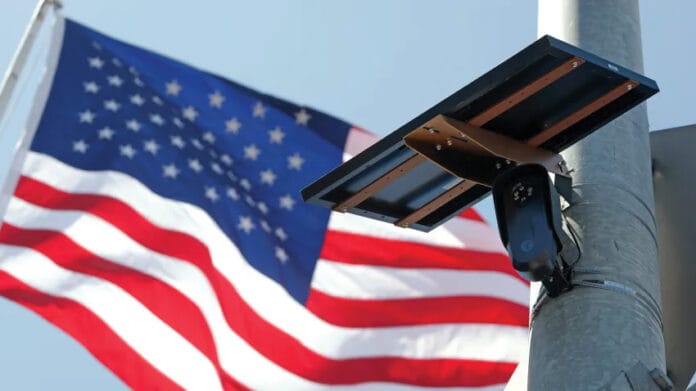
On Monday afternoon, Police Chief Russ Mager will stand before a new town manager, a returning commission and a town filling up for season to explain, for the first time in 13 years, the cameras that photograph every vehicle that crosses onto Longboat Key. His numbers are striking: 89,969 cars captured in a single month, and ten searches. What the PowerPoint cannot settle is the question now running through Tallahassee, Sarasota and every town in America wired for ambient surveillance: not whether the cameras work, but what they are quietly making of us.
—At 1 p.m. Monday, in the commission chambers at 501 Bay Isles Road, the Town of Longboat Key will do something it has not done in the 13 years it has been photographing every car that enters and leaves the island. It will lay the whole apparatus on the table, in public, and talk about it.
—Item 4A on the Town Commission’s Regular Workshop agenda is titled, simply, “Discussion of Flock Cameras.” The recommended action is listed as “None, informational only.” There will be no vote, no ordinance, no motion. And yet the item may be the most consequential conversation of the young season, because it arrives at the precise moment when the technology’s biggest champion, its biggest skeptic and its biggest cautionary tale are all standing in the same room of Florida public life.
—Chief Mager and Capt. Bob Bourque will deliver the presentation, which was originally set for Sept. 28 and pushed to Monday. In the audience, in the center seat of the staff table, will be George Landry, the town’s new manager, inheriting a surveillance program older than most smartphones in the room. On the dais, Mayor Debra Williams and a commission freshly returned for the season. And in the chamber and on the live stream, residents who have spent the fall watching the state of Florida, the City of Sarasota and their own town government each answer the same question three different ways.
—Thirteen Years of Watching, One Month of Numbers
—The chief’s memo to Landry is unapologetic about the program’s pedigree. The license plate readers, contracted through Flock by way of Vetted Security Solutions, “are not a new concept to our Town,” Mager writes. The department has been “utilizing their benefits for approximately 13 years,” and the cameras have “played an instrumental role in keeping the Town safe.”
—Then comes the slide that will define Monday’s discussion, and it cuts in two directions at once.
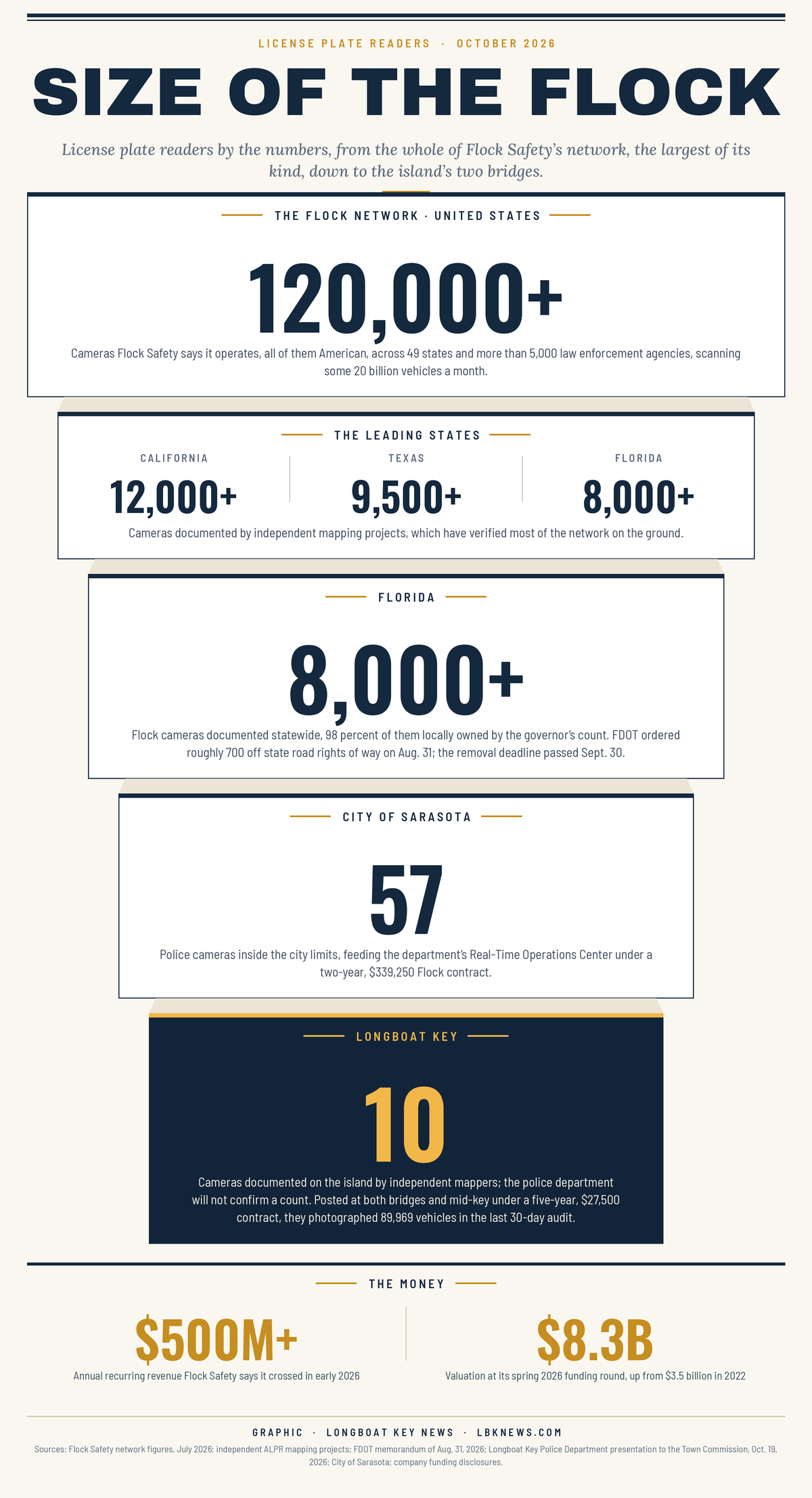
—Between Aug. 18 and Sept. 17 of this year, the cameras logged 89,969 license plate reads, with each vehicle counted only once no matter how many times it crossed the bridges. Out of those nearly 90,000 vehicles, department staff ran exactly ten searches:
- —Four by Capt. Bourque for Flock traffic-count purposes
- —One by Capt. Bourque for system testing
- —Two by Detective Ramsaier on a Sarasota Police grand theft BOLO
- —Two by Officer Castro seeking a suspect who fled a traffic stop
- —One by Sgt. Mathis searching for a hit-and-run vehicle
—Read one way, that is a portrait of extraordinary restraint: half the searches were administrative, and the other half were textbook police work. One search for every 9,000 vehicles photographed. Read the other way, it is a portrait of extraordinary reach: a town of roughly 7,000 year-round residents generated a searchable archive of nearly 90,000 vehicles in 30 days, nearly all of them belonging to people suspected of nothing, logged simply for driving to the beach, the pharmacy or home.
—The search is rare. The capture is total. Both facts are true, and Monday’s debate lives in the space between them.
—What the Cameras Swear They Are Not
—The presentation goes to considerable lengths to fence off the nightmares. A footnote on the title slide declares that use “is proposed as a vehicle-intelligence tool, not automated traffic enforcement or facial recognition,” a curious choice of the word “proposed” for a program entering its second decade.
—The slides itemize what the system stores: plate and vehicle images, plate number and state, make, color and body type, date, time and camera location, hot-list alerts, and audit metadata recording who searched, when and why. They itemize with equal care what it does not: no facial recognition, no biometrics, no driver identity, no DMV owner name attached to the captured data, no search fields for race, gender or any human characteristic.
—Retention is 30 days, after which the images roll off, unless tied to a criminal case, a litigation hold or a public records request. Access requires individual accounts and multi-factor authentication. Shared credentials are banned. Departing employees are cut off immediately.
—Even here, though, the department’s own fine print leaves a door ajar. The sourcing line at the bottom of the retention slide concedes that “final retention settings should be validated against Florida law and Town records practices.” In other words: thirteen years in, the validation is still listed as homework.
—The Memo’s Other List
—There is a quieter tension inside the chief’s own memorandum, and it goes to the heart of what residents have been asking all fall, which is not whether the cameras catch criminals but what else they catch along the way.
—The memo describes the readers as a tool against stolen vehicles, outstanding warrants and missing persons. But it also lists, in the same breath, “a suspended driver’s license, unregistered/expired license plates, no insurance” among the matters the system flags. The PowerPoint insists this is not automated traffic enforcement. The memo enumerates traffic-adjacent offenses as part of the mission.
—That distinction is not pedantry. It is the difference between a camera network that waits silently for the rare violent felon foolish enough to drive onto a two-bridge island, and one that converts a community policing agency into a paperwork checkpoint, pinging officers about expired tags on an island where the gravest threat most afternoons is the afternoon sun. Which one Longboat actually operates is a question the commission can ask Monday with a single request: of the alerts officers acted on this year, how many were felons and stolen cars, and how many were lapsed registrations?
—The Pickup Truck That Proves Every Point at Once
—Buried in the back half of the slide deck is the most revealing artifact Monday’s audience will see, and it was created by the department itself.
—To illustrate how a search works, Capt. Bourque ran a real query in September. The offense type he entered was “City Planning/Traffic Analysis.” The reason: “For presentation for Town Commission.” The result, printed across three Flock “Investigative Summary” reports and a regional map, follows a single black Chevrolet pickup through an ordinary 39 minutes of its owner’s life.
—At 4:05 p.m. on Sept. 17, the town’s camera at 7110 Gulf of Mexico Drive photographs the truck northbound. At 4:18 p.m., a Manatee County Sheriff’s Office camera catches it at Cortez Road and 75th Street West. At 4:44 p.m., another Manatee County camera logs it near 44th Avenue and I-75 in Bradenton. Three detections, two counties, two agencies’ camera networks, one login, one map with three red pins tracing the route.
—Nobody did anything wrong here, least of all the truck’s owner, who was presumably just driving home. That is precisely the point. The slide intended to demonstrate the system’s accountability simultaneously demonstrates its reach: any authorized officer, with a few keystrokes and a stated reason, can reconstruct the movements of any vehicle across a regional web of cameras that no single government fully controls. The demonstration of oversight is also a demonstration of the thing that needs overseeing.
—Five Cases, and a Barrier Island’s Perfect Geometry
—The chief will close with the argument that has carried this program for 13 years: it works, and on Longboat Key it works unusually well, because an island with two bridges is the ideal habitat for a machine that reads plates.
—The presentation offers five cases. In April 2019, the cameras placed suspects on the island during a single-night, three-residence burglary spree that netted more than $500,000 in valuables, leading to the arrest of a professional burglary crew working nationwide. In June 2020, a business burglar smashed a front door and was in and out of town within five minutes; the cameras tracked the car to an arrest in Sarasota. In November 2021, roughly $100,000 in art walked out of a home, and the cameras followed the vehicle until the Manatee County Sheriff’s Office helped locate a subject who confessed, with $27,158 in items recovered. In December 2025, a man who drove from Southeast Florida to strip GPS units off dry-docked boats was tracked from Broward County to Longboat and arrested across multiple jurisdictions. And in February 2025, a $100,000 fraud scheme unraveled when the cameras caught a rental car traveling from Orlando to Longboat just before the crime and leaving just after; the suspect was ultimately arrested in Novi, Michigan, on five warrants from five states.
—These are not hypotheticals, and the officers who built those cases deserve the credit the slides give them. The honest version of Monday’s debate does not pretend the tool is useless. It asks what the tool costs, and who is keeping the receipt.

—The Rules on Paper, and the Officer Across the Bay
—The department’s answer is General Order 9011, “Automated License Plate Recognition Systems,” effective April 2023 and revised in August 2025, backed by accreditation standard 32.04. The presentation promises monthly reviews of all search logs and user access, annual policy reviews, and focused audits after any complaint. The prohibited-conduct slide bans “personal curiosity searches on family, friends, coworkers, neighbors, or public figures,” false or vague search reasons, unauthorized sharing, and treating an alert alone as grounds for enforcement. Violations carry discipline “up to and including termination and/or arrest.” Every search is logged to an individual user. “Unauthorized or personal searches,” the deck states in bold, “are strictly prohibited.”
—It is a serious framework, and the 10-search month suggests a department that takes it seriously. But every agency in America running these cameras has a version of that slide, and one of them sits eleven miles away.
—Across the bay, a former Sarasota police officer was arrested and fired in August and now faces felony charges of official misconduct after investigators say he used that city’s Flock system to search a single license plate 358 times over five months, 121 of them in one day, according to the probable cause affidavit. He has not been convicted. The detail that has rattled Sarasota is not the alleged conduct but the discovery: the department’s audit system did not catch it. A journalist examining public records did, and the department has said it learned of the allegations only when the reporter called.
—When Sarasota residents filled their commission chambers on Oct. 5 demanding written safeguards, retention limits and a public vote, the answer from City Hall was a planned open house and, in the city manager’s words, assurance that “we have checked those boxes,” followed by the franker admission that with “less bodies that we can put on the street,” the technology stays because the city cannot afford the officers it stands in for. One speaker’s reply has traveled well beyond that room: without enforceable rules, “we just have trust. And trust isn’t a safeguard.”
—That is the cloud Chief Mager will present beneath, through no fault of his own department. The lesson of Sarasota is not that Longboat’s officers will misbehave. It is that an audit log is a receipt, not a shield: it records the misuse faithfully and files it, and somebody still has to go looking.
—Tallahassee Flinched. Longboat Stepped Onto the Grass.
—The other presence in the room Monday will be the State of Florida, which has lately become the loudest plate-reader skeptic in the country.
—On Aug. 31, the Florida Department of Transportation revoked every approval for license plate readers on state road rights of way, citing “misuse, data privacy concerns, and surveillance schemes,” and gave local governments 30 days to take them down. Gov. Ron DeSantis, a man never once accused of being soft on law enforcement, declared that Florida must not become a “digital surveillance state.” Some agencies suspended their programs outright. The deadline passed Sept. 30.
—Longboat’s answer, as this newspaper has reported, was not to take its cameras down but to take them sideways: off the state right of way along Gulf of Mexico Drive and onto adjacent town ground, still aimed at the same road, still feeding the same database. The state said not on our road. The town stepped three feet to the left.
—Monday is the commission’s first full opportunity to say, in the sunshine, whether that answer honors the spirit of the state’s order or merely survives its lettering, and whether a program of this reach should rest on a general order the department can revise itself, or on something the public actually votes on.
—The Record Being Set
—Strip away the vendor logos and the workshop item becomes something larger than Longboat Key, which is why it deserves a full chamber. Every community in America is conducting this same negotiation right now, usually without noticing: trading the oldest and least-written-down of American freedoms, the freedom to move through your own life unremarked and unindexed, for a security apparatus that is genuinely useful, genuinely well-intentioned and genuinely incapable of forgetting.
—The cameras on the bridges do not know your name, and the department is at pains to say so. But they know your car, your comings, your goings, your patterns and your deviations, and they hold them for 30 days in a database one login away from agencies you have never heard of, in a network whose reach the department’s own demonstration slide maps in red pins across two counties. Nothing about that requires bad faith to be worth worrying about. It only requires humans, time and a tool that never blinks.
—On Monday, for the first time in 13 years, the whole bargain will be sitting on a screen in the commission chambers, itemized, footnoted and open for questions. No vote is scheduled. The recommended action is “none.” But the record of what Longboat Key decided to accept, and what it decided to demand, starts being written at 1 p.m.
—The workshop will be live-streamed on the town’s website.

