
The storefronts are dark, the tenants are gone and the borrowing is approved. But a notice of default, a seller who says nothing is wrong, and an easement the Army Corps of Engineers refuses to release have left Sarasota County’s marquee waterfront purchase in limbo more than three months past its closing date.
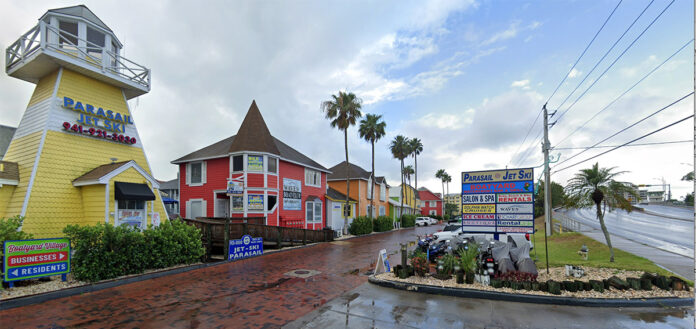
—For four decades, the Boatyard’s jumble of red, yellow and blue buildings told every driver crossing Stickney Point Road that they had arrived at Siesta Key. The faux fishing village at 1500 Stickney Point Road was a working waterfront in miniature: a bar and grill on the water, parasail boats and wave runners at the dock, scooters lined up for rent, a salon, boutiques, a lighthouse rising over Little Sarasota Bay.
—Today it is a ghost town.
—The businesses were cleared out this spring to make way for Sarasota County’s $18.1 million purchase of the 2.04-acre site, the opening move in a public waterfront park project the county has authorized up to $20.77 million in borrowing to pull off. The tenants are gone. The money is lined up. The vision has been presented in color renderings.
—And the county still does not own the property.
—Instead, the deal sits in a legal gray zone that county staff warned could kill it outright. In mid-September, the Office of the County Attorney sent the seller, an entity controlled by prolific Sarasota investor and restaurateur Chris Brown, a formal notice of default over unresolved defects in the property’s title. Staff told County Administrator Jonathan Lewis in writing that if the seller did not sign a written agreement to fix the problems within 10 days, they would recommend terminating the contract.
—That deadline has come and gone. The county says it is still working with the seller. Brown says the issues are minor. No closing has been announced. No termination has been announced. And the most visible commercial corner on the road to Siesta Key sits emptied, hurricane-scarred and frozen, waiting to find out who actually owns its future.
—A deal in default territory
—The trouble surfaced publicly through a Sept. 14 memo from Shawn Yeager, the county’s director of parks, recreation and natural resources, to Lewis. During due diligence, staff discovered problems with the title, including unresolved easement issues involving a neighboring condominium association and a federal right of way along Little Sarasota Bay.
—The county had made clean title a condition of the purchase from the start. When commissioners approved the contract in February, the county attorney’s office explained the standard playbook: the seller clears out the tenants, the seller cures any title problems, and the county takes possession of a clean, empty property.
—Seven months later, that playbook had broken down badly enough that the county attorney’s office sent Big Main Street LLC, the Brown-controlled entity that owns the site, a notice of default the same day Yeager’s memo was written. The letter and memo made clear the county did not want to walk away from the deal, but both documents carried the same bottom line: no written cure agreement within 10 days, and staff would recommend pulling the plug.
—Closing had originally been targeted for July 10. The deal is now more than three months past that mark.
—Two clouds on the title
—The first defect involves the property’s next-door neighbor, the Boatyard Condominium Association, the gated 21-unit residential community that shares the Stickney Point waterfront. The association holds rights to use and maintain water, sewer, drainage, utility and lift station infrastructure physically located on the commercial property the county is buying.
—That issue first emerged in May. The county gave Brown and Big Main 15 days to resolve it, then a 30-day extension, then another extension to Aug. 8. The county attorney’s office worked through the summer with the sellers, their lawyers and the condominium association, and the September memo described substantial progress on the access and utility questions. But as of the default notice, no final resolution had been reached.
—The second defect is the one with no easy fix.
—The easement the Army Corps won’t release
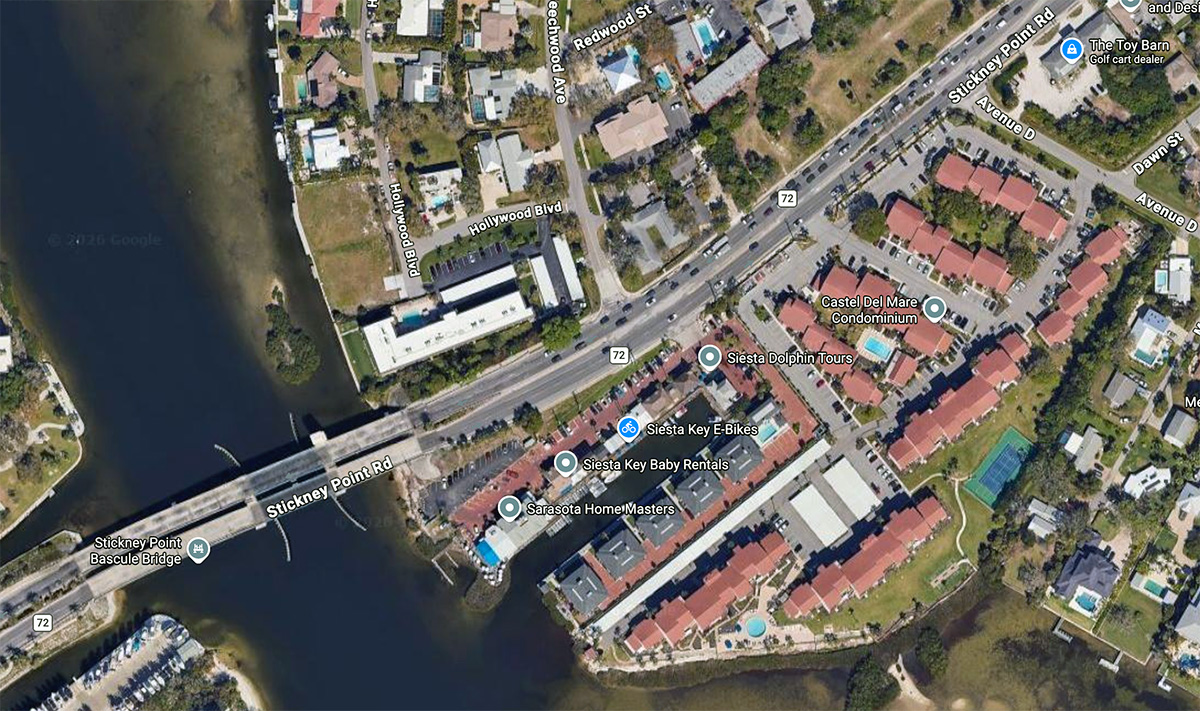
—The western parcel of the property, the piece that fronts directly on Little Sarasota Bay, is burdened by a canal right-of-way easement held by the federal government. The county has been in talks with the West Coast Inland Navigation District and the U.S. Army Corps of Engineers, and the answer that came back was blunt: the Corps is not willing, and may not even be able, to quash or release the easement.
—The Corps offered the county two paths instead, neither of them quick.
—The county could formally apply to have the Corps dispose of or exchange the right of way. That process could take up to five years, could require the county to pay fair market value for the parcel, and could simply be denied at the end.
—Or the county could ask the Corps to approve temporary structures on the easement, such as docks and picnic shelters. That approval process is estimated at one to two years, and it would mean the signature waterfront improvements the county has promised on that parcel, from boat slips to fishing access, would start life as revocable, temporary installations on federal right of way.
—Then came the detail that reframes the entire property. According to the September memo, the Army Corps’ attorney has told county officials that the existing structures sitting on the easement are, in the federal government’s view, unpermitted and unauthorized encroachments.
—Read that again. The colorful village that has defined the entrance to Siesta Key since 1983, the buildings two appraisers valued as part of an $18.1 million asset, includes construction the federal government considers illegal encroachment on its own right of way.
—The seller shrugs
—Brown’s position, relayed through the memo and in his own comments to the Business Observer, is that none of this is the seller’s problem.
—According to the memo, Big Main has taken the stance that the federal right-of-way easement does not constitute a title defect the seller is obligated to cure at all. In the seller’s view, the county should close on the property first and deal with the Army Corps later, as a routine development matter.
—Reached by the Business Observer in late September, Brown downplayed the standoff, describing the problems as “relatively minor issues” for a county that has bought plenty of complicated properties, and saying nothing in the overlapping access agreements is insurmountable. Large transactions, he said, have a lot of moving parts.
—The county’s public posture has been notably quieter. A county spokesperson said in late September that staff and the county attorney’s office were working collaboratively with the seller on the title defects and that no additional action had been taken. The spokesperson would not say how long any extension runs. Neither Lewis nor Yeager responded to the Business Observer’s requests for comment.
—So the public record, as it stands, shows a default notice, an expired 10-day window, a staff recommendation to terminate if no agreement was signed, and then official silence.
—From $8.9 million to $18.1 million in two years
—Hanging over all of it is the arithmetic that made this deal controversial before the first title problem ever surfaced.
—Brown bought the Boatyard in January 2024 for $8.9 million. He is one of the best-known operators on Siesta Key: co-founder of the Above the Bar Hospitality Group, whose holdings have included Summer House, The Cottage, The Hub Baja Grill and The Beach Club in Siesta Village, plus Mad Moe’s in Osprey and a portfolio of downtown Sarasota real estate including the 1700 block of Main Street. When he closed on the Boatyard, Brown talked publicly about upgrading the complex for its existing tenants, calling it an iconic property of the kind that comes available once in decades.
—Two years later, almost to the month, the county agreed to pay him $18.1 million for it, more than double his purchase price, for a property whose docks and structures had meanwhile been battered by Hurricanes Helene and Milton in 2024.
—The county points to two appraisals, one at $14 million and one at $18.1 million. Critics point out the county agreed to pay the higher of the two, for buildings its own commissioners expect to tear down.
—Commissioner Tom Knight has been the deal’s consistent dissenter, casting the lone no vote both on the February purchase and on the May borrowing authorization. His objections have been straightforward: the price is too high, the demolition and operating costs are unknown, and the purchase drains the county’s land acquisition fund at a moment when the program’s own future is uncertain.
—“I just don’t think it’s an appropriate purchase for the price that’s being put together,” Knight said in May, promising to keep voting no.
—The vision: a public front door to the water
—None of the controversy means the underlying idea lacks appeal. Public access to the water in Sarasota County is genuinely scarce, and commissioners across the board have described the site as a gem.
—The property includes roughly 700 feet of bay frontage, 390 feet of canal and boat basin access, more than 5,000 square feet of docks, boardwalks and decks, and 72 parking spaces across 21 commercial condominium parcels. The county’s concept calls for open space, picnic areas, shade structures, restrooms, canoe and kayak launches, fishing access, room for mobile food vendors and 30 to 40 boat slips. Staff has ruled out a full-scale restaurant, a playground and a motorized boat ramp, and has promised public input meetings before any final plan comes back to the board.
—Just as important to the board’s majority, the site is meant to become the home port for the county’s new charter boat medallion program, the permit system commissioners approved in January to bring order to the charter captains operating out of county parks. Commissioner Mark Smith called the Boatyard the perfect location for that operation and framed the purchase as a way to open the water to as many six-pack captains as possible. Commissioner Joe Neunder, acknowledging the tenant situation had been worrisome, argued public water access should benefit as many residents as possible.
—As for the buildings themselves, Neunder was candid at the May meeting about where the county’s planning is headed, saying what makes sense is starting with a clean piece of paper.
—Evicted into limbo
—For the businesses that made the Boatyard a destination, the clean piece of paper came at their expense, and it came whether or not the county ever closes.
—The purchase contract required all tenants out, with the seller given up to 150 additional days after approval to terminate leases and empty the property. By mid-May, the village had hollowed out. Florida Fun Rides, the scooter and transportation rental operation that spent nearly a decade serving the Siesta Key tourist corridor, relocated off the tourism path entirely. Owner Jeff Schermerhorn told Spectrum Bay News 9 that tenants received no relocation assistance and could not get anyone at the county to engage, and he questioned why a county already sitting on public waterfront kept buying more property with taxpayer money.
—Siesta Key Watersports, the last holdout, had operated parasailing, wave runner and boat rentals from the site for 20 years. The business asked commissioners repeatedly to let it stay and operate within the future park. The board’s answer, delivered by Smith, was that watersports rentals are not the target industry for the site. The company scattered its operations to Phillippi Creek, Venice and other locations in a tight waterfront market, with staff telling reporters in May they were playing it by ear.
—All of that displacement has already happened. If the deal now collapses over title defects, it will have happened for nothing.
—What happens if the deal dies
—That is the scenario that should concentrate minds on both sides, because the fallout would be lopsided.
—The county would walk away having spent months of staff and legal time, having authorized borrowing against a land program whose funding is up for renewal, and having presided over the eviction of a functioning commercial waterfront in exchange for nothing.
—Brown, by contrast, would keep a property he bought for $8.9 million, now conveniently emptied of long-term tenants, at the most visible commercial crossroads on the approach to Siesta Key. The site’s commercial intensive zoning is among the most permissive in the county, broad enough that real estate professionals have long noted it could accommodate condominiums or even a hotel. A terminated contract would leave the county’s most prominent would-be park site back in private hands, vacant, and primed for whatever comes next.
—And there is a final twist: if the Army Corps is right that structures on the western parcel are unauthorized encroachments on federal right of way, that cloud hangs over the property no matter who owns it. The county inherited the problem in due diligence. A future private redeveloper would inherit it at the permit counter.
—The referendum wildcard
—The timing could hardly be more delicate. The borrowing for the Boatyard, up to $20.77 million through the Florida Local Government Finance Commission’s pooled commercial paper program, is to be repaid by the ad valorem tax that funds the county’s Environmentally Sensitive Lands Protection and Neighborhood Parkland programs. That tax is scheduled to sunset in 2029 unless voters extend it, and the extension referendum is on the Nov. 3 general election ballot, now less than three weeks away.
—Knight flagged the connection back in February, warning that the Boatyard purchase could leave the land program unable to buy anything else if voters decline to extend it. Supporters of the referendum now face the awkward task of asking voters to renew a land-buying tax while the program’s single most expensive and most visible current acquisition sits publicly stuck in a title dispute, its storefronts dark at one of the busiest intersections in the county.
—A clean closing before Election Day would hand the program a showcase. A collapsed deal, or a lingering standoff, hands its critics a talking point with a waterfront view.
—What to watch
—Several questions will decide where this goes from here.
—Did Big Main sign the written cure agreement the county demanded, and on what timeline? The county’s late-September statements suggest negotiations continued past the 10-day deadline, but no agreement, extension or termination has been publicly announced.
—Will the deal be restructured around the federal easement? One possible off-ramp is a closing that carves out or discounts the western parcel, or that shifts the Army Corps risk to the county with a price adjustment, though any material change to an $18.1 million contract would almost certainly need to come back before the County Commission in public session.
—What does the county’s park plan look like if permanent structures on the bayfront parcel require a federal process that could run five years? The concept plan commissioners saw in May assumed boat slips, launches and fishing access on exactly the water frontage the Corps controls.
—And the longest-running question of all: at what point does the board majority that approved this purchase twice on 4-1 votes conclude that Knight’s warnings about price, costs and complications were not just contrarianism?
—For now, the lighthouse still stands over an empty village, the county still does not hold the deed, and the gateway to Siesta Key remains what it has been since spring: a $21 million question with no closing date.

