
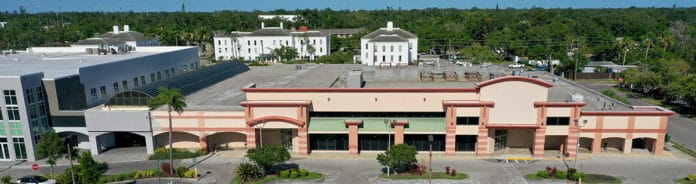
Five weeks after Arlington Park sank the Winn-Dixie redevelopment, the developer is back with the identical plan, a two-page legal argument and a demand for a do-over in front of a friendlier bench.
—When the Sarasota Planning Board killed the Midtown Plaza hotel in September, a 37-year resident named Flow Entler supplied the afternoon its most quoted line. Because the property’s zoning routes site plans around elected officials, she told the board, the decision was theirs alone. “The buck stops with you.”
—It turns out the buck has one more stop.
—On Monday morning at 9 a.m., the City Commission will take up Appeal Application 26-APP-08, the formal demand by Midtown Plaza’s owners that the commission overturn the Planning Board’s 3-2 denial and approve the project the board rejected: a six-story, 145-room hotel, a six-story, 91-unit apartment building, a parking garage and a sliver of retail on the grave of the Winn-Dixie that went dark in 2018 at U.S. 41 and Bahia Vista Street, directly across the Trail from Sarasota Memorial Hospital.
—The appeal, filed Sept. 16 by veteran development consultant Joel Freedman as agent for owner Midtown Associates LLP and principal Gavin Meshad, does not soften a single line of the plan. It does not move the East Avenue driveway the board hated, turn the buildings toward the street as the chair demanded, or relocate the trash compactor off the neighborhood’s corner. Instead, it argues the plan was right all along, the denial was improper, and the city’s own staff proved it.
—What Changed Since September? Nothing. That Is the Strategy.
—Read the 153-page appeal packet and the most striking thing is what is missing: a redesign. The drawings before the commission Monday are the same drawings, received by the city Sept. 2, that the Planning Board voted down a week later. The hotel still runs six stories and 65 feet along the Trail and Prospect Street. The apartments still carry 23 attainable units among their 91. The garage still anchors East Avenue. The Starbucks still stays.
—When the board denied the project Sept. 9, it practically dictated a punch list from the dais: face the buildings to the street, rethink the second driveway onto East Avenue, move the service functions away from the homes across Prospect. The appeal answers none of it, because the appeal’s entire theory is that the board had no legal business asking.
—The argument arrives in a two-page letter from Freedman to City Auditor and Clerk Shayla Griggs, and it is a document worth reading closely, because it frames the fight the commission must now referee. The Planning Board, Freedman writes, “improperly denied” the site plan despite being presented with “uncontradicted competent and substantial evidence and testimony” and a staff report finding the plan complies with every applicable section of the zoning code. The staff analysis, he writes, “established conclusively” that the project meets all seven standards for site plan review.
—Translated from the quasi-judicial dialect: the only evidence that legally counts was on our side, the neighbors’ objections do not rise to the level of evidence, and three board members substituted their personal taste for the code. The letter asks the commission to hear the matter fresh, grant the appeal, and approve the site plan subject to the same six conditions staff recommended in September, all of which, Freedman notes, are acceptable to his client.
—The filing came with a check for $2,763.91, the tiered fee plus escrow for an appeal. As second chances go, it is one of the cheaper line items in a project of this size.
—A Do-Over, Not a Review
—The most consequential words in the appeal may be two in Latin. Freedman asks the commission to hear the case “de novo,” meaning anew. The commission would not sit as an appellate court reviewing whether the Planning Board erred. It would re-try the site plan from scratch, with sworn testimony, exhibits and cross-examination, as if the September hearing never happened, and then do what the board did: grant the plan, grant it with conditions, or deny it.
—That is exactly what the zoning code contemplates. Under Section IV-505(a), an aggrieved person may appeal a Planning Board site plan decision within 10 days, and the commission “shall consider the appeal and grant, grant with conditions or deny the site plan request.” Freedman filed on day seven.
—The code puts one gate in front of the merits: the request to hear the appeal must be approved by a supermajority vote, which on Sarasota’s five-member commission means four votes. The hearing has been noticed and placed on Monday’s agenda as quasi-judicial item XI.2, so the threshold question and the appeal itself are poised to play out in the same chamber where this project was effectively conceived.
—For the neighbors, the format matters as much as the forum. Residents granted affected person status may present sworn witnesses, enter exhibits and cross-examine the applicant’s team, the same procedural arsenal the development team can turn on them. September’s hearing was a neighborhood telling its story. Monday’s could resemble a trial.
—City Hall Argues Against Its Own Board
—Here is the oddity at the center of Monday’s hearing: the City of Sarasota’s professional staff will stand closer to the developer’s table than to its own Planning Board.
—The agenda request prepared for the commission states the administration’s recommendation in one flat sentence, followed by another: “Staff recommends approval of the Site Plan subject to the conditions in the Staff Report. The Planning Board denied the Site Plan on a 3-2 vote.” Development Review Planner Camden Jenkins, who recommended approval in September, presents again Monday.
—The staff report in the appeal packet remains unamended and unrepentant. It finds the project consistent with the Commercial General District’s intent, compatible with the Sarasota City Plan’s Urban Mixed-Use vision for the corridor, and compliant on height, density, setbacks, glazing, parking, loading, trees and landscaping. The 65-foot buildings sit roughly 194 feet from the nearest single-family zoning, nearly double the required 100. Parking comes in at 264 spaces against 221 required. All three grand oaks stay.
—The city’s official summary of why the board said no is almost anthropological in its brevity: discussion “focused around traffic, parking, street activation, the array of uses provided, and whether this application meets the intent of the property’s Future Land Use.” Six members of the public spoke in opposition.
—The Traffic Numbers Monday’s Fight Will Turn On
—Buried in the appeal packet’s transportation appendix is the arithmetic that enraged the neighborhood and armed the applicant, and both sides will be quoting it Monday.
—Under the city’s concurrency methodology, a redevelopment gets credit for the traffic its dead predecessor used to generate. The former shopping plaza, supermarket included, earns a credit of 128.76 evening peak-hour trips. The new hotel, apartments and retail generate 150.06. Net new traffic: 21.3 trips in the busiest hour, far below the threshold that would trigger a full traffic study. The city engineer’s review stamped the project de minimis, and the Certificate of Concurrency was signed in June.
—The same tables contain the numbers the neighbors will read aloud. Both Bahia Vista Street and U.S. 41 at this corner already operate at level of service F, the lowest grade on the scale, and the methodology does not evaluate East Avenue at all, because a local road has no adopted service standard. At September’s hearing, board member Dan Clermont, the project’s strongest defender, still called East Avenue “a broken road,” and board member Alexander Neihaus built the legal case for denial on it, finding that neighbor testimony about safety on East amounted to competent substantial evidence the plan failed to answer.
—That is the collision Monday: Freedman’s letter says the evidence against the project was legally weightless. The board’s own deliberation says otherwise. The commission gets to decide whose record it is.
—The Board That Said No, Briefly Revisited
—For commissioners who did not sit through September’s five-hour afternoon, the draft minutes in the packet compress it to a page, but the hearing deserves its full weight, because it was one of the most forceful Planning Board rejections in years.
—Chair Shane LaMay, an architect, dismantled the plan on design grounds, blasting buildings that “turn their backs” to the surrounding streets, with the apartment building’s street frontage given over to louvered utility rooms. “I think it’s bad design, it’s just poor planning,” he said, before casting the deciding vote. “We could do so much better than this.” Vice Chair Douglas Christy picked apart the circulation plan’s logic, concluding that the East Avenue cut would function as the project’s main door, not its back door. Arlington Park residents catalogued years of grievances with the same ownership’s handling of the block, from delivery trucks to construction dumpsters, and warned of helicopter flight paths and garage overflow.
—Clermont and Tiffany Nisbet voted to approve, with Clermont arguing the project met the code at nearly every turn and that Sarasota needs a hotel by the hospital. The approval motion failed 3-2. The denial passed 3-2. In most Sarasota land-use fights, that is where the story ends.
—The Commission’s Own Creation Comes Home
—There is a reason the Meshad team is comfortable asking the City Commission for rescue: this project was born there.
—In early 2020, a divided commission voted 3-2 to rewrite the rules for large Commercial General properties, permitting residential density on aging commercial land and letting hotels pierce the 45-foot height cap in exchange for payments into the affordable housing trust fund. John and Gavin Meshad stood at that podium and described, with some precision, the project now under appeal: tear down the dead Winn-Dixie, build a hotel for the families, caregivers and traveling medical workers orbiting Sarasota Memorial.
—Every bonus the Planning Board scrutinized in September is a bonus this commission’s predecessors wrote into law. The 65 feet of height, the 25-units-per-acre density, the quarter of apartments reserved for households at or below 120 percent of area median income, held attainable for at least 30 years under the staff conditions. Approval Monday would also trigger the code’s height-bonus arithmetic for the hotel: $5,000 per foot above 45 feet and $10,000 per foot above 55, a $150,000 contribution to the city’s affordable housing trust fund, the very fee one commissioner in 2020 called close to extortion.
—The appeal, in other words, asks the commission a pointed question: did you mean it? The code on these three acres was written to produce almost exactly this project. If a plan that meets that code can be denied on design taste and a local road the methodology ignores, the commission’s redevelopment policy for every aging plaza on the Trail means less than its text.
—The neighborhood’s answer is just as pointed: the standards for review were also written to mean something. Standard five requires adequate provision for vehicular and pedestrian access and safety. Three board members, sitting as the fact-finders the code designates, heard the testimony and found the plan wanting. If a supermajority of commissioners can simply erase that finding at the developer’s request, the quasi-judicial process means less than its ritual.
—What Monday Decides
—The hearing opens at 9 a.m. in the Commission Chambers at City Hall, with sworn testimony and the full quasi-judicial apparatus. Notices went to roughly 70 surrounding owners, from Arlington Park households on Floyd and Temple streets to the Coalition of City Neighborhood Associations and the hospital district itself.
—The possible endings are three. The commission can decline to take the appeal or deny the site plan, leaving the Planning Board’s ruling standing and sending the Meshads back to the drawing board or to circuit court. It can grant the appeal outright and approve the plan with staff’s six conditions, making the board’s most dramatic denial in years a five-week detour. Or it can grant with conditions of its own, splitting the difference by, say, addressing the East Avenue access that nearly every critic circled.
—Whatever happens, the vacant supermarket at 41 and Bahia Vista enters its ninth year as the most consequential empty building in Sarasota, with a national hotel flag waiting in the wings, a hospital across the street minting demand, and a neighborhood that beat this project once now needing to beat it twice. In September, Arlington Park asked who was paying attention and got three votes for an answer. On Monday, the question goes to five people the whole city elected, and this time there is no higher stop for the buck.

