
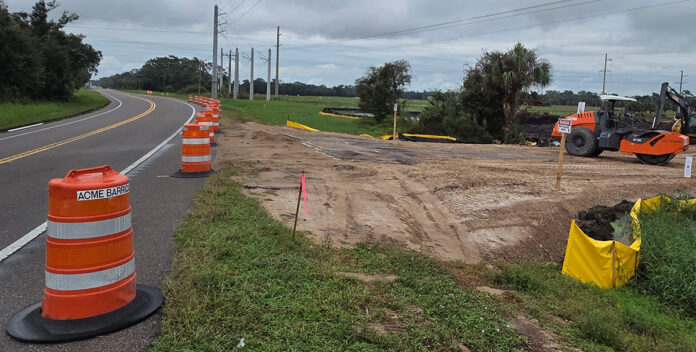
More than 35,000 homes are approved or advancing across Sarasota County and its city core. The beaches are not getting any bigger, the roads are already full, and the governments approving it all have quietly rewritten the rules for measuring congestion. An analysis of the biggest story on the Suncoast.
—Every great resort town gets one golden hour, and Sarasota is living inside it right now.
—Call it what demographers, developers and dreamers have always called such places: a harmonic convergence. A moment when climate, culture, coastline and capital all point at the same dot on the map. Naples had one. Austin had one. Aspen had one and never recovered from it. Sarasota, in the autumn of 2026, is the dot on the map. The money arriving from California, the Northeast and the Midwest is not trickling in. It is arriving in moving vans, wire transfers and all-cash closings, and it has triggered the largest wave of approved residential development in the history of Sarasota County.
—The question is no longer whether Sarasota is booming. The question is whether anyone is actually steering.
—The Number Nobody Has Added Up
—Longboat Key News went looking for a single figure that captures the scale of what has been approved and what is advancing through the pipeline, and here it is: more than 35,000 residential units are approved, entitled or formally moving through government review across Sarasota County and the City of Sarasota, with buildout horizons stretching to the year 2056.
—That number is not speculation. It is the arithmetic of adopted master plans, rezone ordinances and site plans sitting in public files right now:
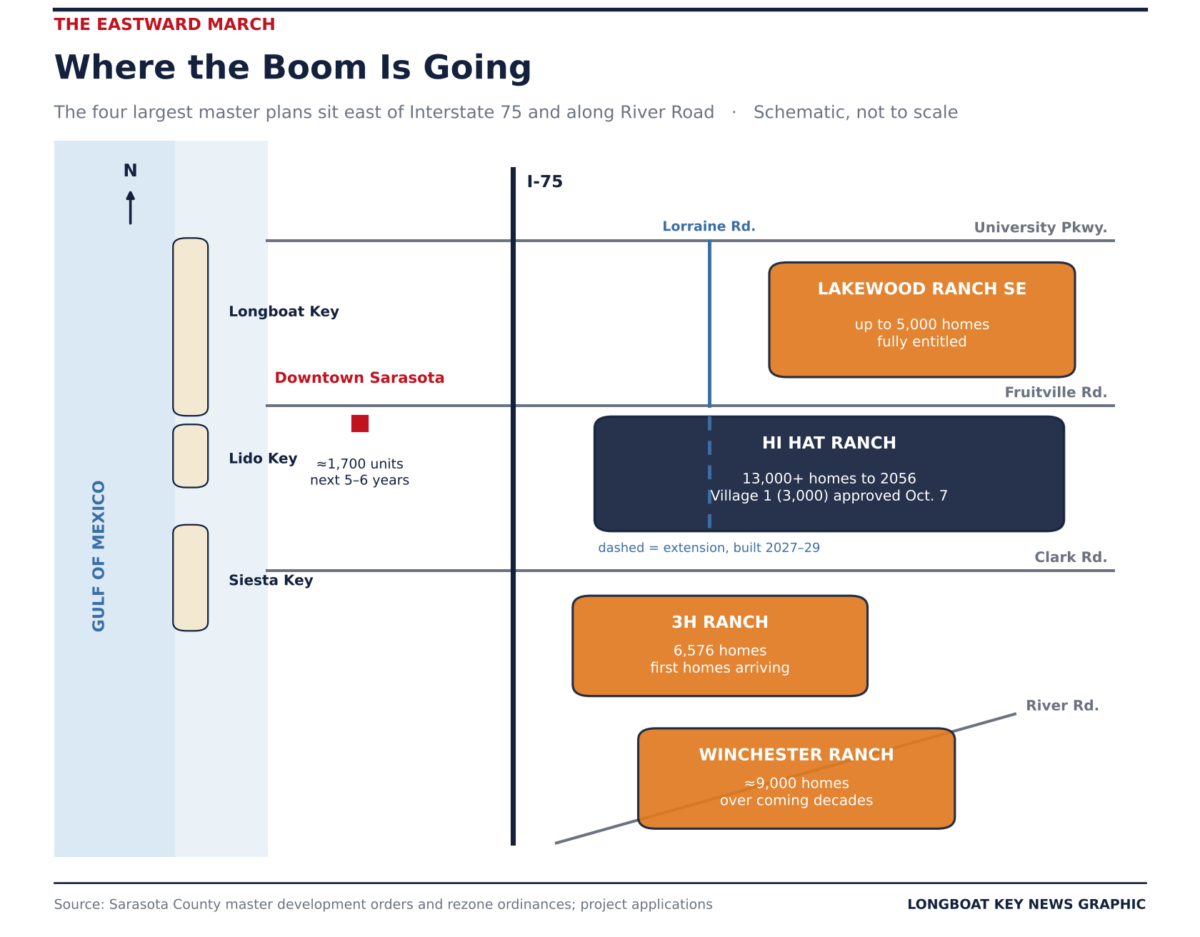
- —Hi Hat Ranch, between Fruitville and Clark roads east of Interstate 75, carries a master development order allowing more than 13,000 homes on nearly 10,000 acres, the largest planned development ever approved in Sarasota County. Earlier this month, county commissioners approved Village 1, the first 3,000 homes on roughly 2,070 acres.
- —3H Ranch, Pat Neal’s 2,727-acre village south of Clark Road, won county approval for up to 6,576 homes, plus a quarter-million square feet of commercial space. The first homes are arriving now.
- —Lakewood Ranch Southeast, the Schroeder-Manatee Ranch expansion across 4,100 acres of Old Miakka pastureland, is fully entitled for up to 5,000 homes, with national builders Pulte, Taylor Morrison, Toll Brothers and Neal already assigned their tracts. Another 4,500 Lakewood Ranch homes are queued just over the Manatee line.
- —Winchester Ranch, along River Road in South County, holds an approved critical area plan anticipating some 9,000 homes over the coming decades.
- —Downtown Sarasota is tracking roughly 1,700 new residential units arriving over the next five to six years, with 19 more projects totaling more than 1,000 units in the city’s review and approval pipeline at any given moment.
—Add the smaller villages, the Fruitville Initiative parcels at the interchange, the infill rezones and the steady drumbeat of projects such as the 282-unit Saravela tower approved this summer on North Tamiami Trail, and the long-horizon total pushes well past 35,000 units. The county’s own staff, as far back as 2021, counted more than 37,500 homes slated for previously undeveloped portions of Sarasota County alone.
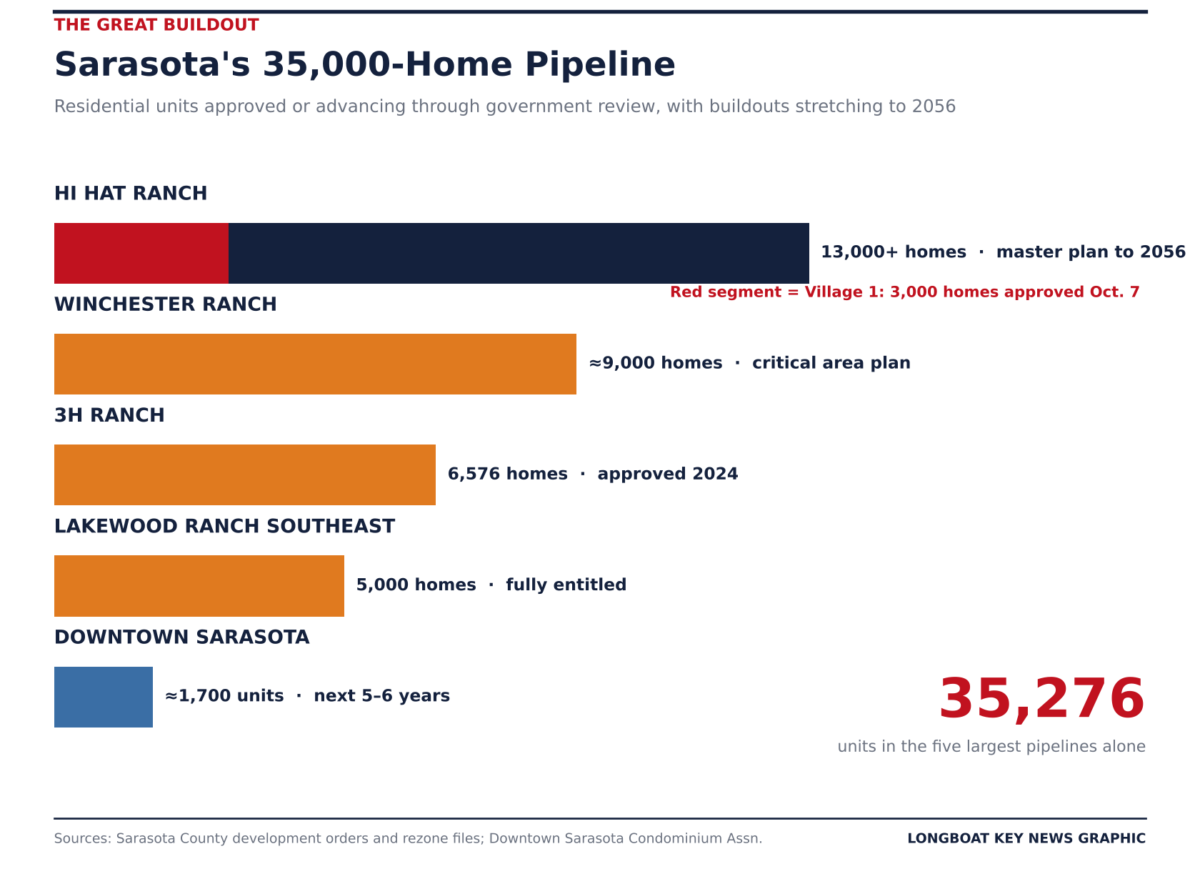
—For perspective: that pipeline, at Florida’s average household size, represents a future population the size of a second city of Sarasota, dropped onto the county’s eastern flank and its downtown core.
—The Eastward March: How the 2050 Plan Became a Conveyor Belt
—The intellectual foundation for all of it is the Sarasota 2050 Plan, adopted in 2002 as an enlightened compromise. Rather than letting sprawl creep eastward one strip mall at a time, the county would channel growth into compact, self-contained “villages” with homes, shops, jobs and schools knitted together, ringed by 500-foot greenbelts, each one fiscally neutral, paying its own way.
—A quarter-century later, the villages are coming, but the fine print keeps getting amended on the way to the dais.
—At 3H Ranch, the required 500-foot greenbelt was trimmed to 50 feet on two sides and waived to zero on two others. At Hi Hat Village 1, county planning staff found the rezoning inconsistent with the county’s own rules because the village arrived without a village center, the very shops meant to keep residents from driving everywhere. Commissioners approved it anyway. The roughly 450 affordable units that earned Hi Hat’s builders their density bonus come with no income verification, and the affordable rentals stay affordable for one year instead of five.
—The pattern has become familiar enough that one commissioner, during a Lakewood Ranch Southeast vote, confessed he did not believe he had the ability to vote no. Lakewood Ranch chief Rex Jensen was blunter still, telling the Herald-Tribune it would have been “illegal” for commissioners to deny his rezone. He may well be right under Florida’s property-rights regime, which is precisely the point: the discretion residents assume their elected boards possess has been narrowed, waiver by waiver, statute by statute, into something closer to a ratification ceremony.
—There have been flickers of resistance. Commissioner Tom Knight voted against Lakewood Ranch Southeast, telling constituents the county was not ready for it. In early 2025, commissioners briefly slammed the brakes on a Hi Hat road deal after an investigative report questioned how county land ended up serving the development. The City of Sarasota’s Planning Board stunned observers in September by denying the Midtown Plaza hotel-and-apartment project at U.S. 41 and Bahia Vista on a 3-2 vote; that denial lands before the City Commission on appeal Monday. Residents fill hearing rooms chanting a four-word creed, “keep the country country.”
—And yet the conveyor belt moves. In the last 26 months, the three largest land-use decisions in county history, 3H Ranch, Lakewood Ranch Southeast and Hi Hat Village 1, all won approval.
—The Vertical City: Downtown’s Second Act
—While the county grows outward, the city grows upward. Downtown Sarasota now accounts for roughly 60 percent of the city’s population growth over the past decade, a staggering statistic for a municipality that spent most of the 20th century as a low-rise winter colony. Some 12,000 people live in the downtown core today, and the Downtown Sarasota Condominium Association projects roughly 1,700 more units landing in the next five to six years.
—The product mix tells its own story about who Sarasota is being built for. The median list price in the core 34236 zip code now hovers around $1.2 million. Bayfront towers at The Quay are trading at a median north of $1.5 million, with pre-construction averages at One Park running past $4 million. Yet a quieter shift is underway beneath the penthouses: of the thousand-plus units currently in the city’s review pipeline, roughly 42 percent are now planned as rentals, most of them tagged affordable or attainable under density-bonus programs and the state’s Live Local Act, the same statute developers have learned to wield as both carrot and crowbar.
—The skyline is changing faster than the sidewalk. The cultural institutions that made downtown worth wanting, the Van Wezel, the opera, the theaters, the galleries, have not grown exponentially alongside the unit counts. The city is still arguing over whether to preserve or replace its purple performing arts hall, still fighting over art in its roundabouts, still trying to get a first restaurant open at The Bay. On event nights and festival weekends, downtown’s daily population already swells toward 100,000. The amenities are the magnet; the magnet is being asked to carry triple the iron.

—The Asphalt Arithmetic
—Here is where the celebration collides with the ledger, because the road math does not work on any calendar currently published.
—Hi Hat Village 1 was approved this month. The Lorraine Road extension that Hi Hat’s own traffic study says the project will significantly impact is still in design, with construction not scheduled to begin until winter 2027 and not scheduled to finish until winter 2029. The widening of Fruitville Road from Debrecen to Lorraine follows the same timeline. The county’s comprehensive plan, meanwhile, prohibits widening Fruitville east of Lorraine at all, meaning the two-lane country road that will serve as the front door to the largest development in county history is, by policy, two lanes forever.
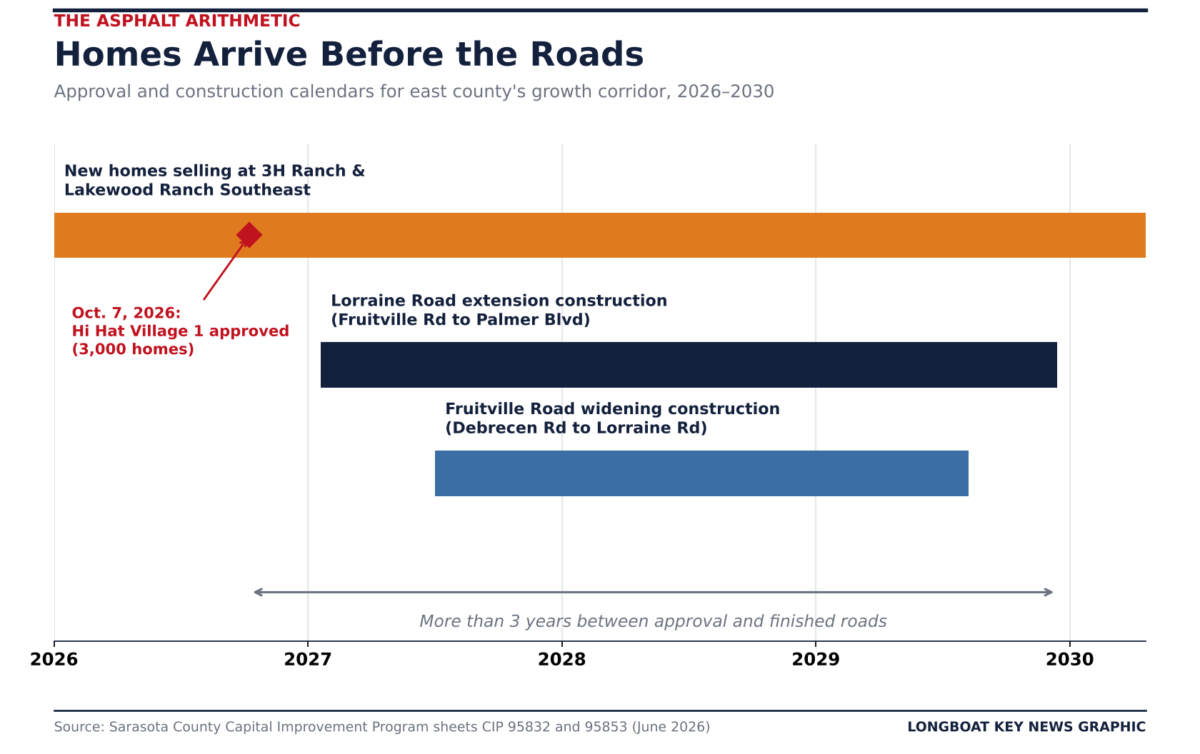
—The county’s own public works director has conceded the deeper problem, warning that drivers now treat Interstate 75 as a local road and that congestion between State Road 681 and the Manatee River is severe. State traffic counts confirm that the busiest stretches in the county include Fruitville at the interstate and University Parkway, exactly the corridors onto which the new villages will empty.
—The city’s answer to its own congestion is, in its way, even more revealing. Sarasota is finishing a rewrite of the Transportation Chapter of its comprehensive plan that abandons traditional level-of-service grades for a volume-to-capacity ratio, and sets the acceptable downtown ceiling at a V/C of 1.0, which is to say, a roadway operating at 100 percent of its theoretical capacity. When pressed at a workshop this fall on how those ceilings were chosen, the city’s own consultant allowed that setting them is more art than mathematical formula. Congestion, in other words, is no longer a problem to be solved. It is a condition to be codified.
—For the barrier islands, the same rewrite carried one more quiet detonation: the deletion of the decades-old policy supporting planning for a second bridge to Longboat Key. Every one of the 35,000 pipeline households that wants a beach day will be funneled over the same handful of drawbridges and causeways that existed when the county had half its current population. St. Armands Circle, the pinch point between them, already floods in a summer thunderstorm and already wages trench warfare over parking spaces. The islands are the prize at the end of everyone’s drive, and the drive is the one thing no master plan has mastered.
—The Market Paradox: Building Into a Split Tape
—Strangest of all, this unprecedented entitlement wave crested during the softest resale market the region has seen since the late 2000s.
—Sarasota County entered 2026 with falling prices in both segments: the single-family median dipped 5 percent year-over-year in February, and condominiums, battered by insurance premiums, milestone inspections and assessment shock, slid further still. By spring the single-family market had snapped back hard. June’s median hit roughly $492,000, up more than 8 percent, as detached inventory collapsed 27 percent to about four months of supply, firmly a seller’s market.
—Condos never got the memo. The condo and townhome median hovered in the $330,000-to-$345,000 range through the year, down as much as 7.5 percent year-over-year, with supply lingering in buyer’s-market territory and cash buyers, a remarkable two-thirds of condo closings, setting the terms. National builders, sitting on thousands of freshly entitled east-county lots, are moving product with rate buy-downs and incentives that compete directly against the resale market in the $400,000-to-$600,000 band.
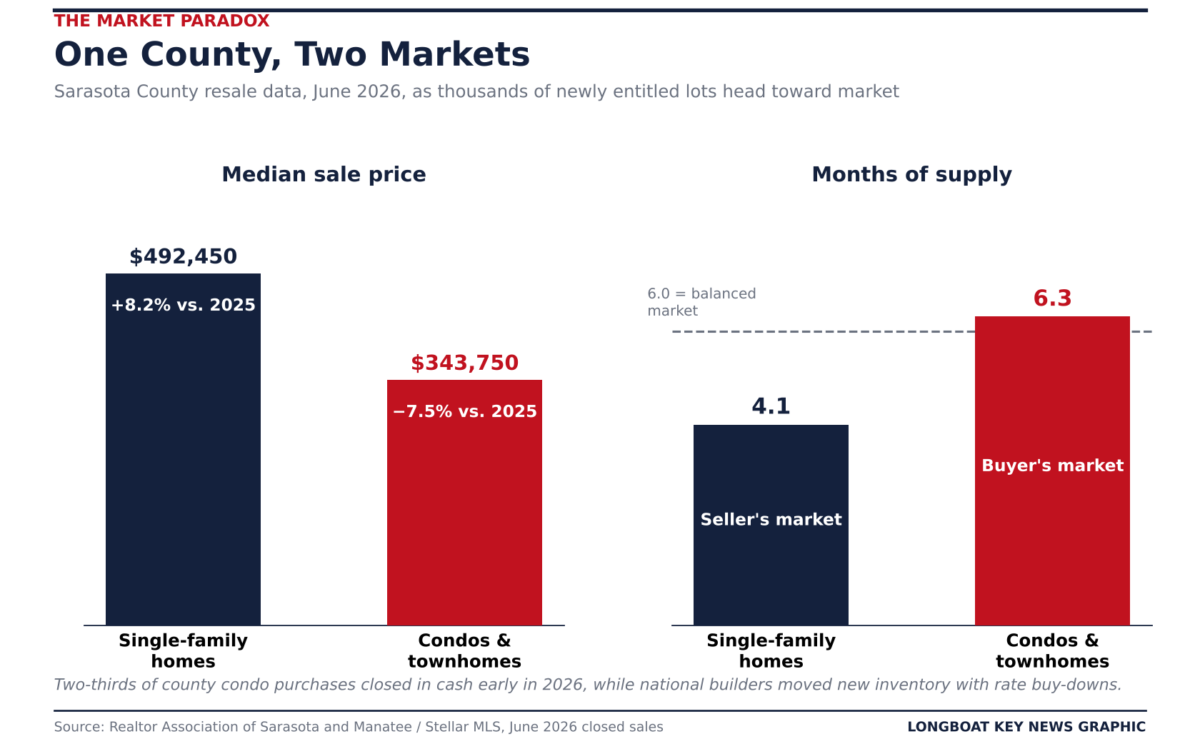
—Read together, the data describe a region sorting itself into two Sarasotas: a luxury coastal market where bayfront product holds value against gravity itself, and a mass-production inland market where volume, not scarcity, is the business model. The 35,000-unit pipeline is a bet that both can run simultaneously for 30 years. History suggests Florida real estate rarely runs in a straight line for 30 months.
—Finite Sand, Infinite Demand
—Underneath every spreadsheet sits the asset that cannot be manufactured: roughly 40 miles of Gulf coastline strung across six barrier keys. Tourism pumps more than $3 billion a year through the county economy and supports on the order of one in seven local jobs, and essentially all of it is leveraged against beaches that must be periodically renourished just to stay the same size.
—The ecosystem absorbing this boom is not an abstraction. Stormwater from 3H Ranch drains toward Little Sarasota Bay and Dona Bay. Lakewood Ranch Southeast wraps around lands near the city’s drinking water sources. Hi Hat’s neighbors, after watching so-called hundred-year storms arrive on an annual schedule, spent their hearing time pleading about fragmented wetlands and floodplain math drawn before the 2024 hurricanes redrew everyone’s assumptions. The county’s own demographic engine is pure in-migration; deaths have outnumbered births here for years, which means every unit of growth is, by definition, imported demand placed on a fixed coast.
—That is the structural tension no commission vote resolves: the thing being sold, Gulf light, open water, an uncrowded paradise, is diluted by the act of selling it.
—So Which Is It: Triumph or Trespass?
—An honest analysis refuses the easy answer, because both answers are true.
—The case for celebration is real. Sarasota’s desirability is the envy of every mid-sized metro in America. The buildout is bringing billions in investment, a construction economy running at the top of national rankings, a downtown more alive at 9 p.m. than it has been in a century, and, for the first time, meaningful numbers of attainable units riding in on the density bonuses. Master-planned communities, whatever their sins, are better engineered than the ranchette sprawl they replaced, with half their acreage held as open space. Growth is not a conspiracy. It is a compliment.
—The case for alarm is equally real, and it is not really about the houses. It is about sequence. The homes are approved on a 2026 calendar; the roads arrive on a 2029 calendar, if then; the greenbelts shrink on request; the fiscal-neutrality promise rests on studies that predate the very villages they are supposed to justify; and the measuring stick for congestion was swapped out at the precise moment it would have started flashing red. A government that genuinely planned for this moment would be building the Lorraine extension ahead of Hi Hat’s first rooftop, not two years behind it, and would treat a staff finding of “inconsistent” as a stop sign rather than a speed bump.
—Sarasota is not overdevelopment off the rails. Not yet. It is something more precarious: a boom running exactly on the rails its builders were allowed to lay for themselves, through a landscape that has a hard physical limit and a government apparatus that has, piece by piece, bargained away its own brakes.
—Golden hours, by definition, do not last. The light that is making Sarasota the most wanted address on the Gulf Coast is the same light by which, 30 years from now, residents of 35,000 new homes will judge whether this generation of leaders planned a city or merely permitted one. The paperwork for that verdict was filed this month, between Fruitville and Clark roads, east of the interstate, where the cattle still graze for a little while longer.

