
A $5.6 million Amendment 3 hole, a sand treaty for New Pass, a channel the Coast Guard gave up on, a $74 million bridge and a six-year permitting saga under Sarasota Bay: two commissions, two hours, one shared ledger of what the islands still owe and what they are still waiting for.
—The agenda for the Oct. 7 joint meeting of the Sarasota City Commission and the Longboat Key Town Commission was printed days in advance. The most persuasive presenter, however, booked itself at the last minute: the night before the two boards gathered at Longboat Key Town Hall, St. Armands flooded again.
—So when city staff stood up to explain a $13.5 million stormwater fix that may not be finished until 2031, the elected officials in the room were not working from memory. Several of them had driven through the water on the way home.
—“There’s an interesting ironic sign there as you leave St. Armands,” one commissioner offered near the end of the discussion. “It says may flood. Now it does flood. I don’t know where the sign comes from, who should put it up, but they should change it… It’s potentially a safety issue. May flood. It does flood.”
—Over roughly two hours, the two commissions worked through a shared ledger of money and water: a constitutional amendment that could blow a $5.6 million hole in Sarasota’s budget, a new sand-sharing treaty for New Pass, a navigation channel the Coast Guard walked away from, a $74 million bridge, a six-year permitting saga under Sarasota Bay, and, briefly, flying taxis.
—Amendment 3: ‘We don’t advocate, we educate’
—City Manager Karie Friling, four months into the job, opened with the subject hanging over every city hall in Florida: Amendment 3, the Nov. 3 ballot measure that would raise the homestead exemption from $50,000 to $150,000 in 2027 and $250,000 in 2028 for non-school taxes.
—Friling said she was warned not to lose sleep over it.
—“Before I came here, everyone said, you know, Karie, this probably isn’t going to happen, so you don’t need to worry about it,” she said. “And then I was on day three, and it happened.”
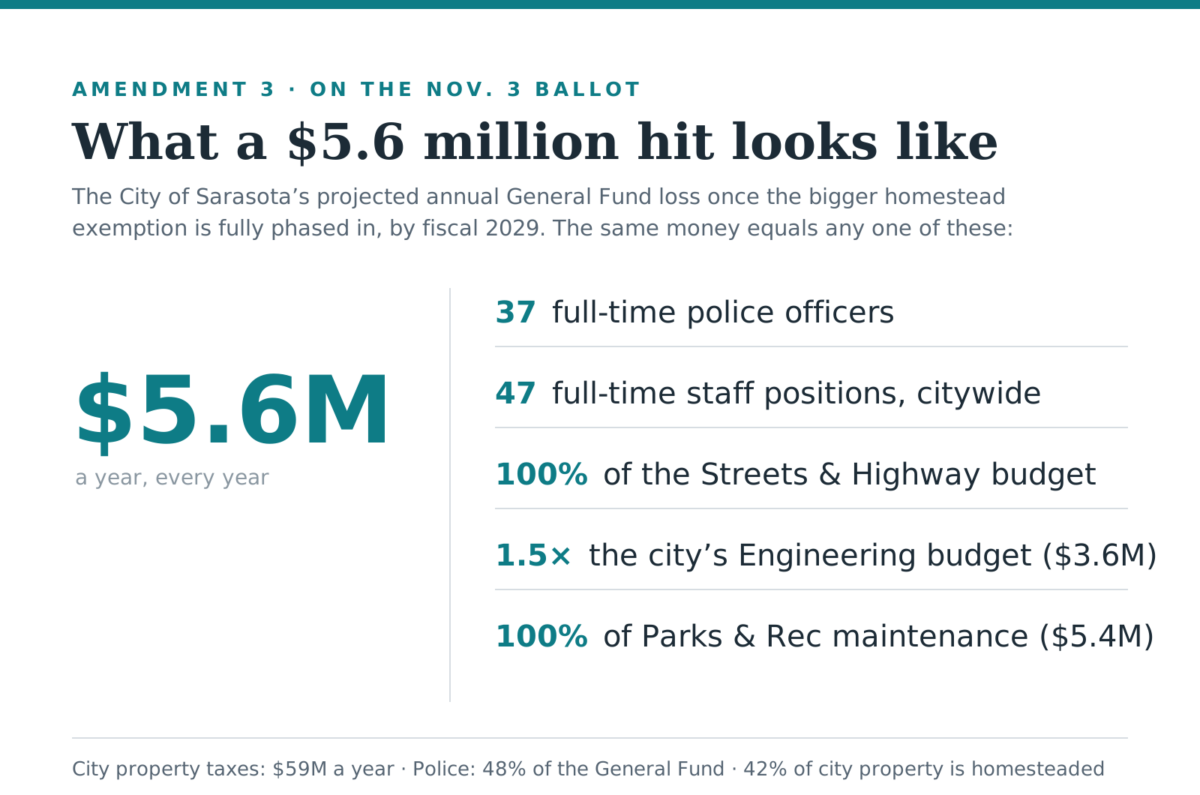
—The numbers she laid out: Sarasota collects about $59 million a year in property taxes for its General Fund. The police department alone consumes 48 percent of that fund, more than $54 million. Some 42 percent of city properties are homesteaded, meaning the amendment lands squarely on the city’s tax base. Staff projects a $5.6 million annual revenue loss once the exemption is fully phased in by fiscal 2029.
—“Obviously we don’t advocate, we educate, and we share facts and information,” Friling said.
—The education was followed moments later by something closer to advocacy from the dais. One commissioner reported that Steve Vancore, who is heading the Florida League of Cities’ “Vote No on 3” campaign, had just launched the effort’s first television ads, which broke the day before the meeting in the Sarasota market.
—“ABC 7, I know, is carrying them extensively in the prime news hours, and the ads are fabulous,” the commissioner said. “So fingers crossed.”
—“We’ll take good news,” Friling replied.
—What $5.6 million looks like
—To make the loss tangible, the city has been translating it for neighborhood groups, with Mayor Debbie Trice doing much of the circuit. The $5.6 million equals 37 police officers, or about 47 full-time staff positions, or the city’s entire Streets and Highway budget, or one and a half times its engineering budget, or the entire Parks and Recreation maintenance budget.
—Sarasota has already adopted its 2026-27 budget with cuts baked in and a hiring freeze on open General Fund positions. Friling described a “three-legged stool” review underway with department directors: cut expenditures, raise revenues and user fees, and find efficiencies. The menu of possibilities on the city’s own slides runs from a millage increase and beach parking fees for non-residents down to the small indignities of austerity: killing wi-fi in the parks and replacing annual flowers with perennials.
—Longboat Key has run the same math and come up with its own warning of roughly $1.4 million a year out of the town’s General Fund, a figure town commissioners have been pushing to homeowner associations for weeks.
—Statewide, the fight has become one of the stranger campaigns in Florida memory. The “yes” side is bankrolled almost entirely by Florida Realtors. The “no” coalition now includes the Florida League of Cities, the Florida Association of Counties, the Florida Sheriffs Association, the Fraternal Order of Police, the state’s firefighters and fire chiefs, Florida TaxWatch and Common Cause. Gov. Ron DeSantis has said he will vote for it but will not campaign for it after legislators rewrote his version. Polls have the measure hovering right around the 60 percent approval it needs to pass.

—A sand treaty for New Pass
—Public Works Director Nikesh Patel delivered the meeting’s least contentious item: the new Pass Dredging and Sand Sharing Interlocal Agreement between the city and the town, effective Sept. 15.
—The 10-year deal locks in a 50-50 split of New Pass sand between Lido Key and Longboat Key, measured cumulatively rather than dredge by dredge. With written consent, one project can take up to all of the available sand, with later projects restoring the balance. The accounting clock starts with the 2025 Inlet Management Plan approved by the Florida Department of Environmental Protection.
—“We’ve been doing the 50-50 share for years,” Patel said. “This just formalizes the agreement.”
—The channel the Coast Guard gave up on
—The agreement arrives on the heels of the completed 2026 Lido Beach renourishment, in which the Army Corps of Engineers dredged New Pass and placed about 300,000 cubic yards of sand along 1.2 miles of Lido shoreline with $12 million in federal funding. Before the dredge, Patel said, parts of the channel held as little as three inches of water. Boaters now have five to nine feet.
—Longboat Commissioner Steve Branham wanted to know whether that would be enough to bring back a marked federal channel, and the answer revealed how far the pass had deteriorated. Town Public Works Director Charlie Mopps told the boards the Coast Guard had essentially written the channel off.
—“The Coast Guard basically said, we’re not going to keep this as a navigation channel. We’re going to pull our buoys. We’re not going to mark it anymore,” Mopps said. He added that Army Corps project managers told him at a recent conference the markers are coming back, though the inlet shoals in at roughly 70,000 cubic yards a year, meaning the channel will need constant surveying “to make sure that it stays well marked… and not directing boaters towards a hazardous condition.”
—Mopps also explained why the Corps never dredged east of the Longboat bridge: a TECO power line serving City Island was found “literally just sitting on top of the mud.”
—“We’re like, hey guys, by the way, you might want to not dredge this right now, because you’re gonna pop a line,” Mopps said. TECO direct-buried the line, but amid the confusion the Corps stuck to the outside cuts and skipped the inner ones entirely.
—Separate from the renourishment, Lido’s state-funded dune restoration is underway. Patel told the boards the goal is completion by the end of the year; the city’s own slide hedges to the end of 2027.
—St. Armands: flooded again, fixed by 2031
—Then came the item the previous night’s rain had already introduced.
—The St. Armands Resiliency and Stormwater Project carries $13.5 million in county-administered Resilient SRQ disaster recovery money plus $479,000 from the city, aimed at drainage, pumping and backflow protection on the region’s most reliably drowned commercial district. The catch, Patel acknowledged under questioning: the county has until 2031 to spend the money, is still selecting a consultant, and the project has not started.
—Longboat Commissioner B.J. Bishop pressed on what happens in the meantime, noting the forecast called for “probably four more days of some pretty dramatic rain events.” Are there emergency pumps staged near St. Armands?
—The answer exposed the structural oddity at the heart of the problem: inside the city of Sarasota, stormwater is managed by Sarasota County. “That’s unfortunate,” came the response from the dais.
—Friling described the night before as a case study in making the arrangement work anyway, with herself, Patel and the police chief “all fully engaged last night for quite a few hours,” coordinating with county counterparts as roads became impassable. She said the city has proposed a year-or-two evaluation of the stormwater system inside city limits, with the eventual goal, if her commission directs it, of taking the system over from the county.
—“We recognize it is not the best situation,” she said.
—‘A band-aid as opposed to a solution’
—Sarasota Commissioner Jen Ahearn-Koch questioned whether even $14 million is real money against the problem.
—“Thirteen and a half million dollars is no small amount of money, but in the big picture it seems a little bit like it’s a band-aid as opposed to a solution,” she said. “If we had unlimited funds, what would that look like?”
—Patel asked for patience until the county’s consultant, the undergrounding work and a separate state-funded corridor project all produce designs. Pressed on whether the project has more impact than a band-aid, he answered: “Absolutely, yes.”
—Another commissioner cut to the political reality of telling a shopkeeper standing in water that a consultant is being procured.
—“They want to know that they’re going to be able to get out of their home tomorrow,” the commissioner said. “What advice would you give to a room full of elected officials who are faced with those phone calls every time St. Armands is flooded?”
—Patel’s advice amounted to: do it once and do it right. “Rushing through the project is a little bit short-sighted, in my opinion,” he said. “The key is to get the flood water as quickly out of the roadway as possible.”
—Vice Mayor Kathy Kelley Ohlrich pointed to a county advisory committee seeded with city residents who “will not let go of it.” And three projects, staff stressed, now have to be choreographed on one small island: the county’s $13.5 million stormwater retrofit, the city-led utility undergrounding of St. Armands, targeted for the January 2028 tax roll, and $1.48 million in state money for the corridor itself, all scheduled so that one crew does not dig up another crew’s finished work.
—Landry’s 30,000-foot sermon
—Town Manager George Landry, prefacing that he is “not an engineer, opposite of that,” closed the stormwater discussion with a barrier-island physics lesson that doubled as a lobbying pitch.
—Water has to go somewhere, he said, and on a barrier island there is nowhere to put it: nobody wants giant retention ponds or deep swales, you cannot pump it straight into the bay without “getting in trouble,” and pumping it across to the mainland means hanging a pipe on a bridge.
—“They don’t like pipes on their bridges,” Landry said of the state DOT. His conclusion: the fix is not local at all. “It’s going to be near impossible for the local folks to try to figure it out,” he said, urging the elected officials to push the Florida League of Cities toward legislative changes in Tallahassee on stormwater treatment and discharge. “That’s the DOT dilemma we’re having all over the state of Florida.”
—A road diet, a paused water taxi and a ghost airline
—The city’s project tour included the 10th Street and Boulevard of the Arts redesign, backed by a $12 million U.S. DOT grant and a $3 million city match, which would take 10th Street from four travel lanes to two with bicycle and pedestrian improvements. A traffic study is underway, with property owners, neighboring governments and the public to weigh in before design is finished and construction anticipated in 2028-29. Road diets have a way of generating their own weather in Sarasota, and this one is just getting started.
—The city’s water transit dock construction, by contrast, got a single slide reading “On Pause.” The town’s companion agenda item, “Water Taxi Information,” came with no backup material at all.
—And then there was Advanced Air Mobility: a proposed regional memorandum of understanding, led by Sarasota Bradenton International Airport with FDOT District One, the Sarasota/Manatee MPO and local governments, to plan for electric air taxis, air cargo and emergency aircraft. The MOU is purely advisory and launches no service. Fittingly, the illustrative rendering on the city’s slide was credited to Lilium Air Mobility, the German air-taxi maker that burned through more than a billion dollars, filed for insolvency twice and ceased operations without ever delivering an aircraft. Its patents were sold off to a competitor. The region, in other words, is planning infrastructure for an industry still learning to stay aloft.
—The $74 million little bridge
—The FDOT portion of the presentation carried two numbers of consequence for everyone who drives to the beach. The John Ringling Causeway improvements now underway, $12.3 million worth of bicycle and transit lanes, signals, resurfacing, drainage and a raised seawall cap near Sunset Drive, run from January 2026 to early 2027.
—Behind that waits the Little Ringling Bridge replacement between Bird Key Drive and Sarasota Harbour West: a $74 million estimated construction cost, with $4 million in design money spent and construction timing still pending FDOT. The 1958-vintage twin spans, which have no shoulders and no bike facilities, would give way to a single taller bridge with bicycle, pedestrian and transit accommodations. It is the only road connecting downtown to Bird Key, St. Armands, Lido and Longboat, which means years of construction choreography on the islands’ lone lifeline.
—Longboat’s pipe and the Army Corps’ moving goalposts
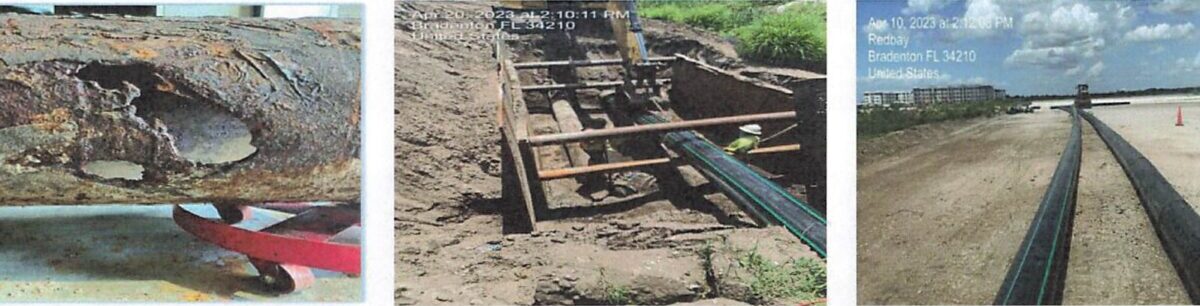
—Longboat Key closed the meeting with its own long-running infrastructure epic: the subaqueous wastewater force main, a new 24-inch pipe to run beside the 20-inch ductile iron main that has carried every flush on the island across Sarasota Bay to Manatee County since 1970.
—The town has been at this since January 2020. A 2020 leak on the mainland side, repaired in about 30 hours, led to a 2021 consent order with the state. FDEP permitted the project in 2022. The Army Corps issued a Nationwide Permit in 2023. Then, in February of this year, the Corps told the town the impacts were too large and a new permit mechanism was required. The town applied for a new Nationwide Permit. Between April and June, the Corps decided that would not do either. An Individual Permit application is now under expedited review.
—The consolation is the money: the town has assembled $24.67 million in outside funding, including a $3 million EPA grant secured through Congressman Vern Buchanan, $1.5 million from FDEP, $15 million in total grant dollars requiring no payback, and a $9.58 million zero-interest state loan. The pipe itself has already been bought at a favorably negotiated price and is sitting in storage, waiting for Washington’s permission to get wet.
—Which made it a fitting final item for a meeting that kept circling the same theme: two local governments with the money, the plans and the partnership largely in place, waiting on counties, consultants, the Corps and the weather.

