
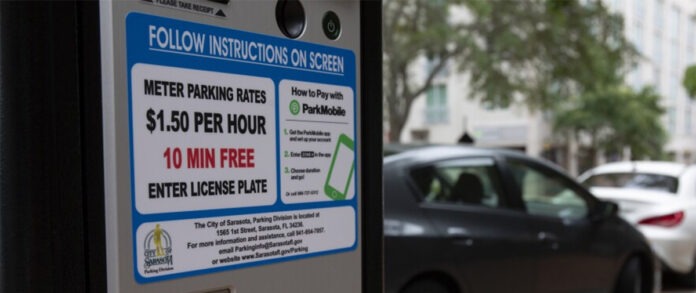
Facing a $2.8 million parking shortfall, the city chose longer meter hours over a 50% rate hike. Three months later, the landlords and restaurateurs it tried to spare packed City Hall to demand a repeal.
“Paid parking is having a real, long-lasting and negative impact on downtown commerce,” Shugar told the commission. “People are choosing to go elsewhere. They’re cutting visits short, meeting friends, having lunch, shopping and spending their days in places where parking is easier and free.”“Paid parking is having a real, long-lasting and negative impact on downtown commerce,” Shugar told the commission. “People are choosing to go elsewhere. They’re cutting visits short, meeting friends, having lunch, shopping and spending their days in places where parking is easier and free.”“Paid parking is having a real, long-lasting and negative impact on downtown commerce,” Shugar told the commission. “People are choosing to go elsewhere. They’re cutting visits short, meeting friends, having lunch, shopping and spending their days in places where parking is easier and free.”The city stretched its parking meters to midnight to help plug a projected $2.8 million hole. On the morning of July 6, downtown packed the City Commission chamber to say the cure is worse than the disease.
—Dozens of business owners, commercial landlords and residents filled the July 6 meeting to unload on Sarasota’s expanded paid-parking program — the rewrite that now keeps the meters running from breakfast until well after most storefronts have gone dark. What the city sold as the gentler way to fix a bleeding parking budget has become the loudest downtown grievance of the summer. By the end of the meeting, even the commissioners were conceding the phones and inboxes have not stopped ringing — and reopening a debate they thought they’d settled in the spring.
—What the meters do now
On the two metered downtown streets — Main Street and Palm Avenue — paid parking is now enforced from 8 a.m. to midnight Monday through Saturday, with Sunday enforcement starting at 1 p.m. That’s a substantial jump from the old 10 a.m.-to-8 p.m. window: two extra hours in the morning, four more piled onto the night, and Sundays folded in. The city also raised citation fines by $5 across the board. The hourly rate itself stayed put at $1.50. The expanded enforcement took effect July 1, and the backlash was immediate.
—How Sarasota got here: a $2.8 million hole
—Sarasota’s parking program is supposed to pay for itself. It hasn’t. The city’s combined downtown and St. Armands parking funds ran a $270,784 loss in the current budget year, and without changes the shortfall was projected to balloon to roughly $2.8 million by 2028 — driven by storm-related revenue losses, aging garages, and a parking fund that underwrites the free Bay Runner trolley to the tune of more than $924,000 a year.
—Back in March, staff handed the commission two ways to close the gap: raise rates or extend hours. Option one would have pushed the on-street rate from $1.50 to $2.25 an hour — a 50% jump — and tripled some employee parking permits. Option two would freeze the rate but stretch enforcement deep into the night, a revenue-maximizing model borrowed from Seattle’s “After 5” program.
—On March 23, the commission chose door number two. It approved the extended hours and the $5 fine bump, and it rejected the rate hike and the permit increases outright — an explicit decision to spare shoppers and downtown workers a bigger bill. The plan drew heat even then: one resident branded city staff “nightmarish” and warned a rate hike would drain millions from the local economy, while the St. Armands Circle Association complained it had learned of the proposal from the news.
—In other words, the very policy that packed the chamber on July 6 was the option the commission picked precisely because it was supposed to hurt less.
—The landlords open fire
—First to the microphone was Ronnie Shugar, who introduced himself as an entrepreneur, downtown landlord with more than 20,000 square feet of retail space, restaurateur, investor and philanthropist. He did not come to discuss parking theory.
“Paid parking is having a real, long-lasting and negative impact on downtown commerce,” Shugar told the commission. “People are choosing to go elsewhere. They’re cutting visits short, meeting friends, having lunch, shopping and spending their days in places where parking is easier and free.”
—Every one of those decisions, he said, “costs a downtown business money, profit, customer curation and retention.” His verdict on the playing field: “Downtown businesses are being forced to compete with one hand tied behind our backs.”
—Shugar zeroed in on the new hours as self-defeating. At 8 in the morning, he said, a customer who wants nothing more than a coffee and a Danish is looking at “$2 just to step inside. Why?” — when there is “a Starbucks or Wawa off Washington with no parking fee headache.” And on the late nights, he argued, the meters are guarding empty streets: “There are literally less than 10% of retailers open. The streets are empty. Why does the city need to incur overhead, payroll or meter maids for those hours?”
—A shot at Venice, and a petition
—Shugar pointed the commission toward a neighbor. “I implore the commission, review the City of Venice’s successful two-hour free downtown parking system,” he said. “They’re treating businesses as partners rather than sources of additional government revenue.”
—He reminded the dais that CNN Travel recently named Sarasota the most desirable place to visit in the country — Main Street among the reasons — then delivered the line that landed hardest: “To those of us who have invested in downtown, paid parking feels like a personal attack on our businesses and on the people whose livelihood depends on them.”
“We pay property taxes, we employ people, we attract visitors. We take risks,” he said. “We are being punished for it.”
—Then he raised the stakes, announcing he is advocating for “a downtown petition to be signed by all commercial property owners and retail businesses” to bring the matter back before the commission and “vote to end paid parking downtown.” The mayor cut him off at the clock — but the message was delivered.
“We looked inside first”
—Fellow business owner and commercial property owner Chris Voelker followed, armed with a pointed contrast. When the city’s parking manager explained that the division had lost revenue because of the three hurricanes, Voelker said, he could only think of his own storm season.
“We small businesses really suffered also because of the three hurricanes,” he said. “But what we did is we looked inside first.” Small businesses cut expenses without degrading their product, he said — “we couldn’t exactly just start charging twice as much for everything.”
—Voelker urged the same introspection of the parking division, and he brought numbers. The division, he said, runs at 43% personnel cost — “one of the highest in the nation.” The city has poured money into parking technology, he added, with “no return on investment that we’re aware of. Why?” Smaller cities than Sarasota manage to offer businesses free parking, he noted, “and we have never even considered that.”
—His closing framed the whole night: “We should be upholding the economic driver of the city. Not getting in its way.”
—The commission reopens the March debate
—By the time the meeting reached commissioner comments, the pushback had clearly registered — and the parking fight the commission thought it had resolved in March cracked back open.
—Commissioner Liz Alpert acknowledged the “consternation” but argued a chunk of it stems from confusion. “There’s an awful lot of people who were not aware that we were charging for parking downtown already,” she said, “and are not aware that it’s only on two streets downtown.” The real irritant, she said, is the calendar: “It seems to be the extra hours that really are bothering people.”
—Then she floated a trade that would effectively rerun the March vote — in reverse. “Maybe we should take a look at going back to the regular hours but then raising the rate,” Alpert said, “because we got to do one or the other.” Her bottom line on the economics was blunt: “Parking is not free. Somebody has to bear the cost.” Either the whole city subsidizes it, or the people who use the spaces pay a user fee.
Accosted in the steam room
—Commissioner Kyle Battie offered proof of how far the issue has traveled. “I’m at the YMCA in the steam room and I got accosted by somebody about parking,” he said, to laughter. His fix: find “some sort of way to funnel people into our garages,” which he noted are running below full capacity.
—The enterprise fund that never was
—Commissioner Jen Ahearn-Koch — the architect of the March compromise — said her inbox tells the story. “I have received a lot of e-mails and had meetings and conversations with folks experiencing all kinds of angst about it,” she said. “I don’t think it’s unfounded.”
—She has watched this movie before. The whole point of metering, she noted, was to stop the general fund from subsidizing parking — a promise dating to her first election nine years ago that “just hasn’t happened.” The operation “is called an enterprise fund and doesn’t function as an enterprise fund the entire time I’ve been on the commission.” Part of the drag: the parking division carries the free Bay Runner trolley, a roughly $924,000-a-year line item the city is now shifting to Sarasota County’s Breeze transit system to qualify for federal grants. Ahearn-Koch said she wants a top-to-bottom review to finally make the fund stand on its own.
—Why the city can’t just shut the meters off
—For all the anger, commissioners made clear there is no magic switch — and the reason sits across the bay on St. Armands Circle.
—The city is contractually bound to charge for parking on St. Armands to service the bond on the circle’s parking garage — a roughly $16 million debt that St. Armands merchants are themselves helping repay, by their own account to the tune of half. Baked into that arrangement, Alpert said, was an understanding that if the circle charged for parking, downtown would too, to keep a level playing field. Walking away is not a policy choice the commission can simply make. “We would be sued if we did not do that,” Alpert said.
That is the box the commission is in: a parking system residents assume is a cash grab, a downtown business corps that says it is bleeding customers, and a bond covenant that makes “just make it free” a fast track to court.
—Where the money actually goes
—Mayor Debbie Trice put her finger on the credibility gap. Too many residents, she said, “honestly believe that parking is free, and the minute that the city is charging for parking, we’re just trying to line our pockets” — without realizing the fees are meant to recoup the real cost of running the system.
—And that cost is ugly where the public feels it most: the garages. The city is facing $750,000 elevator replacements at both the State Street and Palm Avenue garages, plus a $650,000 overhaul of the aging on-street meters. The garage elevators are “broken more often than not,” Trice said, and the cost to fix them is “obscene” — parts come from the manufacturer, not, as staff noted, from Ace Hardware. The expanded hours are, in the city’s telling, what pays for exactly that.
—Ideas on the table
—Rather than dig in, commissioners spent the back half of the discussion brainstorming — and the ideas came fast:
• A parking validation program. Trice floated letting downtown restaurants knock a couple of dollars off the check for customers who show an active ParkMobile session — “$2 or $3 off the dinner check” — and asked the parking team to study it before any workshop.
• Better signage to the free spaces. Trice suggested a simple green sign with an arrow, mounted under the city’s blue “P” logo, steering drivers to the free parking many of them do not know exists — including the garage above Whole Foods on Second Street. By the city’s own count, the vast majority of downtown parking — roughly 88% — remains free.
• Free time in the garages. Both Battie and Alpert pushed making the garages more financially attractive, with a free hour or two, to pull cars off the metered streets.
• Resident parking permits, among other suggestions Ahearn-Koch said residents have been floating.
• Alpert’s swap: roll the hours back to the old schedule and raise the hourly rate instead — the option the commission rejected in March, when staff noted that even at $2.25 an hour Sarasota would still undercut downtown Tampa’s $4 rate.
—What’s next
—The commission’s consensus destination is a workshop dedicated to parking, where members can “bat around ideas” instead of waiting for a formal agenda item — though staff will present first, and the parking division was asked to come back with recommendations on validation, signage and the rest. Ahearn-Koch signaled she may bring forward a separate agenda item for a comprehensive review aimed at finally making the enterprise fund actually function as one.
—Whatever emerges will land on a familiar-but-new desk: the review arrives just weeks into the tenure of a brand-new city manager already juggling a historic property-tax referendum headed for the November ballot.
—For now, the meters run till midnight. Three months after the commission picked extended hours as the fix that would sting the least, downtown’s message — delivered in person, on the record, and with a petition warming up in the wings — is that the sting is the whole problem.

