
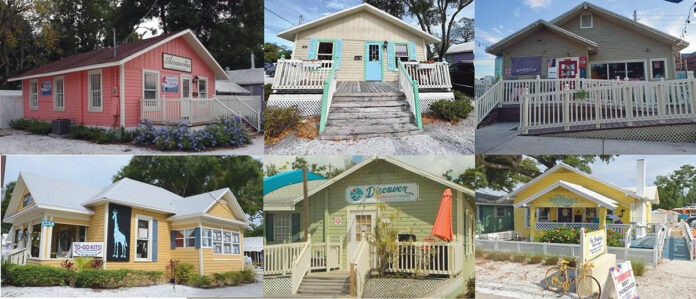
The apartment deal that threatened Fruitville Road’s painted cottages collapsed on a Saturday. On Wednesday, the block’s best-known tenant walked into City Hall with her daughter, a contractor and one of Sarasota’s busiest land-use consultants, and put it on the record: the pancakes are still moving a mile east. City staff gave the rezoning partial sign-off on the first try, and told the family exactly what it will take if a Bungalow Village is ever going to follow.
—Wendy Lee Goldberg had every reason to stay home Wednesday morning.
—Four days earlier, the landlords of the 1899 Fruitville block told their tenants that the contract to sell to a Tennessee apartment developer was dead and the property was not for sale. The 324 apartments, the six-level garage and the bulldozers were off. The Breakfast House, 17 years in a yellow bungalow at 1817 Fruitville Road, was no longer being pushed out.
—Goldberg came to City Hall anyway.
“Hi, I’m Wendy Lee Goldberg,” she told the city’s Development Review Committee when the sixth item on the Oct. 7 agenda was called. “I’m going to let my daughter, who’s in charge, kind of help me to introduce the project.”
—Her daughter, Ciara Bloomfield, the agent of record on the application, then said the thing the whole block has been waiting to hear one way or the other.
“This project is intended to transfer business operations from the current location of the Breakfast House on 1817 Fruitville Road to the subject property,” Bloomfield said.
—The reprieve downtown changed the deadline. It did not change the plan.
“Because I Like Breakfast”
—The team at the table was small. Goldberg. Bloomfield. Mike Schwent of Ampersand Construction. And at the end, a man who had already been up twice that morning on other projects and would be up again on a fourth.
“And I’m Joel Freedman,” the veteran Sarasota planning consultant said. “I’m just helping them out because I like breakfast. Pancakes. Carbs.”
—It got the laugh it was aiming for, and it also answered a question from the summer. In July, Goldberg said she planned to shepherd much of the rezoning herself rather than hire a big land-use firm. The application filed Aug. 28 lists Freedman as an expert witness for the hearings ahead, and on Wednesday he was sitting with the family.
—The Request, in One Breath
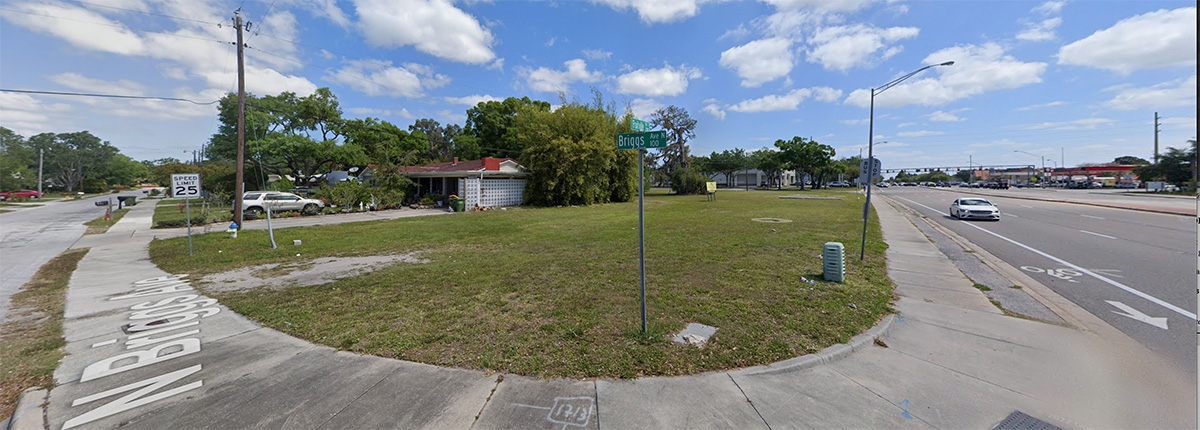
—Bloomfield laid it out plainly. The family is asking the city to rezone 128 N. Briggs Ave. and the adjoining parcel at 0 Briggs Court, at the corner of Fruitville Road near Tuttle Avenue, from Residential Single-Family 2 to Urban Mixed-Use 1, “so we may convert the existing building on the property into a small neighborhood-oriented breakfast restaurant.”
—The item is 26-REN-06. The land is about 45,509 square feet, a little over an acre, which Goldberg bought in May for $1.15 million. The filing describes a house of roughly 1,900 square feet, 54 seats inside and 40 outside, 14 employees and the same hours the restaurant keeps today: Tuesday through Sunday, 8 a.m. to 2 p.m. The city collected $9,026.94 in application fees.
—The narrative in the packet puts the concept in terms no zoning code uses. The idea, it says, is for families “to come into our ‘home’ and enjoy a delicious breakfast with a cozy feel, much like that of eating breakfast at Grandma’s.”
—Partial Sign-Off on the First Try
—The Development Review Committee is not a public hearing and takes no vote on whether the rezoning should be approved. As senior planner Christian Tolner explained at the top of the meeting, it is a committee of city and county departments that reviews every complete application, and while the meetings are open to the public, “participation is limited to committee members.”
—What it can do is tell an applicant to fix things and come back. One project on Wednesday’s agenda, a recycling facility on North Washington Boulevard, was told to resubmit. A downtown tower was on its sixth submittal.
—The Breakfast House was on its first, and when the reviewers finished, Tolner made the call. “We’ll be issuing partial sign off for this project,” he said, telling the team to work with individual reviewers “to complete this project and achieve full sign off.”
—Most departments had nothing to add. Utilities: no comments for a rezone. Schools, police and the Planning Department: no comments. Wesley Stuckey, who reviews solid waste, engineering and traffic concurrency, said he had no comments “for any of the three.” The city’s earlier finding that the restaurant’s traffic is too small to require a study stands.
—The One Thing Staff Needs Fixed
—Case planner Camden Jenkins had exactly one required zoning comment, and it was paperwork.
—The property appraiser shows Goldberg’s land as two separate lots. The application narrative talks about one parcel. Jenkins said he had gone over it with Bloomfield the day before.
“What we’re just looking for is just a higher resolution boundary survey,” he said, “and then just in the narrative refer to both 128 Briggs and 0 Briggs.”
“You Guys Know What Will Be Needed”
—Then came what Jenkins called “a couple of unique advisory comments,” and the one that matters most to anyone hoping to see a Sarasota Bungalow Village on that corner.
—To support the rezoning, the applicant offered two binding promises, known as proffers. One fixes the hours. The other reads: “The proposed use will be a casual restaurant not to exceed 2200 square feet of floor area.”
—Those promises limit what the property can become, which matters to the single-family neighbors north of the corner. They also define what the city is being asked to approve: one restaurant.
—Jenkins read the consequence into the record. “The proposed proffer of use and square footage may require an amendment to the rezone ordinance if future additional uses are proposed on the site,” he said. Then he added: “I discussed that one with both Wendy and Sierra. You guys know what will be needed in the event that you decide to expand operations.”
—Nobody at the applicant’s table disputed it, and nobody asked a question about it. But the meaning is not small. The village the cottage tenants have described since July, with a German restaurant and biergarten, a cookie shop, an art gallery and a trolley tour office gathered around a green, would be additional uses on that land. As the application now stands, bringing them there would mean returning to the city for a rezone ordinance amendment, a separate application with its own fees, community workshop and public hearings.
—Goldberg has said from the start that the restaurant comes first and the village is a hope. Wednesday confirmed that the city sees it the same way: one step now, another later, and the second one is not included in the first.
—A Lot Line to Fix Before the Doors Open
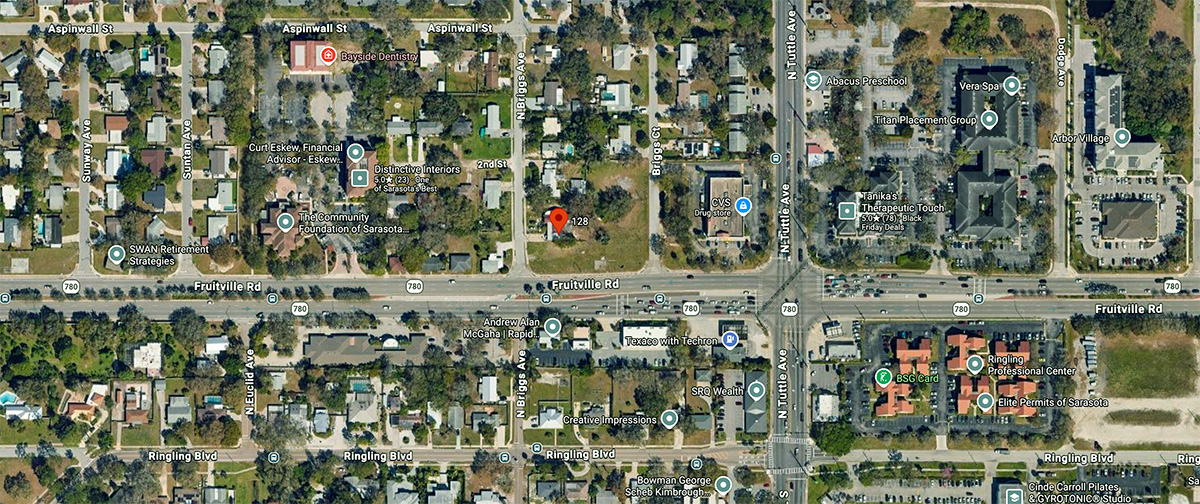
—The second unusual comment involves Goldberg’s own property line. The house sits on the smaller of her two lots, and Jenkins said the rezoning “will create a non-conforming side setback on the southern portion of 128 Briggs Avenue.”
—He offered two ways out. The line between the lots can be moved through a boundary adjustment to provide the required 10 feet, “or a condition could be proffered to merge the lots prior to the issuance of a temporary certificate of occupancy for the restaurant use.”
—Jenkins also put the applicant’s strongest argument into the record himself. The property is zoned single-family, he noted, which is not a district that implements its Urban Mixed-Use future land use designation. The MU-1 zoning being requested is.
—The Bus Stop at the Corner
—Sarasota County’s Breeze Transit asked for coordination on bus stop No. 334, which sits at Fruitville Road and North Briggs Avenue at the southwest corner of the property. Jenkins was quick to put it in perspective.
“This really won’t affect the rezone,” he said, “but in the event that you decide to expand operations further, include more people, and come back with a site plan, Breeze would like to be included in that.”
“I’m Saving Trees”
—City arborist Jackie Hartley read through the tree rules that will govern the site: no removal permits unless the code is met, stricter criteria for grand trees, protection zones shown on any future plan.
—Freedman, doing what consultants do, pinned down the timing. “So since this is just a rezone, are these really more advisory for when the site plan comes in?”
“I suppose, Joel,” Hartley said.
—The item was over. Tolner had announced the partial sign-off and was ready to move on. Goldberg was not.
“Can I make a statement?” she asked. Told she could, she turned to the arborist’s comments.
“I’m saving trees. I just want to let her know that,” Goldberg said. “They’re not going anywhere. There’s two beautiful grand oaks on it that are standing.”
—Anyone who has followed the fight over the 1899 Fruitville block will hear the echo. Two grand oaks stand on that block as well, and a promise to preserve them was one of the commitments Bristol made on its way through city review.
—How the Block Got Here
—In an Oct. 3 email to tenants, owners Alex and Marlene Lancaster said the contract with Bristol Development Group of Franklin, Tennessee, was no longer in effect and that they intend to keep owning and managing the property. “The property is not being offered for sale,” the email reads.
—As reported, the Lancasters said the property had never been listed, that Bristol approached them, and that a nondisclosure agreement kept them from discussing the deal with tenants while it was pending. The email did not say why the contract ended, and Bristol has not publicly explained it. Philip DiMaria of Kimley-Horn, who represented the project through city review, has confirmed that the transaction did not go through.
—Bristol’s plan would have covered about 3.44 acres and 22 parcels between Fruitville Road, Fourth Street, North Osprey Avenue and Gillespie Avenue with a five-story building and six levels of structured parking. It was close to the finish line. The same Development Review Committee gave it partial sign-off in July, and the Planning Board unanimously approved two design adjustments in August. Because the land is zoned Downtown Edge and no rezoning was requested, the project needed only administrative approval, with no City Commission vote.
—For the 17 locally owned businesses on the block, who had been told to expect 90 days’ notice to vacate after a closing, the clock has stopped.
—What Went Away With the Deal
—The collapse also took some things off the table. Bristol’s plan included 36 attainable housing units, a commitment to preserve the block’s two grand oaks, a publicly accessible green space, wider sidewalks, underground utilities and drainage improvements. DiMaria has said he hopes any future proposal carries those features forward.
—And the conditions that made the proposal possible remain. The cottages have no new protection. The zoning that allows a project of that scale without a public vote is unchanged. As reported, Realtor Mark Klecka of Coldwell Banker Realty expects another developer to approach the owners eventually. When the plan first surfaced in April, a Breakfast House manager said the landlord had long said he never intended to own the cottages forever.
—A Village Without Its Cottages
—The end of the sale saves the cottages where they stand. It also removes them from the Bungalow Village plan.
—In July, Discover Sarasota Tours owner Tammy Hauser told the City Commission that Bristol had agreed to sell the tenants their cottages once development began, so the buildings could be lifted and rolled a mile east. With no development and the Lancasters keeping their buildings, that option is moot.
—Hauser says the group is pressing ahead regardless. “We are committed to the Sarasota Bungalow Village vision and dream,” she has said. As reported, she plans to move a donated cottage to Briggs Avenue next summer and open there in October 2027, and she is asking any developer with a historic cottage in the way of a project to call. A second lead has turned up in Laurel Park.
The donated cottage is the 1920s bungalow at 1716 10th Way, offered by Sarasota Motor Club founder Scott Stevenson along with the money he would otherwise spend on demolition. That project was on Wednesday’s agenda too, one item ahead of the Breakfast House. The motor club application, which covers 1060 Goodrich Ave. and 1716 10th Way, also received partial sign-off. Its agent is Joel Freedman.
—The $2.43 million fundraising campaign for the village continues. At the July workshop, the group acknowledged that as for-profit businesses it would not qualify for the nonprofit funding it had hoped for.
—A Corridor in Motion
—The Breakfast House application makes a prediction that reaches past one corner. The city recently designated properties fronting Fruitville Road as Urban Mixed-Use on its Future Land Use map. “This is the first property to be rezoned in the area,” the filing states, “but eventually the entire frontage along Fruitville Road will be rezoned to one of the MU zoning districts.”
—That is the applicant’s forecast, not a city finding. But the agenda offered its own evidence that the corridor is changing. Before adjourning, staff announced the projects that had received full sign-off since the last meeting. Among them: 2250 Fruitville Townhomes.
—What the Neighbors Asked
—About a dozen people signed in at the July 28 community workshop at Selby Library. The summary minutes in the packet show a friendly room with practical concerns: whether the menu will change (it will grow, with gluten-free items and more coffee), where customers will park (not along Briggs Avenue, where a drop-off loop is planned for elderly and disabled guests), and whether the restaurant would help get the dirt stretch of Second Street paved.
—A couple on Briggs said they had been told they could not run a massage business from their home. The reply recorded in the minutes describes what the village is meant to be: “We are dealing with astronomical rent and our goal is to give some of these businesses affordable rent.”
—The Calendar
—At that workshop, the Breakfast House team described an ideal schedule: close downtown Jan. 2, reopen on Briggs Avenue Jan. 16. That schedule was drawn when eviction looked certain.
—Still ahead are full sign-off from the review committee, a public hearing before the Planning Board, action by the City Commission, the lot line fix, a building permit and a renovation. The city’s traffic memo also previews what a later site plan will require, including five-foot sidewalks and new curbing along both Briggs Avenue and Briggs Court, accessible ramps and crosswalks at Fruitville, and driveways set back at least 70 feet from the Fruitville curb.
—Without a sale, the Breakfast House has no notice to vacate hanging over that timeline. It does have a mortgage on an acre a mile east.
—What Comes Next
—The applicant owes the city a clearer survey and a narrative that names both parcels, and a decision on how to cure the setback. After full sign-off, the rezoning goes to public hearings, where the neighbors, the customers and the commissioners who have followed the cottages since April will have their say. Unlike the apartment project it was meant to escape, this one requires a vote of elected officials.
—Bristol has not said publicly why its deal ended. The Lancasters say they are not selling. The village remains a plan, a website and one donated bungalow.
—And on an acre of grass at Fruitville and Briggs, there is a 1956 house, a pending rezoning and two grand oaks that their owner has now promised, on the record at City Hall, are staying put.

