
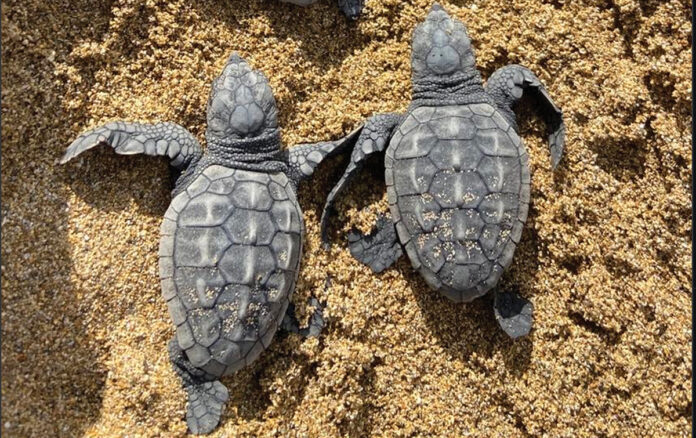
Nesting is nearly done and hatching is in full swing. The count is down from last year’s record and up from the year before, and the bigger question is whether up is good.
—She has been swimming for weeks.
—Somewhere out in the Gulf, off the Yucatán or the Keys, a loggerhead the size of a coffee table stopped eating crabs and turned north. She is perhaps 30 years old and 300 pounds. She has done this before, every two or three years, and she was born here, on this island, in a summer when the buildings along Gulf of Mexico Drive were fewer and darker. She carries a magnetic memory of this coastline that has never left her.
—A few hundred yards off Longboat Key she surfaces and lifts her head. What she is looking for is the oldest map in the world: a low dark shore in front of her, a bright sky mirrored on the water behind. If the dunes are dark, she comes in. If a balcony glows or a pool light burns, she may circle for an hour and give up. Turtle patrols call that a false crawl. On Longboat Key this year, turtles have turned back without nesting 1,889 times.
—Tonight the beach is dark enough. She rides the last of the tide onto the sand and drags herself, all of her, one flipper-length at a time, above the wrack line. A lounge chair someone forgot. A hole a child dug that afternoon. A scarp cut by last week’s tide. Any of them can end it. She clears them, finds sand that holds, and with her rear flippers digs a chamber the shape of a flask. She lays about 100 eggs the size of ping-pong balls, weeping salt from the glands beside her eyes. She fills the hole, scatters sand over it with a violence that looks like grief, and turns for the water. By the time the sky grays, only her tracks remain.
—At first light a volunteer finds them, and a yellow stake goes in.
—That is the battle. It is only the first one.
—Sixty days in the sand
—The eggs incubate for roughly two months, and the sand decides their fate. Too close to the water and a king tide or a passing storm rolls over the nest. Tropical Storm Bertha never came near Florida in July, but its precursor took out nest markers on Longboat, said Longboat Key Turtle Watch President Jeff Driver. An overwashed nest can still hatch. A washed-out nest, eggs scattered on the beach, cannot.
—Temperature decides something else. Sea turtles have no sex chromosomes. Warm sand makes females, cool sand makes males, and sand that gets hot enough makes nothing at all. Raccoons and ghost crabs dig for the rest.
—Nests have grown so dense that volunteers now closely monitor only about every fourth one, Driver said. Those get two extra “biangulation” stakes at the vegetation line, measured off the clutch, so the nest can be found again after a storm rearranges the beach. The others get a single stake and a prayer.
—The night they come out
—Hatchlings emerge at night, usually all at once, and they navigate the way their mother did: toward the brightest, lowest horizon. For 100 million years that was the sea.
—On the morning of Aug. 12, Longboat Key Turtle Watch reported about a dozen dead hatchlings near Gulf of Mexico Drive, drawn inland by lights. Survivors went to rehab. The same morning, Anna Maria Island Turtle Watch picked 55 dead hatchlings off a roadway. Through Aug. 13 that group had logged more than 3,000 disoriented hatchlings this season, 141 of them dead, and a 36 percent disorientation rate that already tops last year’s 31 percent. Twenty nesting adults had been turned around, too.
—Longboat’s ordinance calls for Gulf-side lights out between 11 p.m. and 5 a.m., and turtle watch volunteers patrol those hours looking for glare and for crawls veering the wrong way. After the Aug. 12 deaths they went to the town, and shields and amber bulbs went up on nearby fixtures.
—The moon did not help. The heaviest hatching this summer fell near the new moon, said Melissa Macksey, data manager for Mote Marine Laboratory’s Sea Turtle Conservation and Research Program, leaving almost no natural light on the water to compete with the porch lights. “Just trying our best to continue to work with these municipalities to reduce impacts, from the human side of things,” she said.
—The numbers
—Mote’s patrols cover 35 miles of beach from Longboat Key to Venice. Through Aug. 22 they had counted 4,923 nests: 4,731 loggerhead and 192 green. At the same point last year the count was 5,723. In 2024 it was 4,374.
—Longboat Key stands at 1,302 nests, against 1,471 a year ago and 1,258 in 2024. Casey Key, the eight-mile ribbon south of Siesta, leads the region as always with 2,269. Siesta has 557, Venice 645, Lido 150.
—Nesting is essentially finished. Mote logged nine new nests across its entire territory in the week ending Aug. 22, two of them on Longboat. From here to Halloween, the story is the hatch.
—Last year finished at 5,735 nests, the most in Mote’s 43 years of counting, along with a record 716 disorientation events. In 2007, the same beaches produced 735.
—Why 2025 was a freak
—Macksey is blunt about the comparison. Debris from the 2024 hurricanes happened to shield nests from inland lighting, and hatchlings did unusually well. “We had an insane season last year, so comparing to 2025 is kind of silly,” she said. “Every year is record breaking or second place or third place or top five, so we’re just increasing that baseline. Ten years ago if we had these numbers we’d be thrilled.”
—Jake Lasala, who runs Mote’s program, predicted in the spring that 2026 would fall short of the record but stay strong. So far he is right on both counts. The rising baseline is the real story, and it raises a question nobody on the beach wants to ask.
—Is more turtles actually good news?
—There are two answers, and both are true.
—The first is conservation. A loggerhead takes roughly 30 years to mature, so the females nesting on Longboat tonight hatched in the 1990s, when turtle excluder devices became mandatory on shrimp trawls, when Florida beach towns passed lighting ordinances, when nest marking and predator screens became routine. Lasala credits community-wide conservation and calls the trend heading into this season “incredibly encouraging.”
—The second answer is warmer. Florida sand has been producing overwhelmingly female hatchlings for years, and more females means more nests a generation later whether or not the population is healthier. A study posted in January by researchers on Cabo Verde, off West Africa, put numbers to that worry. Nest counts there rose roughly 100-fold since 2008; drone surveys found the breeding population about 90 percent female; and the best predictor of any year’s nest count was air temperature 31 years earlier. The authors call it a “demographic illusion,” a boom that looks like recovery until there are too few males to fertilize the eggs. They ran the same test on 27 other loggerhead populations, Florida’s included, and found the effect strongest on warm, low-latitude beaches with steady temperatures. The paper has not yet been peer reviewed, but the mechanism is not in dispute.
—So are stressed females laying more? Not exactly. A turtle in poor condition skips years rather than nesting harder. What stress is doing is quieter: tilting every nest toward daughters. And the daughters are coming home.
—The water she goes back to
—When she slips off Longboat before dawn she returns to a Gulf warmer than the one she was born into. Warm water lets females lay more clutches in a season and is nudging the season earlier, part of why the counts keep climbing. Ocean acidification, the same chemistry stripping the reefs Mote is racing to save in the Keys, works on her from the bottom of the food chain: loggerheads live on crabs, whelks and conchs, exactly the shell-builders that struggle in more acidic water. Red tide killed hundreds of sea turtles off Southwest Florida in 2018 alone. Add boat strikes, longlines, ghost nets and plastic, and state wildlife officials estimate one hatchling in a thousand survives to adulthood.
—Do the arithmetic on Longboat’s 1,302 nests. Call it 130,000 eggs. Even if every one hatched, that is about 130 adults, three decades from now.
—Ten more weeks
—Hatching runs through Oct. 31, and hundreds of Longboat nests have yet to open. The asks are small. Gulf-side lights off or shielded after 11 p.m. Blinds closed. Furniture, tents and toys off the beach at night. Holes filled, castles flattened. No flashlights, phone screens or flash photography on the sand. If hatchlings are heading for the road, don’t carry them to the water; call Longboat Key Turtle Watch or Mote, whose contacts are at LBKTurtleWatch.com, and let trained people handle it.
—Macksey, who has watched turtles confound every prediction her team makes, likes to say they are jerks. She also says not to be discouraged. Turtles lay too many eggs to mourn each one, and the trend line, whatever it finally means, still points up.
—The female will be back in two or three years. Whether she can find the dark is up to us.

