
For years, the story of the disappearing catch has played out just off our own beaches: a grouper or snapper hooked in 140 feet of water, reeled halfway to the boat, and then — in a swirl and a snap — gone, leaving the angler holding a rod, a fish head and a grudge. Now that very Gulf Coast frustration, and the Sarasota laboratory working to solve it, is getting a national close-up.
—Mote Marine Laboratory’s research into an electronic shark deterrent is featured in a new episode of the PBS documentary series Changing Seas, the lab announced on July 13. The episode, “Getting Sharked: Search for Solutions,” follows scientists as they test “repellent” technology designed to keep sharks off anglers’ lines — and to keep the peace between fishermen and the predators that have been rebounding along the Southeast coast.
—A Hometown Lab Takes the National Stage
—Changing Seas, produced by South Florida PBS in Miami and distributed nationally by American Public Television, has spent 18 seasons taking viewers underwater alongside working scientists. Its newest season hands an entire episode to a problem painfully familiar to anyone who keeps a boat at a Longboat Key or Sarasota dock: sharks stealing hooked fish faster than anglers can land them.
—The spotlight is a milestone for a local institution. Mote is the only congressionally designated National Center for Shark Research in the country, and its shark work stretches back nearly 70 years. Seeing that research carried into living rooms across the nation — under a title as plainspoken as “Getting Sharked” — is both validation and megaphone for science being done a few miles from St. Armands Circle.
—The Problem Has a Name — and Local Anglers Know It Well
—Scientists call it depredation: the partial or complete theft of a hooked fish by a shark before the angler can bring it aboard. To the men and women running charters out of our passes, it needs no definition.
—The complaints have become a chorus across Gulf fishing communities. One Bradenton-area charter captain described running six offshore spots in 140 to 150 feet of water and getting “sharked” on five of them — losing, by his own count, more than 20 fish in a single day. A 2022 national survey found that 77 percent of anglers had experienced depredation, with Florida standing out as a national hot spot. Snapper and grouper are the most frequently stolen prizes, followed by king mackerel, cobia, tuna and sailfish, and the losses spike during the very season openings anglers wait for all year.
—Why It Hits Home Between Longboat and the Reefs
—This is not an abstract national issue that happens to be filmed nearby. It is a Sarasota-and-Manatee story. The reefs and hard bottom off Longboat Key, Lido and Anna Maria are exactly the waters where the conflict runs sharpest, and the charter fleet that serves our islands absorbs the cost in lost fish, damaged gear and longer, more expensive trips to find water the sharks haven’t already claimed.
—Mote has been surveying sharks off Sarasota since 2003, sending crews into the Gulf every quarter to tag animals and track how fast their numbers are climbing. In one four-day stretch in 2021, researchers landed a record 104 sharks of eight species — a vivid measure of just how much company today’s anglers have on the water.
—The Breakthrough, by the Numbers
—The device at the heart of the episode is not theory. In a study published in the Journal of Fish Biology, Mote researchers reported hard evidence that an electronic pulse device can dramatically change shark behavior.
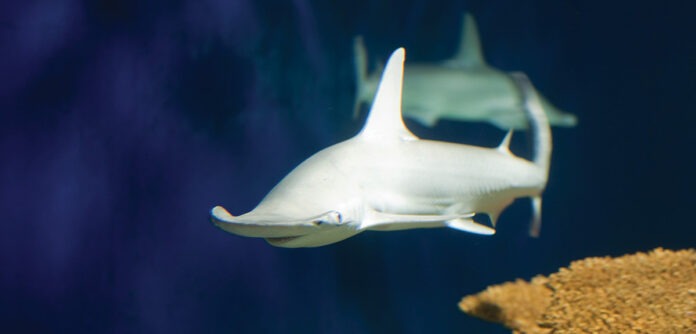
—Working with captive bonnethead sharks across 198 paired trials, the team compared an active deterrent against an identical but powered-off unit. The results were stark. With the device switched off, sharks took the bait more than 90 percent of the time; with it switched on, that dropped to roughly 46 percent. Put another way, the sharks were more than 45 times less likely to eat the bait when the deterrent was live. Even the sharks that did feed hesitated — approaching more slowly and, researchers noted, often recoiling in a sudden “rapid withdrawal.”
—Outsmarting a Shark With a Jolt No Bigger Than a Prank Pen
—The technology exploits a sense sharks have and humans don’t. Sharks hunt in part through the ampullae of Lorenzini — jelly-filled pores on their snouts that detect the faint electric fields given off by living prey. The deterrent, a commercial unit called SharkGuard made by the U.K. company Fishtek Marine, floods those receptors with brief electric pulses.
—The jolt is tiny — comparable, one Mote scientist has said, to the zap of a novelty prank pen — and it does not appear to harm the animal. It simply overwhelms a shark’s most sensitive sense, and the startled shark turns and flees. In the tank, some retreat to a corner and “sulk” rather than return to the bait. On working gear, the unit clips onto the line in place of a sinker, roughly 25 centimeters — about 10 inches — above the hook.
—Not a War on Sharks — a Truce
—Here is why the research matters far beyond the tackle box. Frustrated anglers have increasingly begun asking for sharks to be culled or removed from their fishing grounds — a demand Mote biologists warn runs directly counter to decades of conservation progress. A humane deterrent offers a third path: protect the catch without killing the predator.
—Dr. Demian Chapman, who directs Mote’s Sharks and Rays Conservation Research Program, frames it as a genuine win-win. Sharks, he notes, are only now beginning to recover in the U.S. Atlantic after heavy overfishing in the 1980s and ‘90s, and easing the conflict protects both the fishery and the fragile public support that made that recovery possible. Cutting depredation, he has said, keeps that support from eroding over time. Lead author and Mote senior biologist Jack Morris puts the alternative bluntly: anglers are now asking for the removal of shark species from their grounds, which undercuts the very conservation work Mote has pursued for decades.
—The stakes are not merely rhetorical. Some anglers have already taken matters into their own hands — dragging, shooting or knifing sharks — grim episodes that underscore why scientists are racing to put a nonlethal option in fishermen’s hands.
—Standing on the Shoulders of the “Shark Lady”
—The deterrent research is the latest chapter in a story that began with Mote’s founder. Dr. Eugenie Clark — the pioneering scientist known worldwide as “The Shark Lady” — was among the first to investigate natural shark repellents, showing in the 1970s and ‘80s that a Red Sea sole secretes a chemical sharks avoid. Mote’s former director, Dr. Perry W. Gilbert, tested a repellent called “Shark Chaser” for the U.S. Navy. The new work — funded in part by the endowed chair that now bears Gilbert’s name, along with federal fisheries grants and the Roe Foundation — carries that legacy from chemistry into electronics. Notably, Mote and its scientists report no financial stake in Fishtek Marine, and the company neither funded nor designed the study.
—What’s Really at Stake: A Multibillion-Dollar Coastline
—Recreational fishing is not a side hobby in Florida; it is an economic engine. State anglers have generated billions of dollars in annual economic activity and tens of thousands of jobs — figures anchored by a coastline that includes our own. Every fish lost to a shark is a small subtraction from that ledger, and mounting frustration has already pushed the conflict into politics. Federal legislation introduced in 2025, the Florida Safe Seas Act, sought to curb shark feeding off the state’s coast, a practice some blame for concentrating sharks near popular fishing grounds.
—A deterrent that actually works could take pressure off both the fish and the policy fights — letting anglers keep their catch while letting managers keep the conservation gains that have made Florida’s waters, for better and worse, so full of sharks.
—What Comes Next
—Mote’s scientists are careful to call this a first step, not a finished product. The published trials involved bonnethead sharks — a small, manageable species — in controlled tanks, and the team has also begun testing on sandbar sharks, one of the wild culprits anglers actually contend with. Different species lean on their electric sense to different degrees, so the next phase pushes the work toward real-world conditions and the larger, hungrier sharks doing the most damage on the reef. It is not yet a gadget you can buy at the local bait shop — but the Changing Seas episode makes clear it is moving in that direction.
—Where to Watch
—The full episode, “Getting Sharked: Search for Solutions,” is streaming now as part of the current season of Changing Seas and airing on public television stations nationwide. Mote has also released a companion video highlighting the research, available through the laboratory’s news page. For island anglers who have watched a trophy fish vanish in a boil of white water, it may be the most satisfying half-hour of television this summer.

