
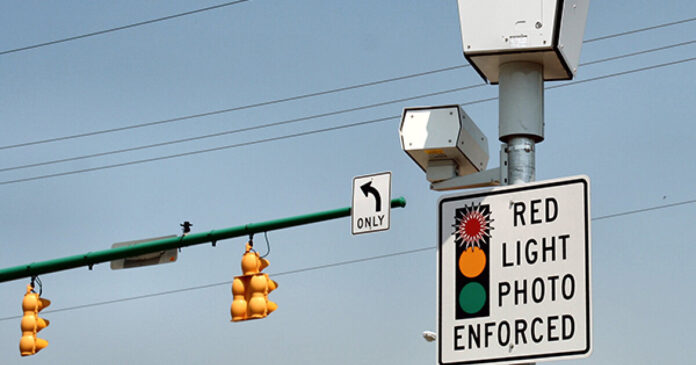
In the 12 months that ended June 30, cameras in the City of Sarasota generated 66,984 notices of violation. That is 183 a day, every day of the year, without a single officer pulling a single car to the curb.
—A camera recorded the car. A police employee reviewed the clip. A notice went out in the mail. Drivers paid just over $7 million.
—Those figures come from two annual reports the Sarasota Police Department presented back to back at the City Commission’s Oct. 5 meeting: one on the school zone speed cameras that went live in January 2025, the other on the red light cameras the city has run in one form or another since 2011. State law requires the reports. Together they took about 16 minutes, drew no public comment and were accepted unanimously.
—They also showed, line by line, who gets the money.
—The school zones: 34,038 notices in the first full year
—The School Speed Zone Safety Program covers six schools with 22 cameras: Cardinal Mooney High, Sarasota High, Sarasota Military Academy, and Alta Vista, Southside and Tuttle elementary schools.
—From July 1, 2025, through June 30, 2026, the program issued 34,038 notices, John Lake, manager of the department’s Real Time Operations Center, told commissioners. Spread over a 180-day school year, that is roughly 190 per school day.
By the end of the fiscal year, 24,614 had been paid. Another 6,596 went unpaid past the 30-day deadline and were converted to uniform traffic citations. Only 114 drivers contested. A hearing officer upheld 102 and dismissed 12.
—Where each $100 goes
—Total school zone revenue was $2,661,200. The report broke it down:
—City of Sarasota: $1,037,868
—State of Florida: $532,240
—Sarasota County Schools: $319,344
—Crossing guard fund: $133,060
—Florida Department of Law Enforcement training: $79,836
—RedSpeed, the camera vendor: $558,852
—Those are fixed slices of each $100 fine: $39 to the city, $21 to the vendor, $20 to the state, $12 to the school district, $5 for crossing guards and $3 for police training.
“This is all broken down into percentages according to per violation,” Lake said.
—The vendor’s cut tops the schools and crossing guards combined
—RedSpeed’s $558,852 is 21% of everything drivers paid. It is more than the school district and the crossing guard fund received together, which was $452,404.
—No commissioner asked about it. The $21 share is the standard arrangement RedSpeed has with Florida cities and counties that adopted school zone cameras after the Legislature authorized them in 2023. The company has said the cameras generated more than $66 million in paid fines statewide by early this year. Critics have called the programs a money grab, and a Hillsborough County magistrate who heard hundreds of appeals called his county’s a rip-off. Police chiefs say the money is beside the point.
—One wrinkle: $2,661,200 works out to 26,612 fines at $100 each, about 2,000 more than the 24,614 violations the report lists as paid. The report does not explain the difference.
‘Where is the rest?’
—Commissioner Jen Ahearn-Koch pressed on the gap between tickets written and tickets paid.
“Notice of violation issued, 34,000. Violations paid, 24,000,” she said. “Where is the rest?”
Lake said a ticket written in May or June may not come due until after the books close. “We’re always playing catch-up,” he said. A driver who does not pay within 30 days gets a second review by police, then a uniform traffic citation by first-class mail, and the cost rises from $100 to $208.
—Ahearn-Koch worked the math aloud and concluded the truly outstanding number was a few thousand, not 10,000. Lake agreed. By the report’s figures it is about 2,800.
—Police: speeding is down 70%
—Vice Mayor Kathy Kelley Ohlrich asked the question a parent would ask: is there any data on safety?
—Lake said the vendor ran a five-day count at city schools in the spring of 2024, before the cameras existed. On Fruitville Road in front of Cardinal Mooney alone, that count logged more than 17,000 vehicles going at least 10 mph over the limit, police said at the time. When the first school year under the cameras ended, Lake said, violations were down about 70% from that baseline.
“It continues today, that rate of 70% reduction,” he said. “And I think it’s probably going to stay that way now that obviously everybody knows not to speed in a school zone.”
“Well, yes,” Ohlrich said. “I’m one of them.”
—The room laughed. For anyone walking a first-grader across Tuttle Avenue at 8 a.m., it is the whole argument.
—The flashing light problem
Ahearn-Koch then raised the complaint that has dogged these cameras across Florida.
“I have received comments from citizens about receiving a citation and the lights were not flashing,” she said. “No one has time to read the signs as they are going down the street, and if the lights aren’t flashing, they don’t think it is being enforced at that moment.”
Lake explained that state law allows the cameras to run the entire time school is in session. When the yellow beacons flash, the reduced limit applies and the camera triggers at 11 mph over. Outside those windows the cameras stay on and enforce the regular posted limit, again at 11 over.
—31 in a 20, or 56 in a 45
He used Fruitville Road at Cardinal Mooney as the example. When the lights are flashing, the limit is 20 and a driver gets a notice at 31. At 11 in the morning, with class in session and the lights dark, the limit is 45 and the notice comes at 56.
—What if the beacon is broken during drop-off, Ahearn-Koch asked, and does not flash when it should?
“If it’s not flashing, we all go back to the posted speed limit,” Lake said. “You’re not going to get a ticket until you get to that 56.”
“I’ve had folks come to me and say it was during the school time, the light was not flashing, but they still got a ticket,” she said.
“That is because they are going over the posted speed limit of 45,” Lake said. “When those people call you, the only reason they are calling you is because they are going 56 miles an hour or higher.”
“That’s not what I’ve been told by them, of course,” Ahearn-Koch said.
—Lake called it “the biggest misconception of the program.” Ahearn-Koch said she had a specific case in which “there’s no way they were physically going over that speed limit,” and would take it up with police later.
—The intersections: 32,946 red light notices
—The second report covered the Intersection Safety Program, the city’s name for its red light cameras.
Those cameras issued 32,946 notices in the same 12 months, about 90 a day. Drivers paid 25,793. Another 4,710 became uniform traffic citations. Just 68 were contested, and the driver won once.
Revenue was $4,378,524.43. The state received $2,128,950. The city received $2,249,574.43.
—A red light camera ticket in Florida is $158. Under state law, $83 goes to Tallahassee, most of it to general revenue with smaller pieces for trauma centers and brain and spinal cord injury research, and the local government keeps $75.
—What the red light report left out
The school zone report listed what RedSpeed was paid. The red light report did not. Its revenue slide has two lines, city and state.
—The difference is in how the vendor is paid. In school zones, RedSpeed takes a cut of each paid ticket. For red light cameras, the city has paid the company a flat monthly fee out of its own share. Under terms in place when the commission last extended the contract in public, in 2023, that was $3,500 a month for each camera approach, or $840,000 a year for 20. The city has added cameras since. What it paid RedSpeed in the past fiscal year was not presented.
More cameras, more tickets
—The count is up. The city’s red light cameras issued 25,861 notices the year before, according to last year’s report. In the spring of 2025 the police department announced six more camera approaches, on Washington Boulevard at Mound Street, 12th Street and Fruitville Road, on South Tamiami Trail at Waldemere Street and on North Tamiami Trail at Myrtle Street.
Ahearn-Koch asked whether violations were not supposed to be going down.
Lake said he anticipated the question. Because the new cameras would skew the comparison, he ran the numbers on only the 20 that were operating in both years. Otherwise, he said, the question becomes “why are we making more money if the program is going down?”
“Twelve of the 20 locations went down,” he said. “And it was an overall of 18% reduction.”
What does that indicate, Ahearn-Koch asked.
“That people are paying attention to the red light cameras, or red lights, actually, to not get a violation,” Lake said.
—Do they prevent crashes?
—Mayor Debbie Trice asked the question that has followed red light cameras since they arrived in Florida: any statistics on collisions at those intersections, before and after?
—Lake did not offer any.
“It’s hard to do that,” he said. He pointed to distracted driving and to a change in signals. When the program began, he said, the intersections had dedicated left-turn arrows. Many now have flashing yellow arrows, and drivers turn in front of oncoming traffic.
“Yes, it’s going to show that there is an increase of crashes, but it’s not because people are running the red lights,” Lake said.
—As for rear-end collisions, the crash type critics most often blame on the cameras, he said the cause is hard to pin down. “If I show up to the crash, the person is not going to tell me that they were texting on their phone, because it’s another ticket.”
—What the state’s numbers show
—The state has tried to answer the question. The Florida Department of Highway Safety and Motor Vehicles compiles crash counts near camera intersections each year. Its report for fiscal 2023-24 compared 174 intersections in 31 jurisdictions before and after cameras went in and found total crashes rose from 17,093 to 18,615, with rear-end and angle crashes both up and injury crashes slightly down. For Sarasota’s intersections it listed 1,958 crashes before and 2,001 after.
—The department cautioned that many factors are in play, including a 25% increase in miles driven statewide over the period.
How Sarasota got here
—The city’s first red light camera began issuing tickets on Dec. 1, 2011, at Bahia Vista Street and Tuttle Avenue, under a contract with American Traffic Solutions. When commissioners approved the program that year, the city was counting on about $400,000 in first-year revenue to help balance its budget.
—In January 2018 the commission voted 3-2 to switch vendors to RedSpeed, a move presented as saving about $19,000 a month. The no votes were Hagen Brody and Ahearn-Koch. “We shouldn’t be turning to these types of devices for revenue,” Brody said at the time.
—The city extended the RedSpeed contract 4-1 in 2022, with Brody again dissenting, and unanimously in 2023. In November 2024 the commission unanimously approved RedSpeed for the school zones. Those cameras went live Jan. 6, 2025.
—The feature Sarasota turned down in 2018
—The 2018 vote had a second part. RedSpeed offered, at no extra cost, to equip six intersections with license plate readers. The detective presenting the contract, John Lake, said they would be used for Amber and Silver alerts. Brody objected to what he called the surveillance aspect, and the commission approved the contract without the readers.
—Eight years later the subject came back around. Public comment at the Oct. 5 meeting included three speakers urging commissioners to rein in or remove the city’s Flock license plate readers, two of them citing the August arrest of a Sarasota police officer accused of misusing the system. Trice asked Lake twice, once for each report, whether the governor’s recent order pulling plate readers off state roads puts the ticket cameras at risk.
“It is not,” Lake said. “This is not a license plate reader system at all.” The school zone law, he said, specifically bars using the cameras that way.
—At the end of the meeting, City Manager Karie Friling told commissioners the safeguards speakers asked for on plate readers are done or underway, and defended the broader direction.
“We cannot lose sight that as our resources continue to shrink and we have less bodies that we can put on the street, that we have to use technology in the most appropriate way possible to continue to keep Sarasota safe,” she said.
—Other cities have pulled the plug
Not every government has stayed the course. Manatee County commissioners voted 5-2 in March 2025 to end their school zone cameras after more than 55,000 notices and complaints that the cameras ran all day. One commissioner called the program a money grab, and the sheriff said he had never supported enforcing when the lights were not flashing. Palm Bay suspended its cameras twice over inaccurate tickets. Osceola County and St. Cloud paused theirs. Boca Raton tickets only when the beacons flash.
—In May a Broward County traffic hearing officer threw out the school zone cases in his courtroom after a defense lawyer argued the radar unit in the cameras was never approved by the state. The same firm has said it expects to make that argument in Sarasota and Manatee. A bill that would have required flashing beacons wherever the cameras enforce the reduced limit died in the Legislature in March.
—Red light cameras have survived repeated repeal attempts in Tallahassee, including a bill the Florida House passed 83-18 in 2018 that stalled in the Senate.
—The bottom line
—Add the two reports together:
—Notices issued: 66,984
—Paid by drivers: $7,039,724
—To the City of Sarasota: $3,287,442
—To the State of Florida: $2,661,190
—To the school zone vendor: $558,852
—Tickets contested: 182
—Tickets dismissed: 13
—The six school zones, which are enforced only when school is in session, produced more notices than every red light camera in the city running around the clock.
Police say the cameras are doing what they were bought to do. Fewer drivers are flying past Cardinal Mooney at dismissal, and fewer are running the same red lights they ran a year ago. No one at the meeting argued otherwise.
—Still, somewhere in Sarasota today a driver is opening an envelope, certain the lights were not flashing.

