
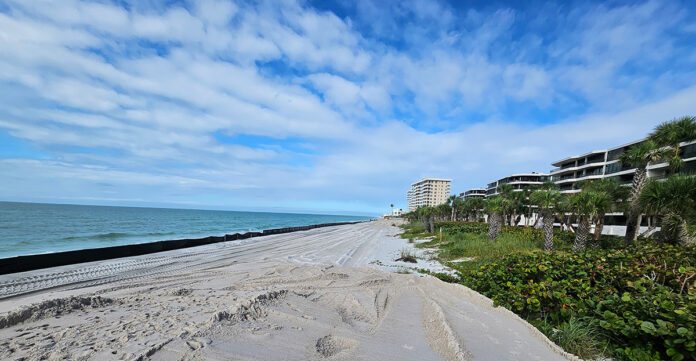
Two years after storm surge swamped its garages, wrecked dozens of cars and took nearly half its dune, the 181-unit Sanctuary at Longboat Key Club is finishing a nearly $1.4 million dune rebuild and has fitted every garage and lobby opening with custom flood barriers. The owners paid for all of it themselves.
—On the night the hurricanes came for Longboat Key, the Gulf of Mexico did something it is not supposed to do.
—It crossed the beach. It crossed the pool deck. It crossed Longboat Club Road and spread over the Longboat Key Club golf course until, from the upper floors of the Sanctuary Condominium’s five Gulf-front buildings, there was no telling where the Gulf ended and the bay began. Palms stood in open water. Putting greens floated like islands.
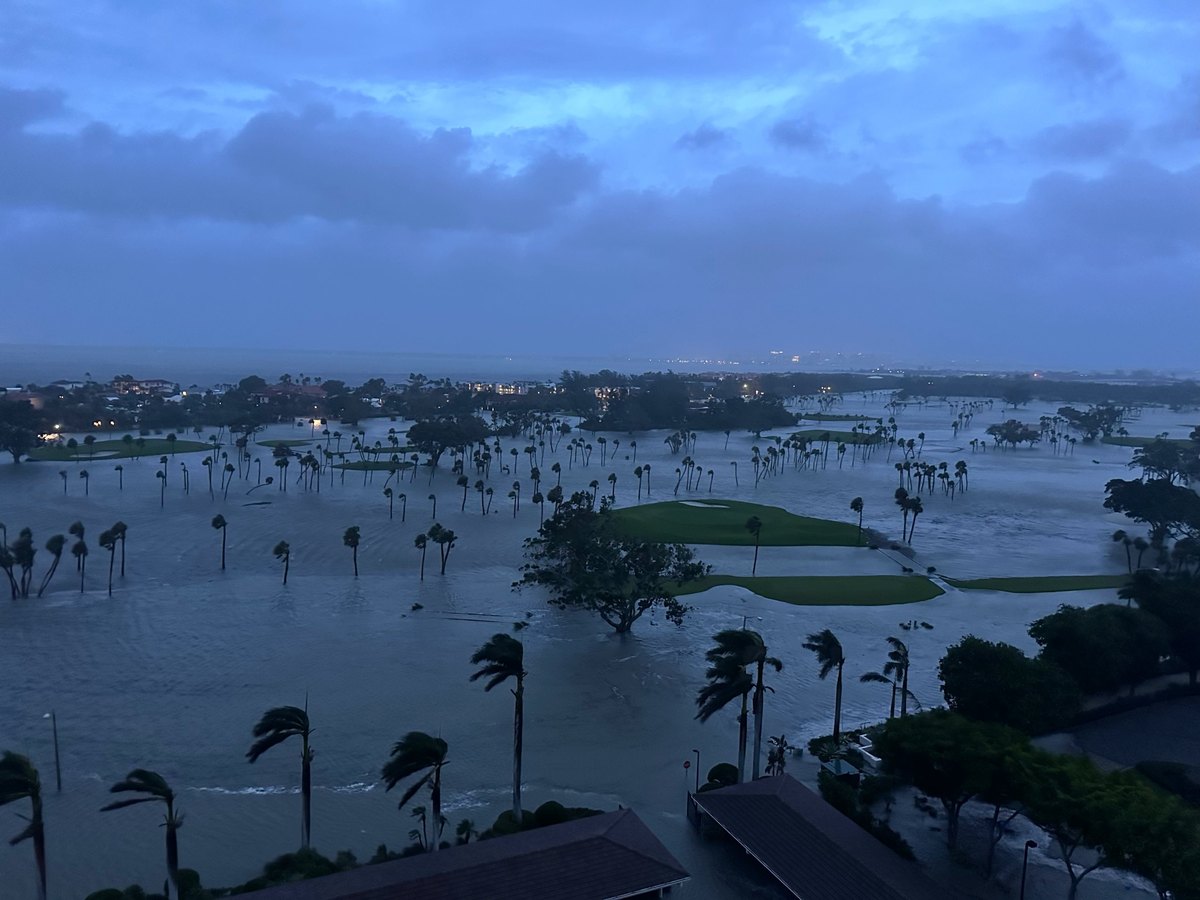
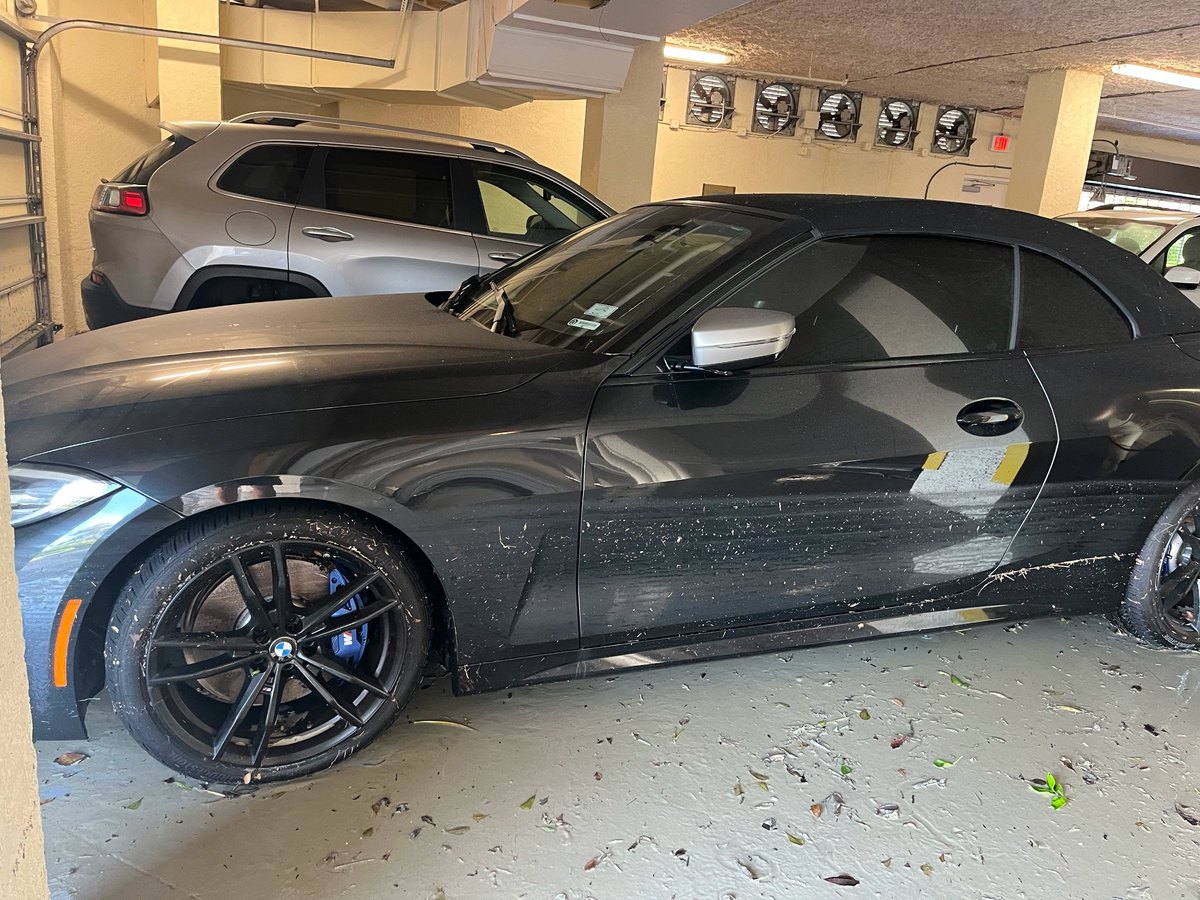
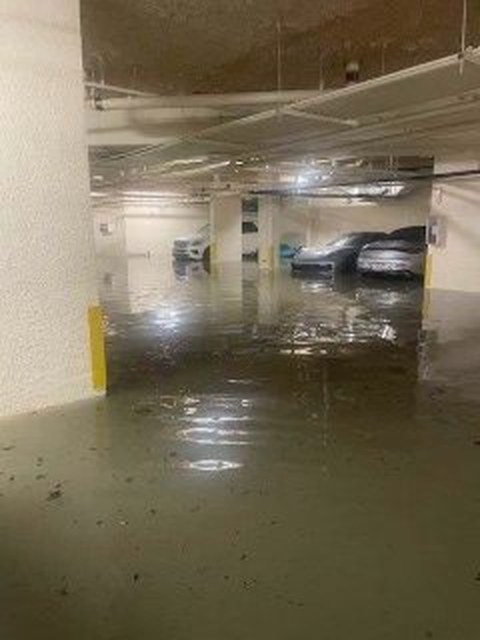
—Down below, in the garages, it was worse. Somewhere between 40 and 50 residents’ cars were destroyed. Jeffrey A. Lenobel, president of the Sanctuary’s community association, lost two of them.
“The water with velocity comes from the ocean,” said Alain Bankier, the board member who heads the community’s dune committee. “The water rising comes from the bay.”
—At the Sanctuary in 2024, it came from both.
—More than two years later, the community has decided it will not be caught that way again.
—This month, a steady parade of dump trucks has been hauling sand from a mine near Fort Myers through the Longboat Key Club gates to rebuild 1,300 feet of dune along the Sanctuary’s beachfront, a project that runs just under $1.4 million. At the same time, the association has armed its maintenance crew with a custom-built flood barrier system that can seal just over 90 garage and lobby openings across all five buildings in about an hour per building.
—There is no FEMA money behind any of it. No grants. No federal dollars of any kind. The owners of the Sanctuary’s 181 units paid for it through assessments they approved nearly unanimously, and the people who built that consensus say it may be the most remarkable part of the story.
“We are unique in that we talked about it, executed it and did it,” Bankier said.
—The Night the Gulf Joined the Bay
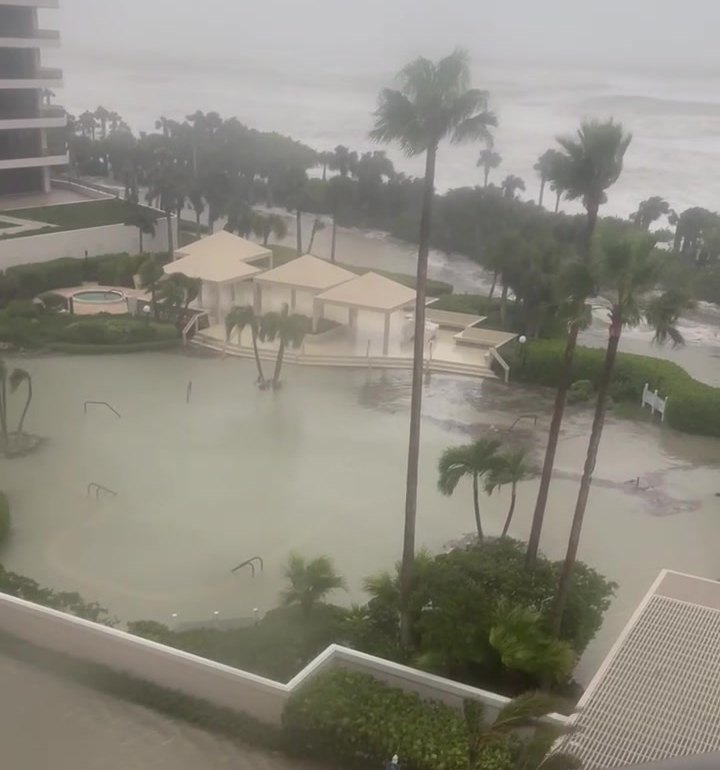
—The Sanctuary sits on 18 beachfront acres behind the guard gates of the Longboat Key Club on the south end of the island: five mid-rise buildings dating to about 1990, multimillion-dollar residences, a resort-style pool, tennis courts and roughly 1,300 feet of Gulf beach out front.
—The back-to-back storms of 2024, Helene in late September and Milton two weeks later, did not knock those buildings down. They did something more insidious. They washed through them.
—The community lost about 45 percent of its dune. The pools went under. The landscaping was all but erased; nearly every shrub and smaller understory tree on the property was gone, leaving the palms and a handful of mature oaks standing over bare ground. The lobbies of the south and middle buildings were lost. With roughly 250 parking spaces tucked beneath and beside the buildings, the garages filled with water, and the cars went with them.
—Lenobel’s description of the property afterward was blunt: The entire place was flooded out.
—Lisa Heath, the Sanctuary’s assistant manager, was on the job through all of it. She and the general manager at the time organized the recovery, and a crew of 50 pre-contracted laborers showed up immediately after the storm to jumpstart the cleaning and restoration process.
—Lenobel said the storms taught the community a hard lesson about where its defenses ended.
“The building was the last point of defense,” he said.
—Once the water reached the buildings, in other words, the buildings were all that was left.
—The Dune Did Its Job
—Here is the part that surprises people: The dune worked.
—When the association’s coastal engineers at First Line Coastal assessed the damage, Bankier said, their first message was that the dune had done exactly what it was built to do.
“The first thing First Line Coastal told us: They did their job, the dunes,” he said.
—A dune is not a wall, and nobody at the Sanctuary pretends it is. Water can and did get over it. What a dune does is take the punch out of the surge. It absorbs the force of the water and the wave action so that by the time the Gulf reaches the buildings, it arrives as rising water rather than a battering ram. The difference between those two things is the difference between a soaked lobby and a structural failure.
—That makes a dune, in a worst-case storm, a sacrificial investment. Board members describe it plainly: a million-dollar investment designed to be spent so the buildings behind it are not. It is also the first line of defense, and the Sanctuary had lost nearly half of it.
—Committees, Not Commands
—Lenobel knows his way around a big real estate problem. A retired attorney who divides his time among Longboat Key, New York City and Fire Island, he chaired the Real Estate Department for decades at Schulte Roth & Zabel, a prominent New York City law firm, and served on its Executive and Operating Committees. He sits on the board of the Asolo Repertory Theatre, co-chairs the board of the Forum on Life, Culture & Society and serves on a number of real estate-related and other boards.
—Lenobel, who has led the Sanctuary’s association since the COVID years, could have run the recovery from the board table. He chose not to.
—Instead, he set up committees, each with its own piece of the problem. That puzzle included the dune and beach, flood mitigation, the hardening of the buildings and the replacement of all the lost landscaping. The approach was comprehensive by design: Figure out the true cost of what was lost, and get ready for the next storm at the same time.
—The committees turned into something like an army. About 50 of the Sanctuary’s 181 unit owners ended up serving on one committee or another. They brought in professionals, gathered information and did their own research. In the process, they did something harder to measure: They built a consensus before anyone asked owners to write a check.
“A lot of harmony has been through Jeff’s leadership,” Heath said. A summary of the strategy fits on a bumper sticker: “Build consensus first, then a dune.”
“We were transparent from beginning to end,” Lenobel said.
—That transparency got tested, because the bills arrived in stages. Owners knew from the start that a disaster meant an assessment, one covering the dune, the landscaping, the lighting, the pools and the tennis courts. Then the first construction bids came in.
“We did have sticker shock,” Bankier said of that first round of bids, which brought a second assessment on top of the first.
—Lenobel talked openly about assessment fatigue. Even so, he said the support from owners was overwhelming and close to unanimous, and owners voted to bring in 9,775 cubic yards of new sand.
“Everyone reached into pockets,” Lenobel said.
—Two Summers of Crossed Fingers
—Deciding to rebuild was the easy part. Getting permission took far longer.
—The project needed two major approvals, one from the Town of Longboat Key and one from the Florida Department of Environmental Protection, which issued state permit ST002688 for the work. Both took a long time. The Sanctuary is among the first condominium associations on the Key to secure a permit for a dune restoration project of its own.
“The town was cooperative,” Bankier said, though the committee still had to grind through its share of bureaucratic red tape. It helped that First Line Coastal had worked with the town before.
—Then came the calendar. Sea turtle nesting season on Sarasota County beaches runs May 1 through Oct. 31, and heavy equipment is off the sand for all of it. Starting in the spring would have meant racing a May 1 deadline and risking a half-built dune left exposed all summer. The committee chose to wait.
“The timing of it is delicate,” Bankier said. “You cannot work during sea turtle season.”
—So the Sanctuary did the one thing it could not control: It waited, and it hoped. The community went through two hurricane seasons with a dune that had lost nearly half its sand, crossing its fingers that nothing big would come ashore. This year, nothing did.
—Crews mobilized in early November, as soon as turtle season closed. The first truckload of sand rolled onto the property at about 10 a.m. on Nov. 16.
—Truck by Truck
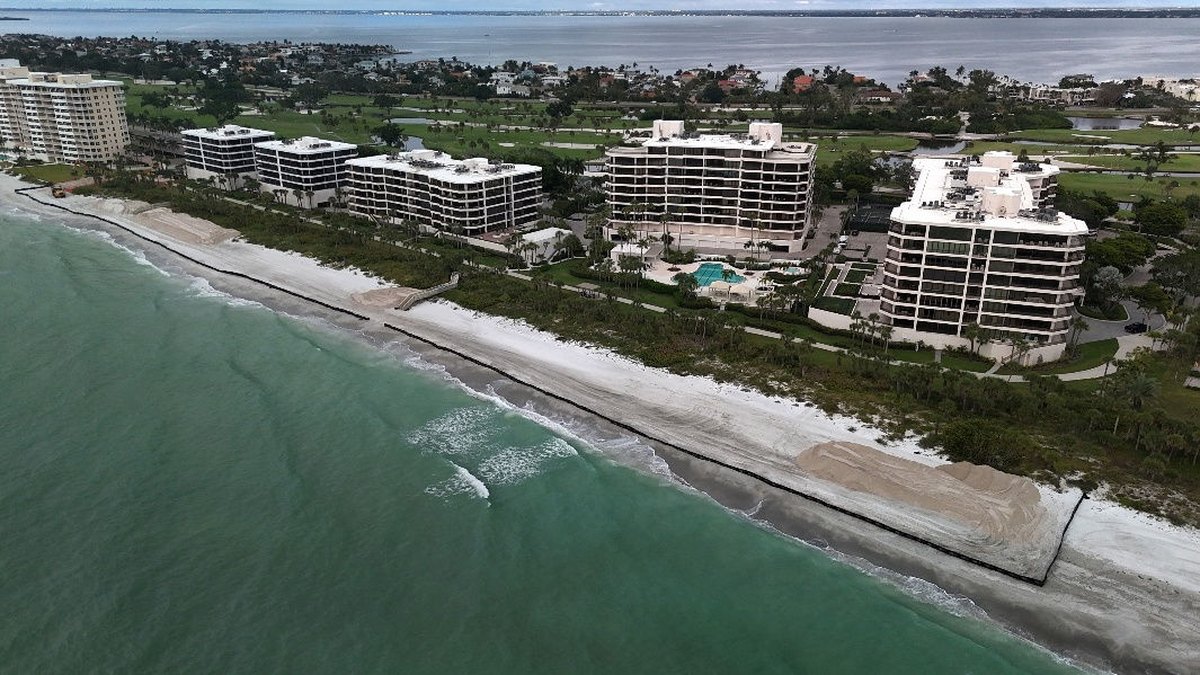
—If you have driven Longboat Club Road this month, you have seen the project before you saw the beach.
—The contractor, ICS Materials, Inc., is hauling sand from an upland mine near Fort Myers. First Line Coastal, with project manager Mark Stroik, has an inspector on the beach every working day, logging every truck, every ton and every problem in a daily field report.
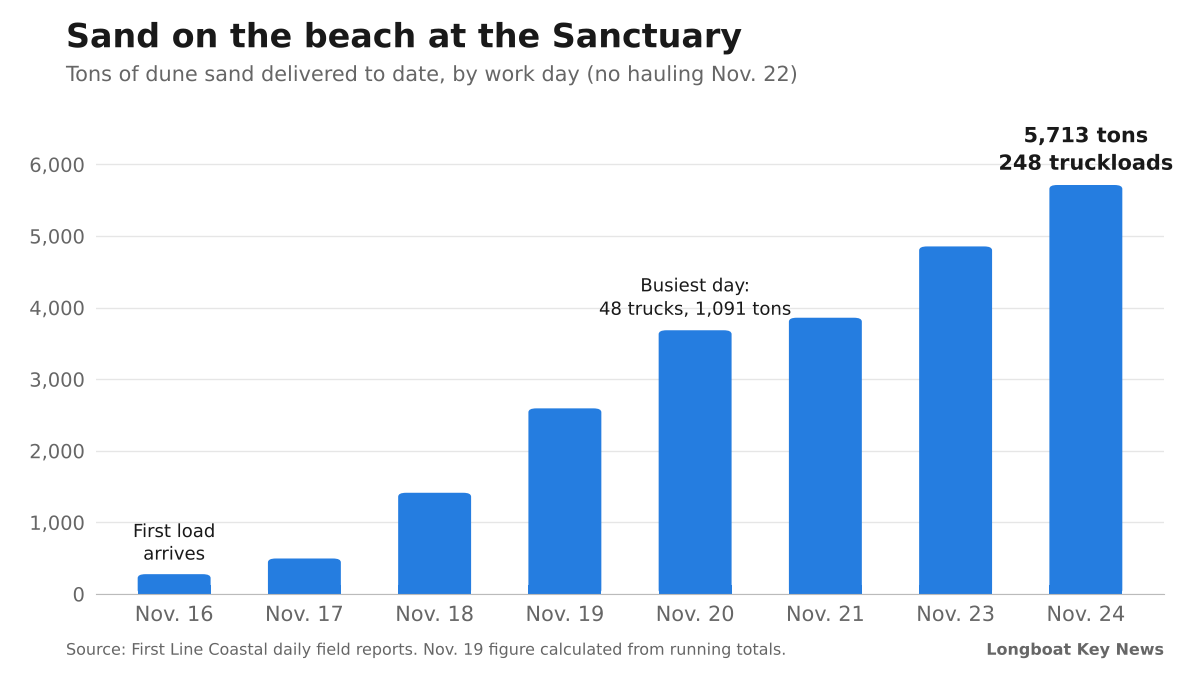
—Those reports tell the story in numbers. Eleven trucks came on the first day. By the time crews broke for Thanksgiving on Nov. 24, 248 truckloads carrying 5,713 tons of sand had come through the gate. The busiest day so far was Nov. 20, when 48 trucks delivered 1,091 tons. Because the mine pit closes on Saturdays, trucks are filled on Fridays and roll in first thing Saturday morning.
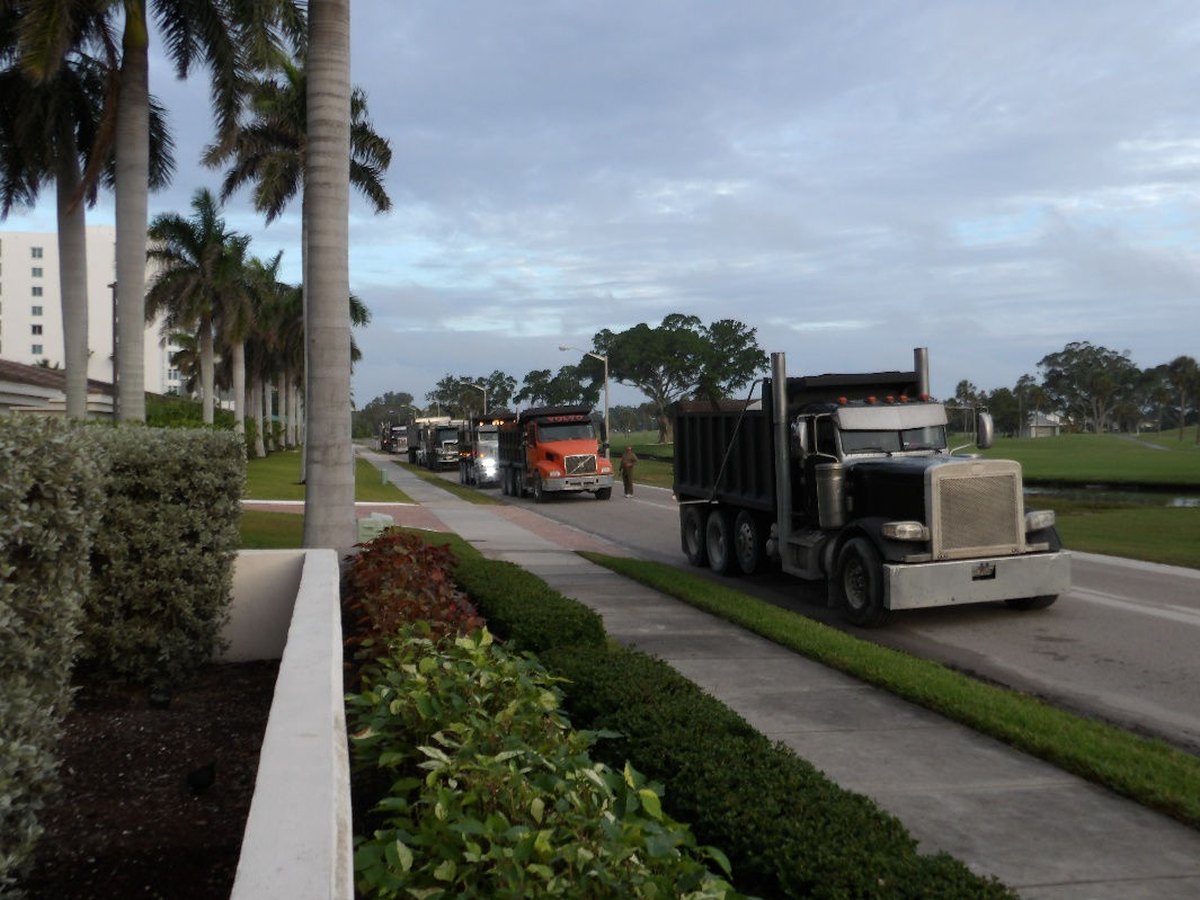
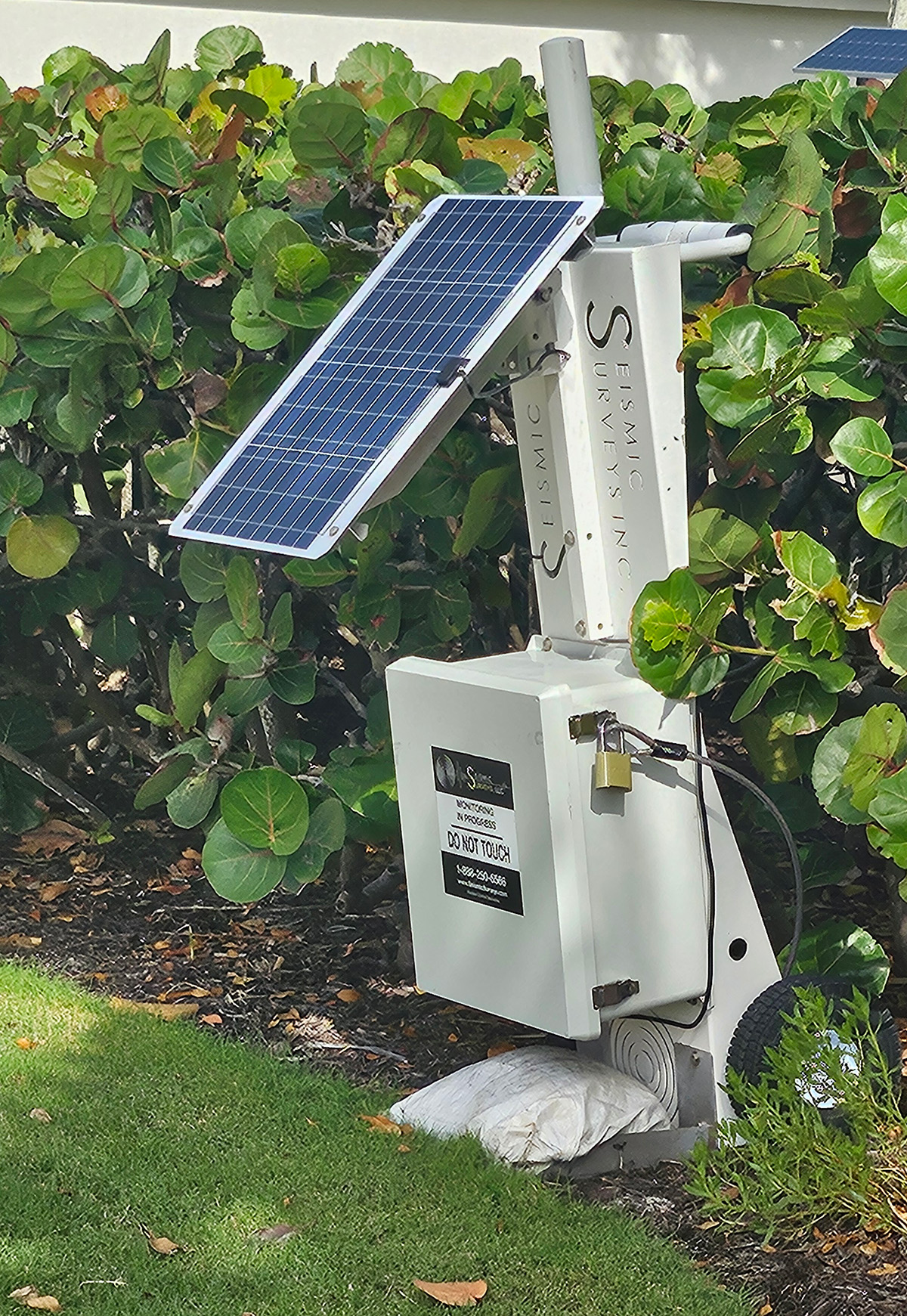
—Not just any sand will do. On the first day, the engineers, the contractor and a representative of the mine went over the sand’s grain size, color and moisture before the contractor got conditional approval to start placing it on the beach. When a delivery truck’s hydraulic system failed on Nov. 20 and spilled fluid into the staging area, the contaminated sand was pushed aside into its own pile, kept out of the dune, and the load was not counted toward the total.
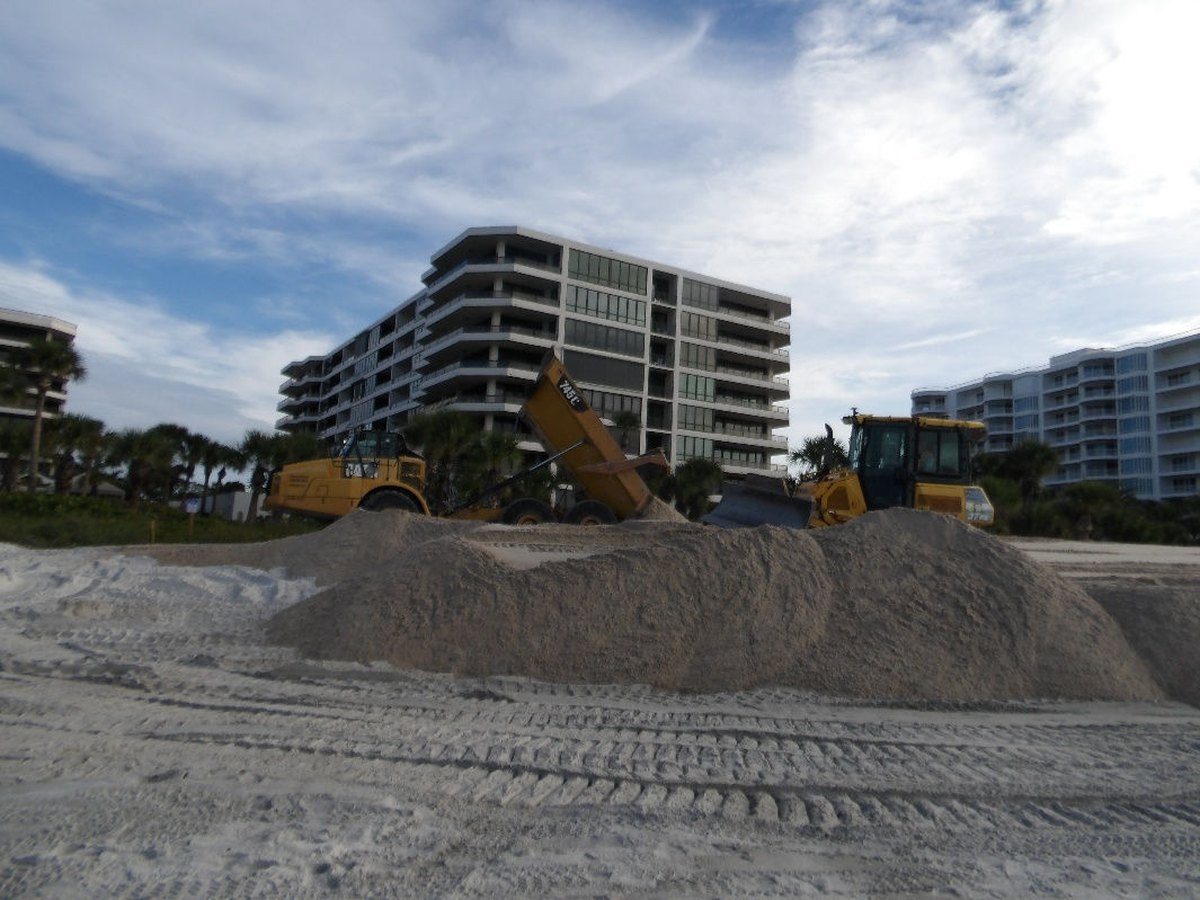
—The rest of the operation runs like a small construction site dropped onto a beach. Sand is dumped in a staging area, pushed seaward by a Komatsu dozer, carried down the beach in a CAT articulated dump truck and shaped by an excavator and skid steers. Three seismometers sit on site to track vibration from the heavy equipment working beside the buildings. A line of black silt fence marks the work zone, and because high tides kept knocking it down overnight, crews now pull it up every evening and put it back every morning.
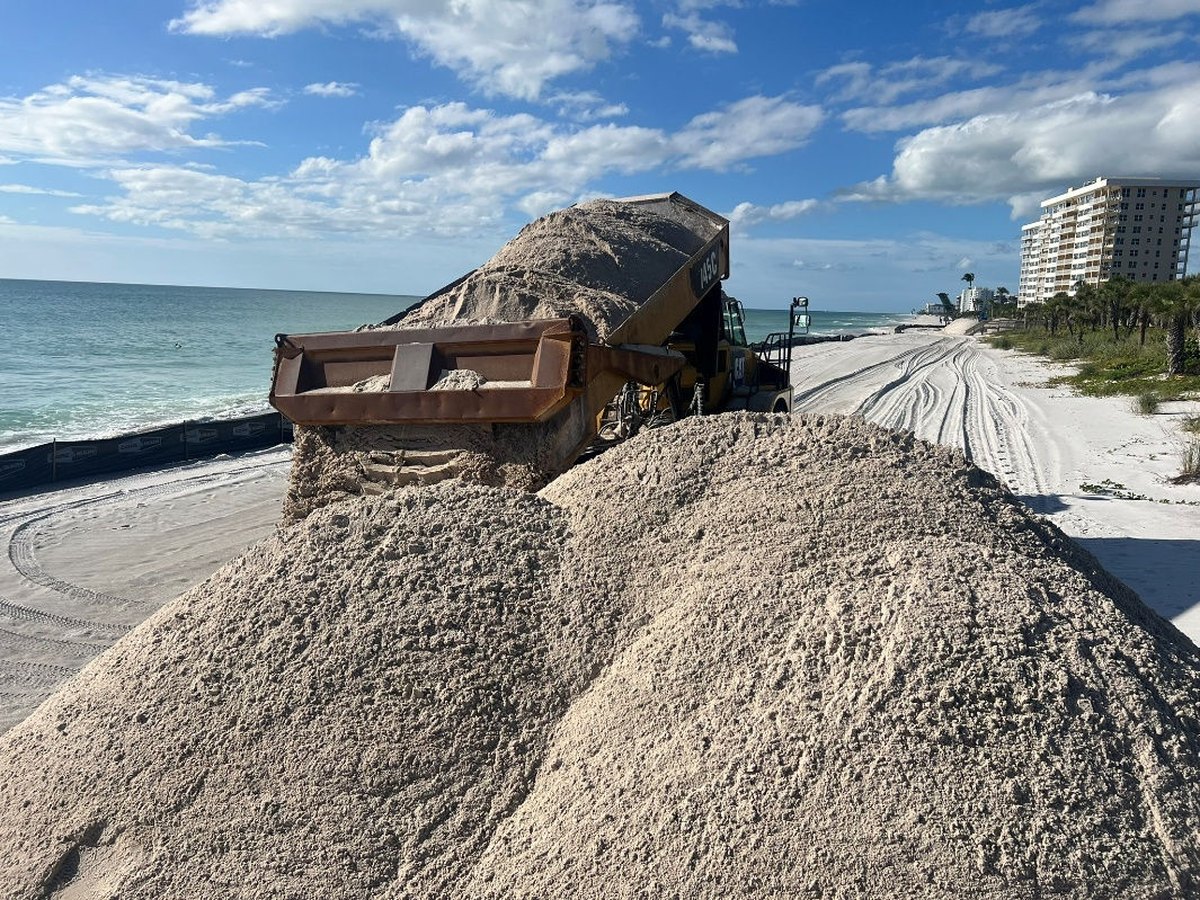
—A parade of heavy trucks through a gated golf community is not invisible, and the field reports are candid about it. Some trucks staged on Gulf of Mexico Drive before the gates opened. Residents of Longboat Key Towers complained about dump trucks waiting on Longboat Club Road in front of their building. Larger trucks rutted the golf course side of the road, and the contractor laid down extra matting and posted flaggers. Each problem was logged, assigned and addressed.
—Drones, GPS and a Two-Crest Design
—The precision is the part that would surprise anyone who thinks dune building means dumping sand and smoothing it with a rake.
—Every afternoon, a drone flies over the beach so the engineers can check where the sand has been placed against where First Line Coastal’s plan says it should be. Those surveys also let the people paying the bill watch the progress, load by load, and compare today’s beach with where the sand was lost and where it originally stood.
—The grading itself is guided by GPS. The contractor set up a base station on the Sanctuary’s north boardwalk, and its machines work from a digital model of the engineered dune template. As of the holiday break, crews had rough-graded the stockpiled sand, with final shaping waiting until the contractor’s model matched First Line Coastal’s template exactly.
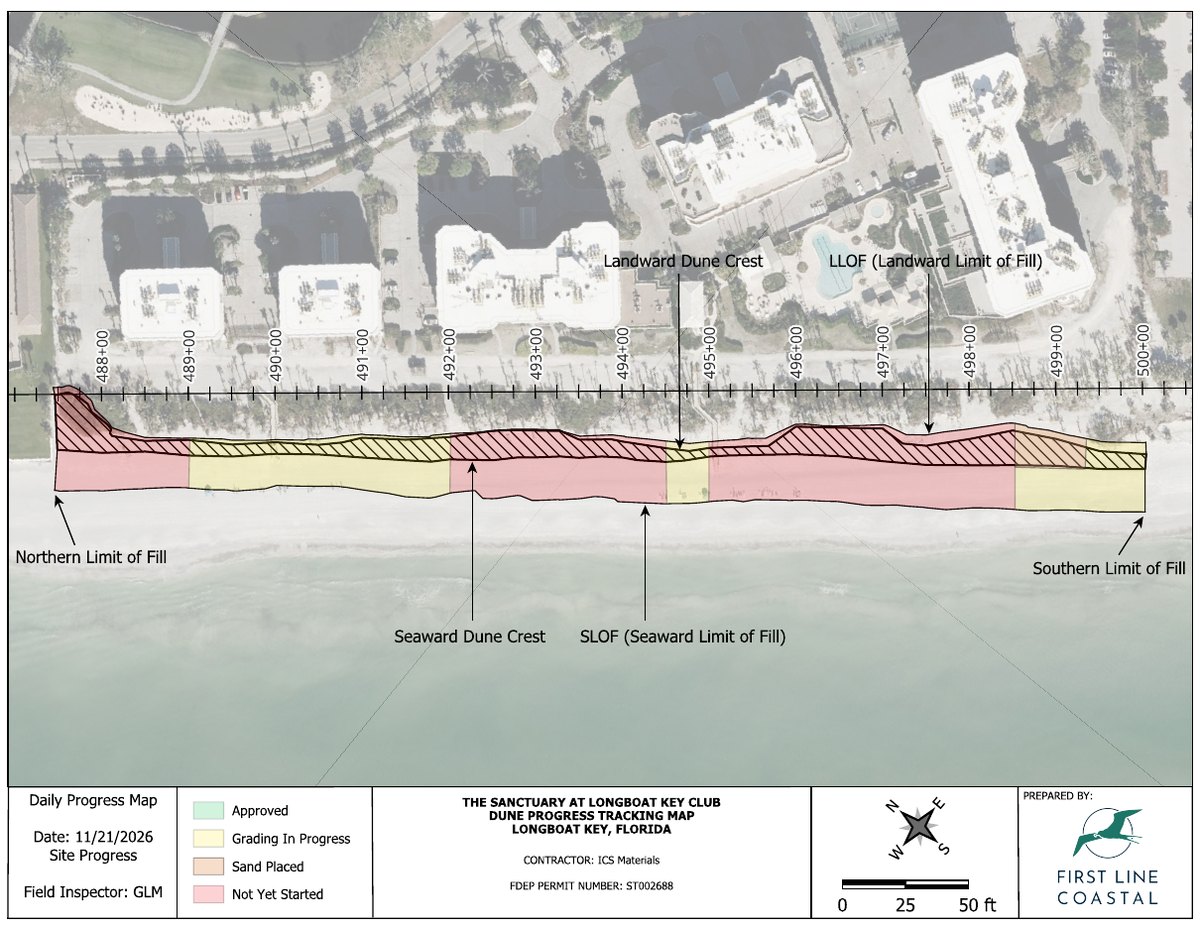
—The design is not a single mound. It is a system: a seaward dune crest closer to the water and a landward crest closer to the buildings, built to the Sanctuary’s own engineered lines. The dune that is coming back, Bankier said, comes back with some enhancements.
—Plant It Immediately
—Sand alone is not a dune. It is a pile waiting for the next high tide.
—Once the sand is placed and the drone surveys sign off on it, the Sanctuary will plant. The community is working with EarthBalance, the North Port-based ecological restoration firm that grows much of the dune vegetation planted on Florida’s beaches. The plan calls for sea grapes, dune grasses and other native plants whose roots sink deep into the sand and hold it together.
—Bankier said the committee was struck by how much science goes into what looks, from a beach chair, like a sandy hill with grass on it.
“Plant it immediately,” he said. “The planting is key. It keeps the sand stable. Let the plants root.”
—The goal is to have the sand placed and shaped by mid-December. Once the dunes are filled in, the black silt fence moves back toward the dune line, leaving plenty of room on the beach for chairs and umbrellas. If the schedule holds, Sanctuary residents will be walking the beach crossovers over their new dunes to the water before Christmas.
—Sealing the Garages
—The dune is the first line of defense. The second is the one that would have saved those 40 to 50 cars.
—Working with Garrison Flood Control, the Sanctuary’s flood mitigation committee has fitted every garage and lobby entrance in all five buildings with removable flood barriers: just over 90 openings in all. No two garage openings are quite alike, and some span roughly 30 feet, so every one was laser-measured and each barrier was fabricated to fit its specific opening.
—The garage-hardening part of the project was spearheaded by then-board member Joe Schena.
“An engineer tested every opening,” Lenobel said.
—The system is built from stacked planks that slide into place across each opening, and it is rated to hold back more than 31 inches of water. When the barriers are not in use, they sit on custom racks, inventoried by opening so nobody is guessing in the middle of a storm warning.
—Speed is the point. The Sanctuary’s maintenance crew can put the barriers up in as little as an hour per building. With three days of warning, the crew can have roughly 80 percent of the system in place while still leaving residents a way to get their cars in and out, then close the last gaps as the storm approaches. Sealed, the buildings’ garages, lobbies and everything inside them stay dry.
—The idea came out of the committee’s homework. Members studied what had worked elsewhere during Helene, including Tampa General Hospital, which ringed its Davis Islands campus with a temporary flood barrier and stayed dry through a record surge on Tampa Bay.
“We became aware through the committee research,” Bankier said.
—The payoff goes beyond cars. Keeping garages and lobbies dry protects the elevators, the mechanical systems and the electrical rooms that make a high-rise livable, and it shortens the distance between a storm and the day residents can come home. Board members are betting the barriers add something buyers notice, too: safety, security and value. The association board, Bankier said, now knows exactly what has to be done if another storm hits.
—Where the Town Comes In
—If the Sanctuary’s dune protects the town’s beach and the town’s beach protects the Sanctuary’s dune, why is the condo paying for it?
—Because the dune is the Sanctuary’s property, all the way to the high-water mark.
“The town does not do dune renourishment on private property,” Bankier said.
—What the town does do is renourish the beach, and its next island-wide project is a big one. Longboat Key has long described it as a 2028 project: about 800,000 cubic yards of sand at a projected $32.9 million. Former Town Manager Howard Tipton told Longboat Key News earlier this year that the work could begin as soon as late fall 2027, with groin construction mid-Key starting before that. That project’s tentative funding includes roughly $12.2 million from FEMA, about $7 million in state grants and about $5 million in tourist tax money.
—The Sanctuary built its dune to fit that plan, not fight it. First Line Coastal designed the new dune so that when the town’s sand arrives, the beach renourishment comes right up to the toe of the Sanctuary’s dune. There will be no overlap between what the condo built and what the town builds; the two are meant to lock together.
“In 2028, when they do the beach renourishment, they will tie into that,” Bankier said.
—That design answers a warning this newspaper raised in March, when beachfront homeowners and associations up and down the Key were trucking in sand on their own: A private sand drop, however well-intentioned, is no match for the Gulf without a big engineered project behind it. The Sanctuary’s dune is engineered, permitted and designed to dock into the town’s project.
—There is an irony in the funding, though. The town’s public beach project is lining up FEMA money. The Sanctuary’s private dune got none.
“No federal money for anything,” Bankier said.
—Flood insurance is not much of a backstop at this price point, either. National Flood Insurance Program building coverage tops out at $250,000 per residential unit, a ceiling that can look small next to Gulf-front condos valued in the millions. Every dollar of damage a dune or a flood barrier prevents is a dollar owners do not have to fight an insurer, or FEMA, to recover.
—The Haves and Have-Nots of the Florida Coast
—Up and down Florida’s Gulf Coast, the 2024 storms set off a scramble for sand.
—Next door on Lido Key, the City of Sarasota just rebuilt 1.2 miles of dunes on the public beach in a $12 million, federally backed project, the first time the city had specifically renourished the dunes there. In Pinellas County, a federal beach rebuild ran aground when the Army Corps of Engineers insisted that private landowners sign permanent public-access easements, and the county pressed ahead with a $125 million restoration of its own. On the Atlantic side, Flagler County’s 11.4-mile emergency dune, built in 2023, was credited with protecting homes and roads during Helene and Milton, even as Milton chewed through an estimated 100,000 cubic yards of its sand. That is a sacrificial dune doing exactly what the Sanctuary’s dune did.
—The demand has reached the plant nurseries. EarthBalance has said storm-driven demand for sea oats is unlike anything it had seen in decades of planting beaches.
—Where the beach is public, governments can line up grants and tourist taxes. Where it is private, the question gets much simpler and much harder: Can the people who own it afford to fix it?
—For a lot of Florida condominium associations right now, that is a painful question. The state’s post-Surfside condo safety laws have forced associations to study their buildings and fully fund their reserves, and the bill has landed on owners. Industry surveys suggest roughly two in five Florida condo owners have faced a special assessment in the past three years. An association already passing the hat for concrete repairs and roof reserves may have little appetite for another seven-figure ask for sand, no matter how good the engineering.
—That is where the Sanctuary’s balance sheet matters. All of its roofs have already been replaced. The association intends to build a reserve specifically for the dune.
“We have great reserves and balance sheets,” Lenobel said. “Unit owners have faith.”
—Others are watching. Neighboring Gulf-front associations are now considering dune projects of their own, and learning the same lessons the Sanctuary did, starting with the fact that the town and the state will not let anyone throw just any sand on the beach. Grain size and color have to be right before the first truck is approved.
—Built on Community
—With the dune nearly in place and the barriers on their racks, the Sanctuary is moving out of hurricane repair and into what Sanctuary general manager Erin Fabian called the implementation stage.
—Ask the people who led it why it worked, and the answers have less to do with sand than with neighbors.
“It is all about the community,” Bankier said. “We have very high standards,” he added, describing a place with a vibrant social life among its owners.
—Lenobel remembers why he bought there in the first place.
“We looked at every condo complex, and it was the nicest, with spaciousness, openness, and it was a great move,” he said.
—Heath, who weathered the storms on the job and has watched the recovery from the management office, put it simply.
“This place is special,” she said. “The owners are kind. I think it’s a neat place, what we’ve done at the Sanctuary.”
—Lenobel put it the way the committee put it to itself in the beginning, standing in the wreckage of 2024.
“As a community, we decided: What can we do to protect ourselves?” he said. “It will happen again. It’s just a question of when.”
—When it does, the sand will be shaped, the dune grasses will be rooted, and the planks will be on their racks, an hour from going up.
—By the Numbers: The Sanctuary’s Comeback
—18 beachfront acres behind the Longboat Key Club gates.
—181 residences in 5 buildings.
—About 250 parking spaces.
—40 to 50 residents’ cars destroyed in the 2024 storms.
—About 45 percent of the dune lost.
—1,300 feet of beachfront dune being rebuilt.
—9,775 cubic yards of sand approved by owners.
—Just under $1.4 million for the dune restoration.
—248 truckloads and 5,713 tons of sand delivered through Nov. 24.
—48 trucks on the busiest day, Nov. 20.
—Just over 90 garage and lobby openings fitted with flood barriers.
—More than 31 inches of water the barriers are built to hold back.
—About 1 hour per building to install the barriers.
—About 50 unit owners who served on recovery committees.
—$0 in FEMA or other federal money.

